1. Executive Summary
Over the last decade, the number of those living in fuel poverty in Scotland has fluctuated between a quarter and third of all households.[1] The fuel poverty challenge is a pressing and complex one, with domestic and global drivers, and solutions spanning multiple policy areas and at multiple government levels.
Scottish Government committed to eradicating fuel poverty with the passing of the Fuel Poverty (Targets, Definition and Strategy) (Scotland) Act 2019 and the publication of its first fuel poverty strategy 2021.[2] Together, they articulate how the Scottish Government plans to tackle the drivers of fuel poverty – energy inefficient homes, low-household incomes, use of energy in the home and high energy prices – by making homes warmer and cheaper to heat, raising household incomes, making it easier to use energy effectively and improving access to affordable energy. And in doing so ensure that by 2040, as far as reasonably possible, no household is in fuel poverty. Interim targets have also been set for 2030 (no more than 15% of households in Scotland are in fuel poverty and no more than 5% are in extreme fuel poverty) and 2035 (no more than 10% of households are in fuel poverty, and no more than 3% are in extreme fuel poverty).
The Scottish Government is expected to lay a revised Fuel Poverty Strategy before the Scottish Parliament by the end of 2026. Five years on from the publication of the first strategy, much has changed. Policy action and innovations in markets and technologies have helped improve the energy efficiency of the Scottish housing stock as well as make some progress in terms of decarbonising heating.[3] At the same time, there have been sharp increases in energy prices and acute cost-of-living pressures placed on consumers due to factors such as the war in Ukraine and the COVID-19 pandemic. Energy bills have also increased because of energy transition policy costs.
Some of these pressures had started to alleviate and efforts made to shift some policy costs from energy bills.[4] However, Scottish households, especially those with low-incomes, on means-tested benefits or with a disability or health condition, continue to struggle to keep up with energy bills. Energy debt is also increasing.[5],[6] The ongoing situation in the Middle East could further exacerbate affordability and debt challenges and drive-up fuel poverty numbers in Scotland.
It is against this challenging and uncertain backdrop that Scottish Government must develop a new fuel poverty strategy, and the time it has to do this is limited. A refreshed approach to tackling fuel poverty is required. One that a) makes the most of the policy levers that Scottish Government has at its disposal to improve outcomes for consumers living in or at risk of fuel poverty and b) sets out the rationale and costs for proposed interventions in meeting statutory fuel poverty outcomes and targets, and how progress against these will be measured. This report explores the first of these requirements and makes proposals around how Scottish Government should focus its efforts in relation to tackling the drivers of fuel poverty and making homes warmer and cheaper to heat, raising household incomes, making it easier to use energy effectively and improving access to affordable energy.
Table 1: Summary of recommendations
|
Outcome |
Recommendations for Scottish Government |
|---|---|
|
Making homes warmer and cheaper to heat |
Align the fuel poverty and heat decarbonisation strategies, ensuring that they reflect consumer interests and needs and that they are published without significant delays Prioritise the delivery of the Social Housing Net Zero Standard and introduction of minimum standards of energy efficiency in the Private Rented Sector Further empower local authorities and local organisations to drive place-based approaches to fuel poverty by providing long-term funding certainty and effective oversight and coordination |
|
Raising household incomes |
Improve targeting of income and energy bill support, taking account of factors such as high energy needs and working to identify and overcome data sharing barriers Consider the impact of rising levels of energy debt on households in relation to the minimum income standard (MIS) Endeavour to deliver fuel-poverty and energy related support directly to consumer bills where possible and be clear on how income support measures will reduce rates of fuel poverty |
|
Making it easier to use energy effectively |
Work with Smart Energy GB, Ofgem, energy suppliers, NESO and others to accelerate the smart meter rollout in Scotland and encourage participation in demand flex schemes Fund advice and energy literacy programmes that support people to access tariffs and other market innovations that can help them manage their energy use |
|
Improving access to affordable energy |
Support the rollout of solar panels and batteries to widen access and reduce electricity costs across all consumers including those in or at risk of fuel poverty. Design and enable effective community energy policies that support local generation, where appropriate, and explore how those living in fuel poverty can benefit from these developments. |
Pursuing these recommendations could help make a material difference to the lives of those living in or at risk of fuel poverty. However, it is important to recognise that in aiming to improve the lived experience of this group of consumers, the proposed actions do not always align directly with how fuel poverty is currently defined and measured. For example, measures to alleviate the negative impacts of energy debt on household incomes could potentially reduce their exposure to fuel poverty, but as it stands may not shift the dial in progress towards statutory targets as energy debt, arrears or debt repayments are currently not factored into how fuel poverty rates are calculated. In the design of a new fuel poverty strategy and accompanying analytical framework, Scottish Government should seek to address this tension, where it exists, between improving consumer outcomes and meeting statutory fuel poverty targets.
2. Fuel poverty and energy affordability trends
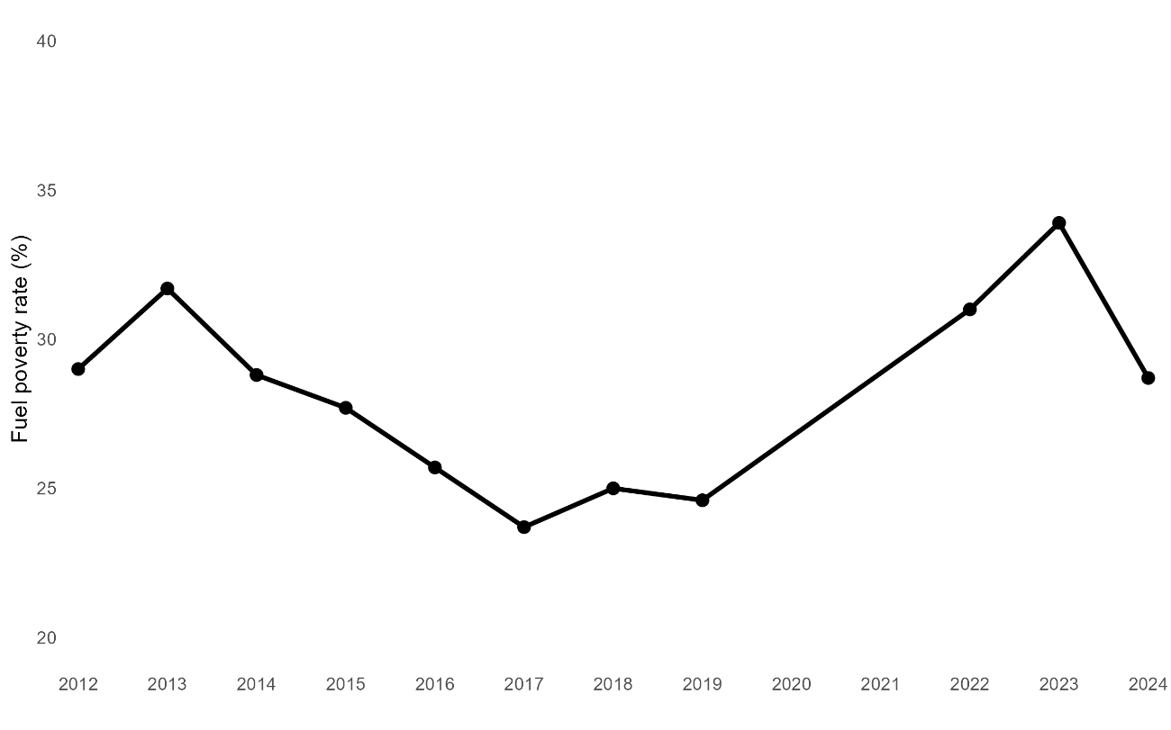
Over the past 12 years, based on SHCS data and as Figure 1 shows, fuel poverty has continued to affect between a quarter and a third of Scottish households. According to the latest figures, in 2024, 732,000 households (or 28.7% of all households in Scotland) were living in fuel poverty, out of which 357,000 (or 14% of all households in Scotland) were living in extreme fuel poverty.[7] This is a decrease from 859,000 households (or 33.9%) in fuel poverty and 491,000 (or 19.4%) in extreme fuel poverty in 2023.
Figure 1: Fuel poverty fell in 2024 but remains above pre-pandemic levels
Fuel poverty rate, Scotland, 2012 to 2024
Source: Scottish House Condition Survey
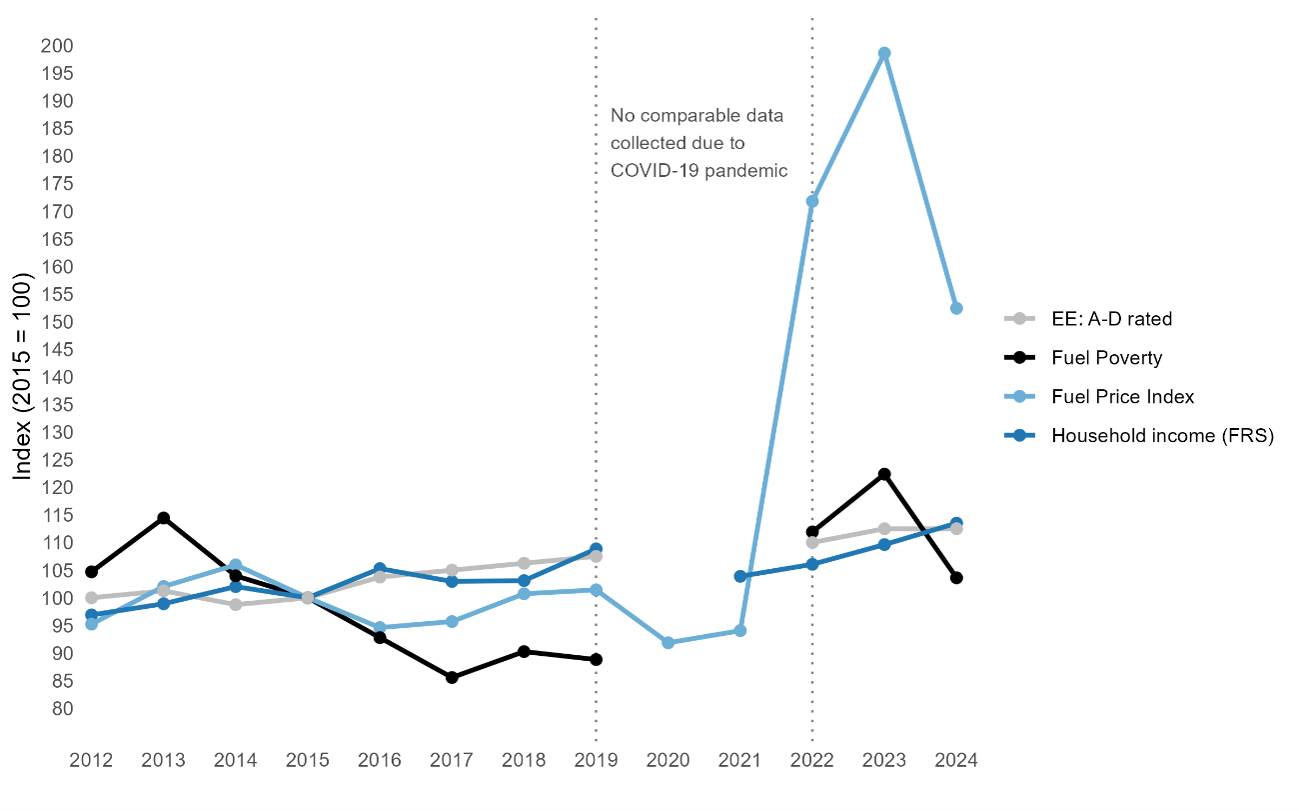
In terms of the drivers of fuel poverty, in Figure 2, based on SHCS data, we see that:
- Improvements in energy efficiency have continued but appear to have slowed in recent years
- Household incomes have generally increased over time, although with periods of little movement, and changes have been modest compared with the sharp movements seen in fuel prices
- Fuel prices increased sharply following 2021 and, despite some recent easing, remain significantly above pre-pandemic levels
- Fuel poverty rates, which had been declining prior to the pandemic, rose following the increase in energy prices but have decreased in the most recent year, although they remain above earlier levels
Taken together, these trends show that changes in fuel prices were considerably larger than changes in household income and energy efficiency over the period shown.
Figure 2: Fuel poverty rose sharply following increases in fuel prices and fell in 2024 as fuel prices eased
Trends in fuel poverty, fuel prices, household income and energy efficiency, indexed to 2015, Scotland, 2012 to 2024
Source: Scottish House Condition Survey (SHCS); fuel price index derived from Department for Energy Security and Net Zero (DESNZ) domestic fuel price statistics; household income data from the Family Resources Survey
With fuel prices increasing sharply and household incomes growing more gradually, households are under increased pressure to meet the costs of their reasonable fuel needs (as articulated by the current fuel poverty definition), which is potentially causing them to fall into or putting them at risk of fuel poverty. This is despite the overall trend of household energy consumption levels falling, in part due to increased energy efficiency and as a result of warmer weather in recent years. [8], [9]
Some of these trends are reflected in Consumer Scotland’s Energy Affordability Tracker that has been running since March 2022, and which tracks consumers’ experiences and behaviours in relation to energy affordability, debt and use. The eighth wave (winter 2025-2026) energy tracker survey results were published in May 2026 with the fieldwork involving approximately 1,600 individuals taking place in January and February 2026.[10]
While recognising that the energy affordability pressures captured by our tracker do not always align directly with the way fuel poverty is currently measured or estimated, they do offer important insights into the lived experiences of consumers that should inform the development of a new strategy.
Consumer Scotland’s Energy Affordability Tracker finds that:
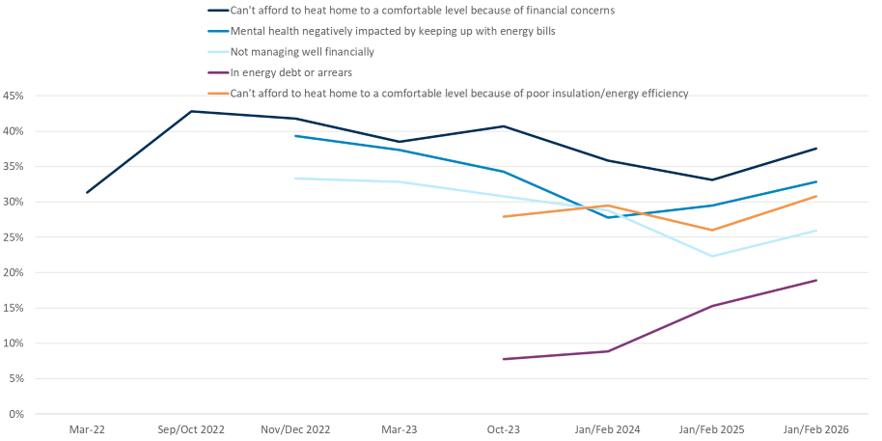
- Households’ perceptions of their financial circumstances have generally improved since the peak of the energy crisis in the last quarter of 2022 but 26% still report not managing well financially, 38% report not being able to heat their homes to a comfortable level due to financial reasons and 31% report not being able to heat their homes to a comfortable level due to poor insulation/energy efficiency. All of this is having a significant impact on consumers’ mental health with the levels of households reporting that their mental health is negatively impacted rising. See Figure 3
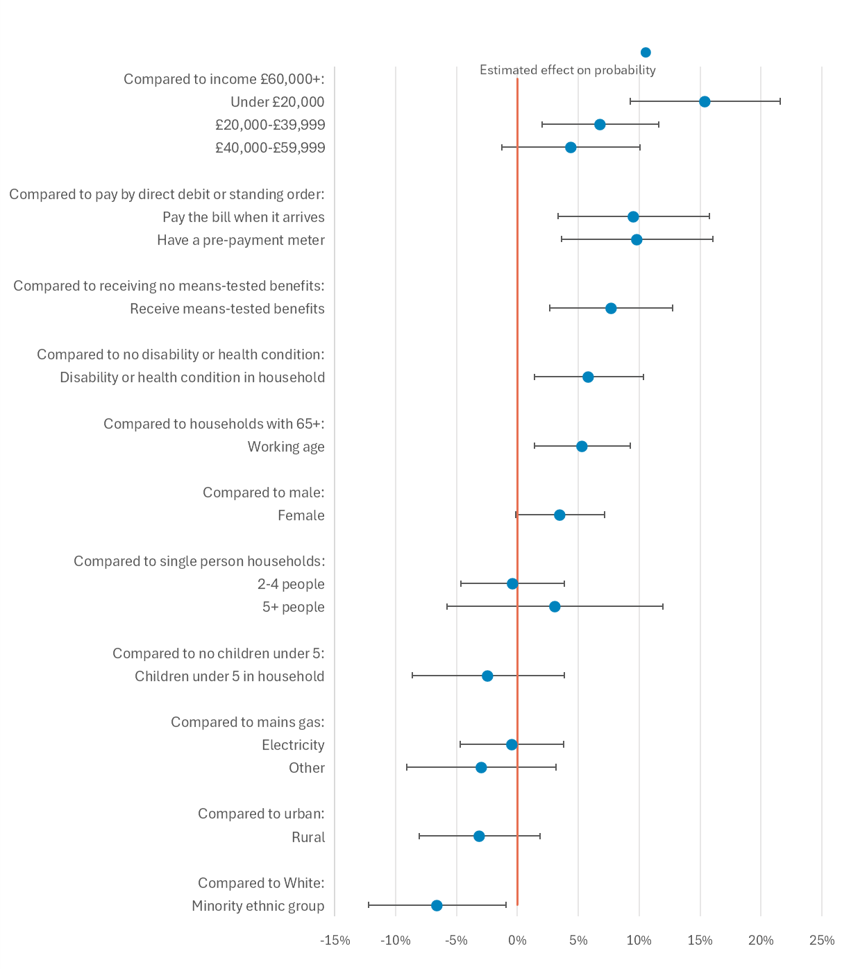
- Difficulty keeping up with energy bills is strongly associated with income and wider household circumstances as shown in Figure 4. Beyond income, several indicators relating to financial vulnerability are also associated with a higher probability of difficulty paying energy bills, especially households:
- who pay their bill when it arrives or have a prepayment meter
- who receive means‑tested benefits
- where a member has a disability or health condition
- working‑age households (no over 65-year-olds)
- The proportion of households receiving financial support to help with the cost of energy increased this year, with just under four in ten respondents (39%) having received at least one form of support. The most common types of financial support were Pension Age Winter Heating Payment (previously Winter Fuel Payment), received by 16% of all respondents, and the Warm Home Discount, received by 11%
- Levels of energy debt in Scotland have increased steadily in recent years. In October 2023 (when the question was introduced to the tracker) 8% of respondents reported being in energy debt, by January/February 2026 it had doubled with 19% reporting being in debt. See Figure 5
- Energy debt is more prevalent among: Households who receive means-tested benefits (38%) compared with those who do not (13%); households with children under five (34%) compared with those without (17%); working age households (under 65-year olds, 21%), compared with those with over 65-year-olds (12%); households with 5 or more members (33%), compared with single person (21%) or 2-4 people households (17%); households where a member has a disability or health condition (31%), compared with those that do not (15%); lower-income households, particularly those with incomes under £20,000 (29%), compared with higher-income households (11-19%); electricity consumers (27%), compared with mains gas consumers (16%). See Figure 6
- Awareness of EPC ratings increased with income, ranging from 13% of those earning under £20,000, to 35% of those earning £60,000 and over. Lower-income households are also less likely to report having any energy efficiency technologies, with around 25-30% of households earning below £60,000 having at least one compared with 51% of households earning £60,000 or more. See Figure 7
Figure 3: While the energy crisis began to ease after autumn 2022, many consumers have still faced significant affordability challenges
Percentage of respondents who experience different energy affordability challenges, March 2022 to January/February 2026
Source: Consumer Scotland Energy Affordability Tracker.
Note: Data for some survey questions may not be available because these survey questions were introduced at a later point. The latest survey sample over‑represents electricity‑heated households and under‑represents households using mains gas compared with published estimates. However, trends in energy debt and affordability metrics over time are broadly similar across heating types.
Figure 4: Low-income households are most strongly associated with higher risks of finding it difficult to keep up with energy bills
Logistic regression results on the probability of finding it difficult to keep up with energy bills, January/February 2026
Source: Consumer Scotland analysis of our Energy Tracker, C1/AFF3: How easy or difficult is it for your household to keep up with your energy bills nowadays? N = 1,608.
Note: estimates are average marginal effects from a logistic regression and represent the percentage‑point change in the probability of difficulty keeping up with energy bills associated with each characteristic, relative to the reference category, holding other variables constant. Error bars show 95% confidence intervals; where these cross zero, the estimated effect is not statistically significant.
Figure 5: The proportion of households in energy debt has continued to increase
Proportion of respondents reporting being in energy debt or arrears, October 2023 to January/February 2026
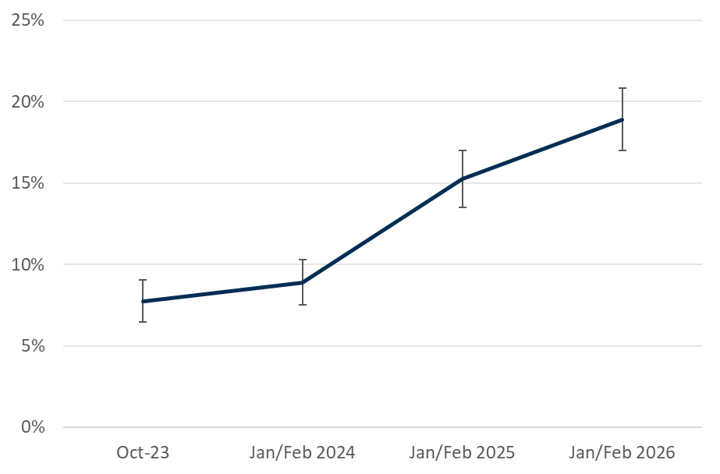
Source: Consumer Scotland Energy Tracker, AFF20: Are you in energy debt or arrears? By this we mean behind on energy bill payments, repaying debt to your energy supplier, paying debt recovery through a prepayment meter, or owing money to someone else as result of borrowing money to pay for energy costs. Error bars represent 95% confidence intervals.
Figure 6: Energy debt is more prevalent among certain households, particularly those relating to finances and household composition
Proportion of respondents reporting being in energy debt or arrears, by demographics and overall average, January/February 2026
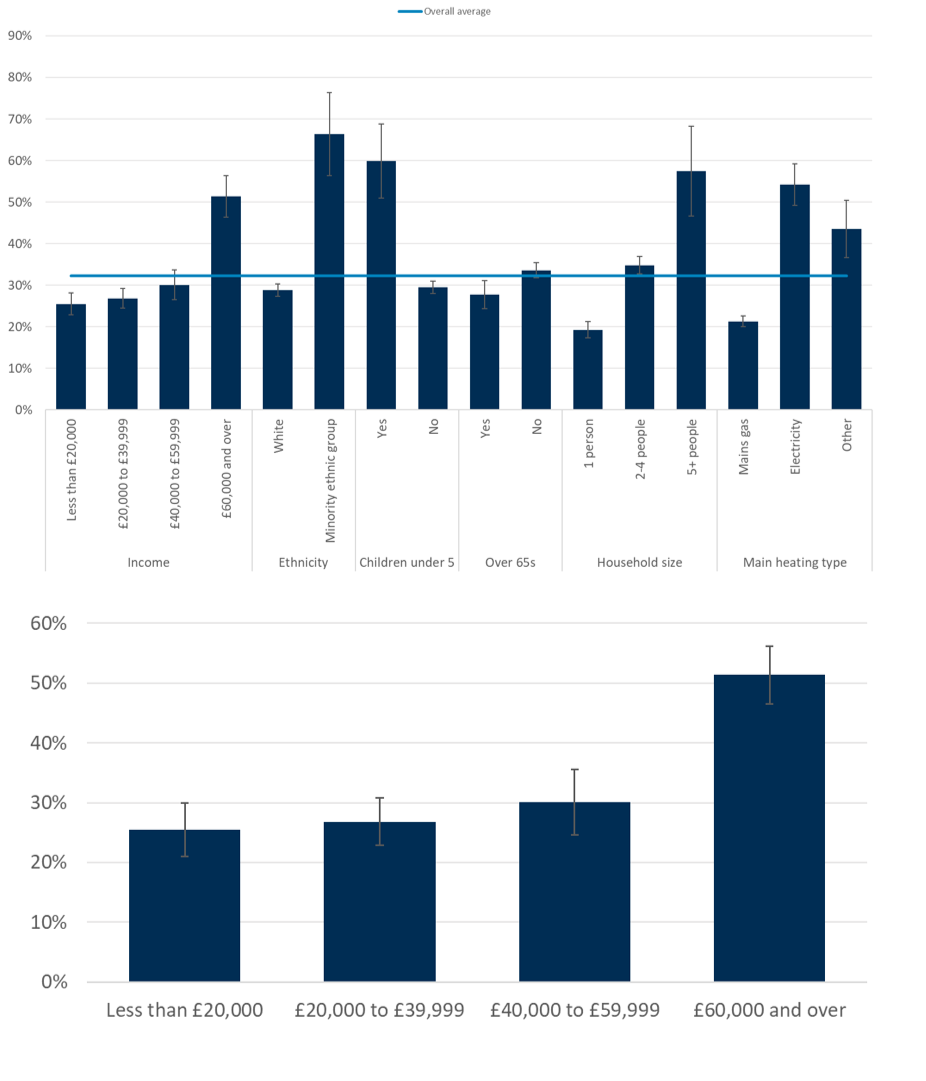
Source: Consumer Scotland Energy Tracker, AFF20: Are you in energy debt or arrears? By this we mean behind on energy bill payments, repaying debt to your energy supplier, paying debt recovery through a prepayment meter, or owing money to someone else as result of borrowing money to pay for energy costs. Error bars represent 95% confidence intervals. N=1,608.
Figure 7: Energy efficiency or LCTs are less prevalent among lower-income households, smaller households, and mains gas consumers
Percentage of respondents who have at least one energy efficiency or low-carbon emitting technology in their home, by demographics and overall average, January/February 2026
Source: Consumer Scotland Energy Tracker, E5a. Does your home have any of the following… Error bars represent 95% confidence intervals. N=1,608.
These energy affordability, debt and efficiency challenges can shape a household’s use of energy (e.g., self-disconnection and/or energy rationing), the fourth driver of fuel poverty, and which the Scottish Fuel Poverty Advisory Panel (SFPAP) argued is the ‘least well understood and least well actioned’ of the fuel poverty drivers in the current fuel poverty strategy.[11]
1.72 Together, these trends suggest that a continued focus on tackling the drivers of fuel poverty is imperative in a new strategy. Indeed, this is a legal requirement as set out in Section 6 on the fuel poverty strategy of the Fuel Poverty (Targets, Definition and Strategy) (Scotland) Act 2019.[12] However, a refreshed approach is required. Especially given the slowed progress around energy efficiency, limited growth in incomes, persistence of high energy prices and a need for greater clarity and momentum around measures to improve the effective use of energy in different types of homes.
3. Making homes warmer and cheaper to heat
Recommendations for Scottish Government
- Align the fuel poverty and heat decarbonisation strategies, ensuring that they reflect consumer interests and needs and that they are published without significant delays
- Prioritise the delivery of the Social Housing Net Zero Standard and introduction of minimum standards of energy efficiency in the Private Rented Sector
- Further empower local authorities and local organisations to drive place-based approaches to fuel poverty by providing long-term funding certainty and effective oversight and coordination
Helping consumers to reduce their energy consumption without compromising living standards is essential to tackling fuel poverty in Scotland. It is also an area where Scottish Government has significant levers at its disposal as housing is a devolved issue. The drafting of a new heat decarbonisation strategy, in line with requirements set out in the Draft Buildings (Heating and Energy Performance) and Heat Networks (Scotland) Bill, needs to be done in close coordination with the development of a new fuel poverty strategy. There needs to be an alignment of measures in achieving fuel poverty outcomes across the two documents, and both strategies should be published without significant delays.[13]
Over the current fuel poverty strategy period, progress towards making Scotland’s homes warmer and cheaper to heat has continued, albeit at a slower pace. This has mainly been achieved through the successful delivery of lower cost loft and cavity wall insulation.[14] Yet, once these types of improvements are installed as far as possible, further advances will rely on higher cost and potentially more complicated measures such as the installation of low carbon technologies including heat pumps. In its latest report on Scotland’s progress in reducing emissions, the Climate Change Committee (CCC) has called for the Scottish Government to provide greater policy certainty and clarity in this area.[15] Undoubtedly, a change of gear and targeting of resources will be required to ensure continued gains. Especially amongst low-income households where, as our energy affordability tracker finds, energy efficiency improvements and low carbon technologies (LCTs) are less prevalent.[16] Any measures need to ensure that these households have all the advice and support they require around the installation, use and maintenance of these improvements and technologies.
Notable successes have been realised over the current fuel poverty strategy period in improving the energy efficiency of households in the social rented sector. SHCS data shows that 71% of homes in the social rented sector are now in EPC bands A-C, compared to 50% of homes in the private rented sector. Moving forward, clarity on the expected level, timescale and associated resources to deliver the proposed Social Housing Net Zero Standard is essential. [17] Scottish Government also needs to prioritise introducing minimum standards of energy efficiency in the Private Rented Sector, as has long been discussed, and was consulted on in 2025. [18], [19]
Alongside Scottish Government, local authorities and other local third sector partners have a critical role to play in developing place-based approaches to fuel poverty that respond to local need. Ensuring that they have the resources and autonomy to do this is essential. The Scottish Energy Insights Coordination Group (SEIC), convened by Consumer Scotland over 2022-23, recommended the introduction of multi-year funding to make delivery of local authority led area-based schemes more sustainable. Both Changeworks and the Existing Homes Alliance have highlighted the barriers that local authorities and other local organisations such as housing providers face in securing and spending funds available to make home improvements and tackle fuel poverty. SEIC also recommended that data on households receiving benefits relating to fuel poverty should be used to more effectively target energy efficiency and clean heating measures. [20], [21], [22]
Close partnership working between local authorities and Scottish Government is also key to addressing the particular challenges faced by rural and island communities around fuel poverty. In recommendations to the Scottish Government, SFPAP highlighted that “island and remote rural communities should have a specific, more focused and co-ordinated, approach for tackling fuel poverty with clear leadership and enhanced resources.” [23] Island and remote rural communities are less likely to be connected to the gas grid, and more likely to be using heating, liquified petroleum gas (LPG) and electric storage heaters to heat their homes. This leaves them more exposed to spikes in fuel prices, such as that which resulted from the USA / Iran conflict in early 2026, and to relatively higher electric (compared to gas) heating prices. Understanding how these pressures impact fuel poverty in rural communities and can be mitigated short- and long-term through a combination of short-term emergency funds and medium to longer term energy efficiency improvement measures is essential, as is who is best placed to deliver them, with local authorities, groups and organisations often well placed given their understanding of local need.
Finally, in line with consumer duty requirements and the wider public service reform agenda, it is essential that the interests and needs of those consumers living in, or at risk of fuel poverty, are sufficiently considered in designing different interventions at local and national levels.[24]
In Table 2 we have adapted Consumer Scotland’s consumer framework for addressing climate change to one that considers heat decarbonisation and fuel poverty taking account of consumer perspectives on cost, convenience, clarity and confidence. This could be useful in guiding Scottish Government’s and local authorities’ thinking and decision-making in these areas.[25]
Table 2: A consumer framework for addressing heat decarbonisation and fuel poverty
|
Consumer perspective |
Description of perspective |
|---|---|
|
Cost |
The costs of energy efficiency and heat decarbonisation are distributed fairly, and measures put in place to ensure households ability to pay does not limit access to low carbon technologies. |
|
Convenience |
Thought is given to which energy efficiency and heat decarbonisation products and services could fit most easily into consumers’ lives and are appropriate for their particular set of circumstances e.g. household demographics, energy needs, building type, geography. |
|
Clarity |
Consumers can access free and tailored advice at every point in the heat decarbonisation and energy efficiency journey, ensuring they understand what they need to do and why. |
|
Confidence |
Consumers trust heat decarbonisation and energy efficiency products and services and enjoy equitable access to strong protections and redress. |
4. Raising household incomes
Recommendations for Scottish Government
- Improve targeting of income and energy bill support, taking account of factors such as high energy needs and working to identify and overcome data sharing barriers
- Consider the impact of rising levels of energy debt on households in relation to the minimum income standard (MIS)
- Endeavour to deliver fuel-poverty and energy related support directly to consumer bills where possible and be clear on how income support measures will reduce rates of fuel poverty
While not all households living in fuel poverty in Scotland are income poor, the majority are. The most recent SHCS results show that of those households living in fuel poverty, 78% were income poor, and 96% of households with an annual net income less than £15,000 were in fuel poverty. Other factors that can push households into fuel poverty can include high energy needs due to a long-term illness or disability, the type of heating fuel used and the poor insulation/energy efficiency of their homes. Consumer Scotland’s energy affordability tracker finds that difficulty in keeping up with energy bills is strongly associated with income and wider household circumstances such as receiving means-tested benefits, where a member of the household has a disability of health condition or the household is comprised of working-age adults.[26]
Real terms median incomes in Scotland have remained largely unchanged in recent years, and the pandemic and the war in Ukraine have contributed to sluggish economic growth and levels of household economic inactivity.[27], [28], [29] Research by the Joseph Rowntree Foundation (JRF) has found across the UK that people on low and middle-incomes struggle to reach a minimum standard of living through benefits and earnings.[30] The current situation in the Middle East could further exacerbate these challenges.
Scottish Government’s current fuel poverty strategy cites a range of measures to boost incomes including the Winter Heating Payment, the Scottish Welfare Fund and discretionary housing payments. Yet, as the SFPAP argue, there is a lack of evidence around the difference these measures make to reducing fuel poverty. SFPAP’s own research highlights the relative benefits and disadvantages of providing income-based support vs taking money of people’s energy bills and underscores the point that as a result of how fuel poverty is currently defined in Scotland, income-based support has less of an impact on tackling fuel poverty than energy bill reductions because additional income is often used to pay other costs and bills. [31], [32] Scottish Government should review where the delivery of energy support for consumers can be credited directly to their energy bills and balances. This may require legislative changes to the Digital Economy Act 2017 to enable Social Security Scotland to share data directly with energy suppliers to identify eligible consumers’ bills and balances or investigate where working with the Department for Work and Pensions can enable devolved energy support to be credited directly to energy bills and balances[33].
There is also scope to improve the effective targeting of income-based support provided by Scottish Government. For example, with respect to those living with disabilities or a terminal illness, where energy consumption may well be higher due to use of essential medical equipment or the need to keep the heating on for longer and/or at higher temperatures. Consumer Scotland’s research finds that just over a quarter of households (26%) where a member has a disability or health condition report struggling with energy bills. Statutory income-related support does not tend to account for energy need and the impact of this on expenditure. Our work sets out a number of policy options and proposals to enable Scottish Government to more effectively target support to those living with disabilities or a terminal illness and lift them out of and/or prevent them from falling into fuel poverty. These include developing better understanding around the costs of running medical equipment and associated with heating, and targeting support at those receiving payments linked to disability, health criteria and/or terminal illness. [34], [35], [36]
Better targeting of support of schemes delivered by Scottish Government and UK Government (e.g., the Warm Home Discount - WHD) will also require a continued focus from both Governments on addressing data sharing issues. Consumer Scotland will be publishing new research on this in 2026. [37] The research will provide insights which may help to inform the practical implementation of future energy bill and income support including in the form of a social tariff.[38] In developing a new fuel poverty strategy Scottish Government will also need to weigh up the relative costs and benefits of investing in longer-term energy efficiency measures and low carbon technologies vis a vis income and energy bill support, and determine the appropriate balance of measures set out in a new fuel poverty strategy.[39]
Another key consideration for Scottish Government in developing a new fuel poverty strategy is how to address the increasing levels of energy debt that consumers in Scotland are facing, especially in relation to assessing whether households have sufficient income to maintain an acceptable standard of living. As per the fuel poverty definition in the current strategy this means a household’s net adjusted income (after housing costs) equates to at least 90% of the UK Minimum Income Standard (MIS) after deducting fuel costs, benefits received for a care need or disability and childcare costs. Energy debt, arrears or debt repayments are currently not factored into the way in which SHCS calculates fuel poverty rates.
Research undertaken by Loughborough University for Christians Against Poverty shows that 10% of lone parents and couples with children in Great Britain who are above the MIS when debt repayments are not accounted for, are pushed below the MIS when these repayments are factored in. Furthermore, where households who are economically inactive due to sickness or disability and have a debt-to-income ratio of 15%, nearly half of them are pushed below the MIS. The risk of falling below MIS becomes more acute at a debt-to-income ratio of just 5% for those who are sick and disabled and at around 20% for those who are employed.[40] Consideration of energy debt and its implications for fuel poverty needs to be taken into account of in the development of a new strategy, in particular around how fuel poverty is measured and the levels of funding made available to support debt and energy affordability advice services.
5. Making it easier to use energy effectively
Recommendations for Scottish Government
- Work with Smart Energy GB, Ofgem, energy suppliers, NESO and others to accelerate the smart meter rollout in Scotland and encourage participation in demand flex schemes
- Fund advice and energy literacy programmes that support people to access tariffs and other market innovations that can help them manage their energy use
Since the publication of the first fuel poverty strategy in 2021, there have been significant advances in the technologies and tariffs available that allow consumers to reduce peak usage and ‘flex’ their energy demand. This can help reduce overall energy systems costs that are paid for by all consumers. It also enables households to take direct action to reduce their individual bills. As time-of-use and flexible tariffs become more common, households can be directly rewarded for their flexibility. New public-private initiatives involving partners such as Octopus Capital and the Scottish National Investment Bank have also emerged. [41] While not specifically fuel poverty targeted, these initiatives may offer interesting insights into how affordable and sustainable homes could be provided at scale through innovative use of tariffs and technologies.
Smart meters are crucial to effective us of new technologies and tariffs. Overall, the data on smart meters and flexible tariffs infers a disparity in Scottish consumers’ capacity to maximise their market power. From 2023 to 2025, smart meter coverage in island areas lagged far behind the GB average. For example, only 18% of homes in Shetland and 26% in Orkney had smart meters in 2025, compared with 68% across Great Britain. In 2026, uptake has accelerated, but coverage in rural and island locations such as Na h‑Eileanan Siar (46%) still remains significantly lower than the GB average of 74%. In highlighting these trends, Consumer Scotland points to the risks the slow rollout of smart meters in Scotland poses to consumers and the wider energy transition. [42] Scottish Government should work with Smart Energy GB, Ofgem, suppliers and local authorities to accelerate smart meter installation in Scottish rural local authorities that in turn can empower households to manage their domestic energy usage.[43]
Consumer Scotland’s research also finds that those on the highest incomes are more likely to have low carbon technologies and be on a time of use or type of use tariff compared to those in lower income bands. Consumer Scotland will be publishing new research findings on consumer-led flexibility in Autumn 2026. [44] Research by Changeworks finds that tenants in the social housing sector are not receiving the advice and support they need to benefit from the installation of new technologies.[45] Scottish Government should explore options around enhancing information provided to consumers living in or at risk of fuel poverty on the types of tariffs that would benefit them most and how they can make the most of any low carbon technologies installed in their homes.
6. Improving access to affordable energy
Recommendations for Scottish Government
- Support the rollout of solar panels and batteries to widen access and reduce electricity costs across all consumers including those in or at risk of fuel poverty.
- Design and enable effective community energy policies that support local generation, where appropriate, and explore how those living in fuel poverty can benefit from these developments.
High energy prices continue to be a significant driver of fuel poverty in Scotland. The SHCS attributed a recent drop in fuel poverty rates (29% of all households in 2024 compared to 34% in 2023) mainly to lower energy prices. Energy prices spiked in late 2022/early 2023 sparking acute cost-of-living pressures. Although they have since fallen back, they remain significantly higher in real terms than before the war in Ukraine began and look set to remain elevated until at least the end of the decade.[46],[47] The full impacts of the ongoing situation in the Middle East on energy prices also remain to be seen. The energy price cap rose by 13% for the period from July-September as a result of rising wholesale prices caused by the impact of the Iran war.[48] Sharp increases in oil and gas prices are also directly impacting off grid consumers in Scotland who rely on heating oil, Liquified Petroleum Gas (LPG) and biogas who are not covered by the price cap. Support scheme for these consumers has been launched by Scottish Government, prioritising those on low incomes.[49] There are also concerns for heat network customers and small businesses who are not protected by the price cap.[50]
While many of the powers to tackle these challenges rest with UK Government, for example, reformed national pricing and the distribution of energy system costs, there are actions Scottish Government can take. [51] [52]
In the short-term, well-targeted emergency support to alleviate the pressures households living in fuel poverty or at risk of falling into fuel poverty face as a result of energy price increases or spikes is vital. Lessons around what works can be drawn from evaluation of schemes such as the now-ended Fuel Insecurity Fund and the ongoing support being delivered for those using heating oil and LPG.. As part of the development of a new fuel poverty strategy, Scottish Government should commit to ongoing gathering of analysis and insights on the impacts of high or spiking energy prices on Scottish households disaggregated by factors including tenure, location and household demographics and apply these insights, along with learning from evaluation of previous measures, to the design of any future support schemes.
In the medium- to long-term, there are several steps Scottish Government can take. Supporting the widescale rollout of solar panels and batteries is key and this can help consumers access cheaper energy as well as allow them to flex demand and use energy more effectively. Evidence suggests public funding for solar can benefit those on the lowest incomes.[53] Scottish Government needs to consider how it supports the rollout of these technologies through schemes such as Home Energy Scotland (HES) and the Social Housing Net Zero Fund - SHNZF), based on evidence and impact assessments of their costs and benefits. Again, tailored advice will also be important to enable consumers to have confidence in using these technologies and identifying appropriate tariffs.
Putting in place clear and efficient development frameworks for appropriate network and generation infrastructure is also important. Delays in obtaining relevant consenting and planning can drive up costs, which are ultimately likely to be borne by energy consumers through their bills.
Support for community energy is another vital component that could offer routes to reducing energy prices for those living in fuel poverty. Both in terms of local generation and the distribution of benefits from energy developments to local communities. This could involve continued investment in schemes such as the Community and Renewable Energy Scheme (CARES) and the Community Energy Generation Growth Fund, as well as putting in place principles that encourage energy developers to deliver improved and targeted community benefits that can assist those living in fuel poverty.
More generally, investment in local manufacturing of low carbon and smart technologies such as solar PV and batteries, and related skilled workforce development, can also help underpin efforts to ensure affordable and sustainable energy for all.
7. Conclusion
In developing and implementing a new fuel poverty strategy the Scottish Government should:
- Make the most of the levers it has at its disposal, and that have the potential to make a material difference in tackling the four drivers of fuel poverty and improving outcomes for those consumers living in or at risk of fuel poverty
- Be clear on where and how different actions are intended to improve consumer outcomes and/or reduce fuel poverty as currently defined and measured
Ultimately, a strategic and coordinated approach to fuel poverty alongside decarbonising heating and tackling climate change can also embody and help deliver Scottish Government’s wider public service reform agenda with a focus on prevention, joined up and efficient services and fiscal sustainability.[54]
Developing a new fuel poverty strategy in the timeline required and against the current uncertain and volatile global backdrop will be challenging. However, Scottish Government should seek to draw on the expertise of the wider sector to support this process and accelerate progress towards reducing and eradicating fuel poverty; a problem that has blighted too many families in Scotland for too long.
8. Endnotes
[1] Scottish Government (2024) Scottish House Condition Survey. Available at: https://www.gov.scot/collections/scottish-house-condition-survey/
[2] Scottish Government (2021) Tackling fuel poverty in Scotland: a strategic approach. Available at: https://www.gov.scot/publications/tackling-fuel-poverty-scotland-strategic-approach/
[3] Climate Change Committee (2026) Progress in reducing emissions in Scotland - 2025 report to Parliament - Climate Change Committee Available at: https://www.theccc.org.uk/publication/progress-in-reducing-emissions-in-scotland-2025/
[4] UK Government (2026) Energy bills coming down thanks to government action, as Prime Minister vows to bear down on cost of living Available at: https://www.gov.uk/government/news/energy-bills-coming-down-thanks-to-government-action-as-prime-minister-vows-to-bear-down-on-cost-of-living
[5] Ofgem (2025) Debt and arrears indicators Available at: https://www.ofgem.gov.uk/data/debt-and-arrears-indicators
[6] Consumer Scotland (2026) Insights from the 2026 Energy Affordability Tracker Available at: https://consumer.scot/publications/insights-from-the-2026-energy-affordability-tracker/
[7] Scottish Government (2024) Scottish House Condition Survey. Available at: https://www.gov.scot/collections/scottish-house-condition-survey/
[8] Notes: All series are presented as indices relative to 2015 (=100). Household income is measured using median weekly equivalised household income before housing costs reported in constant 2024/25 prices. The income series includes a methodological break from 2021/22 following the integration of survey and benefits administrative data. Energy efficiency measures are based on SAP 2009 up to 2013, SAP 2012 (RdSAP v9.92) from 2014 to 2017, and SAP 2012 (RdSAP v9.93) from 2018 onwards. Trends in income and energy efficiency should be interpreted with some caution as underlying methodologies differ across the period shown. Comparable SHCS data are unavailable for 2020 and 2021 due to changes to survey collection during the COVID-19 pandemic.
[9] UK Government (2026) Energy Consumption in the UK (ECUK) 2025 Available at: https://www.gov.uk/government/statistics/energy-consumption-in-the-uk-2025/energy-consumption-in-the-uk-ecuk-2025#chapter-1-energy-consumption
[10] Consumer Scotland (2026) Insights from the 2026 Energy Affordability Tracker Available at: https://consumer.scot/publications/insights-from-the-2026-energy-affordability-tracker-html/
[11] Scottish Fuel Poverty Advisory Panel (2026) SFPAP Response to the Scottish Government's First Fuel Poverty Periodic Report Available at: https://fuelpovertypanel.scot/our-publications/periodic-report-response/part-1-progress-targets-and-drivers/
[12] Fuel Poverty (Targets, Definition and Strategy) (Scotland) Act 2019 Available at: https://www.legislation.gov.uk/asp/2019/10/notes/division/3
[13] Scottish Government (2025) Draft Buildings (Heating and Energy Performance) and Heat Networks (Scotland) Bill Available at: https://www.gov.scot/binaries/content/documents/govscot/publications/strategy-plan/2025/11/heat-in-buildings-plans/documents/draft-buildings-heating-and-energy-performance-and-heat-networks-scotland-bill/draft-buildings-heating-and-energy-performance-and-heat-networks-scotland-bill/govscot%3Adocument/Draft%2BBuildings%2B%2528Heating%2Band%2BEnergy%2BPerformance%2529%2Band%2BHeat%2BNetworks%2B%2528Scotland%2529%2BBill.pdf
[14] Scottish Government (2026) Heating and Insulation - Scottish House Condition Survey Local Authority Tables 2022-2024 Available at: https://www.gov.scot/publications/scottish-house-condition-survey-local-authority-tables-2022-2024/pages/heating-and-insulation/
[15] Climate Change Committee (2026) Progress in reducing emissions in Scotland – 2025 report to Parliament Available at: https://www.theccc.org.uk/publication/progress-in-reducing-emissions-in-scotland-2025/
[16] Consumer Scotland (2026) Insights from the 2026 Energy Affordability Tracker Available at: https://consumer.scot/publications/insights-from-the-2026-energy-affordability-tracker/
[17] Scottish Government (2023) Social housing net zero standard: consultation Available at: https://www.gov.scot/publications/consultation-new-social-housing-net-zero-standard-scotland/
[18] The Scottish Government consulted on this in 2019 Introduction - The Energy Efficiency (Private Rented Property) (Scotland) Regulations 2019: consultation
[19] Scottish Government (2025) Draft Energy Efficiency (Domestic Private Rented Property) (Scotland) Regulations: consultation Available at: https://www.gov.scot/publications/consultation-draft-energy-efficiency-domestic-private-rented-property-scotland-regulations/
[20] Changeworks (2026) A Perfect Storm: 2026 Update on Fuel Poverty in Rural Scotland https://www.changeworks.org.uk/insights/a-perfect-storm-2026-update/
[21] Existing Homes Alliance (2023) Making Retrofit Work - a customer journey with people at its core Available at: https://existinghomesalliancescotland.co.uk/wp-content/uploads/2023/10/EHA-Rapid-Review-of-Scottish-Government-Fuel-Poverty-and-Energy-Efficiency-Delivery-Programmes-Briefing-August-2023.pdf
[22] Consumer Scotland (2026) Scottish Energy Insights Coordination Group Report Available at: https://consumer.scot/publications/scottish-energy-insights-coordination-group-report-html/
[23] Scottish Fuel Poverty Advisory Panel (2026) SFPAP Response to the Scottish Government's First Fuel Poverty Periodic Report Available at: https://fuelpovertypanel.scot/our-publications/periodic-report-response/part-1-progress-targets-and-drivers/
[24] Consumer Scotland The consumer duty Available at https://consumer.scot/the-consumer-duty/
[25] Consumer Scotland (2025) A consumer framework for addressing climate change - toolkit for policymakers (HTML) | Consumer Scotland Available at: https://consumer.scot/publications/a-consumer-framework-for-addressing-climate-change-toolkit-for-policymakers-html/
[26] Consumer Scotland (2026) Insights from the 2026 Energy Affordability Tracker Available at: https://consumer.scot/publications/insights-from-the-2026-energy-affordability-tracker/
[27] Scottish Government (2025) Economic growth and business conditions. - Scottish economic insights: September 2025 Available at: https://www.gov.scot/publications/scottish-economic-insights-september-2025/pages/4/
[28] Scottish Government (2025) Economic Inactivity estimates - Labour Market Trends: September 2025 Available at: https://www.gov.scot/publications/labour-market-trends-september-2025/pages/economic-inactivity-estimates/
[29] Scottish Public Health Observatory (2025) Household income Available at: https://www.scotpho.org.uk/wider-determinants/income-and-employment/data/household-income/
[30] Joseph Rowntree Foundation (2025) A Minimum Income Standard for the United Kingdom in 2025 Available at: https://www.jrf.org.uk/a-minimum-income-standard-for-the-united-kingdom-in-2025
[31] Scottish Fuel Poverty Advisory Panel (2026) SFPAP Response to the Scottish Government's First Fuel Poverty Periodic Report Available at: https://fuelpovertypanel.scot/our-publications/periodic-report-response/part-1-progress-targets-and-drivers/
[32] Scottish Fuel Poverty Advisory Panel (2026) Income-based support versus money off energy bills for fuel poverty support Available at: https://fuelpovertypanel.scot/our-publications/income-based-support-versus-money-off-energy-bills-for-fuel-poverty-support/
[33] The relevant legal gateway for sharing public sector data with energy suppliers for the purposes of fuel poverty interventions is contained within The Digital Economy Act 2017 (DEA) ss. 36-37, and The Digital Government (Disclosure of Information) Regulations 2018. The list of Specified Persons for these sections is contained within Schedule 5 of the DEA, and does not include Scottish organisations. Therefore, Social Security Scotland (SSS) has no explicit power to disclose data directly to energy suppliers for the purposes of targeting the correct supplier customers with devolved energy support. Scottish Government could engage with UK Government to amend DEA to permit this. Alternatively, SSS could share data with the Department for Work and Pension (DWP), which is a Specified Person under the DEA, and the DWP could subsequently share that data with energy suppliers, provided it is comfortable to do so in line with data sharing and protection principles.
[34] Consumer Scotland (2024) Designing energy support for disabled consumers Available at: https://consumer.scot/publications/designing-energy-support-for-disabled-consumers-html/
[35] Consumer Scotland (2023) Health, Disability and the Energy Crisis Available at: https://consumer.scot/publications/health-disability-and-the-energy-crisis-html/
[36] Consumer Scotland (2026) Terminal Illness Energy Support Options Paper Available at: https://consumer.scot/publications/terminal-illness-energy-support-options-paper-html/
[37] Consumer Scotland (2026) Statement on extension to Warm Home Discount scheme Available at: https://consumer.scot/news/statement-on-extension-to-warm-home-discount-scheme/
[38] Consumer Scotland (2025) Response to DESNZ consultation on continuing the Warm Home Discount Scheme Available at: https://consumer.scot/publications/response-to-desnz-consultation-on-continuing-the-warm-home-discount-scheme/
[39] Energy Demand Research Centre (2024) The economy-wide impacts of different approaches to addressing fuel poverty: the importance of where, when and how public funds are spent Available at: https://www.edrc.ac.uk/publications/the-economy-wide-impacts-of-different-approaches-to-addressing-fuel-poverty-the-importance-of-where-when-and-how-public-funds-are-spent/
[40] Christians Against Poverty and Loughborough University (2023) Debt, poverty and living standards in Great Britain. Available at: https://capuk.org/assets/documents/Debt-Poverty-and-Living-Standards_Final-Report-for-publication.pdf
[41] Scottish National Investment Bank Octopus Capital Available at https://www.thebank.scot/octopus-capital
[42] Consumer Scotland (2026) Consumer risks from the slower rollout of smart meters in Scotland | Consumer Scotland Available at: https://consumer.scot/blog-posts/consumer-risks-from-the-slower-rollout-of-smart-meters-in-scotland/
[43] Consumer Scotland (2025) Response to DESNZ consultation on smart metering policy framework post 2025 Available at: https://consumer.scot/publications/response-to-desnz-consultation-on-smart-metering-policy-framework-post-2025/
[44] Consumer Scotland (2026) Insights from the 2026 Energy Affordability Tracker Available at: https://consumer.scot/publications/insights-from-the-2026-energy-affordability-tracker/
[45] Changeworks (2025) Identifying gaps and solutions for energy advice in social housinghttps://www.changeworks.org.uk/case-studies/research-adivce-social-housing/
[46] Electricity Prices The History of the Energy Price Cap | Electricity Prices. Available at: https://www.electricityprices.org.uk/history-of-the-energy-price-cap/
[47] Cornwall Insight (2023) Great Britain Power Market Outlook to 2030. Available at: https://www.cornwall-insight.com/files/cornwall-insight-gb-power-market-outlook-to-2030-q4-2023-5af6d256.pdf
[48] Consumer Scotland (2026) Energy debt at record levels as Ofgem announces 13% hike in prices Available at: https://consumer.scot/news/energy-debt-at-record-levels-as-ofgem-announces-13-hike-in-prices/
[49] Scottish Government (2026) Support for households using heating oil and LPG Available at: https://www.gov.scot/news/support-for-households-using-heating-oil-and-lpg/
[50] Consumer Scotland (2026) Statement on recent increases in oil and gas prices Available at: https://consumer.scot/news/consumer-scotland-statement-on-recent-increases-in-oil-and-gas-prices/
[51] Ofgem (2026) Changes to energy price cap between 1 April and 30 June 2026 Available at: https://www.ofgem.gov.uk/news/changes-energy-price-cap-between-1-april-and-30-june-2026
[52] Consumer Scotland (2025) Ofgem call for evidence on an energy system cost allocation and recovery review Available at: https://consumer.scot/publications/ofgem-call-for-evidence-on-an-energy-system-cost-allocation-and-recovery-review-html/
[53] Grantham Research Institute on climate change and the environment (2026) Adoption, incidence and welfare impacts of interest-free loans: evidence from solar PV Available at: https://www.lse.ac.uk/granthaminstitute/publication/adoption-incidence-and-welfare-impacts-of-interest-free-loans-evidence-from-solar-pv/
[54] Scottish Government (2025) Scotland's Public Service Reform Strategy: Delivering for Scotland Available at: https://www.gov.scot/publications/scotlands-public-service-reform-strategy-delivering-scotland/