Introduction
Scotland’s smart meter rollout continues to fall behind the rest of Great Britain. This creates a risk that some communities will miss out on the benefits of the energy transition. Lower uptake means less access to accurate bills and new innovative tariffs, and reduces the wider system benefits from flexible demand that rely on wide participation.
Smart meters support major changes in the energy market, including time of use pricing and the use of low carbon technologies. However, rollout in Scotland remains uneven, with lower coverage in rural and island areas.
From 2023 to 2025, smart meter coverage in island areas lagged far behind the GB average - for example, only 18% of homes in Shetland and 26% in Orkney had smart meters in 2025, compared with 68% across Great Britain. This year uptake has accelerated, but coverage in rural and island locations such as Na h‑Eileanan Siar (46%) still remains significantly lower than the GB average of 74%.
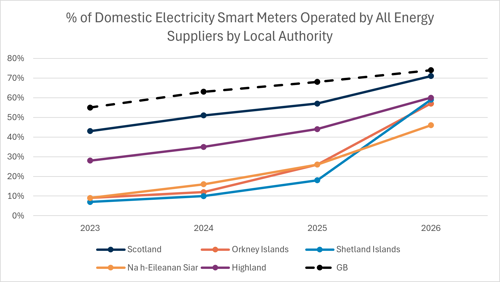
This raises concerns about whether current delivery approaches are working well enough to ensure all consumers can benefit.
Why has the rollout in Scotland fallen behind?
The smart meter programme in Great Britain is led by energy suppliers and depends on consumer choice. Installation is not mandatory, unlike in some European countries. For this approach to work, two things need to happen:
- Suppliers must be able to install smart meters efficiently across Scotland
- Consumers must be confident in the benefits that smart meters might offer and be willing to accept them
In practice, both have been challenging.
Technical barriers and recent progress
Two main issues have slowed rollout in Scotland. Connectivity problems in rural and island areas can make smart meters harder to operate reliably. And more complex existing systems, such as multi rate meters and Radio Teleswitch meters, are harder and more expensive to replace.
But there has been progress. Newer SMETS2 meters, 4G enabled hubs, and emerging solutions like VWAN have improved connectivity and made it more straightforward to install smart meters in more homes.
Challenges in delivering installations
Even where installation is possible, delivery can still be difficult.
There are fewer engineers in remote areas, so the supplier led model can be less efficient in harder to reach locations. As each supplier has fewer meters to install in a given area, there may not be the same incentive to prioritise these areas to the same degree as more densely populated centres. This increases costs and can lead suppliers to prioritise easier installations elsewhere in Great Britain.
Ofgem has strengthened compensation rules through updated Guaranteed Standards of Performance (GSOPs). These changes help consumers who experience delays or problems with the installation or operation of their smart meter. These changes should help to give consumers greater reassurance around the smart meter installation process.
Consumer experience and trust
Consumer experience plays a major role in uptake. Negative experiences can reduce trust and discourage others from adopting smart meters. Some issues remain which can worsen the consumer experience of smart meters:
- Around 8% of smart meters operate in “traditional mode”, meaning consumers are not deriving the benefits from the technology
- Connectivity problems can lead to estimated bills, potentially resulting in larger and unanticipated bills for consumers.
- Faults can limit access to smart tariffs, reducing consumers’ ability to benefit from flexible or time of use offers
For households under financial pressure, these risks can outweigh the benefits.
Updated GSOPs provide compensation for some issues, but there are still gaps. For example, problems linked to the wider smart meter network are not always covered, leaving some consumers without clear redress.
Looking ahead
The rollout so far has shown that UK targets for smart meter installations do not always reflect challenges in nations and regions. While overall progress has been made, gaps in Scotland have persisted.
The UK Government’s post 2025 framework for the roll out introduces supplier led, multi-year plans through to 2030, with stronger oversight from Ofgem. This creates an opportunity to improve performance in Scotland, if suppliers and regulators focus on areas with lower coverage.
How Ofgem could strengthen delivery in Scotland
We have identified several ways Ofgem could improve incentives and outcomes:
Compare supplier performance by region: Ofgem should benchmark how suppliers are performing in Scotland against each other, to ensure their plans are ambitious, realistic and credible
Support collaboration in low coverage areas: Encouraging suppliers to work together in specific locations could improve efficiency and speed up installations.
Improve incentives for harder-to-reach areas: Ofgem could adjust cost allowances to better reflect the higher cost of installing smart meters in remote or complex locations. This could include recognising the need for extra visits, greater engagement, and more difficult working conditions. Careful design would be necessary to avoid unintended consequences, e.g. rewarding historic underperformance.
Continue improving consumer experience: Faulty or unreliable smart meters reduce trust. Strengthening GSOPs to cover more issues would help improve consumer confidence and encourage uptake.
Closing the gap
Closing the smart meter gap in Scotland will depend on improving how rollout works in practice, especially in areas that have been harder to reach.
As the programme moves towards 2030, stronger regulatory oversight will be key. Ofgem’s role should focus more directly on underserved areas, while addressing weaknesses in delivery and consumer protection.
Without action, there is a risk that current gaps will remain, limiting both consumer benefits and the wider value of the energy system.