1. Executive summary
Why consumer welfare matters
We are all consumers. When we do our grocery shop, use a bank account, visit our GP, subscribe to a new streaming service, change our energy supplier, buy a new TV or get the bus to work – these are just some examples of how we all act as consumers almost every day.
Our experiences as consumers affect our quality of life and our wellbeing. Collectively, our experiences as consumers reflect how well the economy is working for the people it is intended to serve.
- When consumers cannot access the goods and services they need, the impacts of exclusion and unequal access can spill over into issues such as poor health, debt or financial security, adding to pressure on public services.
- When consumers experience harms through poor-quality or unsafe products,
misleading information, or unfair practices, the consequences can include financial loss, stress and anxiety, and even physical injury. - When consumers lack confidence and understanding of their consumer rights they are less likely to be able meet their needs and secure redress when problems arise.
The question of how well consumers are served is fundamentally a question of how well the economy is working for the people, and small businesses, at its heart. It’s therefore a question that matters for economic growth - and for the quality of public services.
The framework for this report
This is Consumer Scotland’s first Consumer Welfare Report. The requirement for us to produce a CWR is set out in our founding legislation, the Consumer Scotland Act 2020. The Act sets out that the CWR should address two questions:
- how well the interests of consumers are being served in Scotland
- where harm is being caused to the interests of consumers in Scotland,
the nature and extent of that harm
Our response to these statutory questions is based around our Consumer
Welfare Framework which argues that consumers are well served when they:
- Can access the goods and services they need to participate fully in society
- Are protected from harm and can secure redress when required
- Are confident and empowered to understand and exercise their rights and make informed choices
The report is structured around these three pillars of consumer welfare, with a chapter on each. At the heart of the framework is a cross-cutting theme of equity and fairness. This recognises that the purpose of the report is not just to understand how well the average consumer is served. The aim is to understand how all consumers are served, taking account of their individual characteristics, circumstances and experiences.
Access and affordability: Consumers can access the goods and services they need - fairly and without discrimination or financial hardship - to participate fully in society.
Protection and redress: Consumers are protected from harm and detriment and can secure redress when things go wrong.
Confidence and empowerment: Consumers are confident and empowered to navigate complex markets, and to exercise their consumer rights.
What we found
Consumers feel protected but harms are widespread and pervasive
Most consumers in Scotland feel well protected. But this confidence belies the fact that consumer harms are both widespread and pervasive.
Harms encompass a range of issues, from unsafe products that cause physical harm to misleadingly described or priced products, and to poor quality products that cost consumers time, money or stress to resolve.
Regulation and enforcement are critical to consumers’ interests
A key reason why harms are widespread and pervasive is that the source
of those harms is continually evolving. The growth of new markets and
products - such as the implications of new online platforms for regulating
product safety for example - can increase the risk of consumer harm.
Regulators face a continual challenge to respond to these issues, and to do
so in ways that are proportionate. The report highlights examples of this
challenge - such as responding to the continual evolution of online pricing
practices that can sometimes be misleading, unfair or discriminatory.
But regulation is only one part of the story. The effectiveness of regulation
hinges critically on how it is enforced, and the effectiveness of both
regulation and its enforcement is critical to the question of how well
consumers are served. Recent reforms have strengthened some
enforcement powers, but trading standards services are under significant
pressure.
Consumers lack confidence in exercising their rights
Being able to obtain redress when things go wrong is critical if consumers’ interests are to be well served. But consumers experience of redress is very mixed. Consumers’ satisfaction with redress is generally low, and their awareness of Alternative Dispute Resolution (ADR) is limited - unsurprisingly given how complex and inconsistent the ADR landscape is.
Consumers often have confidence in their ability to understand their consumer rights. But this confidence is frequently misplaced.
Barriers to accessing ADR, legal advice and civil justice continue to limit many consumers’ ability to secure redress when things go wrong.
Affordability challenges accentuate consumer harm
All these issues are exacerbated by persistent affordability challenges.
Affordability challenges can cause harms by constraining consumers’ choices and their ability to meet their needs.
Responding to affordability challenges isn’t just a question of consumer policy. But there is a big agenda for consumer policy - for example, supporting consumers to enhance their energy efficiency or select the right products and tariffs for them; and ensuring that affordability support is effectively targeted - which it often isn’t.
Inequalities in consumer experience are stark
There is significant variation in consumers experience depending on
their characteristics and circumstances.
Those with a disability or financial vulnerability are consistently more
likely to experience a range of consumers harms, to be less confident in
asserting their rights, and be less likely to be satisfied with redress.
Perhaps more surprisingly, younger consumers are consistently more
likely to experience a range of consumer harms compared to middle
and older aged consumers.
Digital access and confidence are increasingly critical to consumers’
successful participation in markets. The digitally excluded are much less
confident in their ability to obtain reliable information to help them
make informed choices as consumers. They are also at risk of exclusion
as an increasing range of services shift online or become digital only
from energy meters and phonelines to banking and public services.
Conclusion – how well are the interests of consumers served?
Most consumers in Scotland are reasonably well served - they tend to feel protected, and are generally able to access the products they need.
However, consumer harms are widespread and pervasive. Understanding rights, let alone exercising those rights, can be challenging even for a confident and savvy consumer.
Whilst the typical consumer is well served, there are significant inequalities in experience. The consumers who are most exposed to harm are often those who are least able to manage it – the disabled, young, those with limited financial resilience, and the digitally excluded. These groups are at particular risk of being left behind in a rapidly evolving economy unless products and services respond to their needs.
This matters because how well consumers are served is not a peripheral measure of economic success but one of its clearest tests: an economy works well only when it works well for the people who rely on it - particularly those most at risk of harm or exclusion.
Data explorer tool
Explore the core indicators from the report by group and over time via our Consumer Welfare report: data explorer tool.
2. Introduction
Why the interests of consumers matter
We are all consumers. When we do our grocery shop, use a bank account, visit our GP, subscribe to a streaming service, change our energy supplier, buy a new TV or get the bus to work – these are just some examples of how we all act as consumers nearly every day.
Our experiences as consumers affect our quality of life and our wellbeing. Collectively, our experiences as consumers reflect how well the economy is working for the people it is intended to serve.
- impacts of exclusion and unequal access can spill over into issues such as poor health, debt or financial security.
- When consumers experience harms through poor-quality or unsafe products, misleading information, or unfair practices, the consequences can include financial loss, stress and anxiety, and even physical injury.
- When consumers lack confidence and understanding of their consumer rights they are less likely to be able to meet their needs and secure redress when problems arise.
This report assesses how well are the interests of consumers are served in Scotland. This is a question that matters for consumers individually. But it matters more broadly for the wider economy and for public services.
- It matters for the economy. Consumer spending in Scotland totalled £129 billion in 2024, accounting for over 60% of total economy-wide spending. Consumers who are well served – who feel protected from harm, confident in navigating complex markets and knowledgeable about their consumer rights – help underpin a dynamic and productive economy. These consumers are more likely to engage with new products, compare offers and shop around which all drive innovation and economic growth.
- It matters for public services. The question of how well consumers are served matters for public services, too. When consumers experience harms – whether as a result of exclusion from essential services or from unsafe or misleading products – the impacts on physical and mental health and financial wellbeing frequently spillover to impact public services such as health and welfare services.
The question of how well consumers are served is fundamentally therefore a question of how well the economy is working for the people, and small businesses, at its heart. And as a result, it’s a question that matters for economic growth, and for the quality of public services.
A Consumer Welfare Report for Scotland
Consumer Scotland’s founding legislation, the Consumer Scotland Act 2020, requires us to produce a Consumer Welfare Report every three years.[1]
The Act sets out that the requirement of the Consumer Welfare Report is to address two key questions:
- How well the interests of consumers are being served in Scotland, and
- Where harm is being caused to the interests of consumers in Scotland, the nature and extent of that harm.
This is the first Consumer Welfare Report that Consumer Scotland has produced to meet its statutory requirement. Its broad purpose – beyond addressing the questions above – is to use evidence to shed light on some of the key issues facing consumers in Scotland, and in so doing to inform public debate about the role of governments, regulators, advice bodies and consumers themselves in addressing these issues.
A framework for assessing Consumer Welfare
What are the interests of consumers, and how can we know if they are being met?
In consultation with stakeholders, this report adopts a Consumer Welfare Framework which argues that consumers’ interests are served when:
- All consumers in society can access the goods and services they need, not just to meet their basic needs, but to participate fully in society without experiencing undue harm, financial hardship or exclusion.
- Consumers are adequately protected from the range of consumer harms and detriment that they may be exposed to. These harms can include, but are not limited to, unsafe products, misleading prices or product information, scams, or simply detriment caused by unreliable or poor-quality products and services. When things do go wrong, consumers need to be able to seek redress and put things right.
- Consumers can participate confidently in markets, are knowledgeable about their rights and know how to exercise those. This confidence and knowledge benefits consumers who are better positioned to obtain the goods and services they need, but it has wider economic benefits too, underpinning the conditions for a dynamic economy.
Securing these outcomes relies on a holistic consumer protection framework. An effective consumer protection framework prevents harm by supporting fair and equitable access to essential goods and services; protects consumers from harm through a robust, adaptable and enforceable set of consumer rights and regulations; and supports consumers to participate in markets as confident consumers, able to make informed decisions and exercise their rights.
This report is structured around these three pillars of consumer welfare, with a chapter on each pillar. An over-arching theme of fairness, inclusion and equity cuts across these three pillars, recognising that inequalities in experience are a fundamental part of overall consumer welfare.
A summary report and data tables are available on our website.
Figure 1.1: Consumer Welfare Framework
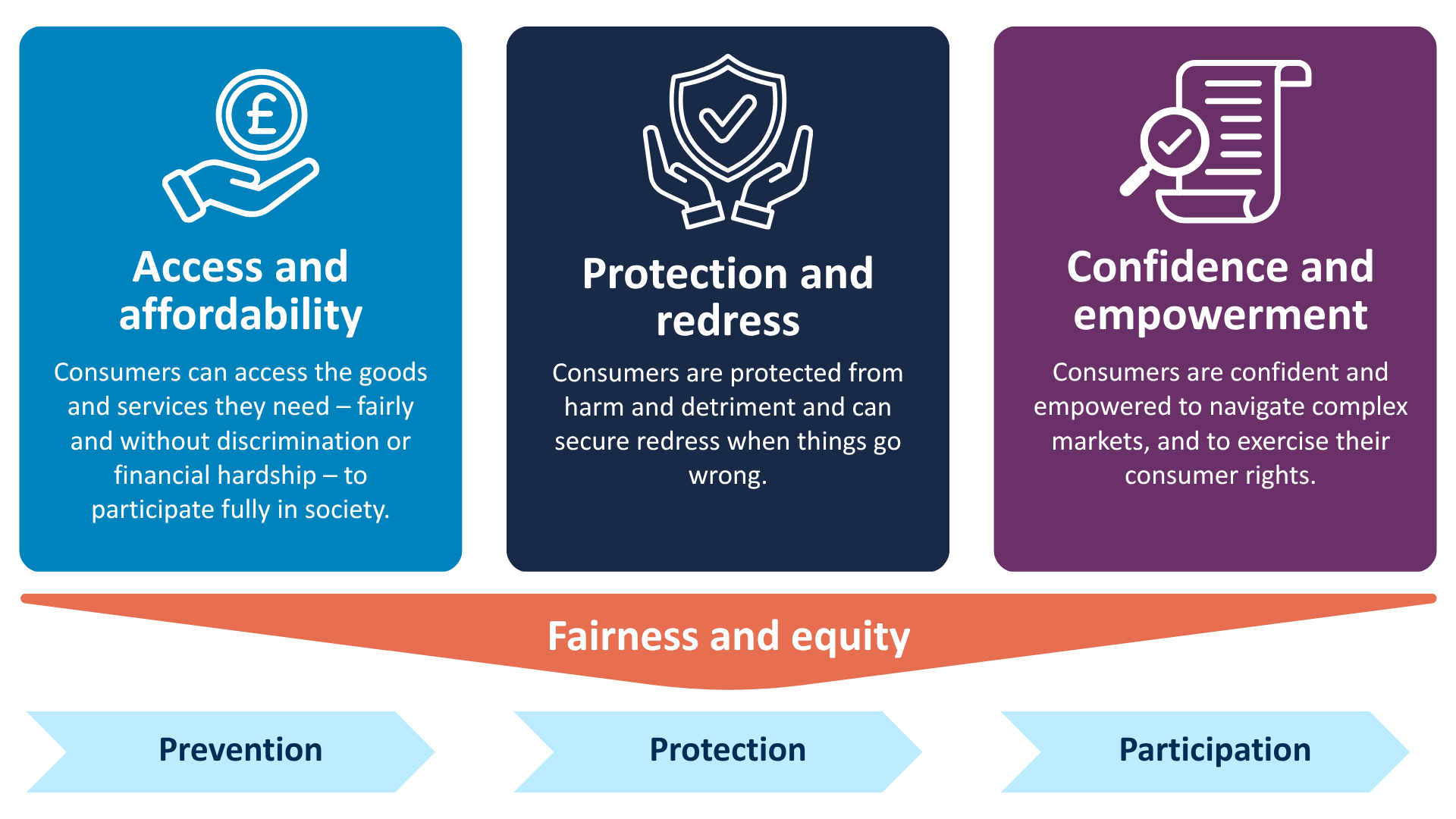
The report uses a range of evidence to assess the extent to which consumer interests are being served within each of these three broad pillars. It takes a holistic approach, examining consumers’ overall experience and outcomes, rather than attempting to assess how well consumers are served in specific markets.
For each pillar, the report:
- Presents data on a number of core outcome indicators, intended to show how consumer outcomes have evolved over time or differ for different groups. There are 14 core indicators in total, see below
- Highlights, through a series of spotlights, some key examples of the issues that affect these outcomes. The spotlights cover examples both of how the evolution of products and markets affect consumers, as well as examples of how policy can respond.
The cross-cutting and holistic nature of consumer welfare means the report is necessarily broad. It encompasses a range of reserved and devolved policy issues, including the evolving regulation of a wide range of different consumer issues, the enforcement of consumer regulation, the design of affordability policy, and the provision of consumer advice.
The report has a focus on the extent to which consumer interests are being served for different groups of consumers. It pays particular attention to consumers in vulnerable circumstances (Spotlight 1.1). But it also considers the variation in consumer outcomes across factors including geographical location, and protected characteristics including age, sex and disability.
The report also considers the experience of micro and small business consumers in Scotland. Scotland’s 350,000 micro and small businesses are purchasers of goods and services, and as such are defined as consumers in the Consumer Scotland Act (2020).
Consumer Welfare Core Indicators
Access and affordability indicators:
- Percentage of individuals living below the Minimum Income Standard in Scotland
- Percentage of consumers who struggled to afford food, energy or housing in the past 12 months
- Percentage of households in Scotland living in fuel poverty
- Percentage of all respondents in energy debt in arrears
- Percentage of households in Scotland with internet access
- Percentage of banked adults who do not access services online
Protection and redress indicators:
- Percentage of consumers who experienced at least one detriment incident in the last 12 months
- Percentage of consumers who experienced a safety issue with a product in the past 12 months
- Percentage of consumers who feel confident they can recognise misleading or unclear information about items or services
- Percentage of consumers who have fallen victim to a scam in the past 12 months
- Percentage of consumers who feel well protected when buying goods and services
Confidence and empowerment indicators:
- Percentage of consumers who feel like confident and savvy consumers
- Percentage of consumers who are confident in understanding their consumer rights
- Percentage of consumers who know where to look for reliable information about items and services
Spotlight 1.1: Consumers in vulnerable circumstances
Consumers in vulnerable circumstances are those who, due to their personal circumstances, are especially susceptible to harm.
A number of factors increase the risk of experiencing vulnerability. These include: being in poor health; having low financial resilience (such as low-income and/or limited ability to withstand financial shocks); experiencing negative life events such as bereavement or job loss; and having low capability (which could include low financial literacy or digital capability, or limited confidence in understanding consumer rights). [2]
Any consumer can experience vulnerability. Consumer vulnerability can be temporary, sporadic or permanent; consumers may move in and out of states of vulnerability over time and may not be vulnerable in all situations; and vulnerability can often be experienced because of factors outside the individual’s control.[3]
Consumers who experience vulnerability may be more likely to experience harm because they are less able to represent their interests, have different needs, or are more prone to behavioural biases that affect their decision-making.
Throughout this report we examine how consumer experiences and outcomes differ for consumers who have characteristics of vulnerability. In presenting the findings from our Consumer Welfare Survey, we consider the outcomes for consumers who experience various characteristics of vulnerability, and present findings for consumers who are experiencing more than one of these vulnerability risk factors simultaneously:
- Has a disability or health problem that either limits them a lot or a little;
- Has low financial resilience – defined as either having fallen behind on at least some bills and commitments or would be unable to pay an emergency expense;
- Has low digital confidence – defined as having low self-reported confidence using the internet.
In total, 59% of respondents to the survey had no characteristic of vulnerability, 30% had one characteristic of vulnerability and 11% experienced more than one characteristic of vulnerability.
Approach
Our approach to this report was underpinned by stakeholder engagement from the outset. The report itself draws on a wide range of evidence, supplemented by a survey of consumers in Scotland – the Consumer Welfare Survey – that was undertaken specifically to inform this report.
Stakeholder engagement. We engaged with a number of consumer landscape stakeholders on a bilateral basis to hear views on our proposed approach to the CWR, and stakeholders’ views on key issues for inclusion. These bilateral meetings were supplemented by a workshop session at the Consumer Network – Consumer Scotland’s forum for engaging consumer landscape stakeholders in Scotland – in March 2026, and a discussion at the Committee on Consumers in Vulnerable Circumstances – an advisory Committee to Consumer Scotland – in November 2025. We are grateful for the time and contribution of all stakeholders involved.
Evidence assessment. Throughout this report we draw on a wide range of data and evidence to assess the core statutory questions – how well are consumers served, and what is the nature of any harm? This evidence includes analysis of data, statistics and research produced by the Office for National Statistics, the Scottish Government, regulators, research bodies, the third sector, and other bodies, including Consumer Scotland’s research.
As part of this assessment of evidence, we identified a series of ‘core indicators’ of consumer outcomes. These core indicators were identified through an appraisal exercise, which assessed a long-list of potential indicators against criteria which included: relevance, timeliness, potential for disaggregation across consumers groups, and frequency and consistency in collection over time.
The data underpinning the core indicators used in this report is available on Consumer Scotland’s Consumer Welfare Dashboard. The Dashboard is an online tool which enables users to explore the data underlying the core indicators in a bespoke way.
Consumer Welfare Survey. We undertook a survey of consumers in Scotland to inform this report. The Consumer Welfare Survey was designed to explore respondents’ experiences of being consumers in Scotland – including issues in accessing or being able to afford essential goods and services, their experiences of different forms of consumer harm and the resolution of issues experienced, and their knowledge of their consumer rights and confidence in asserting those rights.
The survey was completed by 2,034 respondents. It was predominantly an online survey, but also included 50 telephone interviews with digitally excluded consumers to ensure representation from this group. Fieldwork took place between 5th May and 29th May 2026. The survey data presented in this report is weighted by age, gender, region, urban/rural classification and household income, to ensure it is representative of all Scottish adults (aged 18+). Further details on the survey are available in Chapter 6.
3. Pillar 1: Access and affordability
Being able to afford and access goods and services that are important to people’s everyday lives and wellbeing is fundamental to consumers’ interests. This includes areas such as housing, energy, food, transport and digital connectivity, which can account for a significant share of household spending. When consumers cannot access or afford these goods and services, this can lead to harms such as social exclusion, ill-health, and low wellbeing. This chapter examines how the affordability and accessibility of essential goods and services has been affected by a cost of living crisis and technological change.
Key points
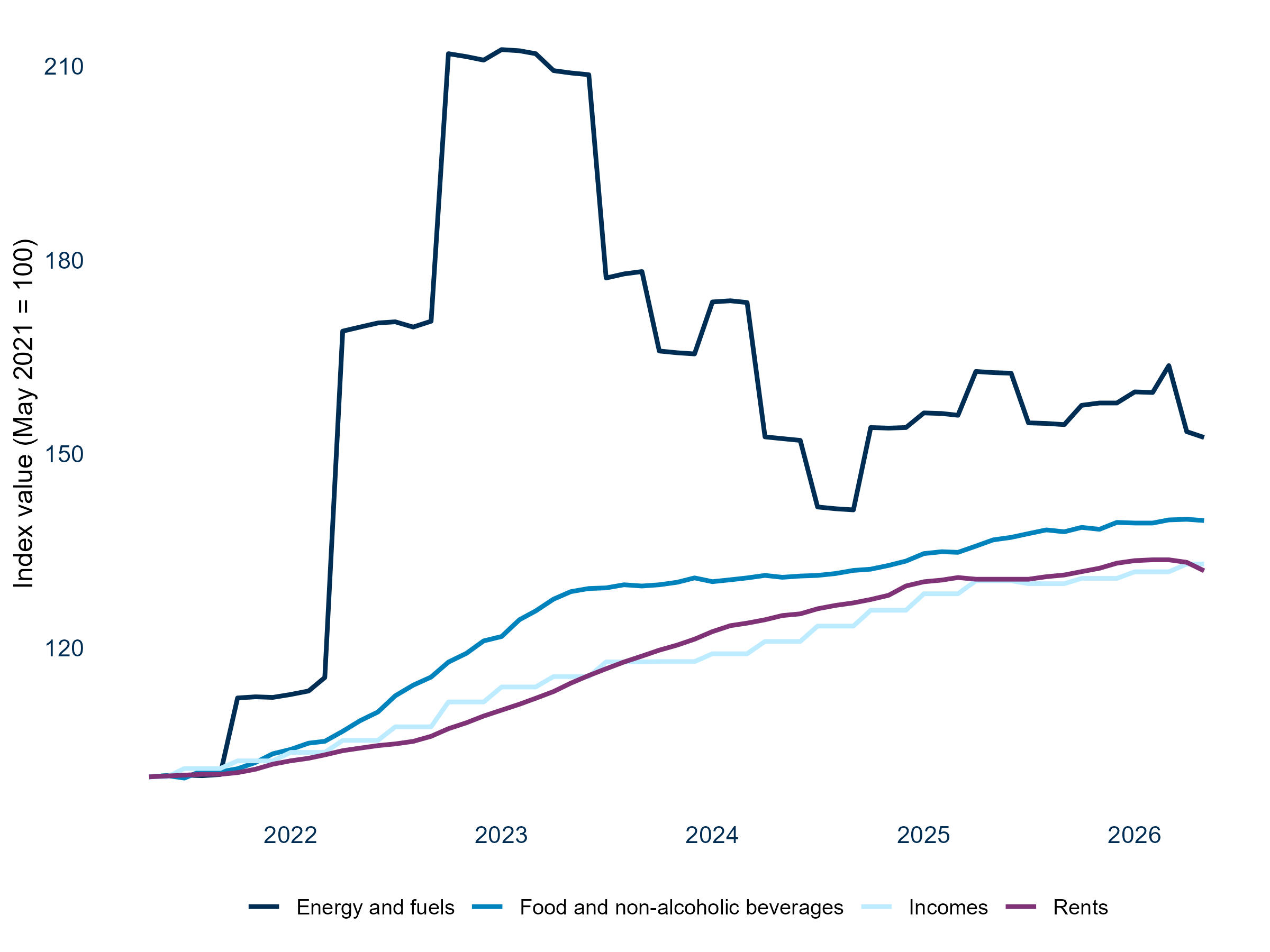
- The affordability of essential goods and services remains a major challenge for many households in Scotland. Although inflation has fallen from its peak, prices have not returned to previous levels. By May 2026, food prices were around 40% higher than in 2021 and energy costs 44% higher, outpacing growth in household incomes over the same period.
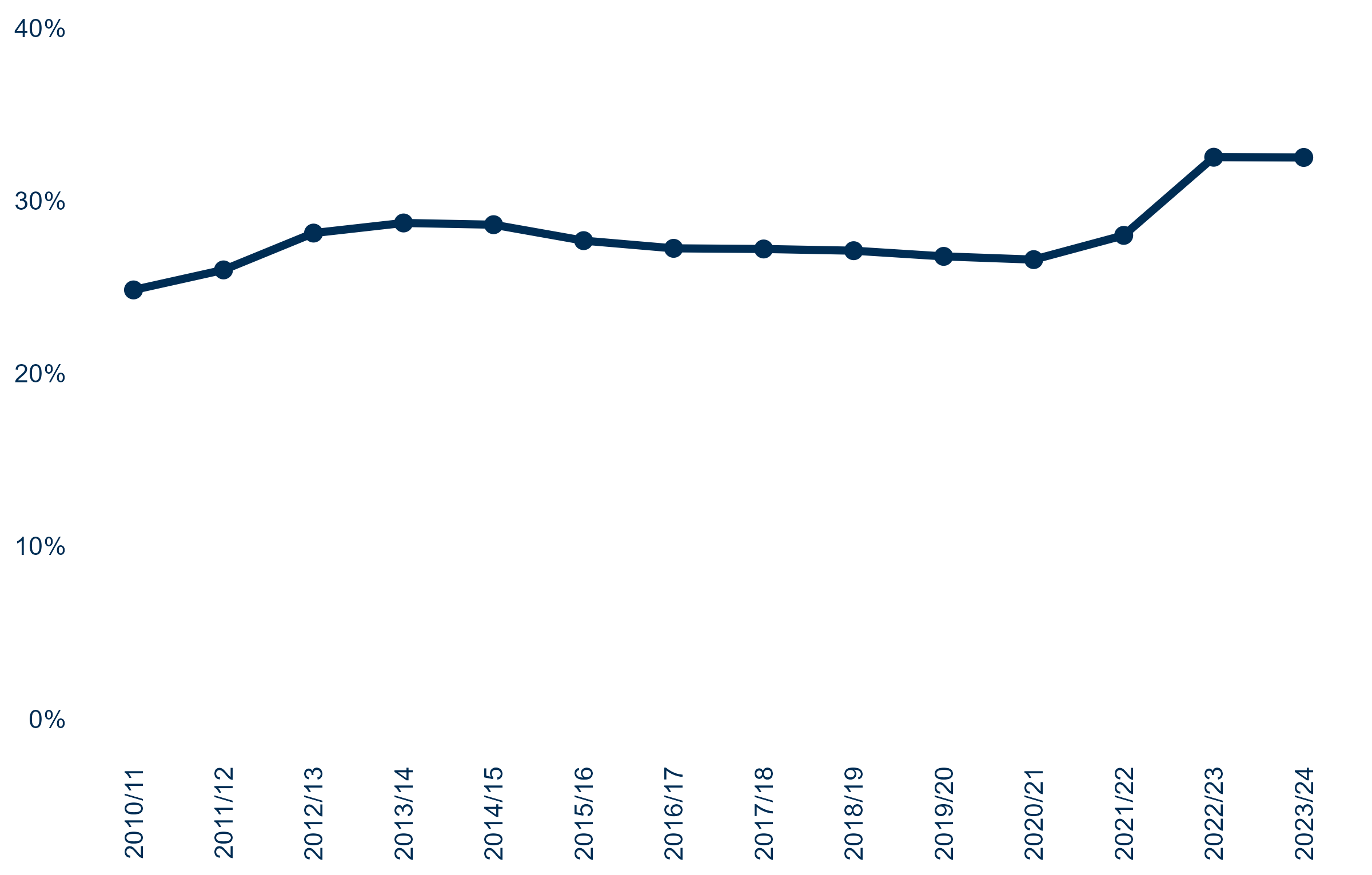
- Affordability pressures have left more households struggling to achieve a minimum acceptable standard of living. Almost one third of people in Scotland were living in households below the Minimum Income Standard in 2023/24, the highest proportion recorded since 2010.
- One in five consumers report struggling to afford essential household costs. Twenty per cent of consumers said they had often or always struggled to afford at least one essential cost, such as food, energy or housing, in the previous 12 months. Affordability challenges are particularly acute for younger consumers, lower-income households and those experiencing financial vulnerability.
- Many Scottish households continue to experience forms of consumer-related poverty. Fuel poverty affected 29% of households in 2024, while 8% of adults worried about running out of food because of a lack of money in 2024. Around 10% of households are projected to be in water poverty in 2026/27.
- Poor targeting of affordability support means consumers are not always receiving help effectively. Existing support schemes in sectors such as energy and water often fail to reach many of the households most in need, while some support is provided to consumers experiencing little affordability pressure. Better use of data and automatic enrolment could improve outcomes and reduce consumer harm.
- The energy market remains a major source of affordability concerns. High energy bills continue to affect household wellbeing, with more than a third of households unable to afford to heat their homes to a comfortable level. Policy action is required both to better target support and to support households reduce their heating costs.
- Digital access has improved significantly, but substantial inequalities remain. Broadband and mobile connectivity continue to lag behind elsewhere in the UK, particularly in rural areas. While 89% of urban consumers can access gigabit-capable broadband, this falls to 54% in rural areas. Scotland also has the lowest geographical 4G coverage and lowest 5G coverage among the UK nations.
- Digital exclusion remains a significant barrier to participation in modern consumer markets. Around 15% of adults in Scotland lack basic digital skills, and households in the most deprived areas remain less likely to have internet access than those in the least deprived communities. Digital exclusion is closely associated with age, poverty and vulnerability.
- Access to financial services is becoming increasingly dependent on digital inclusion. The proportion of adults excluded from online or mobile banking has fallen substantially, but exclusion remains concentrated among older and lower-income consumers. At the same time, continued bank branch closures risk leaving some consumers without suitable alternatives.
- Consumers in rural and island communities face distinctive barriers to accessing essential services. Connectivity gaps, challenges with postal services, slower adoption of new technologies such as smart meters, reduced access to cash and the transition to digital landlines all risk widening inequalities between rural and urban consumers.
Takeaway
While many consumers in Scotland have good access to essential goods and services, the legacy of the cost of living crisis means that a substantial minority of consumers continue to struggle to afford essentials. Technological change also risks creating new forms of exclusion for those with limited resources, skills or digital connectivity. The consumers whose interests are least well served are consistently those on lower incomes, those experiencing vulnerability, and those living in rural and island communities. Improving affordability, ensuring support reaches those who need it most, and preventing digital and geographic inequalities from exacerbating consumer harms are key policy priorities.
The affordability of goods and services
A key tenet of consumer welfare is that consumers can afford sufficient level and quality of goods and services required to play an active role in society. Consumers face affordability challenges either if they can’t afford a basic level of that service, or if securing that basic level of service causes them undue stress or financial hardship.
Some goods and services such as food, housing, water and energy are needed for basic survival, while others, such as access to banking, transport and communications services are required to play an active role in society.
When consumers are unable to afford or access these goods and services, this can lead to harms such as social exclusion, ill-health, and reduced wellbeing.[4] These pressures can also increase demand for public services, including healthcare, social security, and housing services, potentially placing additional strain on their capacity to meet people’s needs.
Whilst affordability challenges are partly the result of a broad set of factors that determine the distribution of incomes, consumer policy has a role to play where market structures or pricing mechanisms result in consumers paying unnecessarily high prices, where the distribution of prices is inequitable, or where some consumers cannot access the tariffs or prices that best meet their needs.
Consumer voice on affordability concerns
"I get really cold, but I cannot afford to turn the heating on and if we ever do turn the heating on, I clock watch, you know, it's on for 30 minutes and then it's off. I'll sit there suffering from 24 hour chronic pain, with my legs going stone cold and my back killing me." - Disabled consumer
“It was just horrible to see debt letters coming through. I didn’t want to open my mail coming through because I was so worried what it was going to be. I was embarrassed and maybe a bit ashamed that I had got into that situation.” - Consumer, in receipt of council tax reduction in water debt, referred to debt collector
“It's very stressful because you're having to budget, you know, you might have to do without something so you can pay the £16 to go to the hospital and then have to wait to claim it back.” - Disabled consumer in the Highlands
How has the affordability of essential goods and services evolved?
The prices of many goods and services began increasing during the inflationary spike that followed the Coronavirus pandemic and Russia’s invasion of Ukraine in 2022. Whilst inflation in August 2026 was 3.1%, significantly below the peak of over ten per cent in early 2023, there has been an enduring impact on the price of a number of categories of goods and services – particularly food and energy. These price effects have a particularly burdensome impact on low-income households, given that they account for a larger share of low-income households’ expenditure (Spotlight 2.1).
Chart 2.1 shows the evolution of three categories of goods and services – energy, food and drink, and housing rents. These three are not the only categories of essential expenditure, but are indicative of some of the most significant pressures on household spending. It shows that, by May 2026, the price of a typical basket of food and non-alcoholic drink was 40% higher than in the same period in 2021, and the energy price cap was 44% higher for the same period. For context, typical household incomes – net of direct taxes – are around 31% higher in May 2026 than five years previously. In slight contrast, average rents across the UK have increased by slightly less, 28%, than the increase in incomes.
The message is that whilst the rate of inflation itself has fallen, prices of some categories such as energy and food, remain higher in real terms than pre-2022 and are continuing to increase.
The price of some essential goods and services have risen faster than incomes over the last 5 years.
Chart 2.1: Cost of food, energy and rents, and Scottish wages and salaries, indexed to May 2021. May 2021 – May 2026
Source: Consumer Scotland analysis of ONS CPIH indices (energy and fuels, food and non-alcoholic beverages), Scottish Fiscal Commission (incomes, rents)
Spotlight 2.1: Household expenditure in Scotland
Household spending is not a perfect measure of what households ‘consume’. For one thing, households can consume public services, which are not associated with expenditure directly. Furthermore, there can be differences in the timing of when households pay for something and when they consume the services they get from that thing – particularly in cases where they borrow to pay for something, or where they purchase a durable item which they may then use for many years. Nonetheless, understanding how households spend is important for assessments of consumer wellbeing.
Households in Scotland spent an average of £530 per week in 2024/25. Amongst the most significant categories of expenditure were housing (including energy) at £90 per week; transport (£80 per week – which includes the costs associated with purchasing vehicles averaged over time); recreation and culture (£70 pw) and food (£65 pw).
On average, households in Scotland spend somewhat less than the average expenditure across UK households, which is around £620 pw. But patterns of expenditure are broadly similar between Scotland and the UK. For example, transport accounts for 15% of total spending in Scotland v. 14% in UK; food accounts for 12% of household spending in Scotland compared to 11% in UK; housing accounts for 17% of household spending in Scotland compared to 18% in UK (in Scotland, higher spending on energy offsets lower costs associated with housing itself).
What is more significant than differences between consumers in Scotland and those in the UK are the differences between types of consumer within Scotland.
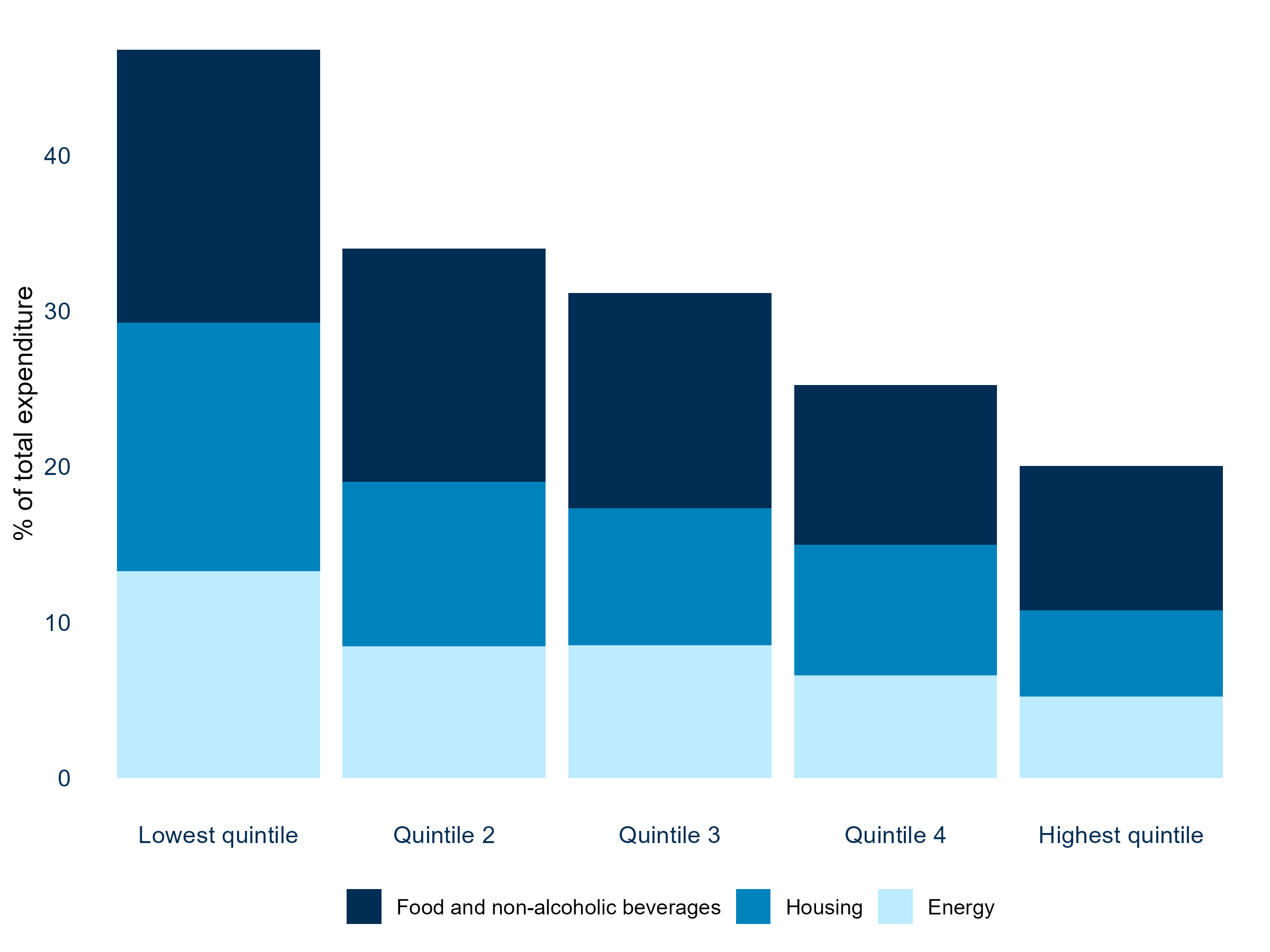
Of particular note, households with different levels of income can exhibit widely different expenditure patterns. Because certain goods and services are essential, households with lower incomes tend to spend more as a percentage on those categories. As shown in Chart 2.2, expenditure on food is 17.5% of total expenditure for households in Scotland in the lowest fifth by income and 9.3% for households in the highest fifth. Energy costs account for 13.3% of expenditure for the lowest income fifth but only 5.2% for the highest. Lower income households also spend proportionally more on overall housing costs (which includes energy) and communication, and proportionally less on transport, recreation and restaurants and hotels.
Patterns of household expenditure also differ by factors such as household composition, and age.
The takeaway is that patterns of expenditure are generally similar between Scotland and the UK – but can vary substantially between consumer groups within Scotland.
Households with lower incomes tend to spend a greater proportion of total expenditure on essential services.
Expenditure on food and non-alcoholic beverages, housing, and energy as a percentage of total household expenditure, by household income quintile, Scotland, 2023-24
Source: Consumer Scotland analysis of The Living Costs and Food Survey, various years, and the ONS’ Family Spending Analyses
The legacy of these price increases can be seen in a number of measures of households’ financial precarity. For example:
There has been a rise in the proportion of individuals living in households whose income does not meet the ‘Minimum Income Standard’. The Minimum Income Standard (MIS)[5] defines the income households need to achieve a socially acceptable standard of living, ensuring they can meet basic needs and participate fully in society. Chart 2.3 shows that, in 2023/24, almost one third of individuals (32%) in Scotland were living in households whose income does not meet the MIS, a rise from just over one quarter before 2022.
Consumer Scotland’s Consumer Welfare Survey found that, in 2026, one in five respondents report ‘often’ or ‘always’ struggling to afford at least one essential household cost (energy, food, or housing) during the past 12 months (Chart 2.4). 13% of respondents had struggled to afford food either ‘often’ or ‘always’ during the past 12 months. Similarly, 12% had struggled often or always to afford energy, and 13% had struggled often or always to afford essential housing services.
These affordability challenges disproportionately affect younger people, women, the unemployed, disabled people, and lower-income households. These households often responded to the cost of living crisis by reducing their consumption of essentials, or borrowing to maintain consumption.[6]
Core indicator 1: More people in Scotland were living below the Minimum Income Standard in 2023/24 than at any time since 2010
Chart 2.3: Percentage of individuals living below the Minimum Income Standard in Scotland (3-year average)
Source: Consumer Scotland analysis of Family Resources Survey
Core indicator 2: Consumers in vulnerable circumstances – particularly those with low financial resilience – are most likely to experience affordability challenges
Chart 2.4: Proportion of adults who have struggled to afford food/ energy/ housing either ‘often’ or ‘always’ during the past 12 months
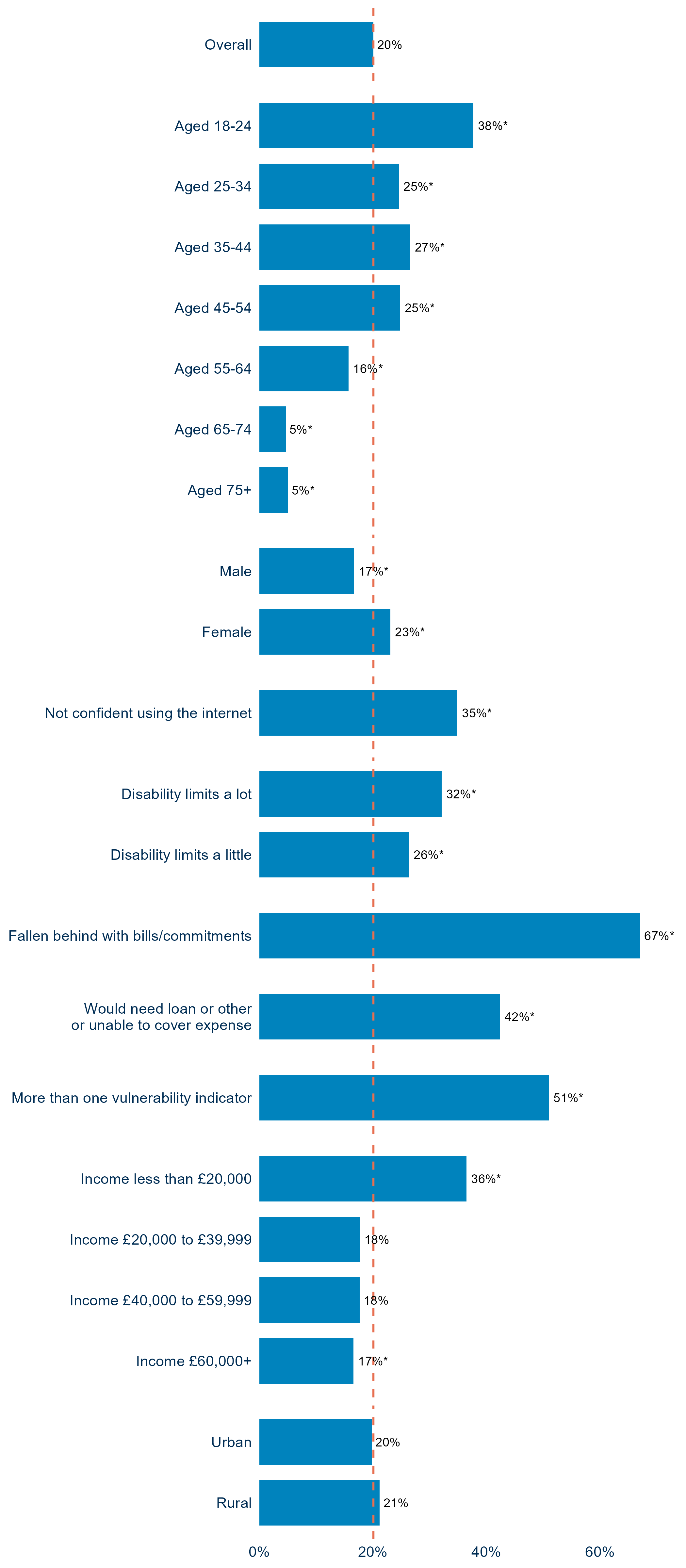
Source: Consumer Scotland (2026) Consumer Welfare Survey
Notes: The data is derived from three separate survey questions, one for each essential product or service. Question - In the last 12 months, how frequently have you struggled to afford energy/food and drink/unavoidable housing costs (rent, mortgage payments, Council Tax)
Weighted bases: overall, n = 2,034; aged 18-24, n = 238; aged 25-34, n = 331; aged 35-44, n = 320; aged 45-54, n = 307; aged 55-64, n = 337; aged 65-74, n = 334; aged 75+, n = 164; male, n = 942; female, n = 1088; not confident using internet, n = 71; disability limits a lot, n = 166; disability limits a little, n = 359; fallen behind with at least some bills/commitments, n = 170; would need loan or other or unable to cover expense, n = 430; more than one vulnerability indicator met, n = 226; household income less than £20,000, n = 347; household income £20,000 - £39,999, n = 602; household income £40,000 - £59,999, n = 364; household income £60,000 or more, n = 574; urban, n = 1604; rural, n = 401. *Symbol indicates a statistically significant difference between this group and the overall average.
A significant minority of consumers in Scotland experience some form of consumer-related poverty. Different forms of poverty can overlap within households, with difficulties meeting one essential need potentially contributing to, or compounding, difficulties in meeting others. Non-exclusive examples relate to fuel poverty, food insecurity and water poverty:
- Fuel poverty. The fuel poverty rate rose to 34% in 2023 (Chart 2.5). It fell back to 29% in 2024, but this remained above the rate of around 25% in the years leading up to the pandemic. Scotland has legislated targets to reduce the fuel poverty rate to no more than five per cent by 2040.[7] A household is fuel poor if it would require to spend more than ten per cent of its income to pay for reasonable fuel needs, and where its remaining income is below the minimum income standard.
- Food insecurity. In 2024, 8% of adults in Scotland had worried about running out of food due to a lack of money or other resources in the last 12 months, a decrease from 14% in 2023 and a return to the range recorded between 2017 and 2021. Six percent of adults reported eating less in the last 12 months due to a lack of money or other resources; 3% had run out for food in the previous 12 months due to a lack of money or resources.
- Water poverty. Whilst consumers in Scotland benefit from lower water bills on average than consumers in England and Wales, around ten per cent of households in Scotland are projected to be in water poverty in 2026/27. This is in line with the rate seen over the past decade, but is projected to increase in future years if water charges continue to increase above the rate of inflation.[8] A household is said to be in water poverty if it spends more than 3 per cent of its disposable income on water charges.
Core indicator 3: Almost one third of Scottish households are in fuel poverty
Chart 2.5: Percentage of Households in Scotland living in fuel poverty
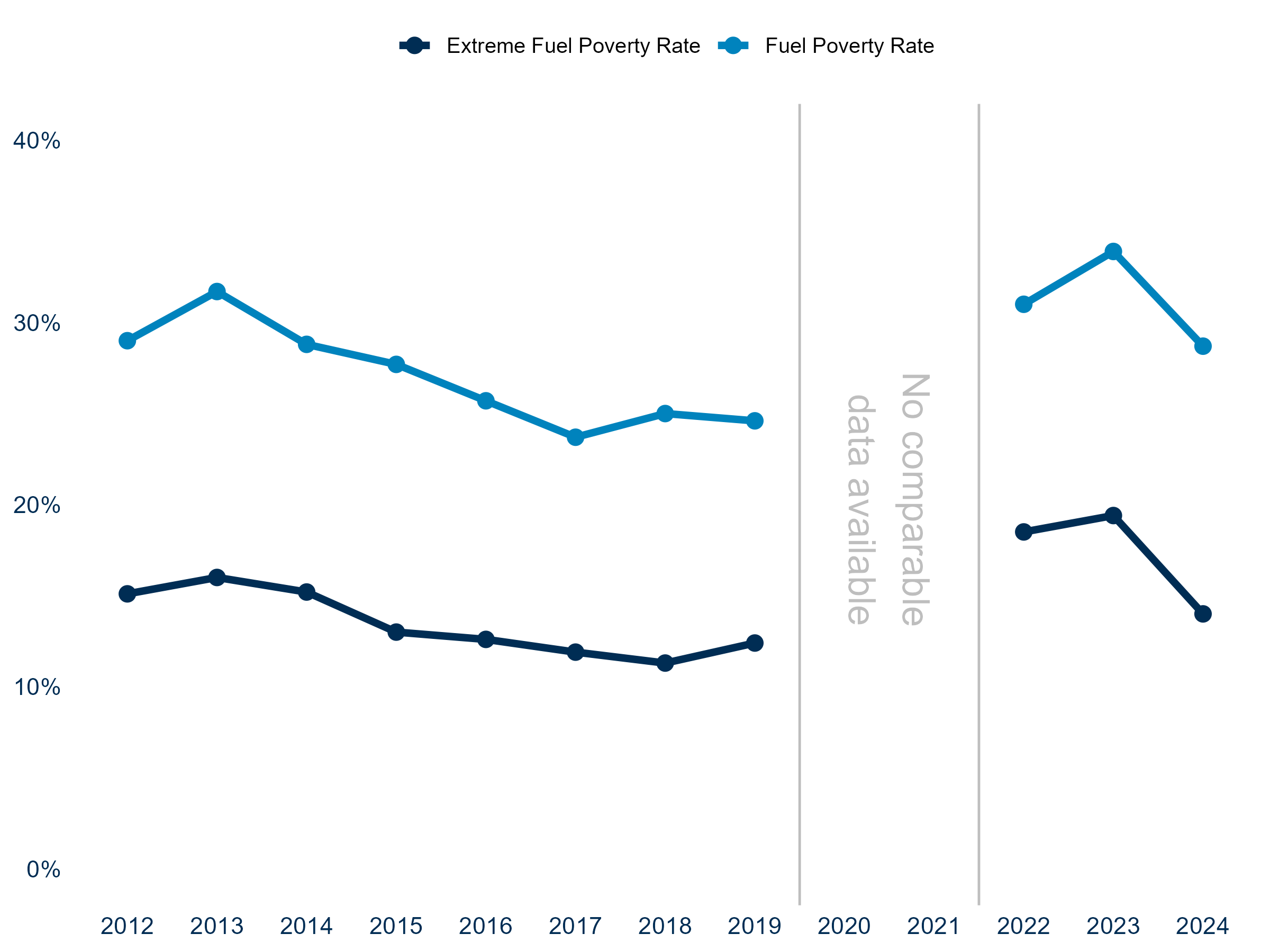
Source: Consumer Scotland analysis of Scottish Household Survey
Weighted bases: 2022, n = 2,931; 2023, n = 3,104; 2024, n = 2,834
One of the implications of rising real prices has been an increase in consumer debt in relation to essential utilities. At a UK level, domestic energy debt has been on a rising trend since 2022, reaching £4.79bn in 2026[9]. Almost one in five consumers in Scotland were in energy debt or arrears in early 2026 (Chart 2.6).[10] Being in energy debt has negative impacts on health and wellbeing for indebted consumers – and since the debt is ultimately socialised across all bills, it indirectly affects a wider cohort of consumers through higher bills. Spotlight 2.3 considers measures to reduce energy bills.
Indebtedness is not confined to energy bills. Rising prices relative to incomes places many households under strain. The latest Scotland report from the Money and Pensions Service shows that 15% of adults in Scotland often use a credit card, overdraft, or borrow money to buy food or pay bills because they have run short of money. The same report finds that 13% of adults in Scotland show ‘strong indicators of needing debt advice due to arrears, using high-cost credit or facing creditor action.[11]
A large proportion of households are indebted in relation to water and sewerage bills. A recent Consumer Scotland report identifies ways to reduce the likelihood of households becoming indebted, and ways to better support indebted consumers to recover.[12]
The broader picture is of a context where a large number of consumers have low financial resilience. The Financial Conduct Authority estimates that 23% of adults in Scotland had low financial resilience in 2024 – defined as having either low savings (not able to withstand losing their main source of household income for even one week), being in financial difficulty (failed to pay domestic bills or meet credit commitments in three or more of the last six months), or being heavily burdened by their domestic bills or credit commitments). The proportion of adults in Scotland with low financial resilience had declined marginally between 2022 and 2024, and is broadly on a par with the UK as a whole (24%).
Core indicator 4: The proportions of households in energy debt has continued to increase
Chart 2.6: Proportion of all respondents being in energy debt or arrears, 2023 to 2026
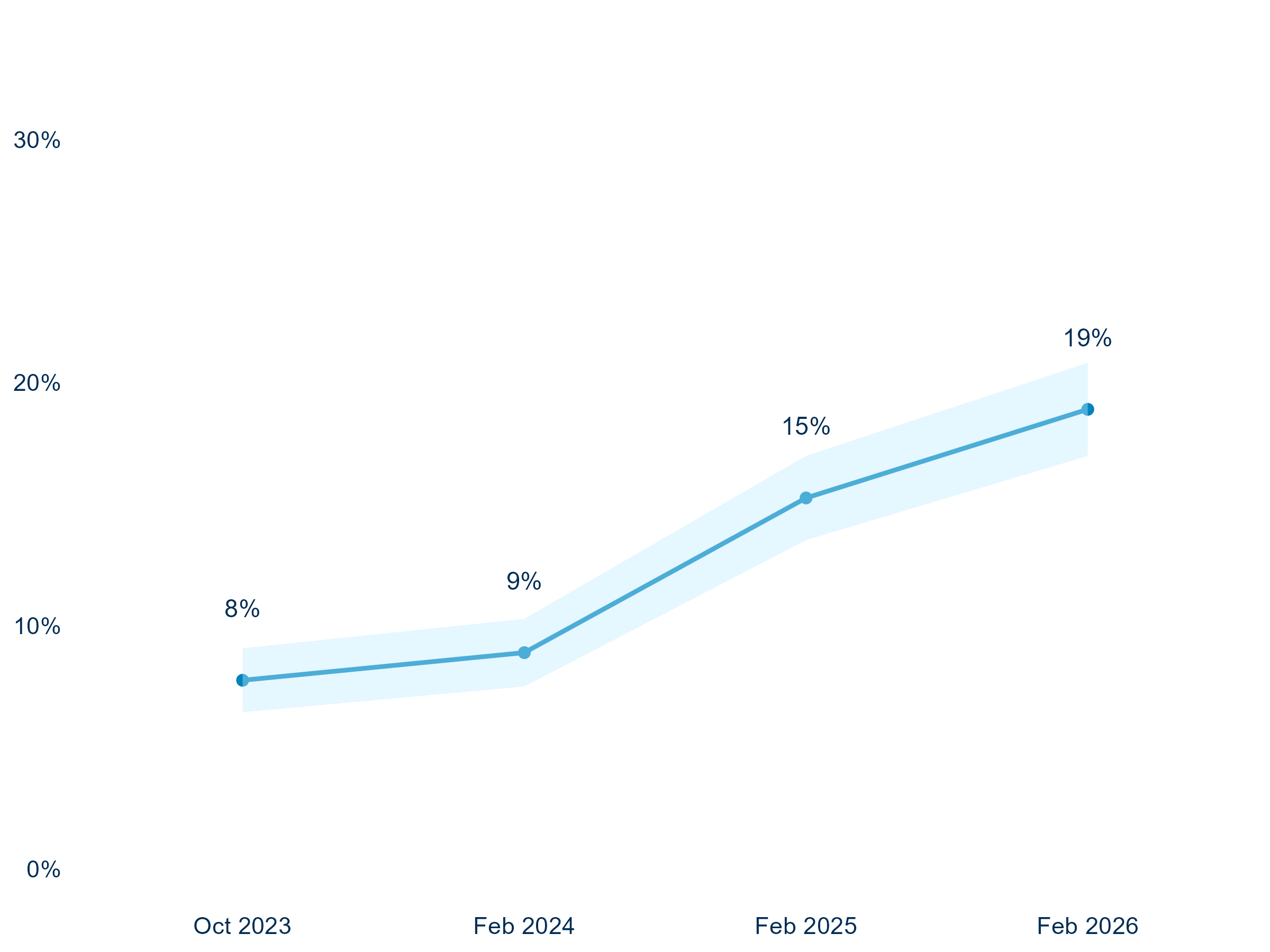
Source: Consumer Scotland Energy Tracker (2026)
Notes: Results are weighted to be representative of the adult population of Scotland. The shaded area represents the 95% confidence interval around each estimate.
Weighted bases: Oct 2023, n = 1589; Feb 2024, n = 1609; Feb 2025, n = 1656; Feb 2026, n= 1608
How can policy respond to cost of living challenges?
Affordability issues are as much about incomes and the distribution of those incomes as they are about the costs of particular goods and services. For a consumer advocacy body like Consumer Scotland, the focus is on identifying opportunities to reduce the costs of particular goods and services, or the way in which those costs affect particular groups of consumer.
Many of these opportunities – indeed most of them – do not apply specifically during ‘crisis’ periods. Making sure that markets operate to deliver fair and affordable prices in ‘normal’ times is a critical part of ensuring that consumers are protected from more rapid price increases observed during a cost of living crisis.
In broad terms there are a number of ways that consumer policy can seek to mitigate cost of living pressures on consumers generally or on particular groups of consumers specifically:
- Ensuring that overall costs are efficient, fair and competitive. Consumers are well served when the prices they pay are a fair reflection of the costs of providing that service, and investing to maintain the provision of that service in future. This is partly about ensuring that markets, nationally and locally, operate competitively. But it’s also about ensuring that market structures and the way different costs are allocated is fair.
- Ensuring that costs are allocated fairly across different groups of consumers. In several markets for essential services, including energy, water and telecoms, discounts or reductions are provided to some groups of consumers, funded through redistribution from other consumers’ bills. The level of discount provided, to whom (i.e. how it is targeted), and the implications for the consumers who cross-subsidise the discounts matters critically for fairness – and for how well consumers are served by these policies. It is also important to ensure that costs are allocated fairly over time. Infrastructure-based markets such as energy, water, and transport can involve substantial fixed costs and provide benefits over many years. Decisions around how these costs are recovered affect how they are distributed between current and future consumers.
- Supporting consumers to access the prices, tariffs or deals that best suit their particular needs. In some markets, a wide range of tariffs are available, and the difference in consumer bills can be substantial depending on whether or not they are on the tariff that best meets their needs. Availability of appropriate information, advice and support is critical to ensure consumers have the confidence and knowledge to access the products that best meet their needs and resources. The onus for this must not rest on consumers alone - suppliers should be proactively offering consumers the products that best meets the consumers, not the suppliers, needs.
- Using regulation to protect consumers from price volatility, inefficiency and the risk of excess profits. Regulation can be used to cap the rate of price increase for a given service (as per the energy price cap), or to determine the degree of transparency that consumers receive in relation to future price increases (such as regulations governing the information that consumers should receive in relation to future ‘mid-contract’ price rises on their mobile contract).
The following three Spotlights illustrate more specifically some of the priorities for policy in enhancing the affordability of essential services.
- The first (Spotlight 2.2) examines how better targeting of affordability policy in a range of markets can help ensure more effectively and efficiently reaches the consumers who most need it. This often relies on better use of data to target and automate affordability support.
- The second (Spotlight 2.3) considers a range of options for improving the affordability of household energy bills more specifically. Energy is a market where policy can have significant impact on pricing and billing, hence the grounds for focussing on it in detail.
- The third (Spotlight 2.4) considers challenges in protecting heat networks consumers from high and volatile bills. Whilst this is a much more niche issue than the issues covered by the other two spotlights, it serves to illustrate the challenges in adapting to the issues created by new or emerging technologies.
The Spotlights are not intended to be comprehensive of all markets in which affordability issues arise, or all areas in which policy can intervene. One area not explicitly covered in the Spotlights is food insecurity. Food insecurity is particularly concerning given its direct impacts on wellbeing – and with around a quarter of a million households in Scotland being unable to feed themselves adequately.[13]
Food insecurity arises in part because it is one of the categories of expenditure over which households have discretion over in the very short term – as a result it is often one of the first areas of expenditure that households cut back on when their budgets are constrained. It is for these reasons that a ‘cash first’ approach to food insecurity – as adopted by the Scottish Government since 2023 – is appropriate as it addresses the fundamental cause of food insecurity – low income.
Spotlight 2.2: Ensuring affordability support reaches the people who need it
Too many households in Scotland cannot afford essential services like water, energy and telecoms — even though affordability schemes exist. In markets for these essential products, a variety of affordability policies exist to provide bill discounts or reductions to groups of consumers who are most likely to face challenges in affording their bills for these services.
These policies are critical. Without them, low‑income households are often forced to choose between cutting back on essential services or falling into debt — with consequences for health and wellbeing. However, affordability support is not nearly as effective is it should be because it is poorly targeted and poorly automated.
- In water for example, our analysis shows that fewer than half of households in water poverty receive the Water Charges Reduction Scheme, through a combination of under-claiming and ineligibility.[14]
- In energy, fewer than half of ‘fuel poor’ households in Scotland receive the Warm Home Discount (WHD); and of those that do receive WHD, around one third are not fuel poor.[15]
- In telecoms, fewer than ten per cent of households eligible for support take it up, often reflecting low awareness of non-automated support schemes.[16]
Fixing affordability support is not primarily a question of spending more money — it is about designing existing support far more effectively.
Improving the targeting of affordability support starts by recognising the challenges that impede better targeting. One barrier is the availability and quality of data needed to identify households in genuine need. Information on income, health conditions, energy use or housing quality is often fragmented, incomplete, or held by different organisations.
But data availability is only part of the problem. A second challenge is around data sharing – in other words, getting the data from an organisation that holds it to a billing organisation.
Some good examples of data sharing do exist, often at a local level. Governments, including the Scottish Government, have a role to play in supporting and encouraging further innovation and piloting to help demonstrate what is practical and achievable. A short-term priority in Scotland should be the more consistent use of DWP data by local authorities to automatically enrol eligible households onto the Water Charges Reduction Scheme, rather than relying on claimants to make the claim themselves. And, it would be possible to automate payments to low-income heating-oil consumers, rather than requiring them to find out about, and apply proactively for, support when that is made available.
Ultimately, the inability to target – and automate – affordability support more effectively means that consumers are not well served. Some consumers experience unnecessary harm because they do not receive adequate support – such as self-rationing or problem debt - whilst others face higher overall bills because affordability support, which tends to be cross-funded across all billpayers, is provided to some who don’t need it.
Spotlight 2.3: Enhancing the affordability of energy bills
The energy market stands out as one where there is in principle scope to reduce consumer harms from high bills. Persistently high energy bills are worsening health outcomes and increasing household debt. Consumer Scotland’s latest energy affordability tracker shows that, whilst the perceived affordability of energy bills has improved considerably since 2022, over a third of households in Scotland cannot afford to heat their home to a comfortable level, and significant numbers think that their mental or physical health is negatively impacted by trying to keep up with energy bills.[17] High energy bills are also a major cause of detriment to small businesses in Scotland.[18]
UK electricity prices remain amongst the highest in comparator countries, and it is generally accepted that energy bills are unlikely to fall to their pre-2022 levels for the foreseeable future.[19] Wholesale gas prices are forecast to remain high given global macroeconomic events. And whilst more renewable electricity is coming on stream, the costs associated with transmitting this electricity across the country, and responding to its intermittency – mean that consumer bills are unlikely to fall in the short-term.[20]
In this context it is critical to take a holistic approach to protecting consumers – and vulnerable consumers in particular – from persistently high prices. Appropriate policy responses include:
- More effective targeting of energy bill support. Current energy affordability interventions – including a mix of (mainly) UK government and (partly) Scottish government policies – provide relatively shallow support that is bluntly targeted. Developing enhanced approaches that more effectively allocate affordability support – which is ultimately cross-subsidised by consumers generally – is a policy imperative.
- Enhancing consumers’ capacity to adopt low-carbon technologies and improve the energy efficiency of their homes. Enhancing energy efficiency is a key way to reduce energy bills. But consumers need greater support to navigate complex energy efficiency markets, and greater protections from substandard installation.[21]
- Helping consumers capitalise on tariff opportunities. There are growing opportunities for consumers to reduce bills by taking advantage of various Time-of-Use tariffs, which charge lower rates at off-peak times. Whether these tariffs are right for consumers will depend on their capacity to use energy off-peak, which in turn depends on consumers’ lifestyles and their appliances. Consumers need support to navigate these choices, and to be able to adopt the necessary technologies.
Spotlight 2.4: Protecting heat networks consumers from price volatility
A heat network, also known as communal or district heating, is a type of heating and hot water system that distributes heat from a central source to multiple properties. They replace the need for individual heating systems such as gas boilers and can utilise low carbon heat sources. Heat networks are natural monopolies, meaning that people who live on a heat network usually cannot switch to a different provider or heating type. Consumers therefore need strong protections to make sure that heat networks are reliable and affordable.
Heat networks currently supply heating and hot water to about 1% of Scotland’s homes (about 30,000 homes).[22] However, this is expected to grow over the next two decades. The Scottish Government identifies heat networks as a vital technology in the transition to net zero.[23]
Consumers on heat networks are not protected by a price cap like gas and electricity consumers have been since 2019. Although heat networks are expected to play an important role in the transition to net zero, most existing networks are still run on gas. One data source suggests that around 85% of heat networks notified by the end of December 2025 reported natural gas as their primary energy source, among those for which a primary energy source was recorded.[24] Where this is procured on commercial markets, gas price volatility is ultimately passed through to consumers’ bills. In addition to having to cover these costs, heat networks also need to undertake ongoing maintenance and upgrade work, comply with forthcoming technical standards, and begin the switch to low carbon fuel sources.
In January 2026, new consumer protections were introduced as part of heat network regulation. These protections include principles to promote pricing practices which are fair and not disproportionate. However, they do not prevent heat networks from passing on costs to consumers if they are properly communicated and reflective of the true cost. This means that under current regulation, consumers will not be protected from the high costs of complying with new technical standards and decarbonisation.
Consumer Scotland has recommended[25] that Scottish Government put in place equivalent support to the heat network efficiency scheme (HNES)[26] already available in England and Wales. This support will help to improve efficiency, reduce emissions, improve infrastructure challenges and support decarbonisation.
Positive consumer outcomes – both existing and in the future – are key to the sector’s success, and its ability to contribute to the decarbonisation of Scotland’s built environment.
The accessibility of goods and services
People’s access to goods and services is not only constrained by affordability. It can also be constrained by limited availability of a service; or, by people’s limited skills or capacity to engage with a product.
This section focuses largely on the specific impacts of digitalisation, and the risks this poses to digitally excluded consumers. But it is important to highlight that access can be constrained for reasons other than technological change. For example, Box 2.5 highlights how issues around women’s safety can affect how they access transport and postal services. As another example, some groups of consumers – including disabled consumers and small business consumers – are not always able to access parcel delivery services effectively. [27]
Spotlight 2.5: Women’s safety in consumer markets: a gendered perspective
Women’s experience as consumers can differ from men’s. As highlighted by UN Trade and Development (UNCTAD), these gender-based issues can include unfair marketing practices, misleading advertising, hazardous products and gender-based price differences.[28]
Personal safety concerns in particular shape women’s experience as consumers, and how they access essential services.
For example, Transport Scotland research evidenced a range of concerns which impacted women and girls’ feelings of personal safety when using public transport, including antisocial behaviour, harassment (sexual and otherwise), verbal abuse, physical assault, and being followed by strangers.[29] For some women this meant no longer using public transport and switching to private transport which both increased costs and was not necessarily safer.[30]
Fears of personal safety are not limited to public spaces. Consumer Scotland, building on work done by Citizens Advice, found that victim/survivors of domestic abuse in Scotland (81% of whom were women) were more likely to experience postal exclusion.[31] To recover post sent to their previous address, women could potentially put their safety in jeopardy to access health letters, legal summons, or benefits decisions.[32] This means women can miss these vital pieces of correspondence, leading to further detriment and harm, such as missed appointments, fines, or disruptions to social security.
Women are entitled to access consumer markets safely. A lack of a cross-market approach means that women’s safety is not treated holistically from a research or policy perspective. More needs to be done to understand how women’s personal safety impacts their access to consumer markets, and what policies can be introduced to tackle issues facing women.
How many consumers are digitally excluded?
Our lives are increasingly dependent on being able to access good quality internet services to engage with a range of products and services, including public services. People’s ability to access services on the internet depends both on the availability of decent internet services, as well as their capacity to use those services.
In Scotland, as in the rest of the UK, the pace of roll-out of fixed and mobile internet services has, by many measures, been remarkable. But telecoms coverage is geographically patchy.
In Scotland, 89% of consumers in urban areas have access to gigabit-capable broadband, but this falls to only 54% of rural consumers.[33] Superfast broadband is available to 99% of urban premises, but 88% of rural premises.
In terms of mobile coverage, Scotland has the lowest 4G geographical coverage of all four nations of the UK, with only 71% of its landmass area having coverage from all providers.[34] Scotland also suffers from the highest incidence of 4G total not-spots (landmass areas which do not receive mobile telephone coverage from any operator). Scotland’s landmass is 9% 4G not-spots, as compared with a UK average of 4%.[35] Scotland also has the lowest 5G geographic coverage range of all four UK nations.[36]
There is also an access gap, with households in the most deprived quintile of neighbourhoods 9 pp less likely to be connected than those in the least deprived quintile (Chart 2.7).
Consumer voice on internet access
“My son will be watching YouTube, if he’s watching YouTube, we can’t do anything … So, if I want to download anything it’s generally once everybody goes to sleep.” - Low-income consumer, rural area, 47[37]
Addressing these ongoing gaps in access must remain a focus of investment programmes, such as the Scottish Government’s R100. [38] The forthcoming review of the Broadband Universal Service Obligation (USO), due to commence in 2026, should also act as a catalyst to improve the connectivity of consumers across the UK; it should increase the speeds specified in the USO, and recognise the potential of new technologies to address connectivity gaps in hard-to-reach areas.
As well as the availability of internet services, people’s access to internet can also be constrained by their own skills and confidence in using it. Digital exclusion affects consumers who are unable to afford an appropriate device or internet connection, who do not have the skills and confidence to use digital technology, or who have a fear or mistrust of using online services or lack the motivation to do it.[39]
15%, or approximately 1 in 6 adults in Scotland lack the digital “foundational skills” to do things such as turn on a digital device, connect to the internet, use an internet-browser, or update a password.[40] There is a strong association between digital exclusion, poverty and people with certain protected characteristics including age.[41]
Core indicator 5: Internet access remains lower in the most deprived areas despite recent improvements
Chart 2.7: Percentage of households reporting internet access in the most deprived (SIMD quintile 1) and least deprived (SIMD quintile 5) areas of Scotland, 2018 to 2023
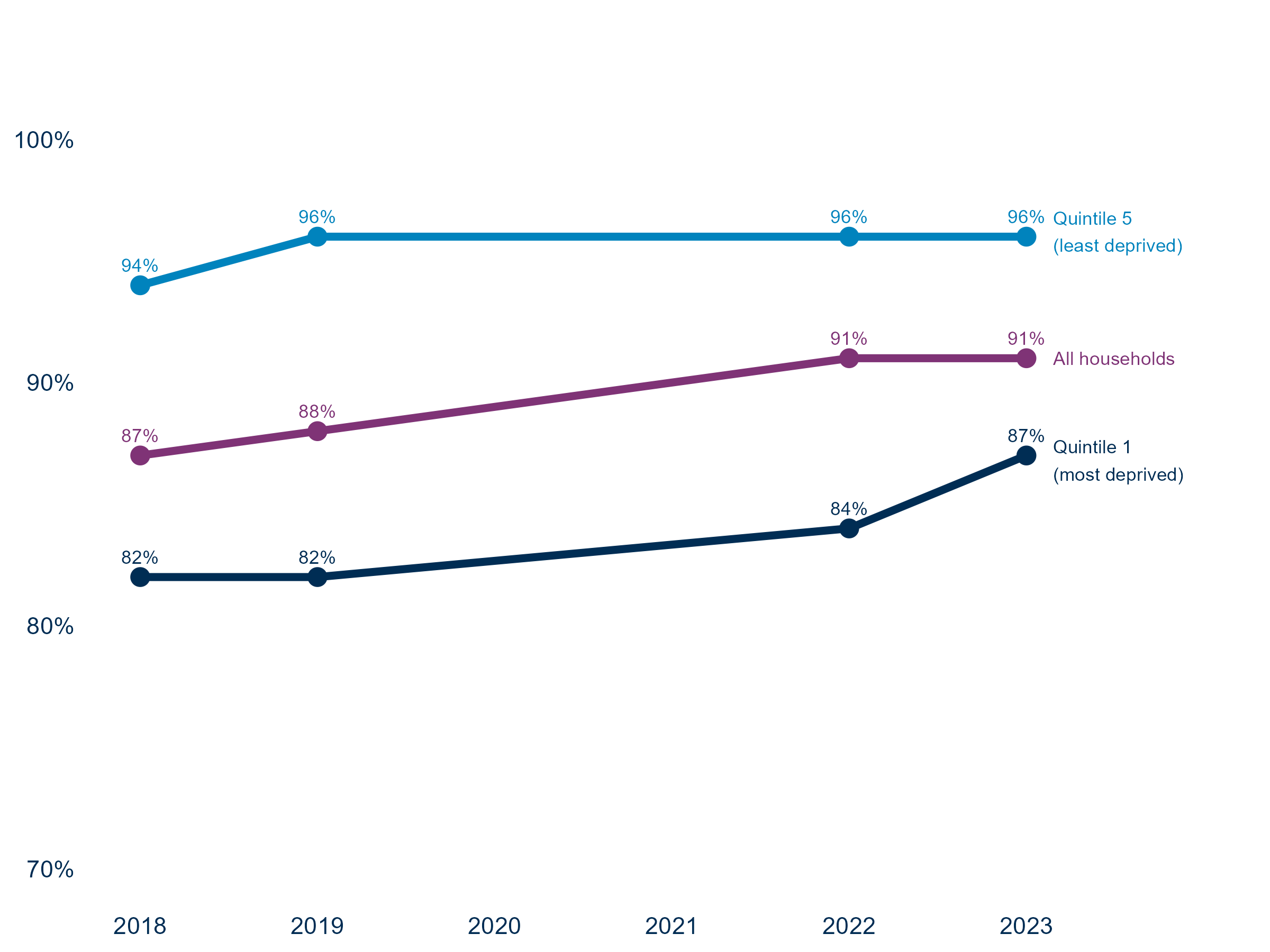
Source: Scottish Household Survey (2023)
Notes: Results are weighted to be representative of households in Scotland. Results for 2020 and 2021 are excluded due to changes in survey methodology during the COVID-19 pandemic. The Scottish Index of Multiple Deprivation (SIMD) is an area-based measure of relative deprivation, and findings are presented for households living in the most deprived quintile (Quintile 1) and least deprived quintile (Quintile 5) areas in Scotland. The y-axis has been truncated, with the scale beginning at 70%.
Financial access and exclusion
Digital access matters not just on its own right, but because digital channels have become the default means of access for many other services. Digitalisation is affecting the way consumers access goods and services in multiple markets, including public services and physical goods. Whilst providing many opportunities to consumers, digitalisation also poses some risks.
In the used-car market for example, technological change has enabled consumers to increasingly purchase at distance – potentially opening up greater choice and strengthening competition – but also increasing risks to consumers from incomplete information at the point of sale, and greater difficulties in securing redress.[42]
The following chapter examines risks associated with misleading pricing or information in a digital world. Here, we focus on the more foundational risk of exclusion as a result of digitalisation.
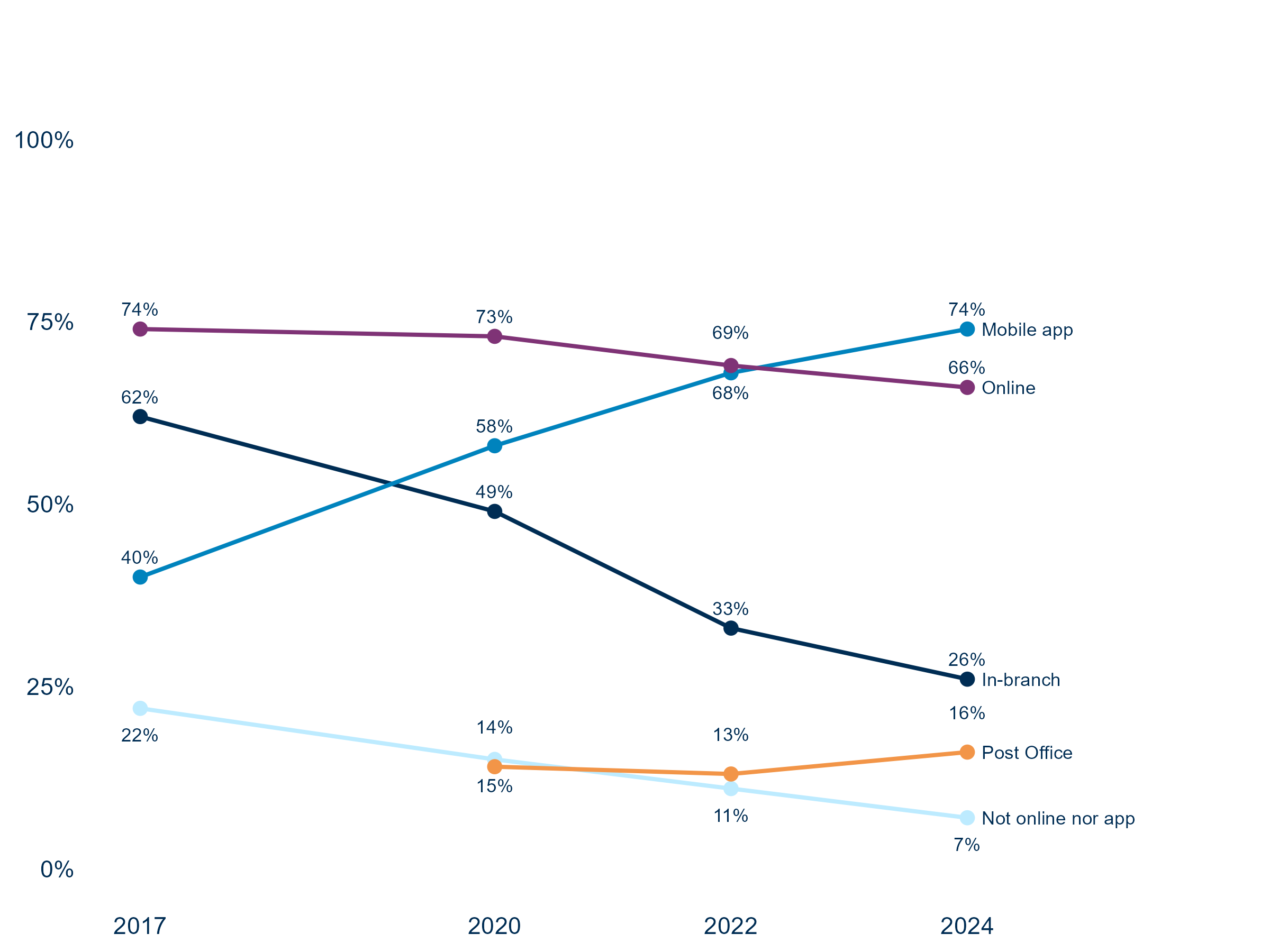
A key measure of digital exclusion from financial services is the share of adults with a current account who do not use online or mobile banking. On this measure, substantial progress has been made: the share of banked adults who are digitally excluded has fallen from 22% in 2017 to 7% in 2024 across the UK as a whole (Chart 2.8). Scotland has seen a comparable improvement over the same period, falling from 29% in 2017 to 9% in 2024, though its rate remains higher than in England at 6% and Wales at 5%.
However, the overall trend conceals important variation. Exclusion is concentrated among older adults, with 17% of those aged 75 and over remaining without access to online or mobile banking, almost double the rate for those aged 65 to 74 (9%) and between three and five times the rate for those aged 25 to 54, where exclusion is just 3% to 4%.
Those on the lowest incomes (under £15,000 per year) are excluded at a rate of 15%, against close to zero for those earning between £75,000 and £100,000.
Furthermore, as bank branches continue to close, consumers have had to find alternative ways to access banking services. In 2024 alone, 18% of banked adults across the UK and 15% in Scotland lost a branch they regularly used over the previous year. The majority of those who lost a regularly-used bank branch responded by banking more digitally (64%), 18% visited their local Post Office as a direct result, whilst 14% found no alternative at all.
Financial exclusion is also more likely to affect consumers from minority ethnic groups.[43] And, the issues of digital and financial access more generally – with their knock-on impacts for access in other markets – are particularly prevalent in rural areas of Scotland, as set-out in Spotlight 2.6.
Core indicator 6: Banking has moved online while branch use has more than halved
Chart 2.8: Proportion of UK adults with a current account who carried out at least one day-to-day banking activity in the last 12 months, by banking channel used, 2017 to 2024
Source: Financial Conduct Authority, Financial Lives Survey (2024)
Weighted bases: 2017, n = 10,676; 2020, n = 4,184; 2022, n = 6880; 2024, n = 4,732
Notes: Results are weighted to be representative of the UK adult population. The Financial Lives Survey is conducted periodically rather than annually; gaps between years do not represent missing data. Adults who do not use online banking or a mobile banking app may still access banking services through other channels, including bank branches and Post Offices.
Spotlight 2.6: Accessibility in rural areas
The distinctive nature of Scotland’s geography can accentuate access issues in rural areas, particularly those in rural and island communities.
As noted in the main body of the report, internet services are generally of lower quality in Scotland’s rural areas, with lower coverage of faster speed connections. Just over half of rural consumers have access to gigabit-capable broadband, while superfast broadband is available to 88% of rural premises compared with 99% of urban premises.
But accessibility challenges in rural areas are not limited to digital services. Postal services are a critical economic lifeline for Scotland’s rural and island communities, yet fragile delivery systems, high surcharges and inconsistent services are placing growing pressure on small businesses and local economies. Consumer Scotland research found that small business consumers in island communities reported difficulties receiving essential materials on time, reputational risks linked to slow or inconsistent deliveries and additional effort required to track or resolve missing items.[44] Transport services – particularly rural bus services – can also limit access to wider employment and leisure opportunities, particularly for disabled consumers and others with limited mobility.[45]
Scotland’s rural areas are frequently placed at a greater disadvantage when technology changes more generally, either when new technologies are rolled out, or existing technologies become obsolete. For example:
- Smart meters automatically transmit gas and electricity readings for domestic and non‑domestic consumers, reducing reliance on estimated billing and protecting consumers from back‑billing and price volatility. They support improved budgeting through real‑time usage information and enable access to flexible tariffs and emerging smart technologies. The smart meter rollout in Scotland has been slower and patchier than in other parts of GB, where the current target is to achieve an 85% smart meter penetration rate by 2030. The latest regional penetration rate figures for Scotland sit at 71%, somewhat lower than the GB average of 74%.[46] But in rural areas the penetration ranges from 66% (Dumfries and Galloway), to as low as 56% (Orkney). There have been a number of historical, technical, and structural barriers to uptake in Scotland, including limited engineering capacity and weak supplier incentives to prioritise remote and sparsely populated areas.[47]
- The planned switch-off of the Public Switched Telephone Network (PSTN) which is due to be switched off by the end of January 2027 - with consumers migrated to Voice Over Internet Protocol (VoIP) technology[48] - exposes some consumers to risk of serious harm due to their telecare devices being disconnected during the migration. Consumer Scotland analysis has found that a significant minority of consumers are potentially vulnerable as a result of the migration, with those in rural areas at a particular risk, due to the combination of more frequent and longer lasting power cuts and poorer mobile coverage and performance.[49] As VOIP services will not work without power, additional back up measures may be needed to ensure the safety of consumers in vulnerable circumstances.
- Access to cash is becoming increasingly difficult for the 6%, or 300,000, consumers in Scotland who rely on it. The distinctive nature of Scotland’s geography can mean that branch closures, and the associated reduction of access to cash and physical banking facilities, can have particular impacts on rural and island communities.
These examples are symptomatic of the more challenging issues associated with accessing essential goods and services in Scotland’s rural areas.
4. Pillar 2: Protection and redress
This chapter is in two parts. The first provides evidence on the prevalence of different consumer harms, including detriment, unsafe products, scams and misleading information. It considers how policy helps to protect consumers from harms – both in terms of regulation and enforcement – and where policy might better serve consumers’ needs. The second part examines how effectively consumers are able to secure redress when problems arise, and how effectively consumers’ interests are served by the redress landscape.
Key points
- Consumer detriment is widespread in Scotland. Around seven in ten consumers (69%) experienced at least one incidence of consumer detriment in 2023/24 according to the Consumer Detriment Study, while 60% reported experiencing a consumer problem causing stress, financial loss or inconvenience in Consumer Scotland's Consumer Welfare Survey. Around 3.5% of all consumer spending in Scotland is associated with detriment.
- Consumer harm is not experienced equally. Younger consumers and those in vulnerable circumstances are significantly more likely to experience detriment, with over three-quarters of consumers aged under 45 reporting detriment compared with around 40% of those aged over 65. Consumers facing financial difficulty are also much more likely to suffer severe detriment and report negative impacts on their finances and mental health.
- Product safety issues affect a substantial minority of consumers. One in seven consumers (14%) reported experiencing a product safety issue in the previous 12 months, while UK-wide evidence suggests 29% of adults have experienced a product safety issue at some point. Electrical appliances account for almost half (45%) of reported safety issues.
- The changing nature of markets is creating new consumer protection challenges. Global supply chains, online marketplaces and emerging technologies are making product safety more complex and increasing the need for a modern, adaptable regulatory framework that can respond to new risks.
- Most consumers are confident they can identify misleading information, but online harms remain common. Nearly three-quarters (73%) of consumers say they can recognise misleading or unclear information, yet 13% often encounter hidden fees when shopping online, 13% often struggle to cancel subscriptions and 10% frequently encounter misleading product information.
- Scams are a significant source of consumer harm, particularly for younger consumers and those in vulnerable circumstances. One in ten adults reported falling victim to a scam in the previous year. Two-thirds (65%) of scam victims lost money, rising to 75% among consumers with at least one vulnerability characteristic and 91% among those whose disability limits their activities substantially.
- Consumers generally feel well protected, despite the prevalence of harm. Over three-quarters of consumers (76%) say they feel fairly or very well protected when buying goods and services in the UK, although younger consumers and some vulnerable groups are less likely to feel protected.
- Many consumers seek redress when problems occur, but successful outcomes are far from guaranteed. Around 77% of consumers contact suppliers after experiencing a consumer problem, yet only half (50%) of those who do so report being satisfied with the outcome. Consumers in vulnerable circumstances are significantly less likely to secure a satisfactory resolution.
- Alternative Dispute Resolution (ADR) plays a vital role in consumer redress but remains fragmented and difficult to navigate. ADR schemes can provide an accessible alternative to courts and often uphold a substantial proportion of complaints, but coverage is inconsistent across sectors, consumer awareness is low, and important gaps remain in markets with high levels of detriment.
- The effectiveness of consumer protection ultimately depends on enforcement and access to justice. Recent reforms have strengthened some enforcement powers, but years of declining investment have left trading standards services under significant pressure, while barriers to accessing ADR, legal advice and civil justice continue to limit many consumers' ability to secure redress when things go wrong.
Takeaway
Consumers in Scotland generally enjoy a reasonable degree of protection, but too many continue to experience avoidable harm and face barriers to securing effective redress. The challenge for policy is to ensure that consumer protection, enforcement and redress arrangements evolve at least as quickly as the markets they are designed to regulate.
Protecting consumers from harm
How many consumers experience detriment?
Consumers can experience a wide range of detriment or harms. These can include physical harms from unsafe products, financial or personal losses from scams, and detriment from having been misled on pricing or other material information.
At the broadest level, consumer detriment arises whenever a consumer experiences problems with an item or service that causes them stress, costs them money, or takes up time to resolve.
Consumer detriment is a subjective measure, reflective of consumers’ perceptions of harms. It encompasses detriment that consumers are aware of, but by definition it excludes detriment that consumers may be unaware of. On the other hand, what consumers perceive as detriment may sometimes not reflect true detriment – the fault of providers or sellers – but reflect unreasonable expectation or user error.
The flagship measure of consumer detriment in the UK is the Consumer Detriment Study (CDS),most recently administered by the CMA.[50] The CDS shows that consumer detriment is widespread. 69% of people in Scotland had experienced at least one incidence of consumer detriment in 2023/24, in-line with the 72% detriment for the UK as a whole.
According to the CMA’s Consumer Detriment Study, the value of this detriment to consumers in Scotland, in 2024, was £4.6 billion. In the context of household consumption spending that year of £129 billion, this is a substantial figure – implying that 3.5% of all consumer spending is associated with detriment.[51]
Detriment varies substantially across sectors. Across the population as a whole, detriment is highest in sectors that consumers purchase from regularly and frequently – with over 15% of the population experiencing detriment in clothing, internet services, or energy. [52]
Which consumers are most likely to experience detriment?
Detriment is not experienced equally by different groups of consumers. Consumers in vulnerable circumstances – including those with a lasting health condition/or disability, and those in financial difficulties – are more likely to experience detriment, according to the CDS. This may reflect that consumers in vulnerable circumstances have:
- more constrained choices over the suppliers or traders to engage with;
- greater challenges in communicating or interacting with sellers to understand choices and their implications;
- less awareness or confidence of consumer rights and redress actions that are available; and
- greater emotional significance attached to any given purchase given relatively more constrained financial resources or less mental health resilience.
The CDS also finds that younger consumers are more likely than older consumers to experience detriment, and to suffer net monetarised detriment of more than £1,500. Those aged 18 – 29 were more than twice as likely than those aged 70+ to experience detriment.
Strikingly, the CDS also found that households which were ‘finding it quite difficult’ financially were significantly more likely to suffer net monetised detriment of more than £1,500 (27%) compared to households who were financially managing comfortably (11%). Households which said they were struggling financially were also much more likely to say that consumer detriment had had a very negative impact on their mental health, and a very negative impact on their finances.
In Consumer Scotland’s Consumer Welfare Survey, the overall detriment incidence was slightly lower than identified in the CDS, with a 60% incidence rate, rather than a 69% incidence in the CDS. This reflects slightly different methodologies - by focussing solely on detriment, the CDS is able to ask about detriment in a more detailed, sector-by-sector way that may act better to jog respondents’ memories; the Consumer Scotland survey covers a broader range of consumer issues, and therefore asks about detriment in a general way which may result in consumers only recalling more impactful detriment experiences.
A common theme between the Consumer Scotland assessment of detriment and the CDS’ assessment is the striking graduation by age (Chart 3.1). There is also evidence that consumers with an ethnic minority background are more likely to experience harm (Spotlight 3.1).
Core indicator 7: The majority of consumers experience detriment
Chart 3.1: Percentage of consumers who have experienced at least one detriment incident in the preceding 12 months
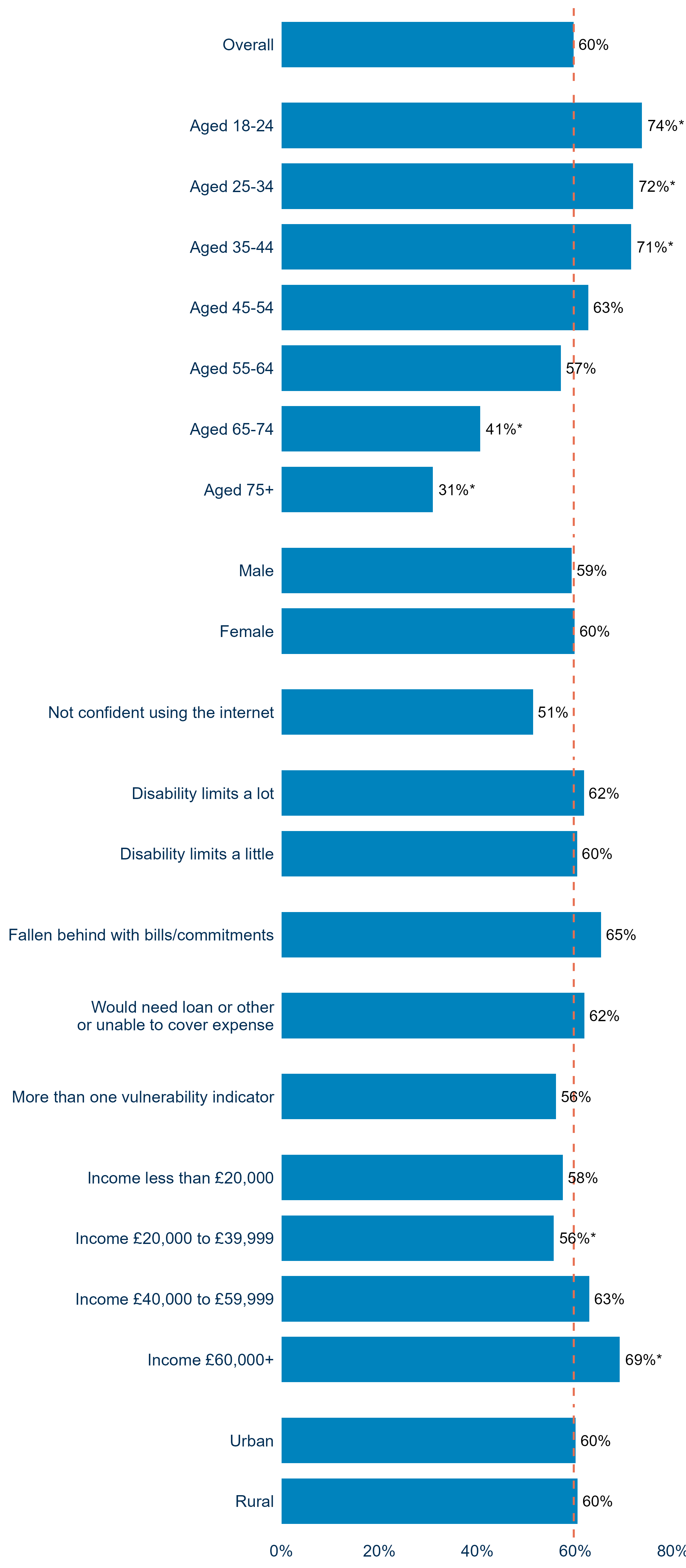
Source: Consumer Scotland (2026) Consumer Welfare Survey
Question: Thinking about the items and services that you have purchased or used in the past 12 months, how many of the purchases have caused problems that caused you stress, cost you money, or took up time or effort to try to resolve?
Weighted bases: overall, n = 2,034; aged 18-24, n = 238; aged 25-34, n = 331; aged 35-44, n = 320; aged 45-54, n = 307; aged 55-64, n = 337; aged 65-74, n = 334; aged 75+, n = 164; male, n = 942; female, n = 1088; not confident using internet, n = 71; disability limits a lot, n = 166; disability limits a little, n = 359; fallen behind with at least some bills/commitments, n = 170; would need loan or other or unable to cover expense, n = 430; more than one vulnerability indicator met, n = 226; household income less than £20,000, n = 347; household income £20,000 - £39,999, n = 602; household income £40,000 - £59,999, n = 364; household income £60,000 or more, n = 574; urban, n = 1604; rural, n = 401. *Symbol indicates a statistically significant difference between this group and the overall average.
Spotlight 3.1: Ethnic minorities and consumer harm
Race and ethnicity are frequently associated with different consumer outcomes, with some ethnic groups consistently experiencing greater harms.
For example, the CMA’s Consumer Detriment Study shows that consumers with a Black (84%) or mixed (86%) background were significantly more likely to experience detriment than those with a white British (71%) or Asian (70%) background.
Moreover, consumers with an ethnic minority background were substantially more likely to experience detriment with ‘very negative’ mental health consequences compared to those with a white background (17% and 11% respectively). Consumers from Black, Asian, Mixed or other minority ethnic backgrounds were also more likely to have stated the complaint process was not clear (16% compared with 7% of consumers from any White background). [53]
Consumers with an ethnic minority background are also more likely to report having ever experienced a product safety issue (40%, compared with 27% for White adults).[54] And research in England shows that ethnic minority tenants are more likely than White British tenants to face eviction or court orders.[55]
In this report, we look at consumer harm through framework of vulnerability. This approach argues that characteristics like low financial resilience, poor health, and low capability are indicators of vulnerability.
Part of the reason why ethnic minorities are at greater risk of experiencing harm is that they are more likely to be in vulnerable circumstances – more likely to have low financial resilience, poor health, etc.
But this is not the only reason. There is some evidence that ethnic minority groups experience greater harm than would be predicted by their vulnerability characteristics alone. This additional risk of harm reflects the effect of discrimination (notwithstanding the fact that ethnic groups’ lower income and poorer health might itself be in part the result of discrimination).
The extent to which the poorer outcomes experienced by ethnic minorities on average reflect discrimination rather than other underlying characteristics is difficult to assess. Regardless of the reasons, the fact that ethnic minorities consistently experience greater harm and poorer experiences is a significant concern. It reflects deep-rooted bias, and indicates that ethnic minority consumers are less well served on average than White British consumers.
Which consumers are most likely to experience unsafe products?
Harm from unsafe products is a more specific, but particularly significant, source of consumer detriment. Unsafe products can in the most severe cases lead to serious injury, fires and deaths, but can also cause more minor injuries and undermine consumers’ confidence to engage in markets.
Recent cases illustrate the potential severity of harm when unsafe products do enter the market. Defective white goods and electrical chargers have been linked to domestic fires; unsafe toys and childcare products have caused choking and injury; and poorly designed lithium‑ion batteries have been associated with serious burns and explosions.[56]
Fortunately, the most severe harms occur infrequently. However, product safety issues are far from rare. According to the Office for Product Safety and Standards (OPSS), 29% of adults across the UK have experienced a product safety issue.[57] When people experience product safety issues, the impacts are often significant. A quarter report physical harm, while around 30% report distress.
Consumer Scotland’s Consumer Welfare Survey asked respondents whether they had experienced a consumer safety issue during the past 12 months (unlike the OPSS survey which does not specify a time-frame). On this narrower basis, one in seven respondents (14%) to our survey said they had experienced a product safety issue in the last year.
Consistent with OPSS findings, the Consumer Welfare Survey also revealed a strong age-gradient, with younger consumers substantially more likely to report having experienced a product safety issue compared to older consumers (Chart 3.2). There might be a compositional explanation for this – e.g. that younger consumers are more likely to buy products in sectors that are most associated with safety issues, notably electrical products, household appliances, and toys. However, sample size limits the ability to test this hypothesis conclusively.
Core indicator 8: One in seven consumers have experienced a product safety issue in the last year
Chart 3.2: Percentage of respondents who had experienced a safety issue with a product they had purchased in the past 12 months
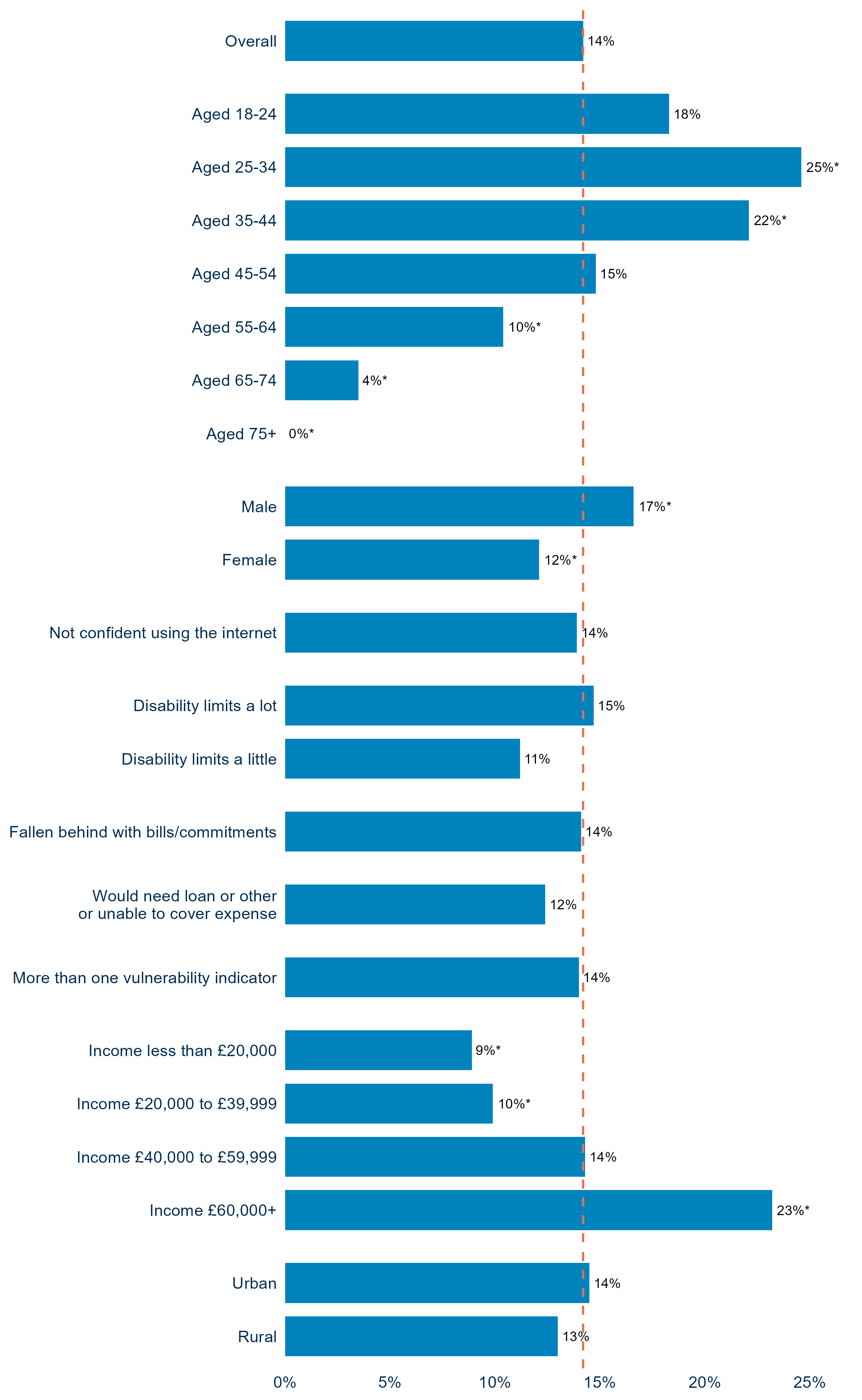
Source: Consumer Scotland (2026) Consumer Welfare Survey
Question: In the past 12 months, have you purchased any product where you or anyone in your household has experienced a safety issue?
Weighted bases: overall, n = 2,034; aged 18-24, n = 238; aged 25-34, n = 331; aged 35-44, n = 320; aged 45-54, n = 307; aged 55-64, n = 337; aged 65-74, n = 334; aged 75+, n = 164; male, n = 942; female, n = 1088; not confident using internet, n = 71; disability limits a lot, n = 166; disability limits a little, n = 359; fallen behind with at least some bills/commitments, n = 170; would need loan or other or unable to cover expense, n = 430; more than one vulnerability indicator met, n = 226; household income less than £20,000, n = 347; household income £20,000 - £39,999, n = 602; household income £40,000 - £59,999, n = 364; household income £60,000 or more, n = 574; urban, n = 1604; rural, n = 401. *Symbol indicates a statistically significant difference between this group and the overall average.
The Consumer Welfare Survey also revealed that those with higher incomes were more likely to have experienced a product safety issue than those with lower incomes. This may reflect that higher income households are more likely to make purchases in sectors that are associated with the highest prevalence of safety issues – notably household appliances and electrical goods. There was no statistically significant relationship between vulnerability characteristics and experience of product safety issues.
The product category people are most likely to experience safety issues in – in both our Consumer Welfare Survey and OPSS research - is electrical appliances. Consumer Scotland’s Consumer Welfare Survey found that among those who had purchased a product posing a safety risk in the past 12 months, 45% related to an electrical safety risk. Research suggests that the average consumer harm associated with an unsafe electrical product is £145.[58] This does not include mental health issues and excludes the most severe harms.
An important development in recent years has been the establishment of a UK wide public database of recalled goods. The Consumer Scotland Act 2020 placed Consumer Scotland under a duty to establish, or secure the establishment, of a publicly available database of recall of goods in Scotland. Since that date OPSS introduced in 2022 an UK-wide public database of recalled goods. Consumer Scotland now works in partnership with OPSS to ensure consumers in Scotland can access the database, share safety alerts and raise awareness of safety issues.
However, protecting consumers from unsafe products is becoming more complex due to rapid technological change and increasingly globalised supply chains.[59] This is a critical time to update the UK’s Product Safety Framework for the modern age, ensure it is fit for the future, and better meets the needs of consumers in Scotland and across the UK.
Spotlight 3.2 sets out how the UK is attempting to respond to these challenges through recently passed enabling legislation.
Spotlight 3.2: Protecting consumers from unsafe products
‘The existing product safety framework has been stretched to its limit by increasingly globalised supply chains and the ever-changing way in which consumers buy products.’ Kate Dearden, Minister for Employment Rights and Consumer Protection, April 2026[60]
Reasons why technological change and increasingly globalised supply chains can pose challenges for consumer protection include[61]:
- Globalised supply-chains can be challenging to monitor and enforce. The growth of online marketplaces has fundamentally changed how consumers buy products, often blurring responsibility for safety. Online platforms – such as Amazon Marketplace, Temu, Shein and others – can supply goods directly to UK consumers from third party sellers, making it difficult to identify who is responsible for ensuring a product is safe, or who should act when something goes wrong.
- Smart devices and connected products are complex, are evolving rapidly, and can receive software updates which materially change product risk after sale.
The heightened risks associated with buying online are reflected in consumer attitudes. Most consumers (71%) agree that products sold in the UK are generally safe given the regulatory framework in place.[62] But only 37% of consumers agree that products sold online are generally safe as a result of the regulatory framework.
The UK has taken an important step towards updating its product safety framework by modernising its legislative framework. The Product Regulation and Metrology Act 2025 provides enabling powers designed to update product safety rules, align them with new technologies, and clarify responsibilities across supply chains.
The Act in principle provides government greater flexibility to respond to emerging product safety risks through a broad, risk-based definition of product safety. It brings online platforms within the product safety regime, giving the government powers to impose legal obligations on the operators of online marketplaces, importers and distributors.
In itself however, the Act does not guarantee safer products, nor provide any immediate protections for consumers. Its effectiveness will depend on how it is implemented through secondary legislation, and how well the regime is enforced in practice. The UK government consulted on a new product safety framework in 2026.[63]
Can consumers recognise unclear or misleading information?
Consumers can be exposed to misleading information across many areas, such as misleading prices, misleading product information or misleading claims.
Asked whether or not they agreed with the statement ‘I feel confident I can recognise misleading or unclear information about items or services’, 73% of respondents either agreed or agreed strongly. Only 5% disagreed.
There was a less obvious age gradient in the responses to this question (Chart 3.3). However, what is striking is how much less likely respondents were to agree if they are not confident in using the internet. Only 40% of respondents who are not confident in using the internet felt that they could recognise misleading information. This is another illustration of the foundational importance of digital services in enabling access to other markets.
Core indicator 9: Low confidence in using the internet is associated with much lower confidence in being able to recognise misleading prices
Chart 3.3: Percentage of respondents who agreed or strongly agreed with the statement “I feel confident I can recognise misleading or unclear information about items or services”
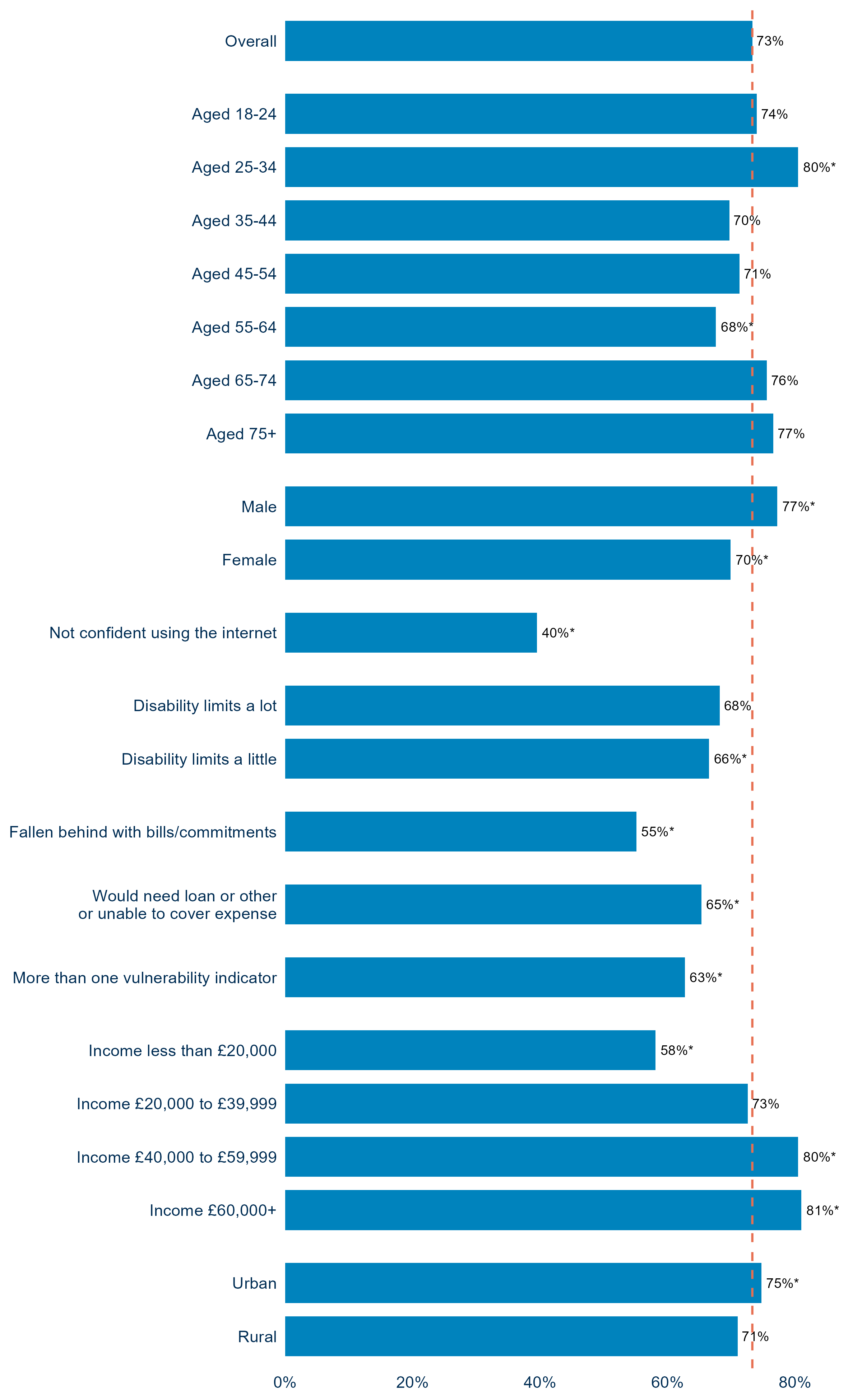
Source: Consumer Scotland (2026) Consumer Welfare Survey
Question: Thinking about your general experiences as a consumer, to what extent do you agree or disagree with the following statement? I feel confident I can recognise misleading or unclear information about items or services.
Weighted bases: overall, n = 2,034; aged 18-24, n = 238; aged 25-34, n = 331; aged 35-44, n = 320; aged 45-54, n = 307; aged 55-64, n = 337; aged 65-74, n = 334; aged 75+, n = 164; male, n = 942; female, n = 1088; not confident using internet, n = 71; disability limits a lot, n = 166; disability limits a little, n = 359; fallen behind with at least some bills/commitments, n = 170; would need loan or other or unable to cover expense, n = 430; more than one vulnerability indicator met, n = 226; household income less than £20,000, n = 347; household income £20,000 - £39,999, n = 602; household income £40,000 - £59,999, n = 364; household income £60,000 or more, n = 574; urban, n = 1604; rural, n = 401. *Symbol indicates a statistically significant difference between this group and the overall average.
Asked about their experiences of shopping online, a majority of consumers who had shopped online had experienced various harmful practices in the past 12 months (Chart 3.4). Over two-thirds had experienced forms of drip-pricing or misleading product information. Difficulties unsubscribing from services and contacting traders about issues were also common. There was a strong age gradient for all these responses, with younger consumers more likely to experience the detriment often or more frequently, compared to older age groups.
Misleading pricing is a particularly pervasive form of misleading information. Consumers need to know the price they are paying for a product – and how that compares to the price of similar products. Misleading pricing disadvantages consumers by resulting in them spending more. It can also undermine consumers’ confidence and trust in markets, and impede competition –negatively impacting economic competitiveness.
Spotlight 3.3 describes some of the circumstances under which misleading pricing can arise, from misleading pricing in physical shops to practices that have been enabled through online platforms.
The majority of consumers who shop online have experienced harmful practices
Chart 3.4: Percentage of respondents who have experienced various practices when shopping online at least once during the past 12 months
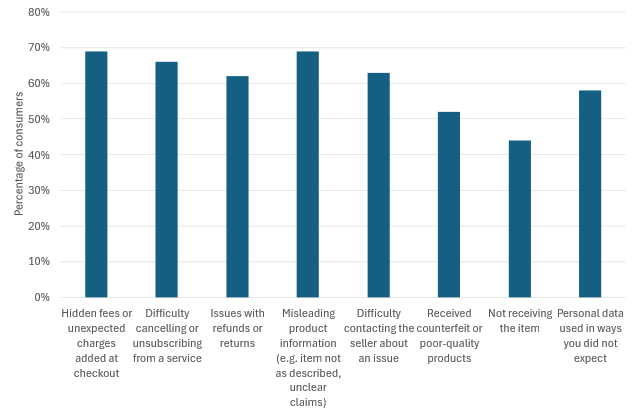
Source: Consumer Scotland (2026) Consumer Welfare Survey
Weighted bases: overall, n = 2,034; aged 18-24, n = 238; aged 25-34, n = 331; aged 35-44, n = 320; aged 45-54, n = 307; aged 55-64, n = 337; aged 65-74, n = 334; aged 75+, n = 164; male, n = 942; female, n = 1088; not confident using internet, n = 71; disability limits a lot, n = 166; disability limits a little, n = 359; fallen behind with at least some bills/commitments, n = 170; would need loan or other or unable to cover expense, n = 430; more than one vulnerability indicator met, n = 226; household income less than £20,000, n = 347; household income £20,000 - £39,999, n = 602; household income £40,000 - £59,999, n = 364; household income £60,000 or more, n = 574; urban, n = 401; rural, n = 401.
Spotlight 3.3: Protecting consumers from misleading pricing practices
Clear and transparent pricing is a fundamental component of a well-functioning consumer market that serves consumers’ needs.
Most bricks and mortar retailers in Scotland understand pricing law and provide pricing transparency most of the time. But examples of wrongly or misleadingly priced products are not difficult to find. In 2023, over 4% of goods were not priced at all in national chains and 6.5% of products had incorrect unit pricing.[64] In addition, 3.7% of products were wrongly charged at the checkout, mostly to the detriment to the customer. Instances of incorrect prices in small and medium retailers were substantially higher. Misleading ‘reference pricing’ – regarding recommended retail prices (RRPs), or claimed savings against a previous or competitors price – is not uncommon.[65]
When it comes to buying goods and services online, the challenges for consumers in ascertaining the price they are paying and how fair that price is are being accentuated by practices such as ‘drip pricing’ ,‘dynamic pricing’ and ‘personalised pricing’.
Drip pricing occurs when consumers are shown an initial price for a good/service while additional fees are revealed (or “dripped”) later in the checkout process. It has been a prevalent practice,[66] but following the DMCCA 2024 is now a banned practice in some circumstances.
Dynamic pricing involves frequent adjustments to price in response to changes in demand and supply.[67] It has become an increasingly prevalent practice in some markets, notably events and travel, enabled in part through technologies which enable prices to vary in almost real time in response to demand and supply fluctuations.[68]
Whilst dynamic pricing enables prices to move frequently in time, personalised pricing – sometimes also referred to as surveillance or algorithmic pricing – occurs when businesses offer the same product at different prices to different consumers or groups of consumers.
Technological advancements in data collection, storage and processing is now enabling a growing number of businesses to introduce forms of ‘personalised’ pricing.[69] In some sectors, use of personalised pricing is widespread – over 50% of businesses in retail and accommodation services reported using some form of personalised pricing.[70] As a result, consumers now sometimes see prices, or price promotions, that are specific or tailored to them in some way.
Neither dynamic nor personalised pricing are unlawful (as long as the final price – or potential final price – is communicated in a transparent and timely manner) but the practices can undermine transparency, and trust, making it much more difficult for consumers to understand whether or not the price they are quoted is ‘fair’, as there is no reference on which they can judge that.
Protecting consumers from the harms of misleading pricing is likely to require action on multiple fronts, recognising the many channels through which consumers buy goods, and the range of pricing practices used by traders. These actions might include:
- Strengthen enforcement capacity. Clamping down on misleading pricing – missing or incorrect prices – in physical retailers has been hampered by a lack of surveillance capacity and constrained enforcement resources within local trading standards services (discussed further below).
- Use new DMCCA powers robustly. Following the Digital Markets, Competition and Consumers Act 2025, drip pricing is now a banned practice where it involves mandatory charges that are not included in the upfront total price. But it is still happening. The CMA has been investigating a number of businesses for undertaking banned drip pricing, and took its first enforcement action against banned practices in April 2026.[71] This action is welcome, but the CMA and other consumer bodies will need to remain vigilant to further cases, and be prepared to take swift enforcement action.
- Proactively investigate personalised pricing. The CMA and other regulators should monitor closely the evolving use of personalised pricing, and its impacts on consumers. This may require the CMA to use its legislative powers to develop a robust picture of the prevalence of the practice, similar to the work of the Federal Trade Commission in the US.[72]
How confident are consumers at recognising scams?
Alongside recognising misleading or unclear information, consumers’ confidence in recognising scams is important to ensuring that they can navigate markets safely and avoid harm.
Scams are many and varied. They frequently prey on consumers by masquerading as a service provider or supplier and asking consumers to make payments or provide personal information in that context.
In our Consumer Welfare Survey, around three-quarters (73%) of respondents agreed with the statement “I am confident that I can recognise scams”. Confidence was lower among older consumers, women, those on lower incomes, and those living in rural areas. The strongest differences, however, were observed among consumers with low digital confidence and those whose disability limited their day-to-day activities a lot. Less than half (46%) of those not confident using the internet agreed that they could recognise scams, while only 62% of those whose disability limited them a lot agreed.
The profile of consumers who lacked confidence in recognising scams closely resembled that observed for recognising misleading or unclear information, underscoring in particular the important role that digital confidence plays in identifying and responding to potential risks when engaging with markets.
How frequently do consumers fall victim to scams?
One in ten adults in Scotland have fallen victim to a scam during the past 12 months, according to Consumer Scotland’s Consumer Welfare Survey. Having a low income, having a disability which limits activity a lot, and having relatively lower financial resilience are all associated with a higher likelihood of having fallen victim to a scam (Chart 3.5).
Of those who had fallen victim to a scam, two-thirds (65%) lost money as a result. Those with at least one vulnerability characteristic were more likely (75%) than those without any vulnerability characteristic (55%) to lose money as a result of the scam. 91% of those with a disability that limits them a lot lost money as a result. In other words, consumers in vulnerable circumstances were both more likely to fall victim to a scam, and more likely to lose money as a result of the scam.
Of those who lost money as a result of the scam, approximately one third lost less than £100, one third lost between £100 and £500, and one third lost more than £500. The findings imply that 6% of Scottish adults lost money as a result of falling victim to a scam, and 2% of adults in Scotland lost more than £500 as a result of a scam. This is a significant amount of harm.
Previous work has indicated that scams activity is increasing, often enabled by growing use of online platforms for communication.[73] This means that scams can often work across borders, representing a low-cost and low-risk activity for scammers, with the potential of substantial returns.
While online platforms are often an enabler of scams, they are also increasingly an important source of information about scams for the general public. The Truth about Youth Survey is targeted at young Scots aged between 11 and 25. It shows that the youngest people in Scotland get information about scams from online channels more than from any other source. Of the top five channels where young people obtained information about scams, three were online – AI Tools (51% and the number one channel), TikTok (39%) and Other Social Media (32%). This shows the importance of using the same channels to inform consumers about scams as are used by scammers to target them.
Tackling scams must inevitably rely significantly on raising awareness amongst consumers of how to protect themselves against scams, given the challenges of disrupting scams behaviour. It may be effective to make use of the same channels from which scams are perpetrated for awareness raising. But it is also critical to make it easy for consumers to report scams, and to enhance the way that intelligence about scams is recorded and shared – to maximise awareness of emergent scams and the preventative actions that consumers can take.
Core indicator 10: One in ten consumers have fallen victim to a scam in the last year
Chart 3.5: Percentage of consumers who have fallen victim to a scam in the preceding 12 months
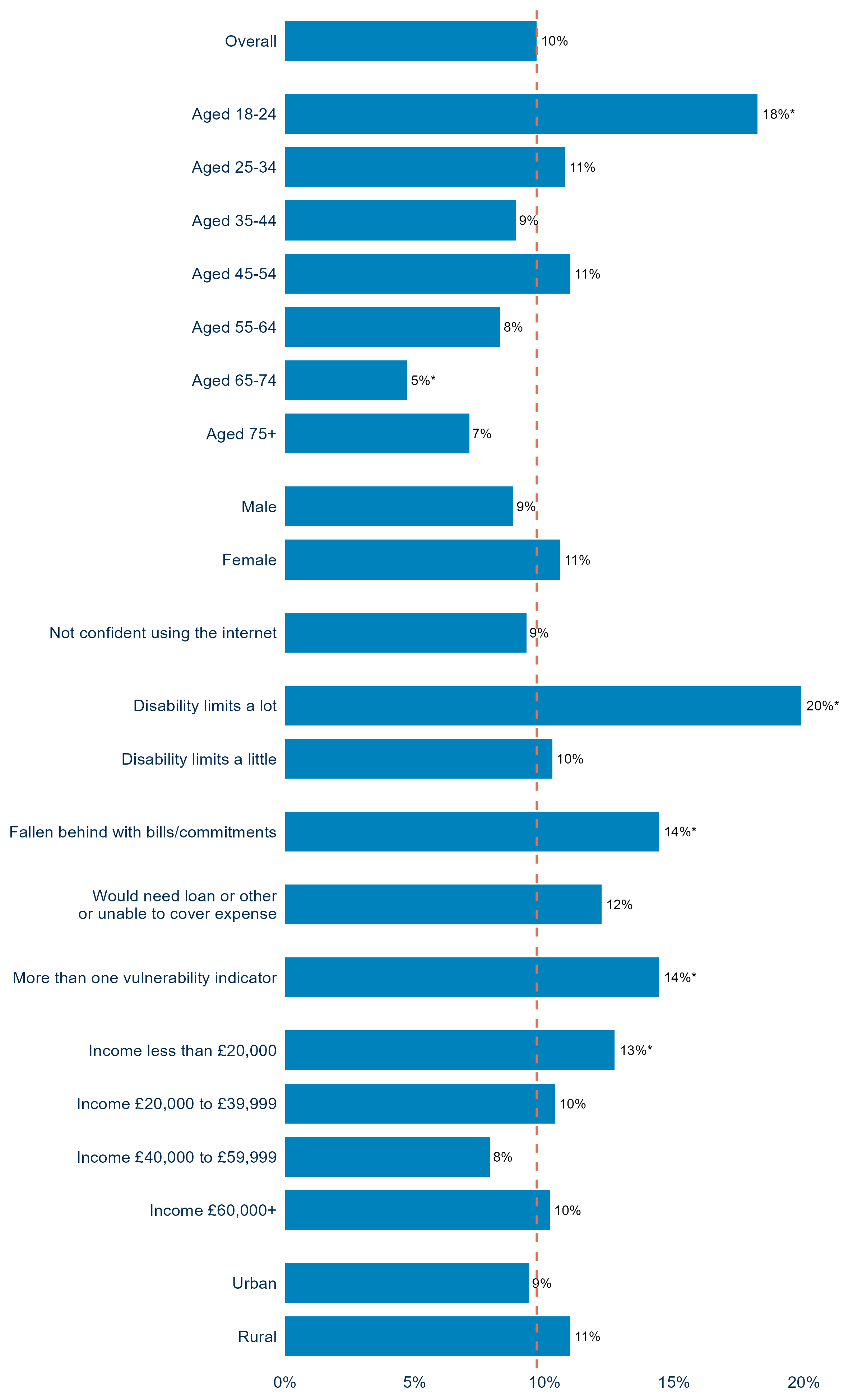
Source: Consumer Scotland (2026) Consumer Welfare Survey
Question: In the past 12 months, have you been targeted by or fallen victim to at least one scam? The chart shows those reporting having “fallen victim to a scam”.
Weighted bases: overall, n = 2,034; aged 18-24, n = 238; aged 25-34, n = 331; aged 35-44, n = 320; aged 45-54, n = 307; aged 55-64, n = 337; aged 65-74, n = 334; aged 75+, n = 164; male, n = 942; female, n = 1088; not confident using internet, n = 71; disability limits a lot, n = 166; disability limits a little, n = 359; fallen behind with at least some bills/commitments, n = 170; would need loan or other or unable to cover expense, n = 430; more than one vulnerability indicator met, n = 226; household income less than £20,000, n = 347; household income £20,000 - £39,999, n = 602; household income £40,000 - £59,999, n = 364; household income £60,000 or more, n = 574; urban, n = 1604; rural, n = 401. *Symbol indicates a statistically significant difference between this group and the overall average.
How can policy help to protect consumers from harm?
The preceding analysis has shown that consumer harm is experienced by a majority of consumers, with a smaller minority experiencing some form of severe harm – such as personal injury or significant financial loss. It is clear that there is scope to improve the way that consumers are served via a robust, adaptable consumer protection framework.
At its broadest, a good consumer protection framework encompasses rights that consumers understand and trust, accessible sources of reliable information and advice, an enforceable regulatory framework to protect consumers from particular practices or harms in specific markets, and accessible sources of redress for consumers to put right problems which go wrong.
The following chapter examines key issues around consumers’ knowledge of their broad consumer rights, and access to information and advice.
The regulatory toolkit available to policy-makers is diverse, ranging from statutory rules on authorisation, standards or requirements through to voluntary codes and accreditations or guidance. The regulatory toolkit, which both the UK and Scottish governments have responsibility for depending on context, can encompass regulations which, for example:
- Authorise who can operate or provide certain services in a sector. The nature of these authorisation regimes themselves varies significantly depending on market and context, ranging from specific forms of authorisation, frequent in financial services, to more general forms of authorisation. The recently passed Non-surgical Procedures and Functions of Medical Reviewers (Scotland) Act 2025 provides the government with the ability to specify where and by who certain procedures are carried out. As another example, the Scottish licencing regime regulates who can operate in the used-car sector in Scotland – and there is scope to enhance how this licensing regime serves consumers best interests.[74]
- Ban particular practices in certain contexts. The recently passed Digital Markets, Competition and Consumers Act 2024 bans practices such as fake reviews and misleading drip-pricing, and provides powers to add further practices to the banned list.
- Set rules about information or disclosures that must be provided to consumers. For example, the DMCCA 2024 clarifies the information that must be provided to consumers as part of auto-renewing subscription charges.
- Set minimum quality and safety standards for products. A key challenge here for regulation is to provide sufficient specificity to adequately protect consumers from harms, whilst also having the flexibility to address new and emergent risks. (see Spotlight 3.2 on product safety).
With all of these regulatory issues, there is generally a question for policy makers as to whether to regulate practices very specifically, or to encourage appropriate behaviours through mechanisms such as codes of practice or accreditation schemes – which themselves can be voluntary or mandatory. And it should be remembered that regulation itself is not the only possible mechanism for protecting consumers from harm – sometimes for example, ensuring the conditions for effective competition can help ensure that consumer interests are served (Spotlight 3.4).
The question of how to best regulate to protect consumers from harm is therefore very context specific, depending on the severity of consumer harm, the pace of evolution of risks, and the structure of the specific market. Regulations may also need to balance consumer protection with considerations of broader market functioning – ensuring that regulation itself does not overly inhibit consumer access or choice for example. Regulation also needs to take into account issues around the enforcement of that regulation – as we discuss later.
Spotlight 3.4: The role of competition in consumer welfare
Competitive markets are an important component of consumer welfare. As noted by the CMA: ‘The pressure of competition, and the rewards of success, drive firms to keep prices low; to improve the quality of their products and services; to innovate; and to operate more efficiently. This benefits people, who get better deals; businesses, which reap the benefits of investment and innovation; and the wider economy, through higher productivity and living standards.’[75]
Competition – and the UK Competition Framework that underpins effective competition – is therefore an important cornerstone of markets that serve consumers well.
But competitive markets in themselves are not sufficient to guarantee that consumers are well served or protected from harm. As noted by the Scottish Government, even ‘competitive markets can still produce outcomes which create significant affordability challenges for households’.[76] To this we can add that competitive markets can be the source of consumer harms – not least because consumers don’t have perfect knowledge of the goods and services available, nor their rights and how to exercise them.
The message is that even where markets operate competitively, this does not negate the need in some cases to proactively protect consumers from harm, nor to support them to be able to exercise their rights. Moreover, the absence of competition in some markets – notably public services such as water – does not in itself mean consumers are not well served; instead, it requires even more careful consideration of the framework required to ensure consumers are well served in those markets.
How well protected do consumers feel?
In this context, what are consumers’ overall perceptions about how well they are protected by the existing consumer protection framework and institutions?
Consumer Scotland’s Consumer Welfare Survey shows that over three quarters (76%) of consumers say they feel ‘very well protected’ or ‘fairly well protected’ when buying items and services in the UK (Chart 3.6).
There are some significant differences between groups. In particular, those aged 18-24 are less likely to feel either very or quite well protected (62%), whilst over 90% of those aged 75 or over feel very or quite well protected. Those on low incomes, or in vulnerable circumstances as regards disability or financial resilience, tend to have a slightly lower likelihood of feeling well protected. However, whilst the differences between groups are sometimes statistically significant, they are often not very substantially different. On the whole, between 60-80% of all groups feel quite or well protected when purchasing items or services.
It is worth noting that the groups that are least likely to have experienced detriment, unsafe products, or fallen victim to a scam, are often the groups most likely to feel well protected as consumers. This might not seem surprising; it is less clear what the direction of causality is. Do people who have experienced more harm feel less well protected as a result; or, are those who feel well protected in a better position to avoid harm?
Overall, the fact that three quarters of consumers in Scotland feel either very or quite well protected is a positive finding. Moreover, only 4% of respondents to the survey said they do not feel well protected, with 17% unsure.
This might suggest that, by and large, regulation is reasonably effective, at least in consumers’ eyes. However, there can be a distinction between having rights, and being able to exercise those rights. A robust consumer protection framework hinges critically not just on rights, but how effectively those are enforced, and how effectively consumers can secure redress when things go wrong.
Core indicator 11: Consumers in Scotland generally feel reasonably well protected
Chart 3.6: Percentage of adults who feel ‘very well protected’ or ‘fairly well protected’ when buying items and services in the UK
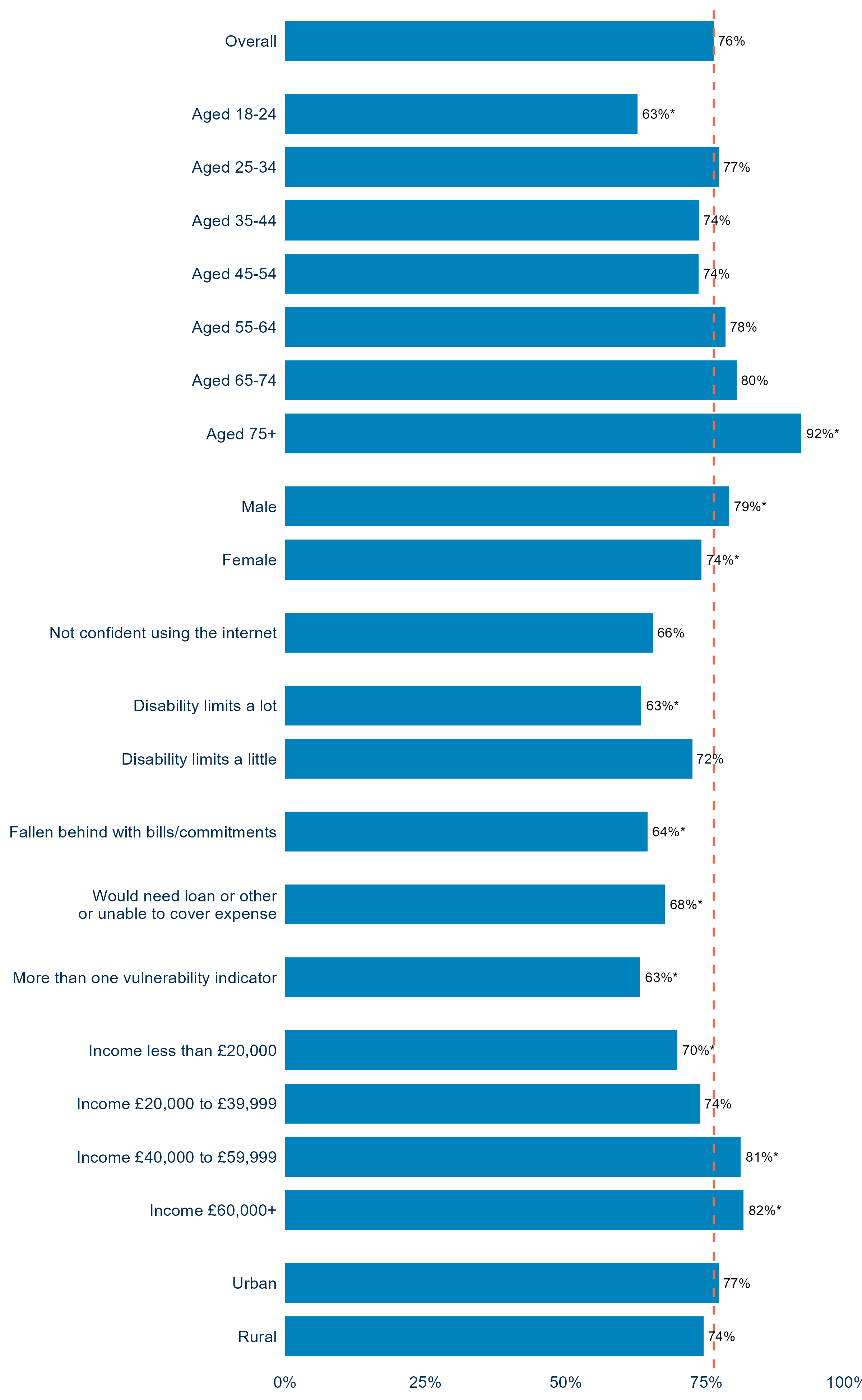
Source: Consumer Scotland (2026) Consumer Welfare Survey
Weighted bases: overall, n = 2,034; aged 18-24, n = 238; aged 25-34, n = 331; aged 35-44, n = 320; aged 45-54, n = 307; aged 55-64, n = 337; aged 65-74, n = 334; aged 75+, n = 164; male, n = 942; female, n = 1088; not confident using internet, n = 71; disability limits a lot, n = 166; disability limits a little, n = 359; fallen behind with at least some bills/commitments, n = 170; would need loan or other or unable to cover expense, n = 430; more than one vulnerability indicator met, n = 226; household income less than £20,000, n = 347; household income £20,000 - £39,999, n = 602; household income £40,000 - £59,999, n = 364; household income £60,000 or more, n = 574; urban, n = 1604; rural, n = 401. *Symbol indicates a statistically significant difference between this group and the overall average.
How effective is the enforcement landscape in protecting consumers?
Good regulation is important. But regulation has to be enforced if it is to serve consumers effectively and protect consumers from harm. In Scotland, enforcement of consumer protection is undertaken by a range of regulators, as well as by local and national trading standards services. Recent years have seen some strengthening of enforcement powers of the CMA, but against a backdrop of declining resource and capacity for local authority enforcement activity.
On the one hand, the DMCCA 2024 grants the Competition and Markets Authority powers to enforce consumer law directly, without having to take a business to court. It is too early to understand precisely how effectively these new powers are being exercised, but they should enable the regulator to take swifter action against breaches of consumer law.[77]
On the other hand, local trading standards services – delivered through 31 local authority trading standards services – have faced many years of declining investment.[78]
The work of local trading standards services is critical to protect consumers from harm and support businesses in complying with their obligations. The remit of trading standards includes a broad mix of reserved and devolved responsibilities including:
- Tackling rogue traders, consumer fraud, doorstep crime and scams;
- Protecting consumers by identifying and removing dangerous or counterfeit goods from the high street and online markets;
- Making sure consumers get what they pay for by ensuring that prices, product descriptions, and weights and measures are accurate;
- Supporting legitimate businesses by providing advice and support to help companies comply with the law;
- Protecting children and young people by tackling underage and illegal sales of tobacco or vapes.
The work of local trading standards is complemented by the work of Trading Standards Scotland, who provide national level support to local trading standard services by coordinating and enforcing cross-boundary and national casework and carrying out specialist functions of tackling illegal money lending and e-crime. TSS also delivers an intelligence gathering and analysis function.
Trading standards services are faced with a challenging picture of emerging harms alongside their more traditional activity; whilst needing to balance enforcement with preventative activity. Against a backdrop of declining resource – the local trading standards workforce has declined by 50% since 2002 – the service is extremely stretched.[79]
A report by CIPFA found that trading standards services had “experienced disproportionate cuts, with staffing levels reduced and vacancies left unfilled…trading standards teams are now at a critical point. Many are barely able, or already unable, to fulfil their statutory duties.”[80]
A UK-wide report by Which? also in 2025, argued that trading standards services are “broken,” struggling to deliver against a backdrop of declining resources and more complex issues. [81] Which? argued that “This erosion of the UK’s consumer enforcement system undermines consumer confidence, is unfair to responsible businesses and runs counter to the government’s economic growth mission.”
Addressing trading standards’ lack of capacity to address new and emerging threats to consumers – not to mention their critical work in existing markets – is an important priority for the UK and Scottish government and other stakeholders. Whilst the precise nature of any alternative models for trading standards delivery will rightly be debated, what is critical is that consumers are adequately protected from harms, and businesses are supported to take preventative action. Consumer Scotland has recently provided advice to Scottish Ministers on the future of trading standards.
Ensuring consumers can secure redress
What actions do consumers take when they experience problems?
It is one thing to have rights, but can consumers exercise those – and can they adequately seek redress when things go wrong?
Evidence from the UK-wide Consumer Detriment Study indicates that around 77% of consumers take action following a detriment experience. Coincidentally, 77% of people who reported having experienced a consumer problem in Consumer Scotland’s Consumer Welfare Survey also said they attempt to contact the supplier following a detriment incident.
Of those in the Consumer Welfare Survey who had contacted the supplier, 50% said they were satisfied with the outcome (again, this is in line with the 52% positive resolution rate in reported in the Consumer Detriment Study) – Chart 3.7. 30% were not satisfied with the outcome, whilst in 20% of cases the issue had not yet been fully resolved (in these cases, consumers were split 50:50 in terms of whether they were hopeful of a satisfactory resolution or not).
Most consumers who experience problems contact the supplier – but they are frequently not satisfied with the resolution
Chart 3.7: Satisfaction with resolution of consumer problems
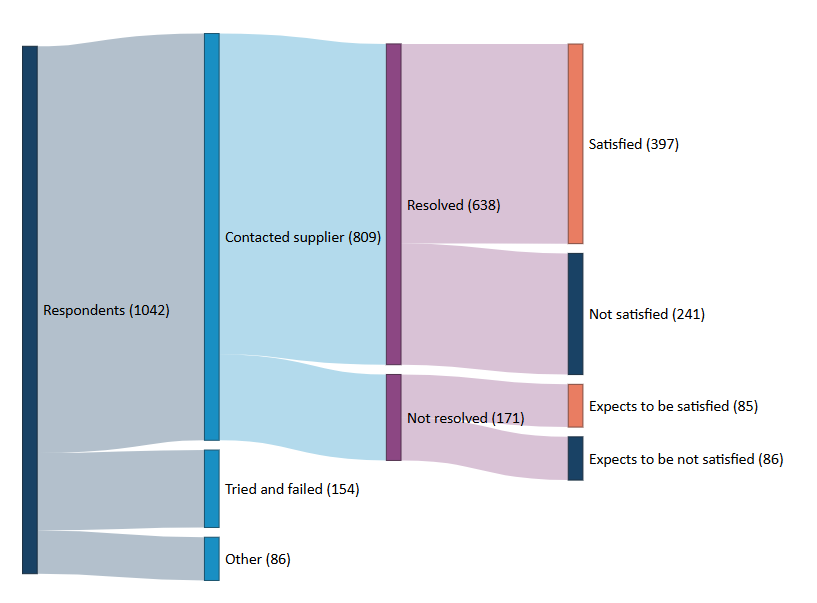
Source: Consumer Scotland (2026) Consumer Welfare Survey
Question: Thinking about the most significant problem you have experienced during the past 12 months, did you contact the supplier to try to resolve the problem?
Weighted base (all respondents who experienced an item or service that caused significant problems): n = 1042
Satisfactory resolution depends on the nature of the problem and can include, but is not limited to: a full refund or partial refund, a replacement, a fix, an apology, compensation or vouchers.
Consumers in vulnerable circumstances were significantly less likely to obtain a satisfactory resolution to their issue – 35% of households with three or more indicators of vulnerability achieved a satisfactory outcome, compared to 40% for those with one indicator of vulnerability, and 56% for those with no indicator of vulnerability.
When consumers cannot obtain a satisfactory resolution to a problem with the supplier, what subsequent options do they have?
What options do consumers have when they cannot resolve issues with a supplier?
Where a complaint is unresolved, the consumer’s only option is to take their complaint to a court, tribunal or to some form of alternative dispute resolution scheme (ADR). Courts are often seen by consumers as costly, time consuming and stressful.[82]
ADR schemes, where they exist, can include an ombudsman, or other adjudication or conciliation schemes.[83] These provide consumers and some small businesses an important alternative route to access justice.
ADR schemes are usually free to consumers, simple to use, quicker than courts and perceived as less stressful. The decision usually binds the trader but not the consumer so a dissatisfied consumer is still free to take court action if that is an option.
Ombudsman schemes in the private sector use a fair and reasonable test (or a maladministration test in the public sector) and this means they can take into account a broader range of circumstances than a court could. Some ombudsman schemes such as the Energy, Financial and the Communications Ombudsman are also available to micro and / or small businesses.
While not all consumer complaints will be justified it is notable just how many complaints are ‘upheld’ by ADR bodies. Upheld essentially means that the complaint is decided fully or partially in the complainant’s favour. It is difficult to obtain Scottish specific figures since most of the consumer ADR schemes have a UK remit.[84]
Looking at UK schemes most recently published figures the number of complaints received and the uphold rate:
- Energy Ombudsman – 93,000 accepted cases received and 70% cases upheld in 2024[85]
- Communications Ombudsman – 31,500 accepted cases and 43% upheld in 2024 [86] and
- Financial Ombudsman Service – 214,600 new complaints received and 30% of the complaints they upheld in 2025/2026[87]
Uphold rates can vary year to year for a variety of different reasons so relying on a single year figures should be treated with caution. Overall though the figures demonstrate the importance of ADR as a route to resolve a complaint.
ADR is relevant too in relation to public services. The Scottish Public Services Ombudsman received 6,588 complaints in 2025/2026. [88] Of the 163 complaints that proceeded to a full SPSO investigation they fully or partially upheld 81% of these complaints. The 6,588 complaints received in 2025/26 marked a significant 51% increase on the 4,572 received in 2024/25. It is not entirely clear what was behind this increase – with some stakeholders suggesting that AI tools are enabling consumers to make complaints more easily than previously – although it is also the case that public satisfaction with local schools, health services and transport has tended to follow a declining trajectory since 2019.[89]
Ensuring the ADR landscape serves consumers’ needs
However, whilst ADR schemes are critical to ensuring that consumers’ interests are served, the ADR landscape is fragmented and complex with some significant gaps. It seems difficult to argue that consumers are currently well-served by the system ADR, and its accessibility.
Despite its importance, ADR is either not available at all in some sectors or is voluntary.[90] Businesses that account for a large proportion of issues are frequently those who choose not to participate in ADR schemes. This is particularly true of sectors where consumer detriment is particularly high, including home improvements, used cars, furniture, clothing or park homes. Recent research from Citizens Advice (2026) highlights that consumers who used a trader who was a member of an ADR scheme were more likely to be able to resolve their complaint compared to those who used a trader who was not.[91]
In some sectors multiple schemes exist of widely varying quality, which impacts consumer confidence by creating consumer confusion.[92] Other than the Financial Ombudsman Service,[93] consumer awareness of ADR is also low particularly in those markets where ADR is voluntary and without a single ADR body.[94]
This therefore highlights important access to justice issues for consumers and includes a range of devolved and resolved issues. A number of ongoing policy developments are also likely to impact this issue which will require careful monitoring.
Enhancing ADR standards
The Digital Markets, Competition and Consumers Act 2024 introduced important changes requiring stricter accreditation standards for ADR providers and only allowing approved ADR providers to be offered to consumers. Much of the detail is found in secondary legislation that came into force in March 2026 and it includes requirements regulating fees where they are charged.
While the Act stops short of making consumer ADR compulsory it does state that the only person who can carry out ADR in relation to a consumer contract dispute is an “accredited” or an exempt ADR provider (Scottish Public Services Ombudsman and the Scottish Legal Complaints Commission are both named in the legislation as exempt providers).[95] While the intended purpose of this is to drive up standards and should mean that the poor quality schemes disappear, in the short term one unintended consequence of this could be the exit of some credible schemes who decide accreditation is not appropriate for them.
Expanding the reach of ADR schemes…or a narrowing of scope?
The Secretary of State for Business and Trade recently stated (April 2026) that the UK government is exploring the case for a single Consumer Ombudsman body in unregulated sectors.[96] While previous attempts to persuade the UK government to introduce a single consumer ADR scheme in unregulated markets failed[97] this could be an important opportunity to drive forward single schemes in markets where consumer detriment is particularly high such as used cars, home improvements and park homes. It would result in a much simpler consumer journey and make it easier to promote awareness.
However, it is concerning that the importance of having a general Consumer Ombudsman s being discussed at the same time as proposals to limit the scope of the work of the Financial Ombudsman Scheme are under consideration. [98] Under these proposals, the existing “fair and reasonable” test used in private sector ombudsman schemes would be adapted in ways that are likely to reduce consumer protection risking ‘moving it from a free, accessible and user-friendly service towards one that is rules based, inflexible and difficult to navigate’.[99]
Other activities in this area include the UK government and Ofgem taking forward proposals to strengthen the enforcement powers of the Energy Ombudsman including shortening time limits.[100] More recently, the government announced in August 2026 that it is working with the Furniture and Home Improvement Ombudsman to develop a system to protect people’s money during building projects with payments directly linked to key project milestones.[101]
Accessing redress through courts
Where consumer ADR is not available the only option will be the courts or in some cases a first tier tribunal. For example, private sector tenancy disputes, including disputes with a property factor, are dealt with by the Housing and Property Tribunal. For many consumers, accessing the courts and tribunals is a daunting and potentially expensive prospect.[102] Over a third (37%) of adults in Scotland have low levels of legal confidence.[103] In addition, 24% of adults perceive the justice system in Scotland as being not very accessible.[104] Research for SPICE noted that a “substantial proportion of individuals with civil justice problems take no formal action, suggesting persistent unmet legal need, particularly among vulnerable groups”.[105]
In these circumstances access not only to advice services but legal aid can play a fundamental role in terms of ensuring access to justice. However, an independent strategic review of legal aid in Scotland in 2018 identified the need for urgent reform of civil legal assistance[106] and since then little progress has been made. [107] In September 2025, a report by the Equalities, Human Rights and Civil Justice Committee concluded that there remained “an urgent need for action to improve the delivery of civil legal assistance” (para 176) .[108] They highlighted unmet legal need due to legal aid deserts which includes both geographical areas (particularly in some rural areas) as well as particular areas of law (such as housing and welfare law, human rights and domestic abuse). In July 2026 the Scottish Government launched a consultation on a new Legal Aid (Scotland) Bill.[109]
The costs and benefits of mass redress
An important development in recent years has been the growth in interest in mass redress mechanisms. These include regulators such as the FCA proposing a mass redress scheme for consumers who experienced detriment caused by a failure to disclose motor finance commission arrangements,[110] the growth in no win, no fee mass consumer claims[111] as well as the introduction of group or class actions in the court. The CMA and trading standards also have powers that enable them to require traders in some circumstances to compensate or take other action in relation to redress.
Some of the evolving issues associated with mass redress in Scotland are discussed in Spotlight 3.5. Bringing multiple claims under ‘opt out’ group proceedings can increase access to justice. It can make redress possible where individual claims alone would be too small to be economically viable to pursue. It can also secure redress for consumers who may not even know they have been harmed and / or would not typically take action. However, for this potential to be realised effective consumer safeguards are required including providing assurance that compensation awards are not fully absorbed by lawyers and funders costs leaving consumers with little recompense for harm.[112] The proposal for a redress scheme for motor finance has also been partially suspended due to several legal challenges to the scheme with an Upper Tribunal decision not likely to be before next year.[113]
Spotlight 3.5: Mass redress in Scotland
Mass redress schemes can be an important route for consumers to obtain redress, particularly where multiple consumers experience the same harm, and can be an effective accountability mechanism for businesses for their actions potentially plugging a gap left by public enforcement. However significant concerns also exist particularly in relation to the way that any litigation is funded by third parties.[114]
Since 2015, there has been a UK-wide class action mechanism specifically for competition disputes in the Competition Appeal Tribunal (CAT). The regime allows proceedings to be brought on behalf of a group on an opt-in or an opt-out basis in appropriate circumstances. There has been a significant increase in the number and value of group damages claims. Examples of the types of consumer disputes that could fall within these requirements include claims against Mastercard (one of the first), Apple and Sony. These claims will include redress for consumers and small businesses in Scotland.
Outside of competition disputes, since 2020 similar rules have existed in Scotland for ‘opt in’ group actions.[115] Recent examples in the Scottish courts include group actions relating to losses suffered by 6,400 customers who have purchased or leased Jaguar Land Rover[116] and 8,500 customers in relation to Nissan and Renault regarding misleading diesel emissions claims.[117]
In principle, Consumer Scotland broadly supported the proposal though we also emphasised that to be effective robust safeguards were also needed.
In England and Wales, the Department of Business and Trade recently considered the same issue.[118] The responses demonstrated a wide divergence in views and for now the UK government is not proposing to extend the opt out group actions beyond competition claims in England and Wales.[119]
5. Pillar 3: Confidence and empowerment
Confident consumers know how to secure the products they need at fair prices – which is both good for them and underpins a dynamic economy. This chapter examines how confident consumers in Scotland are, their knowledge of their rights, and their trust in businesses. It considers the importance of both consumer information and consumer advice in relation to products, traders and rights, examining how well consumers are served by the provision of information and advice.
Key points
- When consumers feel confident and empowered, they are more likely to be able to secure the products they need personally. And confident consumers also help underpin a dynamic and competitive economy.
- Consumer confidence is determined by a wide range of factors. The perceived adequacy of consumer protection, the ability to seek redress, the availability of effective information and advice – both in relation to products and traders on the one hand, and knowledge of rights on the other hand – all contribute to an environment in which consumers feel confident.
- Most consumers in Scotland see themselves as confident and savvy consumers. 71% agree that they are a confident consumer and only 6% disagree. However, confidence is significantly lower among younger consumers (55% of 18-24 year olds), lower-income households (48%), and those with more than one vulnerability characteristic (51%).
- Consumers generally feel confident about their consumer rights, but confidence is unevenly distributed. Overall, 67% of consumers report being confident in their understanding of their rights, rising to 76% among those earning over £60,000 and falling to 50% among people who are not confident using the internet.
- Self-reported confidence does not always reflect actual understanding of consumer rights. When asked a practical question about consumer protections, only 12% of respondents identified the correct answer, while around two-thirds either chose an incorrect answer or believed there was no difference.
- Access to reliable information is a key element of consumer confidence, but some groups face greater barriers to access. Seven in ten consumers (70%) say they know where to find reliable information about products and services, yet this falls to 37% among those who are not confident using the internet.
- Advice services remain important as consumers increasingly turn to AI for information on their rights. Nearly one quarter (23%) of consumers have used AI tools for information about consumer rights in the past year, including almost half (48%) of those aged 25-34. While AI has potential to support consumer empowerment, there are concerns about the reliability of its advice, and the ability of some consumers to access it.
Takeaway
Consumers in Scotland generally report high levels of confidence. However, this confidence often exceeds consumers' actual understanding of their rights, and substantial inequalities exist in consumers’ understanding of these rights and their ability to access trustworthy information. The challenge is not simply to increase the availability of information and advice, but to ensure that consumers can access, understand and apply it effectively, particularly those in vulnerable circumstances.
Why is it important for consumers to be confident and empowered?
Confident and empowered consumers are those who have confidence to try new products, switch services and providers, and shop around. They know how to find products that meet their needs and know how to access the information they need to compare services. Confident consumers demand better products and services from traders, knowing that they can exercise their option to take their custom elsewhere. They know their rights, and hold traders to account where those rights are breached, or where standards are not met.
Being a confident consumer is good for consumers themselves – confident consumers are more likely to secure the products that meet their needs, at a price that is reasonable and fair.
But confident consumers are good for the wider economy too. Consumer spending accounts for almost two-thirds of total GDP in the Scottish economy (around £135 billion out of total economy-wide GDP of £219 billion in 2025)[120]. By demanding better services – in part through voting with their feet – confident consumers help ensure that markets work competitively and dynamically. Competitive markets are crucial for driving economic growth and supply the goods and services that consumers need. But whilst ‘competitive markets’ are often thought of as a supply-side issue, markets need confident consumers if they are to function truly competitively.
What determines consumer confidence?
A wide range of factors can determine how confident a consumer feels. These include:
- The extent to which consumers feel protected from harm – including misleading information or pricing, unfair pricing, or the risk of being exposed to potentially unsafe products.
- How well consumers feel they know what their consumer rights are, and how to exercise those rights. Consumers’ ability to access information on the products and services available to them, and on suitable traders.
- Consumers’ understanding and ability to use that information. Complex terms and conditions, technical language and excessive jargon can make it difficult for consumers to compare products and services and make informed decisions.
- Consumers’ ability to seek more tailored advice on the choices available to them, their consumer rights, and options for redress following a problem.
- The extent to which consumers trust businesses and other providers. Trust is likely to be influenced by a mixture of past experience, consumers’ knowledge of their rights, and policies such as accreditation schemes or trusted trader programmes which can help to instil confidence by signalling quality or adherence to particular standards.
This chapter first examines how confident consumers are in understanding their rights, and in recognising misleading information. It then considers the provision of both consumer information and consumer advice. The adequacy of consumer protection, which is another key determinant of consumer confidence, is considered under Pillar 2.
Consumer voice on complexity
“There is 57 pages to a contract that is full of jargon, and the average person is not going to know what half of that means. I am, you know, fairly educated, but that doesn't mean I'm educated in tenancy agreements or leases, or [that] I know what half of it means.” - Tenant discussing issues in resolving issues
“There are huge problems for tenants in understanding what’s a remarkably complex set of legal rules. The law of landlord and tenant is hideously complicated.” - Housing adviser
How confident are consumers in Scotland?
Our Consumer Welfare Survey asked consumers to what extent they agreed with the statement ‘I am a confident and savvy consumer’.
Overall, 71% of respondents to our survey either agreed or agreed strongly with this statement (Chart 4.1). Only six per cent disagreed with the statement.
It appears therefore that the majority of consumers are relatively confident in their ability to navigate their consumer issues. There are however some striking differences between different groups of consumers.
- There is a strong age gradient, with confidence much lower for younger (aged 18-24) consumers (55%), and higher (90%) for those aged over 75.
- Men are more likely to feel confident than women (76% v. 67%).
- There is a strong income gradient, with low-income households significantly less likely to feel confident (48%) and high-income households much more likely (83%).
- 58% of those with one or more vulnerability characteristic agree that they are confident and savvy, compared to just 78% for those with no vulnerability criteria.
Core indicator 12: Not all consumers feel equally confident
Chart 4.1: Percentage of respondents who agreed with the statement ‘I feel like a confident and savvy consumer’
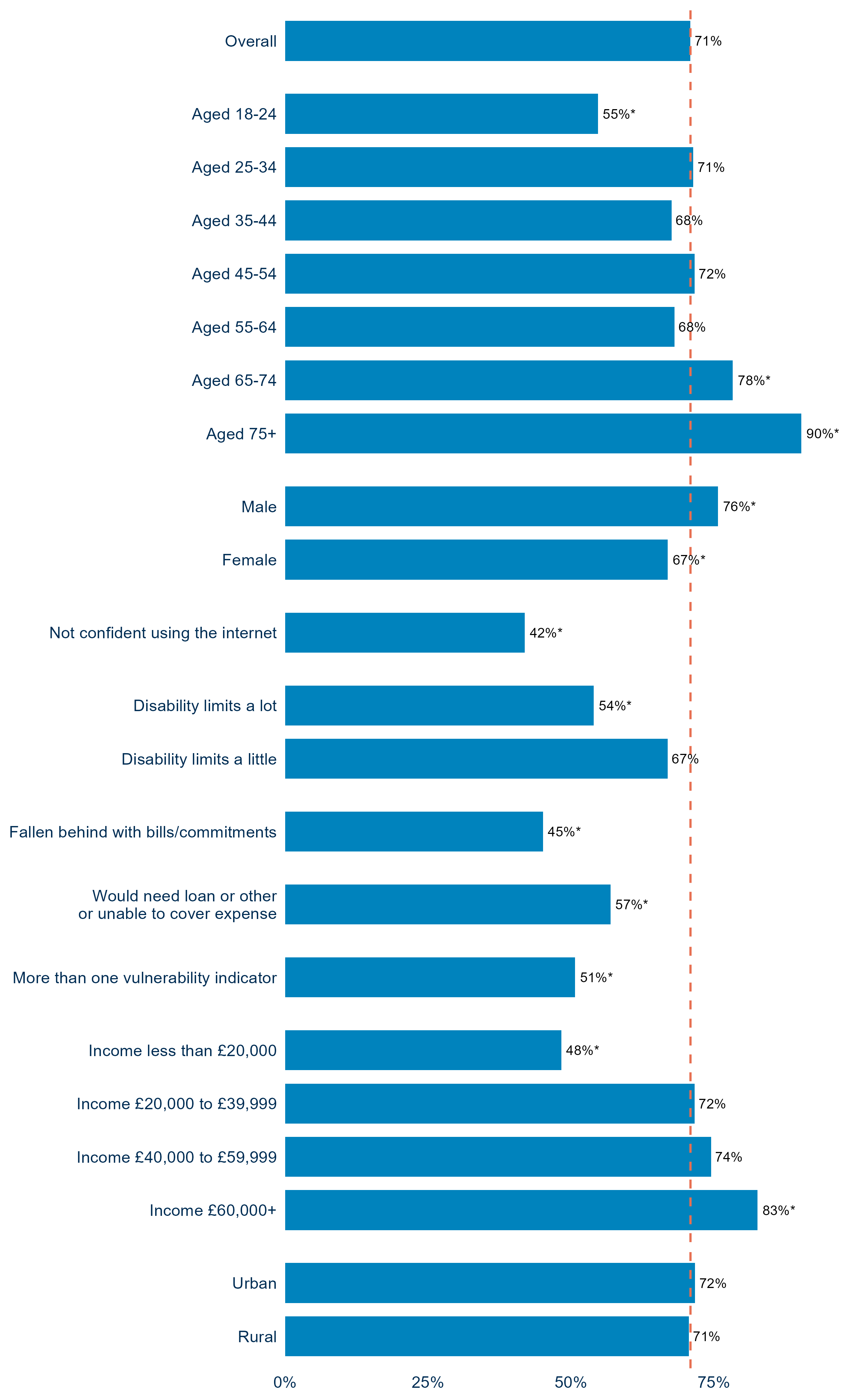
Source: Consumer Scotland (2026) Consumer Welfare Survey
Question: Thinking about your general experiences as a consumer, to what extent do you agree or disagree with the following statement? I feel that I am a confident and savvy consumer
Weighted bases: overall, n = 2,034; aged 18-24, n = 238; aged 25-34, n = 331; aged 35-44, n = 320; aged 45-54, n = 307; aged 55-64, n = 337; aged 65-74, n = 334; aged 75+, n = 164; male, n = 942; female, n = 1088; not confident using internet, n = 71; disability limits a lot, n = 166; disability limits a little, n = 359; fallen behind with at least some bills/commitments, n = 170; would need loan or other or unable to cover expense, n = 430; more than one vulnerability indicator met, n = 226; household income less than £20,000, n = 347; household income £20,000 - £39,999, n = 602; household income £40,000 - £59,999, n = 364; household income £60,000 or more, n = 574; urban, n = 1604; rural, n = 401. *Symbol indicates a statistically significant difference between this group and the overall average.
How confidently and reliably do consumers know their rights?
Understanding consumer rights is an important component of consumer confidence and empowerment, influencing consumers’ ability to make informed decisions, identify when problems have occurred, and seek appropriate support and redress when issues arise.
Our Consumer Welfare Survey found that consumers generally reported high levels of confidence in their understanding of their rights. Overall, two thirds (67%) said they were confident in their understanding, including around half (51%) who were “fairly confident”, and 16% who were “very confident”.
Consumers aged 75 and over were the most likely to report feeling confident in their understanding of their rights (75%), alongside those aged 25-34 (73%), while those aged 18-24 were the least likely to do so (60%) – Chart 4.2. Confidence also increased consistently with income, with 60% of those earning less than £20,000 per year reporting feeling confident, compared with 76% of those earning more than £60,000.
Perceived understanding also increased with confidence using the internet. Among respondents who said they were not confident using the internet, only half (50%) reported feeling confident in their understanding of consumer rights.
Core indicator 13: Confidence understanding consumer rights varies among consumer groups
Chart 4.2: Percentage of respondents who answered that they were confident in understanding their consumer rights
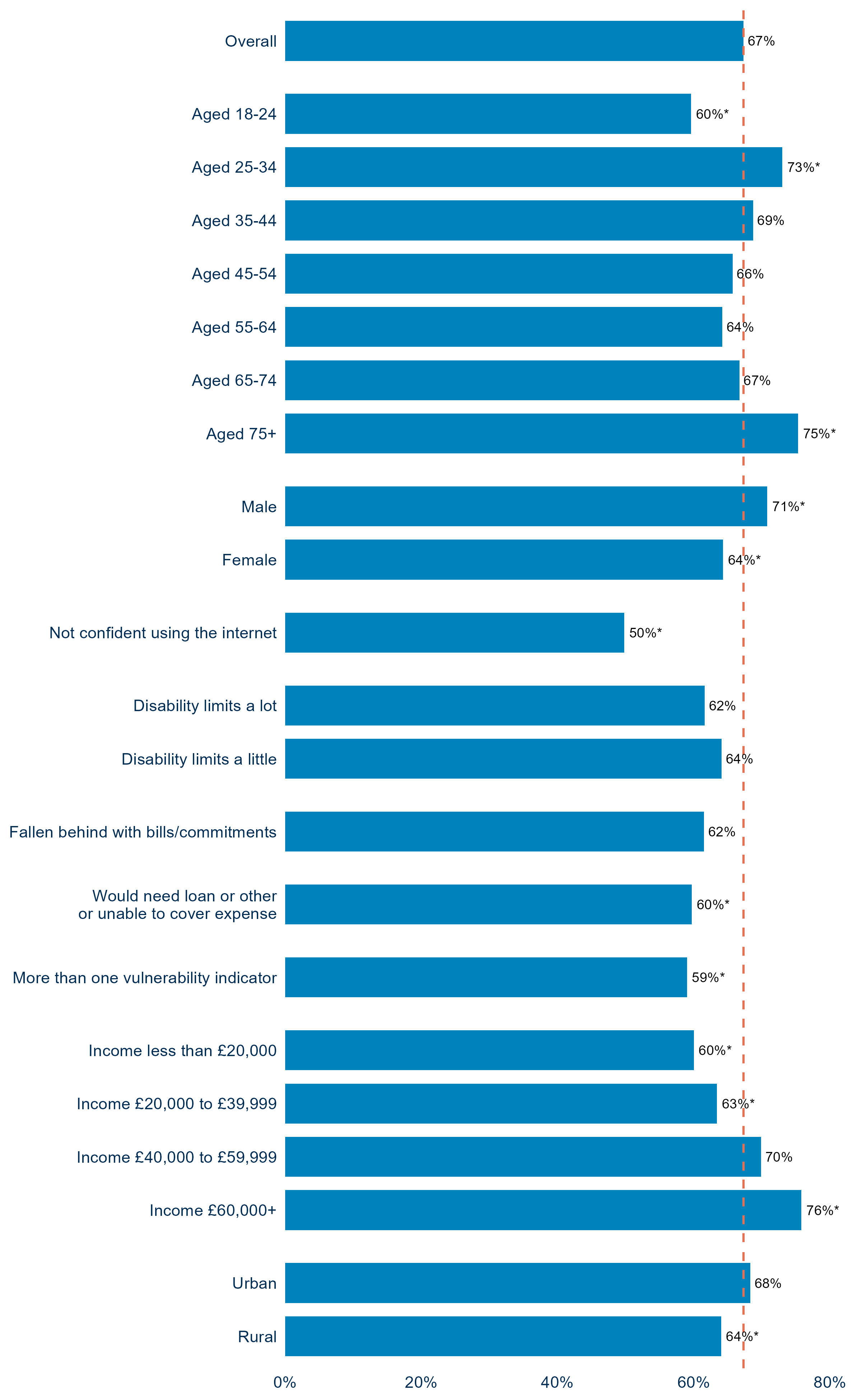
Source: Consumer Scotland (2026) Consumer Welfare Survey
Question - In general, how confident are you in your understanding of your consumer rights?
Weighted bases: overall, n = 2,034; aged 18-24, n = 238; aged 25-34, n = 331; aged 35-44, n = 320; aged 45-54, n = 307; aged 55-64, n = 337; aged 65-74, n = 334; aged 75+, n = 164; male, n = 942; female, n = 1088; not confident using internet, n = 71; disability limits a lot, n = 166; disability limits a little, n = 359; fallen behind with at least some bills/commitments, n = 170; would need loan or other or unable to cover expense, n = 430; more than one vulnerability indicator met, n = 226; household income less than £20,000, n = 347; household income £20,000 - £39,999, n = 602; household income £40,000 - £59,999, n = 364; household income £60,000 or more, n = 574; urban, n = 1604; rural, n = 401. *Symbol indicates a statistically significant difference between this group and the overall average.
Understanding rights: perceptions v. reality
Consumers might feel confident in knowing their rights, but how well placed are those perceptions?
A further question in the Consumer Welfare Survey was used as a proxy measure to test consumers’ understanding of their rights in practice, by asking which offers the greatest protection: purchasing from a high street store or purchasing from the retailer’s website. Overall, responses suggested a potential misalignment between perception and understanding. Only 12% of respondents correctly answered that the retailer’s website offers the greatest protection, while around a third of all respondents (32%) answered that the physical store offers the greatest protection, and a third (33%) answered that there was no difference.[121]
Strikingly, those reporting higher confidence were least likely to select the correct answer, while those in the “not very confident” group were most likely to select the correct answer.
This suggests that self-reported confidence in consumer rights does not always align with actual understanding. This misplaced confidence is important – suggesting that consumers are more at risk of detriment or misleading practices than they might think, and indicating a greater gap in awareness and education than might be assumed from considering self-reported confidence only.
There was also a clear relationship between confidence in understanding consumer rights and perceptions of consumer protection. Among those who reported feeling confident in their understanding of their rights, 89% said they felt well protected as consumers. Conversely, perceptions of protection were substantially lower among those who lacked confidence in their understanding of consumer rights. Consumers aged 18-24, for example, who reported the lowest levels of confidence, were also the least likely to feel well protected as consumers.
How adequate is consumer information and advice?
The previous analysis examined consumers’ self-assessed levels of confidence generally, and in relation to knowing their consumer rights more specifically.
Consumers’ confidence and knowledge of rights is influenced by a range of factors. One factor that influences confidence is the availability of information and advice, both about products specifically, or about consumer rights generally.
It is important to distinguish between consumer information and consumer advice:
- Information is provided to consumers in general (or groups of consumers).
- Advice is tailored to the specific circumstances of an individual.
Moreover, it is also important to distinguish between two broad areas that consumers may require information or advice on:
- At times they require information or advice on particular products or markets, often but not always at the pre-purchase stage of the consumer journey to help them make informed decisions – such as what type of choices they have on energy tariffs or broadband deals, for example, or which traders they can rely on for a particular project.
- Consumers may also require information or advice on their rights as consumers, and how they can access those (often but not always at the post-purchase stage).
It’s important to bear in mind that these issues of awareness of rights and how to exercise those apply as much to public, or quasi-public, services as private services. For example, awareness of advice and redress options is lower in the social rented sector than the private-rented sector (only 48% reported knowing what to do if their landlord fails to address a housing issue compared to 63% in the private rented sector).[122]
The rest of this chapter considers first, consumers’ ability to acquire information on products, services and traders generally, before going on to consider the provision of advice on consumer issues. Consumer advice is a devolved matter, though sometimes (e.g. in relation to energy and heat networks) funded by industry levies that are reserved.
Information on products, services and traders
Trustworthy and reliable information is critical to build consumer confidence. One example of how the provision of information can support consumers to make informed decisions and engage confidently is through the adoption of accredited Trusted Trader schemes – described in Spotlight 4.1.
On the other hand, where information is lacking or unreliable, this can undermine consumer confidence and engagement. Spotlight 4.2 describes an example of how inconsistent and incomplete information – on public EV charging points – can undermine consumer confidence, potentially influencing uptake of this technology.
How do consumers perceive the availability and effectiveness of information?
At a general level, 70% of respondents to the Consumer Welfare Survey agreed or strongly agreed with the statement ‘I know where to look for reliable information about items and services’.
Core indicator 14: Consumers with lower confidence using the internet are less confident knowing where to look for reliable information
Chart 4.3: Percentage of respondents who answered that they were confident in knowing where to look for reliable information about items and services
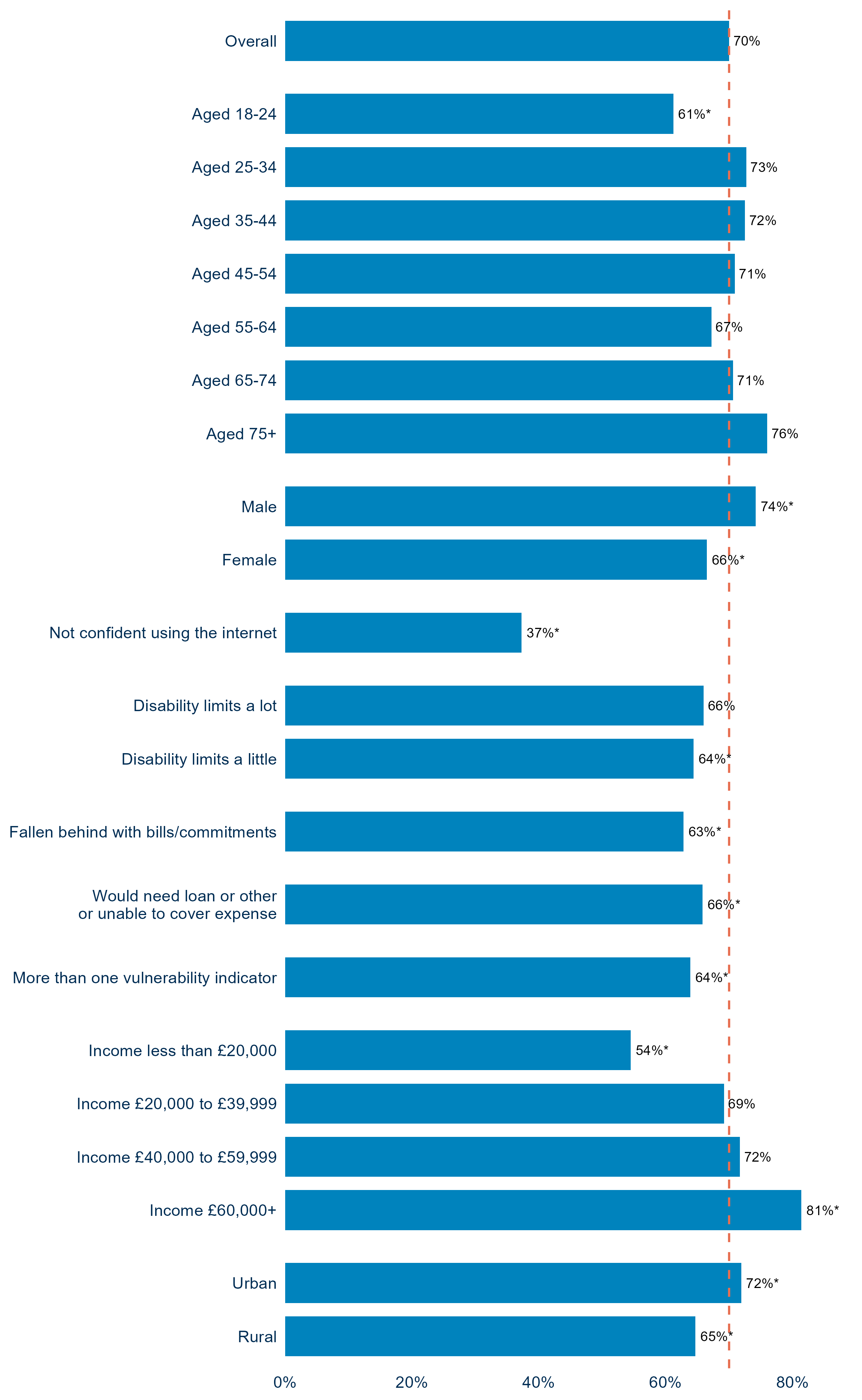
Source: Consumer Scotland (2026) Consumer Welfare Survey
Question - Thinking about your general experiences as a consumer, to what extent do you agree or disagree with the following statement? I know where to look for reliable information about items and services
Weighted bases: overall, n = 2,034; aged 18-24, n = 238; aged 25-34, n = 331; aged 35-44, n = 320; aged 45-54, n = 307; aged 55-64, n = 337; aged 65-74, n = 334; aged 75+, n = 164; male, n = 942; female, n = 1088; not confident using internet, n = 71; disability limits a lot, n = 166; disability limits a little, n = 359; fallen behind with at least some bills/commitments, n = 170; would need loan or other or unable to cover expense, n = 430; more than one vulnerability indicator met, n = 226; household income less than £20,000, n = 347; household income £20,000 - £39,999, n = 602; household income £40,000 - £59,999, n = 364; household income £60,000 or more, n = 574; urban, n = 401; rural, n = 401. *Symbol above a column indicates a statistically significant difference between this group and the overall average.
The proportion of consumers who agreed with this question was lower amongst younger people, the unemployed and those with lower incomes. It was markedly lower (37%) amongst those who are not confident in using the internet, reflecting how important the internet, and digital inclusion generally, have become in enabling consumers to access information.
It’s also important to note that responses to this question were sector-specific. Asked whether they know where to look for reliable information, agreement was highest for food and drink (76%), followed by mobile phones (74%) and electricity/gas (71%). Confidence was lower in relation to insurance (67%) and particularly low for used-cars (48%).
Given that much of the information that consumers rely on is provided by businesses, consumers’ trust in businesses plays an important role in shaping consumer confidence and empowerment.
A reasonably high proportion of consumers (69%) agreed that they trust businesses to provide them with accurate information. However, levels of trust varied across different groups of consumers. Just 53% of respondents whose disability limits their day-to-day activities a lot agreed that businesses provide accurate information, while agreement fell to 59% among those have fallen behind with at least some bills and commitments over the past 12 months.
These findings suggest that consumer trust in organisations is closely linked to broader experiences of vulnerability and confidence. Groups who were less likely to describe themselves as confident and savvy consumers, and who reported lower confidence in understanding their rights, were also less likely to trust the information provided by businesses.
Spotlight 4.1: The role of Trusted Trader schemes in building consumer confidence
A positive development in Scotland has been the work undertaken by some trading standards authorities to encourage the adoption of approved Trusted Trader schemes.[123] Such schemes now exist in 22 local authorities in Scotland primarily in relation to home improvement businesses.[124]
These approved trading standards schemes provide consumers with reassurance that the business has been fully vetted, that customer reviews are genuine and that the scheme is trading standards backed and supported by Police Scotland and consumeradvice.scot.
It also provides businesses, many of which are small businesses, with an important mechanism for distinguishing themselves from less reputable traders.
Consumers can identify members of Trusted Trader and other equivalent schemes such as Buy with confidence (adopted by a further 3 local authorities in Scotland) via Scotland’s Approved Trader Directory.[125]
Unfortunately, local authority approved trader schemes do not exist in all local authority areas. They can be resource intensive and not all Trading Standards services have the resources to introduce them.
They also only apply in certain sectors (home improvement businesses tend to be the majority). Consumer and small business awareness of these schemes is also likely to be low, particularly since the schemes are not available everywhere.
It can also be difficult to distinguish between effective high quality and accredited schemes on the one hand, and trader recommendation platforms where no effective checks are carried out.
Development of an easily identifiable means for consumers to use to determine if traders are reputable along with a public education campaign is therefore important. Broadening the roll-out of these and similar schemes, and promoting consumer awareness of them, can help to enhance the consumer experience and build consumer confidence.
As indicated previously, the UK government announced in August 2026 that it is working with the Furniture and Home Improvement Ombudsman to develop an approved code specifically for the Home Improvement Sector to include access to an Ombudsman scheme.[126] This is likely to have implications for existing Trusted Trader schemes in Scotland, and developments should be monitored closely.
Spotlight 4.2: Transparent and reliable information for EV drivers
Transparent and accurate information is essential to empowering consumers to make purchasing decisions without the risk of incurring detriment. Within the public charging sector for electric vehicles (EVs), however, consumers are too often having to plug in their car to charge without an accurate understanding of the final costs.
While EVs currently make up the minority of vehicles on the road,[127] that is set to change with current UK Government policy set to phase out the sale of new petrol and diesel vehicles by 2030, and new hybrid vehicles by 2035.[128] This is a significant change for Scotland’s consumers, particularly those who live in circumstances where they are primarily reliant on the public charging network, believed to be over half of Scottish households.[129]
The mental energy needed to negotiate public charging infrastructure can be significant. Drivers need to navigate costs which vary between charge point operators and charge speed, and are not always clear on what they include and how they are calculated. Consumer Scotland’s 2026 research found that around a quarter (23%) of EV drivers have concerns around the cost of using the public charging network.
The current variability in pricing across charge points can also create uncertainty, making it difficult to plan ahead.
“Some of them are just ridiculously high. They’ll charge you like 85p a kilowatt. It doesn’t make sense when other chargers are like 35p or 40p a kilowatt.” - Current EV driver
Consumer Scotland research shows that EV drivers face challenges in being able to accurately compare prices between different providers, and understand the likely total price before they plug-in.[130] This can reflect:
- Lack of clarity around the price difference between rapid and slow chargers, and consumers’ underestimation of how much more expensive faster chargers can be.
- Frequent use of “hidden” fees such as minimum charges, parking charges, and overstay fees.
- The frequent requirement for drivers to have the relevant app on their phone to understand pricing structures in full.
These contribute to a situation where EV drivers report being unclear on the overall cost they’re paying to charge their vehicles with public chargers.
Current charge point regulations do include standards around price transparency,[131] but these only require charge point operators to display the maximum price that a consumer could be charged per kWh inclusive of fixed charging fees, and allows the operator to make this available through a separate device such as an app.
In practice, this means that EV drivers may need to access multiple apps in order to compare prices before they begin charging, and can only know the maximum price they will pay rather than being able to accurately compare actual prices that include their fixed charge elements.
EV drivers are entitled to transparent pricing that is available upfront to all drivers, not just those that have downloaded the relevant app, and that is not limited to the maximum price but instead allows drivers to predict with certainty what their final cost will be before starting to charge.
How effective is information for small business consumers?
The provision of reliable information is equally as important for small business consumers. Previous Consumer Scotland research found that the majority of small businesses were confident they knew how to secure the best product for the business when purchasing goods and services.[132] However, there was variation by sector, with fewer – just less than 70% – of small businesses confident they could secure the right product in energy.
As is the case with individual domestic consumers, small business consumers can access information from a wide range of sources. In some sectors, Third Party Intermediaries (TPIs) can play an important role in supporting small business consumers to navigate complex markets and secure the tariffs that best meet their needs. This is particularly the case in energy, water, financial services and telecoms markets.
Whilst TPIs play an important role, they don’t always meet small businesses’ needs effectively. Spotlight 4.3 describes how planned changes to the regulation of TPIs in the energy sector are intended to improve small business’ confidence engaging with them.
Spotlight 4.3: The role of Third Party Intermediaries in helping small businesses access suitable energy tariffs
For many small businesses in Scotland, energy is both a significant operating cost and an essential service. Securing an energy contract that reflects a business's needs can have an important impact on profitability, cash flow and competitiveness. However, navigating the non-domestic energy market can be challenging. Small businesses often have limited time, expertise and resources to compare suppliers, understand contractual terms, assess pricing structures and negotiate contracts.[133]
Third Party Intermediaries (TPIs), including energy brokers and consultants, can play a valuable role. TPIs help businesses compare tariffs, understand available options, identify suitable suppliers and navigate often complex contractual arrangements. Many businesses regard brokers as an important source of support when purchasing energy.[134] [135]
The majority of businesses that use brokers report positive experiences.[136] Ofgem's 2025 non-domestic energy research found that around 72% of businesses that had used a broker were satisfied with the service they received, a figure unchanged from the previous year.[1][137]
However, the experience of using TPIs is not always positive. There is also evidence of a range of consumer harms associated with some broker practices. These include misleading claims about market coverage, pressure selling, differences between quoted and actual prices, limited transparency regarding commissions paid by suppliers, unclear contract terms, hidden fees and poor complaint handling.[138] Businesses have also reported confusion about verbal agreements, with Ofgem's qualitative research finding that only a minority understood that verbal agreements can be legally binding.[139]
These concerns are particularly significant because small businesses generally enjoy fewer protections than domestic consumers.[140] Unlike household consumers, small businesses are not protected by an energy price cap and typically have more limited rights when entering or exiting contracts. As a result, poor advice or unsuitable contracts can expose businesses to significant financial risks.
In response, the regulation of TPIs is evolving. The UK Government has committed to introducing a statutory regulatory framework for TPIs operating in the retail energy market, with Ofgem expected to become the sector regulator.[141] The proposed regime aims to establish minimum standards of conduct, improve transparency, address conflicts of interest and strengthen arrangements for complaint resolution and redress.
Stronger regulation can help ensure that small businesses receive reliable information and advice while preserving the benefits that well-functioning brokers provide, improving small businesses’ trust in TPIs, and helping them to engage confidently in energy markets.
The changing nature of consumer advice
When problems arise that consumers cannot easily resolve with suppliers, consumers have a range of options if they feel they need advice on their rights and next steps.
One option is to contact Scotland’s national consumer advice service – consumeradvice.scot – which is provided by Advice Direct Scotland (ADS).
Depending on the specific issue however, other bodies can also provide advice – notably the Citizens Advice Bureaux in relation to matters around housing or debt. Some of this is funded via the Scottish Legal Aid Board which provides grant funding for projects mainly for housing and debt.[142] A number of energy charities can provide advice in relation to energy issues.
Consumers are beginning to turn to Artificial Intelligence (AI) tools for information and advice about their rights, and how to resolve problems (Users often interpret the information they receive from AI tools as ‘advice’ as there is a sense that the AI tool has tailored it to the specific issues facing the user). Around one quarter (23%) of respondents to the Consumer Welfare Survey said they had used AI in the past 12 months to seek information about their consumer rights. Younger consumers were more likely than average to have used AI for this reason, including those aged 18-24 (31%), aged 25-34 (48%), and aged 35-44 (38%).
In principle, AI tools can help to empower consumers, providing accessible information to consumers about specific consumer issues and rights – at least for those consumers who have the digital capabilities to capitalise on these opportunities.
At the same time however, the jury is still out on the reliability of these tools to provide reliable advice. These issues are considered in more detail in Spotlight 4.4.
Further exploration of the effectiveness and reliability of advice being provided by GenAI is warranted. This is particularly the case in markets, such as financial and legal services, where the provision of advice (as opposed to guidance) is regulated.[143] It is likely that action will be required to improve consumers’ ‘AI literacy’ – their knowledge of how to engage productively with the tools, the pitfalls, and the steps required to verify advice provided by the tools.
At the same time however, it also needs to be recognised that GenAI will not be a satisfactory solution for all consumers in all circumstances, particularly those with limited digital literacy or in vulnerable circumstances. GenAI does not negate the need to ensure that more traditional forms of consumer advice remain available.
Spotlight 4.4: Should consumers rely on GenAI as a source of advice?
ChatGPT was introduced to the public in 2022, and since then the use of generative AI (GenAI) tools has increased. In 2024, 96% of people in the UK were aware of the term ‘AI’[144] in general, and in 2025, over half of people in the UK used GenAI to search the web for information.[145] This includes to get consumer information on areas where professional advice is recommended. 17% rely on GenAI for financial advice, 19% rely on it for medical advice and 12% rely on it for legal advice. [146]
There are also notably high levels of consumer trust in the information people receive from GenAI. About half of all users trust the information they receive to a great or reasonable extent. This increases for regular users of these tools.[147]
GenAI appeals to users because it appears to provide tailored, accurate advice on consumer issues rapidly and at low cost. However, it remains unclear how reliable some of the advice provided by GenAI is. In 2025, Which? conducted an investigation into how accurate common GenAI tools were in answering 40 common UK consumer questions. They found that “AI search tools often make mistakes, misread information and even give risky advice”.[148]
The tendency of GenAI to provide misleading advice has been observed in other contexts, such as health.[149] Some of the explanations for AI’s inaccuracies relate to the challenges it faces in taking into account all relevant personal circumstances, and its inherent tendency to want to ‘please’ the user, by providing answers that help keep a user engaged.[150]
There is the potential that any inaccuracies of GenAI tools in providing consumer advice might be amplified in a Scottish context, if GenAI tools do not recognise Scottish-specific aspects of the consumer advice, information or regulatory landscape. For example, it is unclear whether GenAI tools would recognise that, for example, the advice landscape differs in Scotland compared to other parts of GB, or whether GenAI tools would recognise Scottish-specific regulation in relation to aspects of housing, health, or legal services.
Consumer Scotland has recently launched an investigation into the reliability of GenAI in providing consumer information and advice – and the risks and pitfalls that consumers should be aware of when using GenAI in this context.[151]
6. Conclusions: how well are the interests of consumers in Scotland served?
Conclusions: how well are the interests of consumers in Scotland served?
This Consumer Welfare Report has sought to consider two issues posed in the Consumer Scotland Act 2020:
- How well the interests of consumers are being served in Scotland, and
- Where harm is being caused to the interests of consumers in Scotland, the nature and extent of that harm
The two issues have been considered concurrently, given their interdependence – the extent to which consumers’ interests are served cannot be understood in isolation from the harms they face.
An evolving context
The ways in which consumers access goods and services are evolving, with increasing use of digital platforms, more complex product offerings, and the growing role of data and technology in shaping consumer experiences. Technological innovation continues to deliver new products, new channels, and new ways of interacting with markets at pace.
These developments have brought significant benefits. Consumers have access to a wider range of products and services than ever before, often tailored to their preferences and delivered with convenience and speed. At their best, these developments can enhance consumer choice, increase competition, and reduce costs.
However, these same developments also introduce new risks. Increasing product complexity, opaque pricing practices, and the rapid evolution of digital markets can make it more difficult for consumers to make informed decisions and to understand the choices available to them. New technologies, including artificial intelligence, create both opportunities and new sources of potential harm. Meanwhile, globalised supply chains and online marketplaces can complicate accountability when things go wrong.
Alongside these changes, a fundamental truth remains: consumers’ living standards continue to be shaped by their ability to access and afford essential goods and services. The evidence in this report shows that affordability pressures—particularly in the wake of the cost of living crisis—continue to affect large numbers of households, often disproportionately impacting those with the least financial resilience.
Consumers operate in markets that offer unprecedented opportunity and choice, but which also pose growing challenges for effective participation. This evolving landscape places increasing demands both on consumers themselves and on the frameworks designed to protect them.
What determines whether consumers are well served? The principles
In this context, it is important to be clear about what it means for consumers to be well served.
This report has adopted a Consumer Welfare Framework which argues that consumers’ interests are served when:
- All consumers in society can access the essential goods and services they need, not just to meet their basic needs, but to participate fully in society without experiencing undue financial hardship.
- Consumers are adequately protected from the range of consumer harms and detriment that they may be exposed to. These harms can include, but are not limited to, unsafe products, misleading prices or product information, scams, or simply detriment caused by unreliable or poor quality products and services. When things do go wrong, consumers need to be able to seek redress and put wrongs right.
- Consumers can engage confidently in markets, knowledgeable about their rights and how to exercise those.
Securing these outcomes relies on a holistic consumer protection framework which prevents harm, protects consumers, and supports consumers’ confident participation.
How well served are consumers? The reality
This Consumer Welfare Report has examined how well consumers are served, and the harms they face, through the lens of three pillars of consumer welfare: access and affordability, protection and redress, and confidence and empowerment.
The evidence presented in this report points to a mixed picture.
Many consumers in Scotland are well served much of the time. Consumers in Scotland benefit from a developed consumer protection framework, a network of advice and advocacy services, and markets that often provide considerable choice, innovation and convenience.
Markets provide consumers with access to a wide range of goods and services, often at high levels of convenience and quality. Many consumers report feeling confident in their ability to navigate markets, understand their rights, and secure satisfactory resolutions when problems arise. Most consumers also report feeling reasonably well protected by existing consumer protection frameworks.
However, beneath these positive findings are significant challenges.
Consumer harm is widespread and varied. Harms include:
- Financial loss arising from scams, unfair practices, misleading information or poor-quality products and services.
- Physical harm caused by unsafe products.
- Time, effort and stress associated with resolving problems and pursuing complaints.
- Harm through exclusion as a result of difficulties accessing essential goods and services.
- Harm through complexity as a result of increasingly complex tariffs, terms and conditions, digital interfaces, pricing structures, online marketplaces and rapidly changing technologies – which takes up time and shifts the burden of protection onto consumers themselves.
This report reveals striking differences in the experiences of consumers in the prevalence and impact of these harms. Across all three pillars of consumer welfare, a consistent pattern emerges: while many consumers experience relatively positive outcomes, a significant minority face multiple consumer challenges. These consumers are more likely to struggle with affordability, experience detriment, be exposed to scams, face barriers to accessing essential services, have lower levels of confidence and awareness of rights, and achieve poorer outcomes when seeking redress.
These inequalities in consumer experience are generally not unique to Scotland (Spotlight 5.1). Consistent with evidence from across the UK, low-income consumers and disabled consumers are among those most likely to be poorly served by markets. They are more likely to experience affordability pressures, lower financial resilience, detriment, scams, exclusion from services and difficulties securing satisfactory outcomes when problems arise.
Younger consumers also stand out throughout the report. They are more likely to experience detriment, product safety issues and scams, while also reporting lower levels of confidence in consumer protection frameworks. These findings may reflect patterns of consumer expenditure – either in terms of the types of products purchased, the purchase channels used, or the price of those products; further research may be required to pin-down the relative contribution of these (and other) factors.
At the same time however, Scotland’s unique geography poses additional risks to consumers. Rural and island consumers often experience markets differently from their urban counterparts. This is particularly evident in infrastructure-based markets such as telecommunications, postal services, banking, energy and transport, where geography and lower population density can make service provision more difficult and costly. The impacts include lower levels of digital connectivity, more limited access to physical services, slower deployment of new technologies, and greater exposure to the risks associated with market transitions and service change.
These issues are not simply inconveniences. As more services become digital and as infrastructure systems evolve, there is a risk that existing geographical inequalities become exacerbated, and that those consumers who are digitally excluded suffer further disadvantage.
Affordability is one of the most significant consumer challenges. Although inflation has eased, the legacy of the cost of living period continues to be felt. Essential goods and services often remain more expensive than they were before 2022, and significant numbers of households continue to struggle to meet basic costs. There is scope to improve the effectiveness of affordability interventions, particularly through better targeting, improved use of data and greater automation of support.
It is also important to remember that improving consumer welfare is not only about addressing inequalities. Even consumers who are broadly well served face emerging risks. Technological and market change makes markets more difficult to navigate, exacerbating broad-based lack of understanding of consumer rights and complex redress frameworks.
Generative AI, increasingly personalised and dynamic pricing, new routes to market, and the growing complexity of digital services all create opportunities for consumers, but also new forms of risk. Consumers will need better information, stronger protections and greater support to navigate these changes confidently. These conclusions hold not just in the markets for privately-provided goods and services, but also in relation to many public services.
The overall conclusion of this report is therefore that consumers in Scotland are reasonably well served in many respects, but not consistently, not equally, and not sufficiently for some groups who experience the greatest risk of harm.
Spotlight 5.1: How different is the consumer experience in Scotland compared to the rest of the UK?
In broad terms, the experience of an average consumer in Scotland is no different from that of an average consumer in the UK.
On the CMA’s flagship measure of consumer detriment for example, the proportion of consumers in Scotland experiencing detriment, at 69%, is very similar to the equivalent UK figure of 72%.[152] These figures are from the 2024 Study, and in the previous 2021 Study, detriment results were also largely equivalent between Scotland and the whole UK (although in 2021, it was in Scotland where the detriment incidence was slightly higher).
The fact that detriment rates are broadly equivalent in Scotland to the rest of the UK is unsurprising for three reasons:
- First, the UK consumer protection framework is largely a reserved function that applies UK-wide.
- Second, consumers in Scotland on average have very similar patterns of expenditure as those in the UK as a whole – as discussed in Spotlight 2.1.
- Third, levels of consumer vulnerability are similar in Scotland as in the UK. For example, in the FCA’s flagship Financial Lives Survey, 49% of adults in Scotland show at least one characteristic of vulnerability – identical to the proportion for the UK as a whole.[153] Moreover, rates of low financial resilience are very similar (13% in Scotland v. 14% in UK), as is the proportion of adults who don’t speak English well.
However, despite there being limited differences in the average consumer experience between Scotland and UK, some differences do emerge from the fact that a greater proportion of the population of Scotland live in remote communities and islands. One of the implications of this is that Scotland has a somewhat higher proportion of off-grid consumers, and higher proportion of consumers who rely on heating oil (5.1%) compared to the case in England and Wales (3.5%).[154]
But the more important point is that differences in consumer experience within Scotland are far more significant than the average differences between Scotland and the rest of the UK. Picking up the off-gas grid point again, for example, there are urban local authorities in Scotland where fewer than 5% of households are off the gas grid; but other local authorities where the majority of households are off the gas grid.
And, more generally, as we have highlighted throughout this report, differences in consumer experience within Scotland – on dimensions such as age, income, and other measures of vulnerability – are often substantial.
The differences in consumer experience within Scotland are far more significant – and more important – than differences in the average consumer experience between Scotland and the UK.
Final reflections
Scotland benefits from strong consumer protections, committed advice services, active regulators and many well-functioning markets. These strengths matter, and consumers would be substantially worse off without them.
But being "reasonably well served" is not the same as being well served.
Too many consumers continue to struggle to afford essentials. Too many experience avoidable detriment. Too many face barriers to understanding their rights or securing redress. And the consumers most exposed to harm are often the same consumers who already face wider disadvantages.
Ultimately, the question of how well consumers are served matters not only for the welfare of consumers themselves, but because of its significance for wider policy agendas. Consumers who can access essential services, participate confidently in markets and avoid preventable harms are better able to contribute to the economy and society. Conversely, consumer harms generate costs that are often borne elsewhere: through poorer health, lower wellbeing, reduced economic participation, increased demand for advice and public services, and broader inequalities.
Enhancing consumers’ interests
Policy should aim to ensure that consumers can access essential services, participate confidently in markets, and secure effective redress when things go wrong. Meeting these aims requires ambition on the part of governments, regulators and industry. We identify five principles for action:
- Policy-makers must remain focussed on tackling the enduring consequences of the cost of living crisis. Affordability policy should be designed around the realities of consumers' lives, ensuring that support reaches those who need it most through better use of data, improved targeting and greater automation. Currently, too many consumers struggle to access essential goods and services because support systems are too complex to navigate or too fragmented to reach them.
- The interests of consumers who are least well served must be placed at the heart of decision-making. Success should not be measured solely by average outcomes for the average consumer. It should be judged by whether markets and services work for those consumers who currently experience the greatest risk of harm.
- There needs to be renewed investment in consumer confidence and empowerment. As products, services and technologies become more complex, consumers need access to high-quality information, trusted advice and clear explanations of their rights. Governments, regulators and industry all have a role to play in raising awareness of consumer rights, improving access to reliable information, and ensuring that consumers can act on that information with confidence. Consumer empowerment should be seen as a long-term investment in a stronger and more dynamic economy.
- Consumer rights are meaningful only when they can be enforced. Strong regulatory frameworks must be matched by effective enforcement and accessible routes to redress. Enforcement services, regulators and dispute resolution bodies need the resources, powers and capacity to respond to increasingly complex markets and emerging risks. Consumers should be able to trust that when rules are broken, action will be taken, and that when harm occurs, it can be put right.
- Governments, regulators and industry must work together to ensure that technological change delivers for consumers. New technologies, artificial intelligence and data-driven innovation have the potential to lower costs, expand choice and improve access to services. But these opportunities will only be realised if innovation is accompanied by transparency, accountability and appropriate safeguards. The goal should not be to slow innovation, but to ensure that it develops in ways that strengthen consumer welfare, reduce inequalities and build trust.
The next decade is likely to be shaped by rapid and profound economic, technological and societal change. The policy choices made will determine whether those changes widen existing inequalities or create a future in which all consumers are able to participate fully, confidently and fairly in the economy.
This report therefore makes the case for government, regulators and industry to be bold: to put consumers at the centre of decision-making, to prioritise those who are least well served, and to work together to build markets and services that are fairer, more inclusive and more resilient. The prize is a stronger economy, and a Scotland in which all consumers can flourish.
7. Technical Annex
A number of general caveats apply to all indicators in this report that are based on our Consumer Welfare Survey. Notes under each figure summarise the caveats most relevant to that indicator but this section sets out the full detail for readers who would like more information.
Weighting and geography: Figures are weighted by age, gender, region, urban and rural classification, and household income, so that results are representative of all adults in Scotland (aged 18+). Urban and rural areas use the 2-fold classification in the Scottish Government's 2022 Urban Rural Classification report.
Small bases: Figures for respondents who are not confident using the internet, and for those with no bills or commitments, are each based on weighted counts of fewer than 100 respondents and should be interpreted with caution. Groups with low base sizes are not reported separately: respondents who did not answer "male" or "female" (gender), and those who answered "neither confident nor unconfident" or who do not have internet access (internet confidence).
Disability: Grouped based on whether respondents have a physical or mental health condition that has lasted, or is expected to last, 12 months or more, and whether it affects their day-to-day activities. Responses are grouped as:
- "No disability": no long-term condition, or one that does not reduce day-to-day activities;
- "Limits a lot": a long-term condition that reduces day-to-day activities a lot;
- "Limits a little": a long-term condition that reduces day-to-day activities a little.
Vulnerability: A composite variable, derived from separate survey questions, recording whether respondents had none, one, or more than one of the following:
- Poor health: a disability that limits day-to-day activities a lot or a little;
- Low financial resilience: having fallen behind on at least some bills or commitments in the past 12 months, relying on a loan or another source of funds, or being unable to cover an unexpected expense of £250;
- Low digital confidence: low confidence in using the internet.
Can cover emergency expense: Based on whether respondents would rely on a loan or another source of funds to cover an unexpected emergency expense of £250. Respondents were asked which of the following they were most likely to do to pay for this expense. Responses are grouped as:
- "Would not rely on loan or other to cover emergency expense": savings or current account money, an existing overdraft, or a credit card (paid off in full next month or over time), plus "don't know" and "prefer not to say";
- "Would rely on loan or other, or be unable to cover emergency expense": a personal loan, a payday, short-term instalment or pawnbroking loan, borrowing from friends or family, selling something, cutting back on other spending, another answer, or being unable to pay for the expense right now.
Struggling with bills: Based on how well respondents said they were keeping up with bills and credit commitments at the moment. Responses are grouped as:
- "Keeping up with bills or commitments": keeping up with all of them, whether without difficulty, with occasional struggle, or with constant struggle;
- "Fallen behind with at least some bills or commitments": falling behind with some, or having real financial problems and falling behind with many;
- "No bills or commitments": no bills or credit commitments.
8. Endnotes
[1] Consumer Scotland Act 2020 Section 17
[2] FCA (2025) Financial Lives 2024 survey - Vulnerability & financial resilience: Selected findings
[3] Consumer Scotland (2024) Consumer Scotland’s approach to working with consumers in vulnerable circumstances (HTML) | Consumer Scotland
[4] Public Health Scotland (2026) Population health impacts of the rising cost of living in Scotland
[5] Joseph Rowntree Foundation (2026) Households living below a Minimum Income Standard: 2008–2024
[6] Bank of England (2026) Monetary Policy Report - April 2026 | Bank of England – the UK's central bank
[7] Scottish Parliament (2019) Fuel Poverty (Targets, Definition and Strategy) (Scotland) Act 2019
[8] Consumer Scotland (2025) Affordability of water and sewerage charges
[9] Ofgem (2026) Debt and arrears indicators
[10] Consumer Scotland (2026) Insights from the 2026 Energy Affordability Tracker
[11] Money and Pensions Service (2026) MoneyView 2026
[12] Consumer Scotland (2026) Understanding the experiences of consumers in water debt
[13] Watts, Slater and McKenzie (2025) The Distribution and Functions of Food Support Organisations in Scotland and their Implications for Policy
[14] Consumer Scotland (2025) Affordability of water and sewerage charges, p.30
[15] DESNZ (2026) Continuing the Warm Home Discount Scheme: Final stage impact assessment, p.13
[16] Ofcom (2026) Pricing and consumer engagement report
[17] Consumer Scotland (2026) Insights from the 2026 Energy Affordability Tracker
[18] Consumer Scotland (2026) The business of being a consumer: Exploring small business consumer experiences and their impact
[19] Institute for Fiscal Studies (IFS) (2026) Electricity prices
[20] For a recent discussion of these issues, see the discussion at the Scottish Parliament’s Economy, Tourism and Energy Committee on 1 September 2026 Economy, Tourism and Energy Committee 2nd Meeting, 2026
[21] See for example Consumer Scotland’s Investigation Investigation outcome: Converting Scotland’s home heating
[22] Scottish Government (2024) Heat Networks Delivery Plan: Review Report 2024
[23] Scottish Government (2021) Heat In Buildings Strategy: Achieving Net Zero Emissions in Scotland's Buildings
[24] Consumer Scotland internal analysis of unpublished Heat Network (Metering and Billing) Regulations notification data to 31/12/2025
[25] Consumer Scotland (2024) Creation of a Heat Network Efficiency Scheme
[26] UK Government (2026) Apply for the Heat Network Efficiency Scheme (HNES): Round 13
[27] Citizens Advice (2025) Parcel problems reach record as 15 million people are let down on the doorstep
[28] UNCTAD (2024) Empowering women as consumers: 5 things to know
[29] Transport Scotland (2023) Women's and girls' views and experiences of personal safety when using public transport
[30] Transport Scotland (2023) Women's and girls' views and experiences of personal safety when using public transport
[31] Citizens Advice (2024) Failing to deliver: how the rising cost of living has exposed and ongoing failure to tackle post exclusion; Consumer Scotland (2026) Tackling postal exclusion in Scotland
[32] Consumer Scotland (Unpublished) Postal Exclusion in Scotland
[33] Ofcom (2026) Connected Nations: Spring Update 2026, interactive report
[34] Ofcom (2026) Connected Nations: Spring Update 2026, interactive report
[35] Ofcom (2025) Connected Nations: UK Report 2025
[36] Ofcom (2026) Connected Nations: Spring Update 2026, interactive report
[37] Consumer Scotland (2025) Post services for low income rural consumers
[38] Scottish Government (2026) Broadband and connectivity
[39] Audit Scotland (2024) Tackling digital exclusion
[40] Audit Scotland (2024) Tackling digital exclusion
[41] Audit Scotland (2024) Tackling digital exclusion
[42] Consumer Scotland (2026) Investigation outcome: Consumer challenges in Scotland's used car sector
[43] Fair4All Finance (2023) 1 in 5 people from minority ethnic groups experience discrimination due to race when dealing with financial providers finds new report - Fair4All Finance
[44] Consumer Scotland (2026) An equitable postal service for the islands
[45] Consumer Scotland (2026) Disabled consumers living in rural Scotland
[46] UK Government (2026) Smart meters in Great Britain, quarterly update March 2026
[47] Scottish Parliament debate (2024) Meeting of the Parliament: Rural and Island Digital Connectivity Challenges
[48] UK Government (2023) UK transition from analogue to digital landlines
[49] Consumer Scotland (2023) Consumers in Scotland and the transition to VoIP – summary report
[50] Competition and Markets Authority (CMA) (2025) Consumer detriment survey 2024
[51] Scottish Government (2026) GDP Quarterly National Accounts: 2025 Quarter 3 (July to September) - gov.scot
[52] For further analysis of the CDS, see Consumer Scotland (2025) Insights from the Consumer Detriment Survey 2024
[53] Competition and Markets Authority (CMA) (2025) Consumer detriment survey 2024
[55] Generation Rent (2023) Discrimination against minority ethnic private renters
[56] Dearden, Kate – Minister for Employment Rights and Consumer Protection (2026) Ministerial statement: Product Regulation and Metrology Act: Product Safety Framework Reform Consultations
[57] Office for Product Safety and Standards (OPSS) (2025) OPSS Product Safety and Consumers: Wave 9 – Harms and Detriment
[58] Office for Product Safety & Standards (OPSS) (2026) Estimating detriment from unsafe and non-compliant products on the UK market
[59] UK Government (2026) The UK’s new product safety framework
[60] Dearden, Kate – Minister for Employment Rights and Consumer Protection (2026) Ministerial statement: Product Regulation and Metrology Act: Product Safety Framework Reform Consultations
[61] UK Government (2026) The UK’s new product safety framework
[62] Office for Product Safety and Standards (OPSS) (2025) OPSS Product Safety and Consumers: Wave 9 – Harms and Detriment
[63] UK Government (2026) The UK’s new product safety framework
[64] SCOTTS (2023) Press Release: Scottish Trading Standards find serious pricing issues in supermarkets and convenience stores that are costing consumers £millions across Scotland
[65] See for example CMA (2026) Court endorses CMA action as Emma Sleep agrees to change sales practices
[66] Department for Business & Trade (2023) Estimating the prevalence and impact of online drip pricing
[67] Consumer Scotland (2024) Dynamic Pricing - A Consumer Scotland insight report
[68] Bank of England (2026) This time it's personal: the rise of dynamic, personalised pricing and what it means for inflation
[69] Federal Trade Commission (2025) Surveillance Pricing Update & The Work Ahead
[70] This figure does include firms who use ‘loyalty pricing’ which in its simplest form is arguably not strictly ‘personalised’ – although retailers are increasingly using the data collected through loyalty schemes to tailor offers to specific consumers.
[71] Competition and Markets Authority (CMA) (2025) CMA launches major consumer protection drive focused on online pricing practices
[72] Federal Trade Commission (2024) FTC Issues Orders to Eight Companies Seeking Information on Surveillance Pricing
[73] Scottish Government (2021) Scams prevention, awareness and enforcement strategy: 2021 to 2024
[74] Consumer Scotland (2026) Consumer challenges in Scotland's used car sector
[75] Competition and Markets Authority (CMA) (2024) The State of UK Competition Report 2024
[76] Scottish Government (2026) Supporting documents - Price controls on essential food items: consultation paper
[77] Competition and Markets Authority (CMA) (2025) How the CMA uses its direct consumer enforcement powers
[78] See for example Audit Scotland (2002) Made to Measure: An overview of trading standards services in Scotland; CIPFA (2025) Society of Chief Officers of Trading Standards in Scotland: Strategic Outline Case and Options Appraisal for the Future Delivery of the Service ; SCOTTS (2025) Trading Standards Workforce Survey 2025 – Policy Briefing; Which? Trading Standards in Crisis: rebuilding an effective and accountable consumer enforcement system
[80] CIPFA (2025) Society of Chief Officers of Trading Standards in Scotland: Strategic Outline Case and Options Appraisal for the Future Delivery of the Service p. 7.
[81] Which? (2025) Trading Standards in Crisis: rebuilding an effective and accountable consumer enforcement system p.6.
[82] Department for Business, Energy and Industrial Strategy (BEIS) (2018) Resolving Consumer Disputes: Alternative Dispute Resolution and the Court System; House of Commons Research Briefing (2022) Consumer disputes: Alternative Dispute Resolution (ADR)
[83] Citizens Advice (2017) Confusion, gaps, and overlaps: A consumer perspective on alternative dispute
resolution between consumers and businesses; House of Commons Research Briefing (2022) Consumer disputes: Alternative Dispute Resolution (ADR)
[84] One Scottish specific schemes consumer ADR scheme is the Scottish Legal Complaints Commission. In relation to public services there is also the Scottish Public Services Ombudsman which is discussed below.
[85] Trust Alliance Group (2025) Annual Report 2024(most recent published report as of 16 September 2026)
[86] Trust Alliance Group (2025) Annual Report 2024(most recent published report as of 16 September 2026)
[87] Financial Ombudsman Service (2026) Annual complaints data and insight 2025/26
[88] Scottish Public Services Ombudsman (SPSO) (2026) Statistics 2025-26
[89] Data on satisfaction with public services sourced from Scottish Household Survey, various years.
[90] House of Commons Research Briefing (2022) Consumer disputes: Alternative Dispute Resolution (ADR)
[91] Citizens Advice (2016) Built to Fail: How the home repairs market is failing consumers. This research found that 86% of people who used a trader who was a member of an ADR scheme said their issue was resolved after taking action, compared to 67% of people whose trader was not a member (p.14).
[92]Citizens Advice (2017) Confusion, gaps, and overlaps: A consumer perspective on alternative dispute
resolution between consumers and businesses; Which? (2025) Strengthening ADR frameworks: advancing fair and effective consumer dispute resolution
[94] See for example Citizens Advice (2026) Built to fail: How the home repairs market is failing consumers on the home improvements market.
[96] Department for Business and Trade (DBT) (2026) Letter from the Rt Hon Peter Kyle MP, the Secretary of State for Business and Trade, to the Rt Hon Liam Byrne MP, Chair of the Business and Trade Committee
[97] Department for Business Energy and Industrial Strategy (BEIS) (2018) Modernising consumer markets: Consumer Green Paper
[98] Financial Conduct Authority (FCA) and Financial Ombudsman Service (2026) Modernising the redress system; HM Treasury (2026) Review of the Financial Ombudsman Service - Consultation response. The relevant proposals are now being taken forward in the Financial Services and Markets Bill that is currently in the UK parliament.
[99] Consumer Scotland (2026) Modernising the redress system: Consultation response
[100] Department for Energy Security and Net Zero (DESNZ) (2026) Fairer, Faster Redress in the Energy Market : Consultation response on the Role and Powers of the Energy Ombudsman
[101] Department for Business, Innovation, Science and Trade (BIST) (2026) Government steps in to protect families from cowboy builders and aggressive bailiffs
[102] If a dispute is for less than £5,000 simple procedure in the Sheriff Court is available and consumers can represent themselves. Above £5,000 consumers can still represent themselves but legal representation is likely to be needed.
[103] Consumer Scotland (2024) Using Legal Services in Scotland
[104] Consumer Scotland (2024) Using Legal Services in Scotland
[105] SPICE (2026) Access to legal aid and advice services in Scotland
[106] Evans, Martyn (2018) Rethinking Legal Aid: An Independent Strategic Review
[107] Scottish Parliament (2025) Report on the Equalities, Human Rights and Civil Justice Committee inquiry into Civil Legal Assistance in Scotland para. 19
[108] Scottish Parliament (2025) Report on the Equalities, Human Rights and Civil Justice Committee inquiry into Civil Legal Assistance in Scotland
[109] Scottish Government (2026) Legal Aid Reform: Consultation
[110] Financial Conduct Authority (FCA) (2026) FCA confirms motor finance redress scheme
[111] Our investigation into used cars noted stakeholder evidence about the emergence of claims management firms that pursue used-car complaints in return for a share of any settlement particularly in higher-value or finance related disputes. Consumer Scotland (2026) Consumer challenges in Scotland's used car sector. In England and Wales see Solicitors Regulation Authority (2026) High-volume consumer claims
[112] Solicitors Regulation Authority (2026) High-volume consumer claims
[113] Financial Conduct Authority (FCA) (2026) Motor finance scheme partially suspended
[114] Civil Justice Council (2025) Review of Litigation Funding
[115] Rules introduced under Civil Litigation (Expenses and Group Proceedings) (Scotland) Act 2018 came into force on 31 July 2020.
[116] Milligan v Jaguar Land Rover (2025) CSIH 16. Available from https://www.scotcourts.gov.uk/media/rctl3pir/2025csih16-reclaiming-motion-steven-blair-milligan-against-jaguar-land-rover-automotive-plc-and-others.pdf
[117] MacKay v Nisan Motor Co Ltd [2025] CSIH 14. Available from 2025csih14-reclaiming-motion-by-joseph-mackay-against-nissan-motor-co-lotd-and-others.pdf
[118] Department for Business Innovation, Science and Trade (BIST) (2026) Opt-out collective actions regime review: summary of call for evidence responses
[119] Department for Business Innovation, Science and Trade (BIST) (2026) Swifter and simpler competition redress, regulatory appeals and competition enforcement
[120] Scottish Government (2026) GDP Quarterly National Accounts: 2025 Quarter 3 (July to September)
[121] UK consumer law assumes that an in-store consumer can inspect goods before purchase, whereas an online customer cannot. Consequently, the Consumer Contracts (Information, Cancellation and Additional Charges) Regulations 2013 give consumers a 14-day cooling-off period for most distance contracts (online, telephone, mail order) and off-premises contracts (for example, doorstep sales). During this period, the consumer can cancel for any reason, even if the goods are not faulty.
[122] Consumer Scotland (2026) A Fairer Rental Market: Life in Scotland’s social rented sector p. 22
[123] SCOTTS (no date) SCOTSS Partner Councils
[124] According to SCOTTS (no date) SCOTSS Partner Councils as of 16 September 2026.
[125] SCOTSS (no date) Scotland’s Approved Trader* Directory
[126] Department for Business, Innovation, Science and Trade (BIST) (2026) Government steps in to protect families from cowboy builders and aggressive bailiffs
[127] Zapmap (2026) EV market stats 2026
[128] Department for Transport (2025) Phasing out sales of new petrol and diesel cars from 2030 and supporting the ZEV transition: summary of responses and joint government response
[129] Scottish Government (2026) Scottish House Condition Survey: 2024 Key Findings
[130] Consumer Scotland (2024) Consumer Experience of Electric Vehicles in Scotland
[132] Consumer Scotland (2026) The business of being a consumer: Exploring small business consumer experiences and their impact
[133] Consumer Scotland (2025) The business of being a consumer: Exploring small business consumer experiences and their impact
[134] Ofgem (2025) Businesses’ experiences of the energy market 2025
[135] Citizens Advice (2025) Small and micro businesses experiences of the energy retail market
[136] Citizens Advice (2025) Small and micro businesses experiences of the energy retail market
[137] Ofgem (2025) Businesses’ experiences of the energy market 2025
[138] DESNZ (2024) Consultation outcome: Regulating Third-Party Intermediaries (TPIs) in the retail energy market
[139] Ofgem (2025) Businesses’ experiences of the energy market 2025
[140] Consumer Scotland (2025) The business of being a consumer: Exploring small business consumer experiences and their impact
[141] DESNZ (2024) Consultation outcome: Regulating Third-Party Intermediaries (TPIs) in the retail energy market
[142] Scottish Legal Aid Board (SLAB) (2025) Annual Report and Accounts 2024-25. SLAB funded 17 projects providing £2.278 of funding
[143] According to the Financial Advice Working Group for HM Treasure and the Financial Conduct Authority (2017) Consumer explanations of “advice” and “guidance”, advice is “a service which recommends a specific course of action based on consumers’ individual circumstances and goals”, whereas guidance “provides information and/or options to narrow down consumers’ choices, without making an explicit recommendation.” p. 4.
[144] Department for Science, Innovation & Technology (2024) Public attitudes to data and AI: Tracker survey (Wave 4) report
[149] Ramaswamy et al. (2026) ChatGPT Health performance in a structured test of triage recommendations
[150] Financial Times (2026) The end of the mortgage broker? How AI is transforming the UK property market
[151] Consumer Scotland (2026) Investigation into AI-generated consumer advice and information | Consumer Scotland
[152] Competition and Markets Authority (CMA) (2025) Consumer detriment survey 2024
[153] Financial Conduct Authority (FCA) (2025) Financial Lives 2024 survey
[154] House of Commons Library (2026) Households off the gas-grid and prices for alternative fuels