1. Our response - summary and key recommendations
Summary
We appreciate the attempts Ofgem is making to reduce the level of debt in the energy sector. As the statutory advocate for consumers in Scotland, we are concerned both about individual households that are in energy debt, and the impact in the form of increased costs that this has across consumers more broadly.
Consumer Scotland considers that it is worth exploring reforms to the change of tenancy process, given the proportion of overall debt that arises where there has been a change in housing occupant. If done right they will help to reduce costs, and reduce the debt burden on suppliers. We therefore tentatively support Ofgem’s early thinking.
The changes in question are substantial. They will fundamentally alter the home move process for consumers. Suppliers have to play their part if they are to be successful. This means having quick, efficient, and simple processes in place that will allow a homemover to set up a new account and change payment method, if they choose, within a matter of minutes. If consumers face lengthy wait times to contact a supplier, or for their information to be processed and an account set up, the policy will be a failure and consumers will be exposed to unacceptable risks of self-disconnection.
As this work progresses we would encourage Ofgem to consider a range of different consumer archetypes and change of tenancy scenarios. These should specifically focus on difficult cases, where steps in the process have gone wrong or been missed, and on consumer groups for whom self-disconnection is particularly high risk or high impact.
We would also encourage Ofgem to ensure that in the course of making any changes that the lines around who is responsible for the energy supply at a premises are not blurred at any point. For rental properties where there is a gap between tenants this is a particular risk. If the changes are done poorly then there is a risk that consumers could end up paying the costs for a period before they moved in.
We would be very happy to discuss any of the content of this response with Ofgem and would be delighted to contribute further to the thinking on this topic moving forward.
Key Recommendations
Consumer Scotland recommends that Ofgem test its proposals against a range of consumer archetypes and change of tenancy scenarios, not just “happy path” scenarios. Some consumers, like the terminally ill or those with health conditions, will be at higher risk of self-disconnection, and face higher consequences if they do disconnect. An effective process must accommodate difficult cases. It must also accommodate differences in Scotland, which has its own distinct housing laws and procedures.
Suppliers customer service arrangements are absolutely critical to the success or otherwise of any reforms to change of tenancy. The changes under consideration will carry a degree of additional inconvenience for consumers. Suppliers have to play their part. This means creating simple, informative pathways that enable a new account to be set up and in a matter of minutes. Ofgem must ensure appropriate requirements are in place to ensure suppliers have the systems, processes and workforce in place to achieve this, and there should be firm penalties for failing to do so.
A broad consumer awareness campaign should be carried out to advertise the change in process if these proposals are taken forward. Consumers should not be caught by surprise by a new process given the risk of accidental self-disconnection. Individual-level communications should also be carefully designed. These must be waiting for a new occupant when they move it, and very simply set out the steps they need to take to set up an account, the information they need to have to hand, and the payment options available to them.
2. Our response
Question 1: Please provide evidence or data with respect to levels of debt or arrears in the sector relating to change of tenancy. Where relevant please include information associated with unnamed accounts such as the number of unnamed accounts, average length of unnamed accounts, average debt and the overall debt associated with these accounts.
No answer.
Question 2: Please provide evidence or data you may have about a customer’s experience when moving into a new property and setting up their energy account. This may include any common issues such as billing issues or queries that may be experienced in this time, the average duration for a new householder to set up an account, and whether enhanced processes exist for the identification of vulnerable consumers.
It is important that Ofgem consider a range of different scenarios around changes of tenancies and of energy supply arrangements, not just “happy path” scenarios. Consumer Scotland has engaged with landlord and advice organisations to get an understanding of potential issues that could arise during a change of tenancy. Scotland’s housing and tenancy laws and procedures, which can differ from those of the rest of GB, will affect how any CoT rules work in practice. Below is a summary of the steps generally involved in change of tenancies in the Scottish private rented sector.[1]
Figure 1
Typical change-of-tenancy journey for Scottish private rented sector tenancies
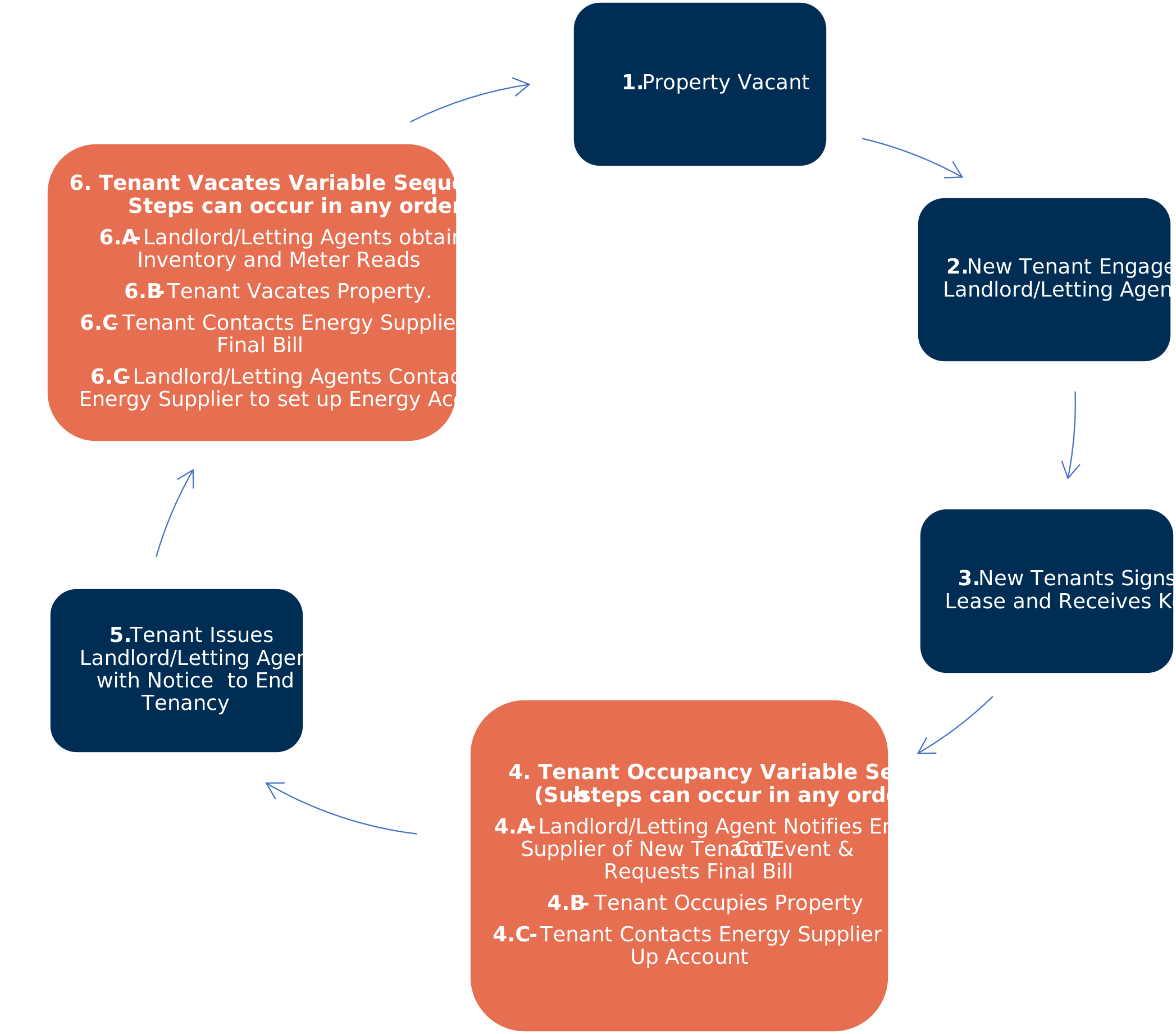
There are several “variable sequences” in the above steps that could give rise to consumer detriment if Ofgem were to proceed, without appropriate mitigations, with the proposal to change a meter to prepay upon a change of tenancy. We discuss these below.
Potential for consumers to pay for energy not used by them
The content of the call for input largely appears to discuss circumstances in which there is no gap in time between two primary occupants. This is likely to be the case where there has been, for instance, a house sale – the original occupant ceases to the be the owner at the same time as the new occupant assumes ownership.
For rented accommodation, however, there will commonly be a gap between the first resident moving out and the new occupant moving in. The landlord or letting agent would be responsible for the energy supply in the interim period. More thinking needs to be done about this latter scenario. The interim period could in some cases be days, but in others could be weeks or months.
This means that for any new requirements Ofgem prescribes there will need to be two separate notifications to the supplier and subsequent sets of actions – the first ending the contract with the original occupant and placing responsibility for supply with the landlord (or letting agent), the second ending that contract with the landlord and placing responsibility for supply with the new tenant. There is otherwise a risk that tenants could become liable for energy bills incurred before the start of their tenancy, or that any nominal credit assigned to the account is used up by the landlord prior to the new tenant moving in.
Tenant moves in before the landlord or letting agent has informed the supplier of a change of tenancy
We understand that Ofgem’s intention is only to allow a meter to be switched to prepay where it is known that there is no occupant. We would welcome confirmation of this as part of future consultations on this topic. Otherwise, a tenant could initially be on a credit-metered supply which is subsequently and without notice switched to prepayment, following the landlord’s notification to the supplier. This could pose a risk of self-disconnection, which could pose a major problem for certain categories of consumer, such as those with essential medical equipment.
Vulnerable cases where setting up an energy account may not be a priority
Social housing providers told us that many of their tenants may be entering a new property at a very difficult time, for instance having lost a previous property or having moved due to domestic abuse. In these circumstances it may not be a priority to contact their energy supplier. It is absolutely critical that the process is made as easy as possible for these individuals. This includes ensuring an awareness campaign is conducted to make sure that everyone is familiar with any new process, and that individual communications are sent that very simply explain how to top up or set up an account. We would also recommend that suppliers are required to take interim steps to keep the supply to a premises live in particularly difficult circumstances, by lodging additional credit on the meter for instance.
We recognise it will not be possible to codify rules such that they can account for every variable sequence without making the regulation unduly complex and burdensome. However, Ofgem must make sure to test any proposals across a range of different scenarios, and ensure safeguards are embedded to prevent consumer detriment across differing event sequences.
Q3: Do you have views or preferences regarding the approach we take to enabling the proposed changes to the supplier home moves process? For example, should the approach be set out in SLCs and / or associated guidance or could it be covered through industry rules or elsewhere?
We recommend the use of SLCs and associated guidance if Ofgem take this policy forward. SLC 7 already sets out related obligations for licensees. For the sake of transparency amendments to this section of the SLCs would provide a clear means to incorporate this policy, accompanied by more detailed guidance to incorporate the regulator’s expectations and consumer protections in more details.
Q4: Do you prefer a outcomes-based approach or something more prescriptive for consumer protections in Change of Tenancy?
Given the challenges of setting out every possible consumer archetype and sequence of events in licence, it appears inevitable that some degree of outcomes-based regulation is required. However, if new change of tenancy procedures are to be successful, it is absolutely essential that suppliers have the systems, processes and workforce in place to enable a new account to be set up with minimal fuss and in a very short space of time. The change Ofgem is considering is a very significant one, and involves a measure of inconvenience for consumers. Suppliers have to live up to their end of the bargain if we are to support this change. It will be totally unacceptable if consumers are unable to quickly contact their supplier to set up an account or restore supply to their home. Where suppliers fail to deliver there should be harsh and immediate penalties – this could be in the form of a Guaranteed Standard of Performance payment, as well as Ofgem enforcement action.
Q5: Do you have any views on the above suggestions for consumer protections or have any alternatives that should be considered?
Sufficiently Informing Consumers
The proposals do not cover how consumers, both tenants and landlords or letting agents, would be sufficiently informed about these changes and the novel process. We recommend that Ofgem consider how to both effectively communicate both the change in the process. This should include both a broad awareness campaign to make sure the change is widely known. This campaign could be led by an industry body like Smart Energy GB, for instance, while engaging closely with consumer advice and advocacy bodies. Careful thought should also be given to individual consumer communications, which should be waiting for the new occupant of a premises when they come in. These must be as simple and straightforward as possible, and ensure they know exactly who they have to call or contact to set up an account, the different payment methods available to them, the information they need to have to hand, etc.
Structural Barriers to Consumer Engagement
Qualitative research on prepayment shows that consumers who move into properties with an existing prepayment meter often feel ill‑informed about the payment method and report limited discussion with suppliers about alternative payment options.[2] Many consumers may not, therefore, actively seek to move away from prepay. While this is not necessarily a problem in itself, as Ofgem reports smart prepay customers tend on average to be the most satisfied cohort of consumers[3], it raises questions about the current communication practices of suppliers. As indicated above, if Ofgem’s changes are to be successful it is absolutely critical that consumers are well-informed of their options, and that the steps for them to change payment method are as simple as possible. As this work progresses we would be more than happy to contribute to the design of effective processes to ensure that in a single call, webchat or website visit a consumer can set up their account in the manner of their choosing.
Challenges for Vulnerable Consumers – Early Identification
Ofgem should give consideration to whether and how vulnerability status can be identified prior to, or early in, the change of tenancy process. Certain vulnerable consumers, including those with health conditions or at-home medical equipment, could face disproportionate harm from potentially unknowing self-disconnection. There are clearly issues around disclosing sensitive information around vulnerability, particularly where the consumer may have no pre-existing relationship with a supplier, and may not be comfortable sharing this information with a landlord or letting agent. Nevertheless, we consider it is worth exploring whether there is a feasible solution that would facilitate early identification of high-risk households. Stakeholders have told us that some suppliers provide online “housing portals” that allow disclosure of tenant information before they move in.[4] This service is not universally provided by all suppliers, requires a landlord to be aware of a tenant’s vulnerability, and to disclose it in a timely manner.
Challenges for Vulnerable Consumers – Notional Credit
Consumer Scotland previously highlighted the cost premium that many disabled and terminally ill consumer pay for their energy, and that working-age disabled and terminally ill consumers are likely to miss out on affordability support to help with their higher bills.[5] Research from health charities highlight that a terminally ill person’s energy bills can rise by 75% after their diagnosis,[6] with one case study highlighting that the additional average estimated monthly cost (before heating and typical electricity costs are accounted for) totalling more than £270.[7] Charities have told us that there are many reasons that a terminally ill household may need to move property during palliative care (such as the need to be closer to health services, or specialist schools to accommodate the needs of terminally ill children).
Given the confluence of risk factors – high energy use and thus higher costs, the absolute necessity of maintaining an electricity and heating supply, and the fact that contacting an energy supplier may not be a priority – the terminally ill and those with health conditions should be an absolute priority consideration in this process. This should be reflected in the level of notional credit that is assigned. Ofgem should consider whether and how consumers with these characteristics can be quickly distinguished from others, and prioritised by suppliers, including by logging additional credit on the meter if more time is required to set up the account. And, more broadly, we cannot assume that every household will be capable of contacting an energy supplier as soon as they move in – a week or two of credit should be the minimum expectation.
Zero standing charge tariff application
We are unclear of the rationale for Ofgem’s suggestion to apply a zero standing charge tariff by default where there has been a change of tenancy. This would have some negative outcomes. It would penalise high users. As outlined above this includes the terminally ill and those with health conditions. It would also potentially allow landlords to avoid all of the fixed costs of the system during the period where the property is vacant. These costs will be borne by everyone else. Furthermore, it would appear to inadvertently necessitate the creation of a zero standing charge variant of the price cap by Ofgem, which we understood Ofgem were not minded to do. The tariff in question would be a default arrangement, and so therefore would appear to be subject to a cap.
3. About us
Consumer Scotland is the statutory body for consumers in Scotland. Established by the Consumer Scotland Act 2020, we are accountable to the Scottish Parliament. The Act defines consumers as individuals and small businesses that purchase, use or receive in Scotland goods or services supplied by a business, profession, not for profit enterprise, or public body.
Our purpose is to improve outcomes for current and future consumers, and our strategic objectives are:
- to enhance understanding and awareness of consumer issues by strengthening the evidence base
- to serve the needs and aspirations of current and future consumers by inspiring and influencing the public, private and third sectors
- to enable the active participation of consumers in a fairer economy by improving access to information and support
Consumer Scotland uses data, research and analysis to inform our work on the key issues facing consumers in Scotland. In conjunction with that evidence base we seek a consumer perspective through the application of the consumer principles of access, choice, safety, information, fairness, representation, sustainability and redress.
Consumer Principles
The Consumer Principles are a set of principles developed by consumer organisations in the UK and overseas.
Consumer Scotland uses the Consumer Principles as a framework through which to analyse the evidence on markets and related issues from a consumer perspective.
The Consumer Principles are:
- Access: Can people get the goods or services they need or want?
- Choice: Is there any?
- Safety: Are the goods or services dangerous to health or welfare?
- Information: Is it available, accurate and useful?
- Fairness: Are some or all consumers unfairly discriminated against?
- Representation: Do consumers have a say in how goods or services are provided?
- Redress: If things go wrong, is there a system for making things right?
- Sustainability: Are consumers enabled to make sustainable choices?
Our response has been framed by our Consumer Principles. Reviewing policy against these principles enables the development of more consumer-focused policy and practice, and ultimately the delivery of better consumer outcomes.
4. Endnotes
[1] Figure 1 is not an exhaustive list of the stages of the tenancy process in Scotland, but a typical life cycle that should inform how Ofgem’s policy proposals will work in practice.
[2] Savanta and Ofgem, Prepayment Meter Customer Journey - Qualitative Research, p.11-20, 2023
[3] Ofgem, Debt strategy update: supporting the reduction of energy debt, November 2025
[4] For example, Utilita’s Housing Portal
[5] Consumer Scotland, Designing energy support for disabled consumers, December 2024
[6] Marie Curie, One Charge too Many, 2023
[7] Childrens Hospices Across Scotland (CHAS), Help Power Precious Lives, 2023