1. Executive Summary
Postal services remain a vital channel for consumers to communicate and be communicated with in Scotland, providing a route for letters on healthcare, financial and legal matters as well as birthday cards and personal letters to friends and family. This physical communication requires fleets of delivery vans and lorries to ensure that post can be received at addresses across the whole country.
A rapidly growing sector in the postal services market in the last decade has been parcel delivery, with many goods from sofas and TVs to books and beehives now available to be sent direct to homes. The COVID-19 pandemic boosted this trend and has driven more consumers online for their goods purchases, with the volume of parcels has doubling in the last decade, from 1.8 billion in 2013-14 to 3.6 billion in 2022-23.
With transport being the biggest source of emissions in Scotland, there is a need to look at how consumption of goods being delivered to homes contributes to these emissions and how this can be reduced to meet the goals of being a Net Zero country. This research seeks to address gaps in the evidence around what consumers and small businesses would be willing to do to reduce the emissions from their delivered purchases and sets out a series of recommendations for further work in this sector.
Summary of recommendations
- Retailers and parcel operators should offer greater choice for consumers with clear and transparent information on carbon, speed and cost at point of sale. The focus should be to allow consumers to make an informed decision about carbon impact.
- UK Government and Ofcom should work with stakeholders to create a clear and comparable table of CO2 emissions for all parcel operators which is reported on annually using credible and transparent data sources.
- Ofcom should work with parcel operators and retailers to improve the sustainable delivery options provided to consumers, with communication of environmental impact of each option in a clear, concise, and accessible way. Consumer Scotland would encourage a co-ordinated, cross-sector approach that draws on established carbon offsetting models from other countries
- UK and Scottish governments should examine options for developing targeted support to help small businesses adopt sustainable delivery methods, recognising their limited resources compared to larger firms. Options could include financial incentives, accreditation schemes, or proportionate legislation to enable fair and practical compliance.
- Ofcom should examine the specific impacts of the transition of the postal sector to net zero for consumers in rural and remote areas in Scotland who may be negatively affected by any increases in costs, due to limited delivery choices and existing surcharges by parcel operators. The regulator should identify what additional protections or support may be required for remote and rural consumers to ensure the transition does not have an adverse impact for these consumers.
2. Introduction
Who we are
Consumer Scotland is the statutory body for consumers of postal services in Scotland. Established by the Consumer Scotland Act 2020, we are accountable to the Scottish Parliament. The Act provides a definition of consumers which includes individual consumers and small businesses that purchase, use or receive products or services.
Our purpose is to improve outcomes for current and future consumers, and our strategic objectives are:
- To enhance understanding and awareness of consumer issues by strengthening the evidence base
- To serve the needs and aspirations of current and future consumers by inspiring and influencing the public, private and third sectors
- To enable the active participation of consumers in a fairer economy by improving access to information and support
Consumer Scotland uses data, research and analysis to inform our work on the key issues facing consumers in Scotland. In conjunction with that evidence base we seek a consumer perspective through the application of the consumer principles of access, choice, safety, information, fairness, representation, sustainability and redress.
Consumer Scotland has some specific statutory functions in relation to postal services by virtue of the Consumers, Estate Agency and Redress Act 2007.[1] We also receive specific funding for our advocacy and research functions in relation to postal services.
In relation to sustainability, the Consumer Scotland Act 2020 states that our functions include promoting environmentally sustainable practices and that we must have regard to the environmental impact of the actions of consumers.[2] Consumer Scotland’s Strategic Plan 2023 – 2027 sets out the detail of our approach:
“Scotland has an ambitious net zero target and consumers’ choices will be key to achieving it. Our intention is to understand and track consumers’ priorities for, and experience of, the transition to net zero. We want to understand how the transition can be made easier for consumers on lower incomes, or who face other disadvantages, to make sure they are not excluded. We will use our insights to help inform the design of net zero and adaptation policy and practice across the public and private sectors.” [3]
Background
The role of this report
This report examines the attitudes and views of consumers and small businesses in Scotland on and considers how the design of postal markets can enable consumers to make choices that support environmental sustainability and the transition to net zero.
This report forms part a wider series of Consumer Scotland work on this topic. Other outputs include research on general attitudes to net zero and consumer decisions across all goods and services, as well as more specific work on topics including low carbon technologies, electric vehicles and water and wastewater services. All this work is published on our website.[4]
Consumer Principles and the Climate Change Framework
At Consumer Scotland, our work is guided by Consumer Principles to mitigate consumer harm and bring about the best outcomes. These core consumer principles—access, choice, safety, information, fairness, representation, and redress—aim to ensure that consumers can obtain the services they need, are treated fairly, have access to clear information, are protected from harm, and have meaningful opportunities to influence service design and resolve issues.
Consumer Scotland has created ‘A consumer framework for addressing climate change’ toolkit.[5] As part of the toolkit, there are four areas – the Four C’s – of Cost, Convenience, Clarity and Confidence which identify ‘key issues for considering the role of consumers in progressing the transition to a more sustainable future.’[6]
In the table below, we set out how the Four C’s perspective can be used as a framework to identify issues within the postal services for consumers.
Figure 1
A Consumer framework for addressing climate change (the Four Cs)
|
Perspective |
Description of perspective |
Postal services |
|---|---|---|
|
Cost |
The costs of responding to the climate emergency are distributed fairly |
Fair allocation of costs of delivery, including costs for remote areas Vulnerable or low-income consumers can participate in the market |
|
Convenience |
Sustainable products and services are designed in ways that fit easily into consumers’ lives |
Consumers either do not experience significant impact on speed or are willing to make informed trade-offs for slower, but sustainable options Consumers have or can find knowledge of new technologies (i.e. postal lockers) |
|
Clarity |
Consumers understand what they need to do and why |
Consumers have clear information and can make sustainable choices Information provided about emissions is meaningful to consumers and is provided by trustworthy sources |
|
Confidence |
Consumers trust sustainable products and services, have strong protection, and have access to redress |
Consumers are sufficiently protected from harm related to postal products Consumers understand the benefits for themselves and others of making lower carbon choices There are prompt and effective redress mechanisms if things go wrong |
Cost
This perspective examines whether additional costs incurred by businesses responding to the climate change emergency – in this instance, action taken reduce the climate impact of postal services – are fairly distributed for consumers. This considers upfront costs as well as ongoing costs. Costs should also be distributed fairly between current consumers and future consumers and not create prohibitive barriers to low-income consumers participating in the market.
Example
If parcel operators switched to carbon neutral delivery initiatives but this change led to significantly increased delivery prices this would negatively impact consumers. A large price increase would be prohibitive to some consumers from sending parcels. To meet the cost principle, parcel operators could offer multiple delivery options and allow the consumer to choose based on cost against other considerations, including carbon emissions and speed. Some customers may not be willing, or able to pay for higher cost services.
Convenience
Behavioural changes for consumers should be simple to undertake and barriers or friction to change should be removed as far as possible from the processes/markets to allow for greater consumer take up of the behaviour. Application of the convenience perspective includes understanding whether there is a requirement for specialist knowledge for consumers to participate effectively. If prior knowledge is needed, are there – or can there be – trustworthy products and installers who can be easily identified and found by consumers.
Example
If parcel operators increase the number of drop-off locations, consumers may need to become more confident and knowledgeable about how postal lockers work. Consumers should be able to find easy instructions to use a postal locker to get their item. If not, this would present a challenge to consumer convenience and could inhibit a change in behaviour.
Clarity
It must be clear to consumers what they have to do to change their behaviour, and this information should come from trustworthy sources.
Example
If parcel delivery in the Scottish Highlands changed to use drone technology, information and advice about what this means for consumers and what they need to do must be easy to find and proactively provided to consumers. And, if there are additional benefits or risk due to these changes, these should be articulated to consumers so they are aware of how it could impact them.
Confidence
The final C in our framework is Confidence. This is whether consumers trust that the actions they undertake to transition to net zero will make a difference. Consumers should have confidence that decarbonisation of the postal market will be beneficial for them, with clear protections from potential risks. Through these transitions, they need to be able to see benefits for themselves and their communities from changing their behaviours.
Example
If a consumer uses an online retail site and chooses a delivery option, the emissions information about the parcel operator should be available at point-of-sale. It should come from a trustworthy source so consumers can be confident about the information and know that the retailer and parcel operator are not ‘greenwashing.’
In addition, Confidence is also about consumer protection; consumers must be protected from any trader who may take advantage of them. And, if something does go wrong, there should be adequate systems or mechanisms of redress for the consumer. For example, if a delivery is lost, postal consumers should be able to find the appropriate channels with ease and rectify the issue. Difficulties in getting redress when problems occur can undermine consumer confidence in any market.
Key trends
Much of the parcels and letters markets in the UK today depends on some form of fossil fuel-based transport to reach consumers and businesses across the country.[7] Although there has been a positive increase in the rollout of Electric Vehicles (EVs) and biofuel for long-haul trucks, most postal freight still uses fossil fuels at some point. Despite the significant rise in digital communications over the past two decades, postal services remain vital for consumers in Scotland, providing routes to:
- communicate with providers of essential services including banks and energy companies
- engage with key public services including healthcare, social security or taxation.
- connect with friends and family
Postal markets also underpin the online retail sector, delivering goods to consumers’ homes and a supporting a rapid growth in e-commerce.
In 2023-24, 3.9 billion parcels were sent in the UK[8] – more double the 1.8 billion parcels delivered in 2013-14.[9] In the parcels market, the Business to Consumer market is the largest segment,[10] and the UK has one of the largest online retail sectors in Europe.[11] While there has been some recent decline in volumes as people readjust their online spending habits post-pandemic, the overall trend still represents a significant increase over the last decade. Consumer Scotland research has found 94% of consumers had purchased products online in the previous year (YouGov 2024).
Contribution of postal services to emissions
Transport emissions are the largest source of Scottish Greenhouse Gas emissions.[12] Letters and parcels are mainly sent by road freight so contribute to transport emissions.
It is difficult to estimate the exact contribution postal operators make to emissions. There are around 11,900 UK companies which are required by UK legislation to publish their carbon emissions.[13] These companies can be quoted, unquoted, or Limited Liability Partnerships (LLPs). All quoted companies have to follow Streamlined Energy and Carbon Reporting (SECR), and large unquoted and LLPs do if they meet the definition of being large:
- Annual turnover of £36 million or more
- Balance sheet total of £18 million or more
- 250 or more employees.[14]
Most companies report their carbon emissions using the ‘Greenhouse Gas Protocol’ as the most used methodology.[15] Scope 3 of the Protocol requires each company to examine their value chain for emissions, which can require reliance on information provided by other companies.[16]
Each company may interpret their Scope 3 emissions differently as there are inherent difficulties in interpreting where to draw the line for a company’s responsibility for those emissions.[17] These challenges can make comparisons between parcel companies difficult for both policymakers, businesses and consumers.
There has been some action at a company level, with postal delivery companies making investments in recent years to reduce their carbon emissions. This has been through investment in more sustainable and low-carbon infrastructure for buildings like sorting hubs, more electric vehicles and other low carbon delivery solutions.[18] For example, Royal Mail has cut per-parcel emissions by 20% between 2024-2025, utilising these decarbonisation techniques, as well as investing in future technology such as Micro-Electric Vehicles and Unmanned Aerial Vehicles.[19] Postal lockers are becoming more widespread as a hub solution for consumers that reduce door-to-door emissions, with more than 115 million retail parcels delivered or returned via parcels lockers in the UK from 2024-25.[20]
Growth in lower carbon alternatives
In a survey commissioned by Consumer Scotland (carried out by YouGov) in 2024, it was reported that 37% of respondents in Scotland who had purchased products online in the last year had their postal items sent to a parcel locker.[21] The usage of postal lockers has increased among the younger demographics, with 52% of those aged 16-34 getting their parcels delivered to lockers. Of these, 29% stated they chose parcel lockers for environmental reasons. By contrast, 28% of those aged 55+ had their postal items sent to a parcel locker, and only 13% of those cited environmental reasons for doing so.
These figures map onto the broader UK as well, with 40% of people (equivalent to 21m UK adults) having used parcel lockers in the last year.[22] Again, younger consumers were more likely to have used them, with over half of under-45s now using them monthly. For those who have tried lockers, their usage ‘quickly accelerates’ with their share of online orders collected via parcel locker more than double the average across all UK consumers. Lockers have overtaken click-and-collect from store and other out-of-home options as the most popular alternative to home delivery. This shows a significant shift in behaviour which is underpinned by a combination of convenience, security and sustainability concerns.
Additionally, there is a greater use of pedal cycles to reduce final-mile emissions, with Oxford-based company Pedal and Post launching their fleet in London in 2025.[23] Their London operations are expected to complete over 100,00 zero-emission deliveries annually, saving an estimated 20+ tonnes of CO2 each year. The Energy Saving Trust reported that 50% of motorised trips transporting goods in European cities and 33% of all urban deliveries could be shifted to (e)cargo bikes.[24]
The European Commission carried out research to understand, assess and analyse the impact of e-commerce driven transport and parcel delivery on air pollution and CO2 emissions.[25] The research assessed interventions which could impact emissions from those retail options. In its case studies, the research found that some interventions could lead to emissions to be reduced significantly, which is set out in the table below.
The table in Fig.3 comes from the European Commission’s ‘Study to assess and analyse the impact of e-commerce driven transport and parcel delivery on air pollution and CO2 emissions.’[26] It presents projected greenhouse gas (GHG) emission reductions across various e-commerce and retail logistics solutions by 2030.[27] It shows that most future trends, such as increased pick-up point density, virtual shopping, and modal shifts from road to rail, could yield substantial emission reductions, with some strategies (like long-distance modal shifts) achieving up to 99% lower emissions compared with current levels.
Figure 3 provides a summary of case studies and potential for change in pollutant exhaust pipe emissions compared with maintaining the status quo/current situation reproduced from a 2021 European Commission report.[28]
Figure 3
Summary of case studies and potential for change in pollutant exhaust pipe emissions compared with maintaining status quo/current situation (reproduced from the European Commission report [2021]
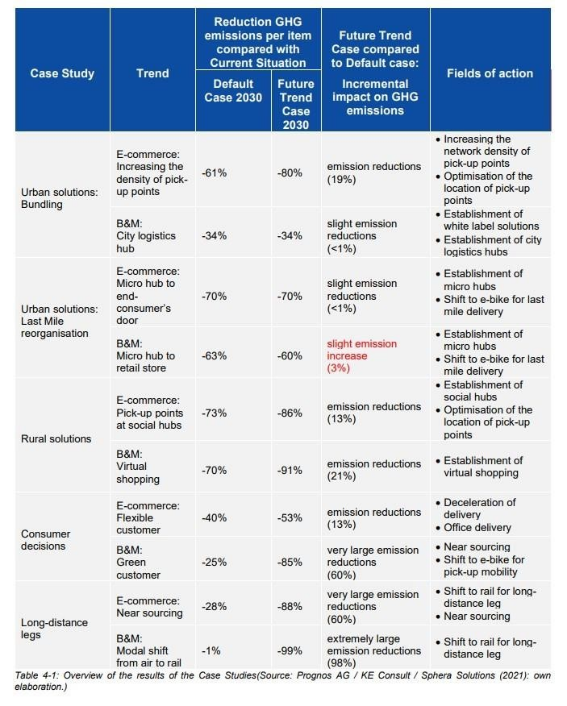
As part of this work, the European Commission found that some consumer facing decisions could deliver moderate decreases in carbon emissions from retail delivery, including increased density of pick-up points, more virtual shopping options for rural consumers, and particularly deceleration of delivery and near sourcing of goods. These options could give consumers greater control and responsibility for their emissions, potentially leading to reduced private car trips and greater use of active and low carbon transport to reduce the emissions impact of purchase decisions.
Given the scale of this issue, now is an opportune time for this issue to be considered in the UK. For UK consumers who buy online, they are often given their choices in terms of price and speed of delivery for goods they want to buy online. However, there is often little information provided to consumers on the carbon emissions that the delivery would produce, nor on the carbon emissions produced by an item purchased.
Policy change
In 2024 Ofcom the UK Government extended the Growth Duty to Ofcom under the new Economic Growth (Regulatory Functions) (Amendment) Order 2024, which means it must consider both economic growth, including environmental sustainability, as part of its regulatory activities under Driver 7, which includes “reporting on the sustainability performance of industry.”[29] This Duty extends to how the postal sector is regulated. For several years Ofcom reported on developments and investment in the sector that were environmentally beneficial, however in its most recent report on the market (published December 2023) this section was removed.[30]
While this section was not reinstated in the 2024 Ofcom annual monitoring report on the postal market, this report included some analysis on consumer views on environmentally sustainable operations. Ofcom outlined that just under half of consumers (46%) reported that they would prefer postal services to be delivered in an environmentally responsible way, even if it took longer for their items to be delivered.[31] However, consumers were less willing to pay extra for their post to be delivered in an environmentally sustainable way. Mentions of environmental sustainability were also not mentioned in the 2025 Ofcom report: Measuring user experience of parcel delivery to residential addresses.[32]
Existing gaps in evidence and need for research
Many of the interventions proposed for consumers in the European Commission’s study are voluntary, which means we require an understanding of the views and willingness of consumers and small businesses to engage with them.[33] For UK consumers, the review of literature and existing evidence on the UK postal market that Consumer Scotland commissioned in 2023 found that there is little research on what consumers and small businesses in the UK currently think about the decarbonisation of the sector.[34] This includes the actions they take to reduce their postal emissions (such as regularly using parcel lockers or batching deliveries), and what their perceptions are of the actions needed to encourage them to adopt more sustainable options. [35]
The existing evidence base suggests that consumers have some interest in more environmentally friendly delivery methods, with one recent research study finding over 70% of UK consumers would choose a carbon-friendly method over the traditional method if it was available.[36] However, nearly 60% of respondents said they would not be willing to pay for that carbon-friendly option.[37]
Similarly, as noted above Ofcom research found just under half of consumers (46%) would prefer postal services to be delivered in an environmentally sustainable way, even if it took longer to be delivered.[38] However, only one-third consumers (35%) agreed that they would prefer postal services to be delivered in an environmentally sustainable way even if they had to pay more.[39] Research for Consumer Scotland in 2023 found that just 13% of consumers in Scotland always opt for an environmentally friendly parcel operators, if available.[40]
These findings are consistent with evidence from other countries. According to research by the International Post Corporation, 32% of cross-border online shoppers surveyed across 39 countries strongly agreed that they would be willing to receive a package a few days later to reduce the environmental impact, an increase of 5% from the previous year. However, fewer customers (12%) had changed their online shopping behaviour due to sustainability concerns.[41]
Consumer Scotland has identified a research gap in how consumers and small businesses in Scotland perceive decarbonisation in the postal sector. This report draws on consumer experience and behaviour when engaging with postal services to understand their perceptions, knowledge, and actions around decarbonisation in this sector. From this evidence, we have made a number of recommendations on how the postal sector in the UK can decarbonise while still centring consumer choice and protection.
International examples
As part of our broader research on the decarbonisation of postal services, we looked at other countries to see what other postal providers were doing in this space. We found two examples, Germany and Denmark, were at the forefront of tracking their emissions, making the data available to consumers, and moving towards total decarbonisation. Their approach could provide useful insights into how the UK postal sector can move towards decarbonisation while maintaining consumer choice and confidence.
Germany and Denmark have made notable progress in decarbonising their national postal services, aligning with broader climate goals. Deutsche Post DHL has committed to achieving net-zero emissions by 2050, with interim targets including a 42% reduction in Scope 1 and 2 emissions and a 25% reduction in Scope 3 emissions by 2030, based on 2021 levels.[42] Denmark’s PostNord is aiming for fossil-free operations by 2030 and has already reduced Scope 1 and 2 emissions by 55% since 2020.[43] Both companies use internationally recognised frameworks such as the GHG Protocol, ISO 14064, and GRI Standards to track and report emissions, ensuring transparency and accountability through annual sustainability reports.
To support these goals, both postal services have developed tools and systems that allow consumers to engage with emissions data and make informed choices.
- Deutsche Post DHL offers the GoGreen and GoGreen Plus services, which include carbon offsetting and insetting (reducing greenhouse gas emissions within the company’s value chain) options.[44] These are integrated into the parcel booking process and visible in customer dashboards, allowing users to track their individual CO₂e impact
- PostNord Denmark provides fossil-free delivery options and uses the Nordic Swan Ecolabel to highlight sustainable choices at checkout.[45] These features are designed to make emissions data accessible and actionable for everyday consumers
The impact of improved consumer information on consumers’ choices is significant. For example, DHL reports that over 50% of its deliveries in Germany are now carbon-free, with one in four parcels delivered using electric vehicles or bicycles.[46] Rail transport options offered by DHL can reduce emissions by over 30% compared to road freight.[47] PostNord’s fossil-free delivery options can cut parcel-related emissions by up to 80%, and 67% of its fleet energy use is now renewable.[48] These statistics demonstrate that when consumers opt for sustainable delivery methods, they contribute directly to national emissions reductions and help accelerate the transition to low-carbon logistics.
By making emissions data visible and offering low-emission delivery options, both Deutsche Post DHL and PostNord Denmark empower consumers to play an active role in climate action. These initiatives not only support corporate sustainability goals but also foster a culture of environmental responsibility among the public. As more consumers choose fossil-free or offset delivery services, the cumulative impact can drive systemic change in the logistics sector, reinforcing the importance of transparency, innovation, and collaboration in achieving climate targets.
3. Methodology
Consumer Scotland commissioned a number of pieces research focused on consumer and small business views of decarbonising the postal sector. These are part of a wider range of research projects Consumer Scotland has commissioned on climate change adaptation and mitigation across the policy areas we work in.
Consumer Scotland commissioned Progressive Partnership, an independent research agency, to undertake qualitative research on consumers’ views and levels of awareness and engagement with issues relating to the decarbonisation of postal services.
Objective and scope
The objective of this research was to examine:
The level of consumer and small business awareness in Scotland of environmental sustainability and the transition to net zero in relation to postal services
- How consumers and small business in Scotland are currently engaging with issues relating to the decarbonisation of postal services
- Their willingness to engage with more environmentally sustainable practices and innovative technological provisions in relation to postal services including identifying any barriers and enablers to this
- How to ensure that any solutions are designed inclusively to ensure that the needs of all consumers and small businesses in relation to environmentally sustainable postal services are met
The definition of ‘consumer’ in the Consumer Scotland Act includes small business and we asked the researchers to explore what action small businesses in Scotland (which we defined as having less than 50 employees) are taking on this issue and their attitudes to environmental issues relating to postal services.[49]
Fieldwork and data collection
Fieldwork took place between 9th January and 13th February 2024. There were 30 consumer participants and 31 representatives from small businesses. All 31 small business participants were responsible for making decisions about postal services within the business. Half of each sample group completed the diary task prior to attending either the focus group if they were a consumer or an interview if they worked in a small business.
The research conducted by Progressive Partnership involved:
- a three-day online diary. The online diary consisted of a series of tasks for consumers and small businesses and was completed by half the sample before they took part in either of the options below. The tasks included sharing experiences relating to using postal services and keeping a diary of their experiences of sending and receiving items.
- online focus groups with consumers, and
- in-depth interviews with people working in small businesses in Scotland
The sample was broad and covered a range of consumers and small businesses across the whole of Scotland. The consumers who participated included nine who lived in urban areas, 11 semi-rural and 10 rural consumers including four who lived in Island communities and an even gender split as far as possible. [50]
The small business sample included 10 urban small businesses. 11 semi-rural and 10 rural small businesses including six island businesses. A wide range of businesses across different industries took part in the research, including:
- wholesale food businesses
- retailers
- gift makers
- estate agents and property factors
- automotive businesses
- manufacturers
- distilleries
- IT businesses
- an agritourism business
- antique sellers
- an art gallery
Our report also heavily utilises additional qualitative and quantitative research commissioned by Consumer Scotland in 2024 on consumers perceptions of and engagement with the transition to net zero:
- The qualitative research was undertaken in March 2024 by Thinks Insight and Strategy and consisted of online community activities, and online focus groups with a total of 57 consumer participants. The Scottish Government’s ISM behavioural tool for moving beyond the individual to also consider the social and material influences on behaviour was used to support the research design, analysis and reporting.[51]
- The quantitative research consists of a survey of consumers’ general attitudes to net zero. The survey research was undertaken by YouGov, and fieldwork was undertaken between 26th February, and 5th March 2024. The sample for this survey was n=2,062 and is representative of all adults living in Scotland aged 16+.
4. Key Findings
Cost, speed and convenience are the key factors shaping consumers’ choices when using delivery services.
Consumers in our qualitative research (Progressive, 2024) on consumer and small business views of decarbonising the postal sector identified a range of factors that research participants consider when ordering items online for delivery. While preferences shifted slightly depending on the urgency and type of item ordered, cost, speed of delivery and the convenience of delivery or drop off location emerged consistently as the most important factors influencing consumer decision making.
Cost
Many consumers found delivery fees frustrating and were keen to secure ‘free’ delivery wherever possible. This was particularly the case where consumers shopped online frequently, as they were mindful of the cumulative effects of regular delivery costs.
The drive for free delivery also stems from some consumers believing that delivery is ‘paying for nothing’ and should be avoided wherever possible.
One rural consumer aged 18-40 said: “I'll always pick free delivery. I'll actually add extra stuff into my basket to get free delivery… I'll not pay delivery if I don't have to because I grudge it. I'd rather pay an extra ten pound of products to get free delivery.”
Retail practices such as offering free delivery above a specified spending threshold may influence consumer purchasing patterns, potentially contributing to increased consumption and associated environmental impacts. Similarly, the provision of free returns can lead to higher volumes of postal activity, which may have implications for carbon emissions. However, these services also play a significant role in facilitating consumer access to goods and services.
Speed
Speed is another important factor for consumers, and some research participants indicated that they seek a next day delivery option for all their online orders. However, consumers regularly weighed up speed versus cost, and some selected longer delivery times for non-urgent items if this was cheaper.
One semi-urban consumer aged 18-40 said: “I'll buy it on [the online retailer] because it's next day delivery because there is a 30-day policy in case something breaks, which is actually quite good […] I sometimes prefer spending those maybe two pounds extra or three pounds extra, but I have next day delivery and I know what I'm getting.”
Convenience
For rural consumers, particularly those living on islands, next day options were less regularly available. For these consumers, concerns around convenience – such as the location of parcel drop-offs, cost, and reliability of the delivery company were more important factors.
Consumers generally were interested in the location of parcel drop-off points and their ability to choose where parcels could be left, particularly if they were not going to be home to receive them. While consumers also regarded the reputation and reliability of a parcel operator as important, they felt that they rarely had the opportunity to exercise a choice in this matter, so it was less commonly considered in their decision-making.
When environmental issues are considered, these are seen as secondary factors rather than key drivers
In contrast to cost, convenience and speed, most consumers in our qualitative research on decarbonising the postal sector said that the environmental impacts of their postal decisions – with the exception of packaging – had never occurred to them previously.
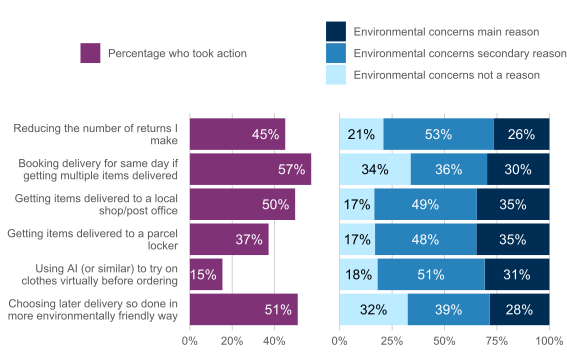
Our net zero perceptions survey (YouGov, 2024) with consumers across Scotland explored a range of actions that consumers may take when purchasing goods online which could be due to environmental reasons. This included ‘batching’ online deliveries, reducing the number of returns or getting delivery to a parcel locker or local pickup. Consumers were asked the extent to which environmental concerns were a factor in them selecting these options.
Figure 4 below shows that consumers do take actions in the use of postal services that could have environmental benefits. However, the data also shows that in the majority of cases environmental concerns were not the main reason for consumers taking that action.
Figure 4: Environmental concerns are not normally the main reason for taking actions that may reduce emissions from postal services.
Percentage of participants taking actions, and their stated reasons for taking those actions
Base: All who purchased products online in the last year (n = 1932)
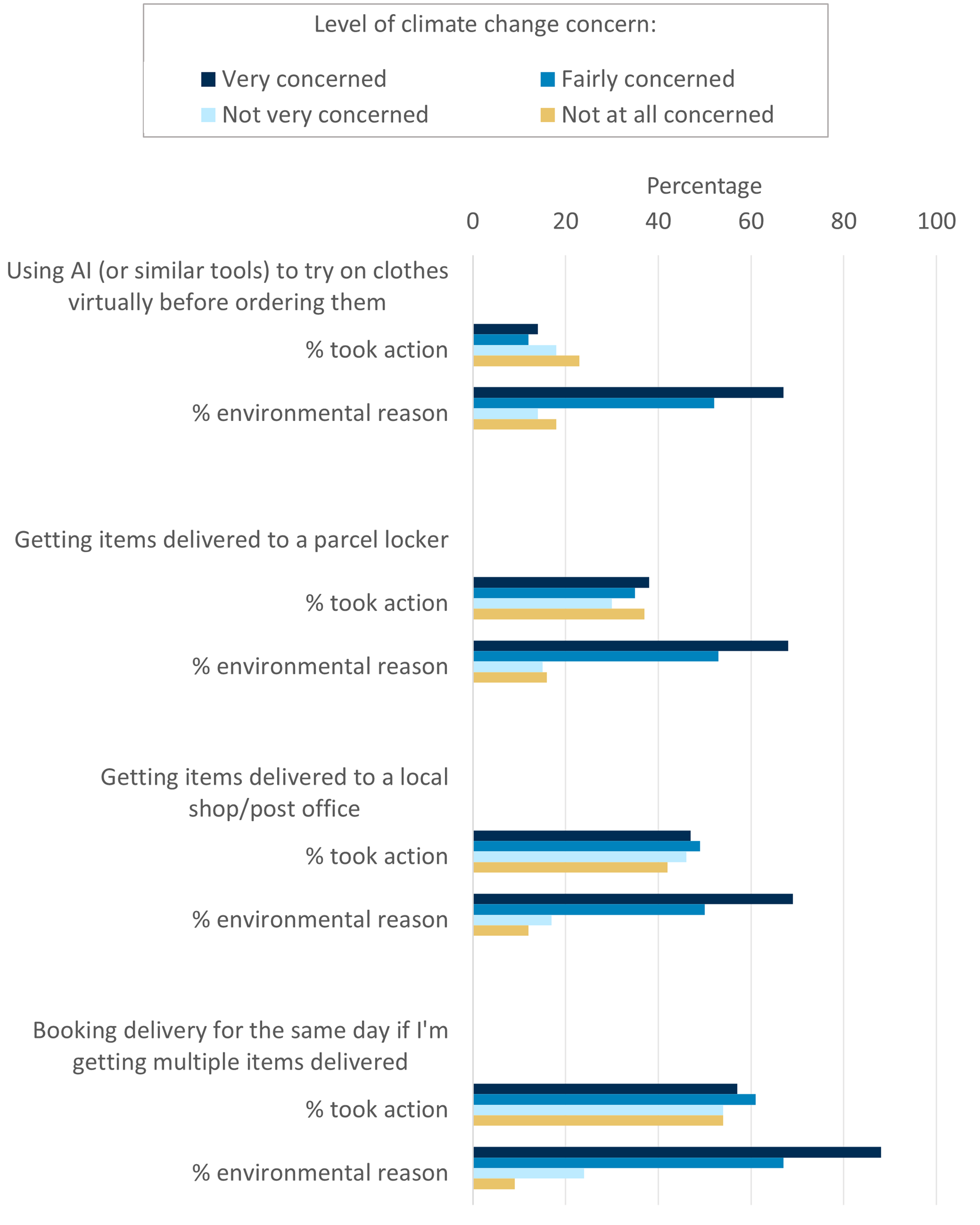
When responses to this question are analysed further, to consider the responses set against the respondents’ level of concern about climate change, we find that generally those who are more concerned about climate change are not actually statistically significantly more likely to take these actions – they are just more likely to say that environmental concerns were a (main or secondary) reason (Fig. 3). This suggests that concern about climate change may not currently be a driver of behaviour change among those who are more concerned about the environment.
Figure 5: Those who are more concerned about climate change are not more likely to take actions that reduce carbon emissions from post, but are more likely to report environmental concerns as a reason when they do
Percentage of respondents who took the specified action and the percentage of those who reported that environmental concerns were a reason for doing so, by level of concern about climate change
Note: See Annex for a full version of this chart
Base: All who purchased products online in the last year (n = 1932)
These findings complement the findings from our qualitative postal research (Progressive, 2024). Most participants who took part in that research do not currently consider environmental factors when using postal services. While some consumers who took part in the qualitative research mentioned using more sustainable options such as postal lockers, grouping together deliveries or selecting recyclable packaging, they considered any environmental benefits of their choices to be secondary benefits, rather than primary drivers.[52]
Similarly, our cross-market qualitative research also found that consumers valued cost and convenience over environmental factors, leading them to opt for affordable and readily available options despite knowing the carbon implications (Thinks, 2024).
This means that any changes that parcel operators made around emissions would be more effective if they followed the framework outlined earlier, ‘the Four C’s’ of: cost, convenience, clarity, and confidence. From our qualitative research, cost and convenience are important to respondents for their postal needs. More than that, any changes need to be made clear to consumers so they can make informed choices. This would enable them to see the benefits of their actions and have confidence in their choices as consumers in the postal market.
Consumers may be willing to give greater consideration to sustainability in their decisions about deliveries – as long as the trade-off works for them
Participants in our qualitative postal research (Progressive, 2024) indicated that they were willing to trade off some aspects of convenience and cost of the service to gain more environmentally friendly deliveries. Many participants stated they were willing to adopt more environmentally sustainable options, but some qualified this by saying they would only do so if there was no impact on cost or delivery time, or if an appropriate balance was struck.
One rural consumer aged 41-60 said: “Given I try to be sustainable in other parts of my life, I'd like to see it as important, but it's probably way down on the list underneath convenience and all the rest of it. If someone is going to say to me it's a couple of quid less to send something in a less sustainable way, I probably would do that.”
One rural small business said: "I would be more likely to use it, I would definitely take the brunt of an increase in cost, if that was an option I'd definitely do it… if it was 10% more cost and 10% more sustainable I'd go for it."
Cost-related trade offs
The view many held was that environmentally friendly delivery options were often more expensive than other options (Progressive, 2024). For those in rural and island areas, respondents commented they were often subject to higher delivery charges and so would be very reluctant to further increase their delivery costs.
Any legislative changes or policy recommendations would have to take into account rural and remote contexts, especially in Scotland. Additional protections may be required to ensure that any burden of additional costs is not placed on rural consumers who already pay surcharges for delivery.
Rural and remote consumers
Across our research, respondents commented they were often subject to higher delivery charges and so would be very reluctant to further increase their delivery costs.
Given that there are broader issues faced by rural and remote consumers, careful consideration of rural contexts is needed when considering any policy or operational changes which may impact cost and speed. It may mean that protections are needed to ensure that the burden of any additional costs is not placed on rural consumers.
While consumers would be reluctant to pay extra costs for more sustainable deliveries, a survey by the Retail Technology Show reported that 75% of consumers thought retailers could do more to be sustainable.[53] The survey found that 67% of UK consumers believed making fulfilment carbon-neutral was the main ways they could improve green retailing. Additionally, 50% were in support of online retailers being taxed to offset their carbon emissions from delivery.
Responsibility
Based on the Retail Technology Show evidence, consumers view a large share of the responsibility for carbon emissions as sitting with the retailer, rather than with themselves.[54] This was mentioned in our research (Progressive, 2024), where respondents stated that it was up to large companies and parcel operators to create change, as the results of individual change would be minimal by comparison.
Speed-related trade offs
Some consumers were willing to trade off speed for more environmentally friendly delivery solutions. Participants were more flexible around delivery times, and while they were typically keen to receive their items as quickly as possible, some were prepared to wait longer for non-urgent items. For those choosing a later delivery date, around half (51%) chose this option to ensure items are delivered in environmentally friendly ways (Progressive, 2024).
However, quality of service was crucial for all participants, with items arriving at the scheduled delivery time being regarded as particularly important. Those consumer participants living in rural and island locations often noted they had to wait a few days for their deliveries and that another day or two may not make much difference. They would, however, generally prefer an improvement to delivery times.
Convenience-related trade-offs
In our quantitative research, over half (57%) of consumers book their deliveries of multiple products (‘batching’) for the same day, with 1 in 3 saying they did this for environmental concerns (YouGov, 2024). Some participants appreciated the secondary environment benefits from their decision. Our qualitative postal research found that it was mainly for convenience that consumers used batched delivery - with consumer participants aligning delivery with days they would be home or at their place of business.
One rural consumer aged 18-40 said: “I've seen myself altering my order so that everything comes in the same day, but it's the day I want it to be… and it’s good that it helps the environment.”
Our quantitative research found that 1 in 3 (37%) get items delivered to a parcel locker (YouGov 2024). There were mixed experiences of consumers using these lockers, with younger respondents living in towns and cities most likely to use these. Respondents also pointed out that it may not be as environmentally friendly if multiple people were having to drive to the lockers – the carbon emissions were just being passed on. While parcel lockers could be more convenient, consumers were not clear if these necessarily led to less emissions.
Several consumer respondents mentioned using lockers for online marketplaces for both sending and receiving items. Parcel lockers have become important tools for the second-hand goods market, with some marketplaces using locker services for consumers sending and receiving goods. Seven in 10 (68%) have bought second-hand goods in the last year, with 1 in 2 (49%) citing environmental reasons for doing so (YouGov, 2024).[55]
However, for most people, lockers did not provide any benefits over standard delivery as home delivery was more convenient.
One rural consumer aged 18-40 said: “What exactly is the benefit of those lockers? Because surely, they're still having to drive and deliver them there? So, I don't understand. I suppose people who live in a town centre who can walk there, but me personally, and obviously by the sounds of it, everybody else here [in the focus group] doesn't have one locally. So, to get there, you're going to have to drive there. So, you're also doing those miles that the driver would've originally done. So, what difference does it make?”
Many decisions about deliveries sit outside of consumers’ control and they feel unclear about the environmental impact of any action they might take
Participants in our qualitative postal research highlighted that they have a limited role in determining the overall sustainability of their deliveries (Progressive, 2024). Participants felt that they are currently unlikely to be able to choose the type of packaging that is used, the parcel operator carrying out the delivery or the vehicle type used. This lack of consumer choice meant that they felt they had very little ability to make meaningful changes to carbon emissions. For consumers in remote and rural areas, choices are likely to be even more limited because of the smaller number of operators that deliver to their area.
Even if consumers were more empowered in these choices, some felt that these issues were of only marginal importance, compared to other factors associated with production and delivery. They felt that greater ownership of these challenges resided with retailers and parcel companies, who could make impactful decisions such as deploying electric vehicles or make batched deliveries the standard.
In addition, some consumers felt that there would only be value in making changes to their own decisions if everyone else did likewise, otherwise they were concerned that they would incur personal costs with minimal overall impact.
Personal satisfaction was cited by some consumers as a motivating factor for making more sustainable decisions:
One urban consumer aged 18-40 said: “a feelgood factor when you do something that’s eco-friendly”
However, there was also a sense that the limited impacts of these choices diminished this sense of satisfaction. Even highly environmentally and active participants in our cross-market consumer research (Thinks, 2024; YouGov 2024), who reported choosing options such as batching or drop off points for deliveries wherever possible, questioned whether the impact of their choices made a significant difference.[56]
Better consumer information could help consumers to engage further with environmental concerns when making decisions on deliveries
Consumer Scotland’s cross-market qualitative and quantitative research found that consumers have little understanding of net zero terminology (Thinks, 2024; YouGov, 2024). However, four in five (79%) online shoppers expressed interest in receiving information on the sustainability of delivery options during the ordering process, with 65% wanting this information before making a decision.
Qualitative postal research found that consumers are currently unable to compare companies or assess the impact of measures such as using electric vans (Progressive, 2024). Consumers who wanted to change their postal service habits valued concise, relevant information about sustainable options at the point of order, noting that generic messaging was unlikely to influence their choices.
Participants suggested that user-friendly, jargon-free information would help them weigh environmental costs against speed and price. Some proposed a traffic light-style system, like food labelling, to indicate how climate-friendly different postal options are.
One rural consumer aged 18-40 said: “Usually you see a bit of CO2 stuff, it is just a lot of jargon unless you've got a right interest in that background. It is a little waffle for me. So as long as it was something that explained like what sustainability benefits are and like, we can do this, we can do that, it'd be something for me to consider.”
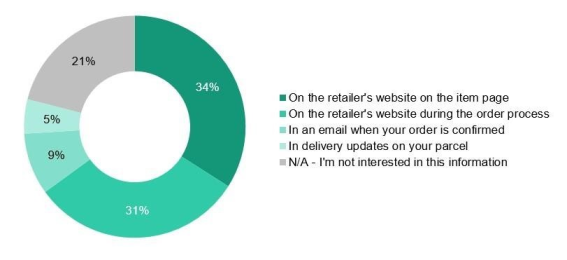
It is important for consumers that information on the comparative sustainability of different delivery options is provided at the right point in the decision-making process. Generally, this will be when selecting the delivery option on the retailer’s website, as illustrated in Figure 6 below (YouGov, 2024).
Figure 6: Most consumers want to see information on carbon emissions on the retailer’s website
Preferred location of information on the carbon emissions related to purchase when ordering products online.
Base: All who purchased online products in the last year (n=1,931)
Some consumers also identified parcel delivery comparison websites as another place where information on sustainability could be provided, alongside information on cost and delivery time/speed, to allow consumers to weigh up the pros and cons of the different options. Our cross-market research (Thinks, 2024) also highlights this, suggesting that consumers tend to choose pre-selected options, and so choosing certain delivery options becomes habit. If retailers were to change the choice architecture of their delivery options, and provide salient information to consumers, this could precipitate a change in behaviour.
However, consumers did identify some challenges and risks with information provision about sustainable delivery options. Respondents were clear that the information about sustainable delivery options would need to be accurate and come from a trustworthy source. This would allow consumers to be able to discern whether their choices were effective, rather than participating in ‘greenwashing’.
Additionally, some questioned whether the information might be misunderstood, or that it might lead to feelings of guilt amongst those who were not able to afford a (potentially more expensive) sustainable option. It is important to consumers that information is accurate and reliable, and some suggested there may be merit in an external body verifying the information provided.
One urban consumer aged over 41 said: “So if I knew if it was a good [sustainability] rating, the additional cost was marginal, and the extra cost was to go to a sustainable option, I would be quite tempted to go with it... And I know you’ve got an independent assessment that says this is a definitely a more sustainable option and I would be much more inclined to go for that. I might not do it all the time. I might be feeling particularly tight one day or whatever, but those are the kind of things that would help me.”
There is scope for consumers to have greater engagement with the provision of environmentally friendly packing
Based on our quantitative research (YouGov, 2024), there is significant consumer interest in environmentally friendly packaging, with 1 in 3 (36%) of consumers reporting that they avoid buying a product containing non-recyclable or single use packaging, and the same proportion (35%) indicating that they chose to buy a product based on whether its packaging was reusable and recyclable.
Those consumers who avoided buying non-recyclable/single-use plastic in the last year raised concerns about:
- the material ending up in landfill (65%)
- packaging taking a long time to decompose (55%)
- packaging ending up in the ocean (51%)
These figures were higher than the proportion of consumers concerned about the contribution of non-recyclable packaging to carbon emissions, with only 30% citing this as a concern.
Consumers in our qualitative postal research raised further concerns about different aspects of packaging (Progressive, 2024):
- Many consumers were concerned that retailers and delivery companies used too much packaging, although they recognised that there were circumstances in which this was necessary to protect fragile items.
- Some consumers were concerned that in some circumstances no packaging was used, with labels instead placed on the product directly. They recognised the environmental benefits of this but did not feel it was the right solution for all deliveries.
- Overall, however, consumers do not feel that they have any choice with regards to how their items are packaged, with a perception being that these are decisions taken by either the retailer or the parcel operator.
One semi-rural consumer aged 60+ said: “It’s out of my hands. I don’t think I can contact the supplier and say: ‘Don’t send it in plastic’.”
Small businesses navigate a range of factors when determining the importance of sustainability in their use of postal services
Some small business participants who took part in our qualitative research indicated that they had adopted sustainable business models and had incorporated sustainability across their operations, including when using postal services (Progressive, 2024). For example, this included making use of packaging material from other local businesses, or sourcing materials and products from low emission companies.
Cost, Speed and Quality of Service
For other small businesses cost and speed were valued more highly. Respondents stated that they often chose to use faster delivery options to meet customer expectations. Some small business respondents felt they needed to deliver items to customers fast to ensure their service could compete with large multinational businesses which are able to provide next day delivery on their items.
One semi-rural small business said: "As a small business, cost comes at the top of the list for me and for customers…I don't want customers waiting so I often pick next day delivery."
One semi-rural small business said: "For me sustainability would come first, for my customer I think it comes last."
Meanwhile for some small business participants, quality of service was a key driver. Their prime concern was that goods should arrive when expected, rather than actual speed of the delivery.
Sustainable Measures
A number of small business participants mentioned that sustainable packaging was important for them. Some used recycled and recyclable packaging for sending items, some asked for packaging from other local businesses who do not have a use for it and several re-used their supplier’s packaging.
One semi-rural small business said: “We only use reused packaging, I only use boxes, bubble wrap, that has used before, I chap [knock on] my neighbour’s door and actively go and collect packaging.”
In terms of other environmentally beneficial measures, participants noted that activities such as batching orders or buying in bulk were primarily done for efficiency savings rather than for environmental benefits.
Further Measures
However, it should be noted that small businesses who participated in the qualitative research had enabled them to think about further actions they could take for future sustainability (Progressive, 2024). Several participants suggested that policy changes such as financial incentives, accreditation, business support, and further information would allow them to move forward with more environmentally friendly delivery models.
Respondents wanted information on the impact of sustainable options, such as carbon emissions information. Some wanted this information to be presented from a local or industry perspective, with regular updates to make the impact more meaningful. This could be shared on their website and would allow consumers to make more informed choices.
One semi-rura small business said: "I want to see an everyday comparison - if it says so many tonnes of CO2, what does that mean? If it's jargon there's no point in sharing it."
As with individual consumers, small business owners wanted sustainable delivery information to be up front and available – as they had limited time to look for the information themselves. To have this would make it easier for them to compare their options and allow them to make more sustainable choices going forward.
One semi-rural small business said: "I would like to know how it's more sustainable, for example if they use electric vehicles…and I would want the information in advance. If I am comparing companies and one says they're more sustainably I would look at that favourably"
There are social, behavioural, and economic barriers to changing to more environmentally sustainable delivery options
As part of our cross-market research (Thinks, 2024) several barriers were identified which impact people’s choices when it comes to choosing sustainable delivery. Identifying these barriers is important in understanding how consumers engage with parcel operators, as well as in understanding what behavioural changes need to occur to move towards a decarbonised postal service.
Moreover, this research also suggested ways that these barriers could be overcome, drawing on a co-creative approach with respondents drawing on their experience of postal services.
Barrier 1: consumers tend to choose the quickest option, so behavioural change is needed
The first barrier is the habit to choose the quickest delivery option. As has been seen throughout this report, consumers prioritise speed of delivery for their items. Our qualitative research with Progressive (2024) identified that consumers will choose pre-selected delivery options and the highlighted option is usually the quickest delivery option.
Consumer Suggestions:
Alter the choice architecture of online shopping platforms to prompt consumers to choose more sustainable delivery options.
Example:
- having the most sustainable option be the default,
- having pop-ups that suggest visiting in-store if the item is in stock locally
- showing how many other shoppers chose a sustainable delivery
Consumer Scotland would highlight that any change in consumer choice architecture must be beneficial and avoid causing harm to consumers in line with the Digital Markets, Competition and Consumers Act 2025.[57]
Barrier 2: Lack of knowledge or awareness of environmental impacts
Another barrier identified in our cross-market work (Thinks 2024) is the lack of knowledge or awareness about the environmental impacts of deliveries. For consumers to make informed choices and potentially alter their behaviour, they need access to accurate information.
Both the Thinks (2024) and Progressive (2024) research has highlighted the current lack of awareness of sustainable options, and that there is a need for information which is noticeable, relevant, and draws the attention of the consumer when choosing delivery options.
Consumer Suggestions
A communications campaign on sustainable delivery options may be necessary to properly inform consumers about emissions – although who would take responsibility for such a campaign was not identified.
Raising awareness of the carbon cost of online shopping creatively could emphasise the environmental issues of order fulfilment and give consumers the knowledge to make an informed choice.
Consumers would like to have easy information available at point-of-sale, but there should also be an investment in local collection points, parcel lockers, or final-mile cargo (e)bike deliveries. These delivery options should be accessible and convenient so people can change their behaviour with limited effort.
5. Conclusion
The decarbonisation of postal services in the UK is a critical step toward meeting national UK (2050) and Scottish Government (2045) targets for net zero emissions. With over 10 billion items sent through the post in 2023-2024, the sector contributes significantly to carbon emissions, making sustainable delivery practices a key issue in the future evolution of the market.[58] Consumer Scotland’s research highlights that both consumers and small businesses are increasingly aware of environmental impacts, yet cost, speed, and environmentally friendly packaging remain higher priorities for consumers than delivery -related sustainability. This indicates that while there is interest in greener options, practical considerations often outweigh environmental concerns in consumer decision-making at present.
To accelerate progress towards decarbonisation of the postal sector, policy and regulatory interventions should address these barriers by promoting affordable, efficient, and transparent low-carbon delivery solutions. Consumers and businesses expressed willingness to adopt sustainable options if they were competitively priced and clearly communicated. Considering this, Consumer Scotland’s Four C’s framework could help decision-makers to create consumer-centred decarbonisation policies which would have a positive impact for everyone. For example, measures such as incentivising green parcel deliveries, improving information on carbon impacts, and supporting innovation in packaging could help shift behaviours. Ultimately, decarbonising postal services will require collaboration across industry, government, and consumers to balance environmental goals with quality of service, cost to consumers, and speed of delivery.
6. Annex
Climate change concern, and consumer actions and motivations in postal services
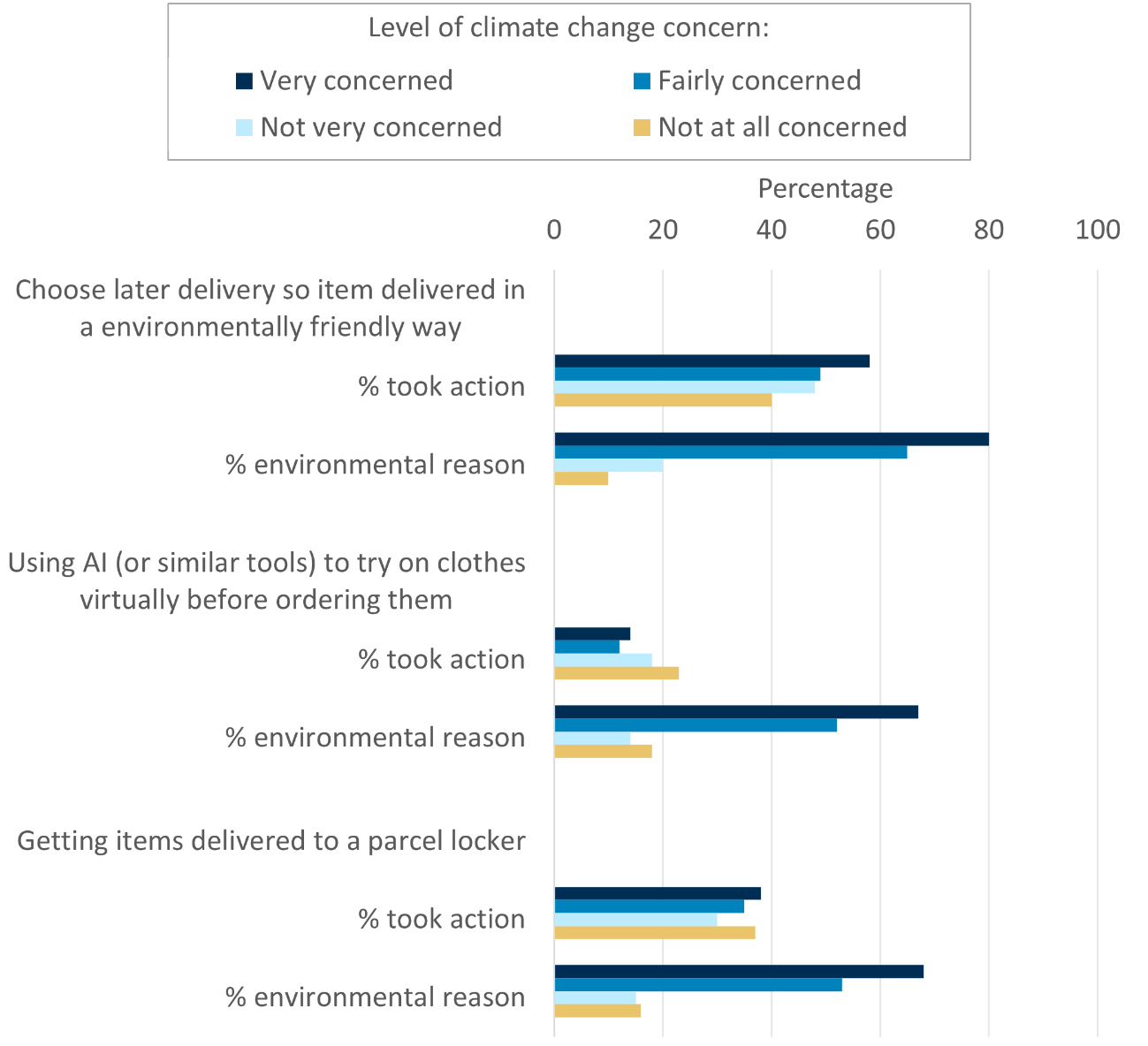
Question 15 in the survey asks, for 6 actions related to online shopping, whether respondents took the action and separately, for those who did, the extent to which the action was environmentally motivated. This allows us to explore the relationship between climate change concern, actions and motivations. We can look separately at the association between climate change concern and taking a particular action on one hand, and the association between climate change concern and the stated reason for taking that action on the other. Doing so reveals a nuanced picture.
Figure 7 divides the survey respondents into groups based on their response to Question 1, their level of concern about climate change. For each of these four groups (very concerned, fairly concerned, not very concerned, not at all concerned) the proportion who took each specified action is calculated, along with the proportion of those who stated that environmental concerns were a (main or secondary) reason for taking that action.
Some people take these actions for reasons other than environmental concerns. Many do not report that environmental concerns were a reason for acting in the ways set out, so they must have done so for other reasons. Moreover, it is notable that there is no clear association across the charts between level of concern about climate change and the likelihood of taking the specified actions. If concern about climate change motivated sustainability-focused actions we would expect to see that association in the data. However, this does not seem to be the case.
On the other hand, there is a clear association, among those who did take the actions, between level of concern about climate change and reported reason for taking the action. In other words, those who are more concerned about climate change are no more likely to take these actions, but they are more likely to say environmental concerns were a reason when they did take the action.
One interpretation of this pattern is that those who report taking the action for environmental reasons would have taken the action anyway if climate change was not a concern. This entails that there are other reasons that people to take these actions, and it could be argued that these reasons are the necessary condition for consumers’ actions, with environmental motivations being additional to those reasons. In other words, when presented with a choice between two options consumers are likely to choose the more sustainable option unless they have a reason to do so other than climate change.
Figure 7: Those who are more concerned about climate change are not more likely to take actions that reduce carbon emissions from post, but are more likely to report environmental concerns as a reason when they do
Percentage of respondents who took the specified action and the percentage of those who reported that environmental concerns were a reason for doing so, by level of concern about climate change
Base: All who purchased products online in the last year (n = 1932)
Responses to other questions in the survey seem to support the idea that while concerns about climate change may be reported as motivating factors, they don’t seem to produce greater levels of action. Question 16 asks how often respondents took each of three explicitly sustainability-motivated actions in the last year, and the results show that those who are more concerned about climate change are more likely to have taken these actions – which have an environmental motivation ‘built in’. Figure 8 shows an example of results from Q16.
Figure 8: When an environmental motivation is ‘built in’ to an action, those more concerned about climate change are more likely to report taking that action
Frequency of choosing to order from retailers that state that their packaging is sustainable, by level of concern about climate change.
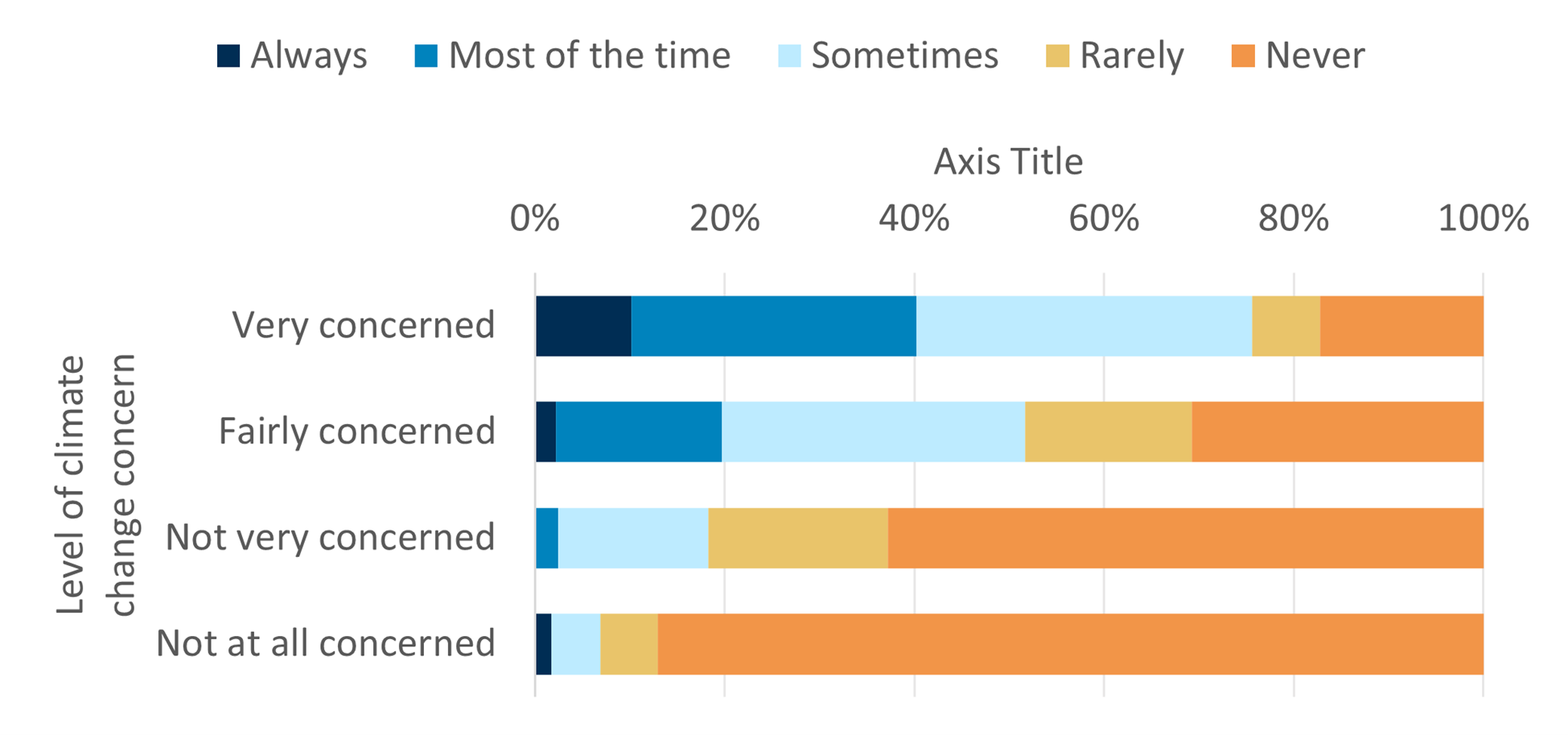
Note: The question asked was: “Thinking about the last year, please indicate to what extent, if at all, you did each of the following when ordering products online: Chose to order from retailers that state that their packaging used for delivery is sustainable”
Base: All who purchased products online in the last year (n = 1932)
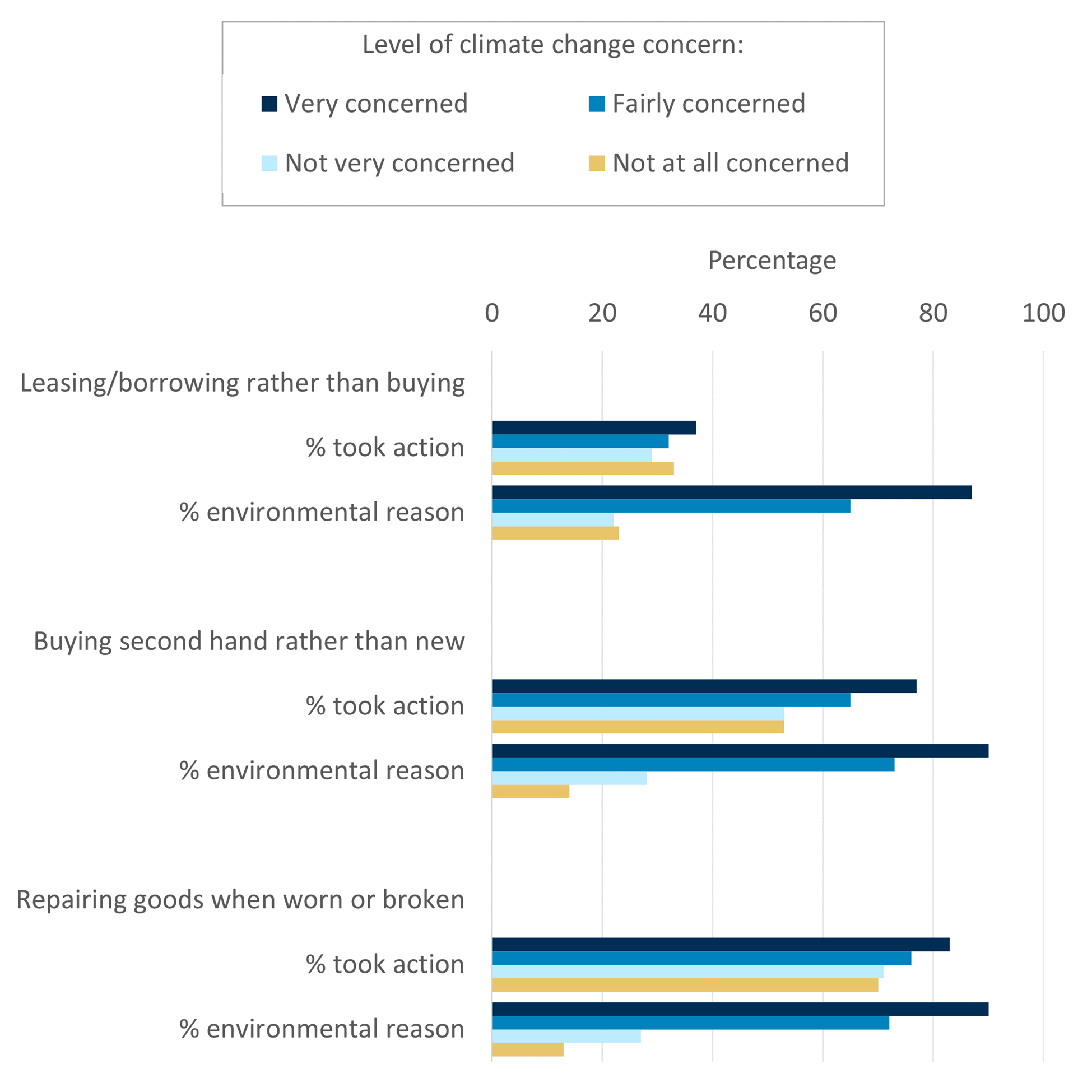
However, where motivation and action are separated in the question, as in Question 15, we get similar results. Question 9 uses the same format as question 15, but for actions related to the idea of a circular economy. Again, we can see that while level of concern about climate change is strongly linked to the reported reason for these actions, there is far less of an effect on the likelihood of taking action (Fig. 9).
These findings suggest that, if consumer action is to be a significant part of efforts to decarbonise the economy, sustainable choices need to be made more attractive than unsustainable choices. Most people are already concerned about climate change, but that does not seem to have a substantial effect on the choices they make as consumers.
Figure 9: Climate change concern is only weakly linked to likelihood of taking actions related to a circular economy
Percentage of respondents who took circular economy related actions, and the percentage of those who reported that environmental concerns were a reason for doing so, by level of concern about climate change
Base: All who purchased products online in the last year (n = 1932)
7. Endnotes
1] Is the also statutory consumer advocacy body for consumers of postal services in Scotland.
[2] Section 2(1)(d) states that Consumer Scotland’s functions include promoting – (i) sustainable consumption of natural resources, and (ii) other environmentally sustainable practices, in relation to the acquisition, use and disposal of goods by consumers in Scotland. Section 7(6) states that Consumer Scotland “must have regard to the environmental impact of the actions of consumers.
[3] Consumer Scotland (2023) Strategic Plan 2023-2027 (HTML) | Consumer Scotland
[4] Consumer Scotland (2025) Publications | Consumer Scotland
[5] Consumer Scotland (2025) A consumer framework for addressing climate change - toolkit for policymakers (HTML) | Consumer Scotland
[6] Consumer Scotland (2025 A consumer framework for addressing climate change - toolkit for policymakers (HTML) | Consumer Scotland
[7] Gov.UK (2023) Transport Statistics Great Britain: 2023 Freight - GOV.UK; Pegasus Couriers (2025) UK Parcel Delivery Guide: How Your Package Travels| Pegasus Couriers
[8] Ofcom (2024) https://www.ofcom.org.uk/siteassets/resources/documents/postal-services/monitoring-reports/2023-2024/post-monitoring-report-2023-24.pdf?v=384016
[9] Ofcom (2015) https://www.ofcom.org.uk/siteassets/resources/documents/postal-services/monitoring-reports/annual_monitoring_update_2014-15.pdf
[10] Ofcom (2025) https://www.ofcom.org.uk/postal-services/information-for-the-postal-industry/monitoring_reports
[11] Office for National Statistics (2024) https://www.ons.gov.uk/businessindustryandtrade/retailindustry/bulletins/retailsales/january2024; Centre for Retail Research (2024) https://www.retailresearch.org/online-retail.html#:~:text=Britain%20had%20the%20largest%20online,14.9%25%20over%20the%20same%20period; House of Commons Library (2025) https://researchbriefings.files.parliament.uk/documents/SN06186/SN06186.pdf
[12] Scottish Government (2021) https://www.gov.scot/publications/scottish-greenhouse-gas-statistics-2021/pages/3/
[13] Eco Skills Academy (2025) SECR Reporting Guide 2025: UK Business Compliance Rules
[14] Eco Skills Academy (2025) SECR Reporting Guide 2025: UK Business Compliance Rules
[15] Gov.UK (2019) Environmental reporting guidelines: including Streamlined Energy and Carbon Reporting requirements - GOV.UK (www.gov.uk)
[16] Greenhouse Gas Protocol (2013) https://ghgprotocol.org/sites/default/files/2023-03/Scope3_Calculation_Guidance_0%5B1%5D.pdf
[17] Journal of Cleaner Production (2018) https://www.sciencedirect.com/science/article/abs/pii/S0959652618306528
[18] EKOS/Consumer Scotland (2023) https://consumer.scot/media/c2nf0nnp/review-of-the-literature-and-policy-on-the-uk-postal-market.pdf; Ofcom (2022) https://www.ofcom.org.uk/siteassets/resources/documents/postal-services/monitoring-reports/financial-year-2021-22/annual-monitoring-update-postal-market-2021-22.pdf
[19] PostEurop (2025) Royal Mail cuts emissions per parcel by 20% in 2024-25 - PostEurop; Royal Mail (2025) royalmail.com/sites/royalmail.com/files/2025-07/RMG-ESG-Report-2024-25.pdf
[20] Retail Times (2025) 115 million parcels processed through UK lockers as out-of-home delivery gains ground
[21] Consumer Scotland (2024) Consumer perceptions of and engagement with the transition to net zero HTML | Consumer Scotland
[22] Retail Times (2025) 115 million parcels processed through UK lockers as out-of-home delivery gains ground
[23] Pedal and Post (2025) Pedal & Post Launches in London – Pedal & Post
[24] Energy Savings Trust (2020) EST007-01-ESTDFT-Electrifying-last-mile-deliveries-guide-WEB-02.pdf
[25] European E-commerce (2024) CMI2024_Complete_light_v1.pdf
[26] European Commission (2021) https://op.europa.eu/en/publication-detail/-/publication/f27d8740-49e3-11ed-92ed-01aa75ed71a1?utm_source=chatgpt.com
[27] European Commission (2021) https://op.europa.eu/en/publication-detail/-/publication/f27d8740-49e3-11ed-92ed-01aa75ed71a1?utm_source=chatgpt.com
[28] European Commission (2021) https://op.europa.eu/en/publication-detail/-/publication/f27d8740-49e3-11ed-92ed-01aa75ed71a1?utm_source=chatgpt.com
[29] Growth Duty Statutory Guidance (2024) https://assets.publishing.service.gov.uk/media/66476caebd01f5ed32793e09/final_growth_duty_statutory_guidance_2024.pdf
[30] Ofcom (2023) https://www.ofcom.org.uk/__data/assets/pdf_file/0032/272795/post-monitoring-report-2022-23.pdf
[31] Ofcom (2024) Post Monitoring Report 2023-24
[33] European E-commerce (2024) CMI2024_Complete_light_v1.pdf
[34] Consumer Scotland (2023) UK Postal Market Literature and Policy Review | Consumer Scotland
[35] There was some external quantitative research on consumers’ willingness to pay extra for sustainable delivery or their willingness to wait longer for a delivery, there was little existing qualitative evidence on the consumers’ awareness of environmental issues in relation to postal services or on their willingness to engage with more environmentally sustainable practices in relation to this market what consumers currently think about the decarbonisation of the sector, relation to postal services to reduce their postal emissions and their perceptions of the actions needed to encourage them to adopt more sustainable options in relation to postal services.
[36] IMRG (2021) UK Consumer Home Delivery Review 2021
[37] IMRG (2021) UK Consumer Home Delivery Review 2021
[38] Ofcom (2024) https://www.ofcom.org.uk/siteassets/resources/documents/postal-services/monitoring-reports/2023-2024/post-monitoring-report-2023-24.pdf?v=383938
[39] Ofcom (2024) https://www.ofcom.org.uk/siteassets/resources/documents/postal-services/monitoring-reports/2023-2024/post-monitoring-report-2023-24.pdf?v=383938
[40] Consumer Scotland (2023) the-universal-postal-service-consumer-scotland-insight-report.pdf
[41] Cross-border E-commerce Shopper Survey (2024) https://www.ipc.be/services/markets-and-regulations/cross-border-shopper-survey
[42] DHL Group (2025) Environment - DHL Group
[43] PostNord (2025) Heavy transport: Towards a fossil-free future | PostNord
[44] DHL Group (2025) GoGreen Plus | DHL EXPRESS
[45] PostNord (2025) Nordic Swan Ecolabel for e-commerce logistics | PostNord
[46] DHL Group (2025) Sustainable parcel shipping - joining forces for the good of the environment | DHL Paket
[47] DHL Group (2025) Rail transport service | DHL
[48] PostNord (2024) We manifest climate leadership | PostNord & PostNord is one of Europe’s Climate Leaders | PostNord
[49] Including what steps could be taken to motivate them to adopt more sustainable postal delivery options.
[50] Location was classified using the Scottish Government’s Urban Rural Classification (2020) https://www.gov.scot/publications/scottish-government-urban-rural-classification-2020/pages/2/
[51] Gov.UK (2013) https://www.gov.scot/publications/influencing-behaviours-moving-beyond-individual-user-guide-ism-tool/
[52] Packaging was the issue most raised by many consumer participants – with either too much or too little packaging both being reported as issues.
[53] Retail Times (2023) Half of UK shoppers support online delivery taxes to carbon-offset fulfilment emissions
[54] Retail Times (2023) Half of UK shoppers support online delivery taxes to carbon-offset fulfilment emissions
[55] Consumer Scotland (2024) Consumer perceptions of and engagement with the transition to net zero | Consumer Scotland
[56] Consumer Scotland (2024) Consumer perceptions of and engagement with the transition to net zero | Consumer Scotland
[57] Hausfeld (2025) A wake up call for online retailers as CMA tackles misleading choice architecture |
[58] Ofcom (2024) Post Monitoring Report 2023-24