1. Executive Summary
Background
Financial service providers deliver vital, essential services to consumers in Scotland, enabling them to participate in society and to contribute to the country’s purposeful economic growth.
Many consumers are able to engage with the financial products and services they need in a way that works well for them. However, there are also areas where the financial services market does not work as well as it should for some consumers. In these areas, a range of actions are required to ensure that all consumers in Scotland have effective, equitable access to key products and services.
This report presents the findings from Consumer Scotland’s initial scoping of how effectively financial services meet consumers’ needs. Based on this analysis, we have developed a number of key messages and recommendations, and identified several areas for potential future work to improve outcomes for consumers in financial markets.
Banking and cash access
Some consumers in Scotland don’t have the access that they need to banking and cash services. This includes access to basic bank accounts, banking products and facilities and access to cash withdrawal and deposit facilities.
Research by Which? has shown that Scotland was the first part of the UK to see over half of its bank and building society branches close, with 751 of 1,041 branches closed between January 2015 and the end of 2025 and another 13 due to close as of July 2026.[1]
The distinctive nature of Scotland’s geography can mean that bank branch closures, and the associated reduction of access to cash and physical banking facilities, can have significant, negative impacts on rural and island communities. Older people, disabled consumers and small businesses can also be particularly affected.
Access to cash remains important, with approximately 6%, or just over 280,000 consumers in Scotland, depending on access to cash. The Financial Conduct Authority (FCA) has put in place rules to address the cash access needs of consumers and businesses which require designated firms to address gaps in local cash provision. These rules came into force in September 2024 and the FCA has committed to reviewing this framework later this year.
Separately, HM Treasury has commissioned an independent Review on Access to Banking Services to assess how changes to in-person banking services are affecting consumers. It will be important that this review brings forward actions that strengthen protections on the availability of in-person banking to ensure these services can be easily accessed by all consumers who require them.
Around 2% of consumers are ‘unbanked’. The cost of not having a bank account can be an extra £500 a year. Without access to a bank account, everyday tasks can become challenging and paying for essentials such as insurance and energy bills can cost more. This can in turn reduce access to credit and create barriers to employment.
Many banking products are designed to be digital by default, heightening the risk of some consumers becoming increasingly financially excluded due to digital exclusion. Given the relatively poorer levels of digital connectivity in Scotland when compared to most other parts of the UK, this can disproportionately impact consumers in Scotland, particularly in rural and island areas.
Financial Inclusion
Financial inclusion activity in Scotland is delivered across a number of different policy areas, including anti-poverty work, financial services, digital inclusion, advice provision, and education.
The UK Government’s Financial Inclusion Strategy sets out its approach to improve financial inclusion and wellbeing across the UK. Much of the strategy activities will benefit consumers in Scotland, however certain measures and investments will only cover England and Wales resulting in a relative gap in provision in Scotland. This follows on from the longstanding use of dormant assets funds in England to support financial inclusion, which has not historically been how these funds have been deployed in Scotland. This is set to change as the Scottish Government has updated Ministerial Guidance to include financial inclusion as one of the purposes on which dormant assets funds can be used.
However, stronger coordination of financial inclusion activities could benefit consumers in Scotland, by addressing systemic issues that lie at the heart of financial exclusion, such as low financial resilience, gaps in access to banking services and poor financial literacy. Leadership will be needed from the Scottish Government, in conjunction with other stakeholders, to bring together the range activities being delivered in Scotland, including those emerging from the UK Financial Inclusion Strategy alongside specific devolved policy interventions, to identify gaps, ensure a joined up approach and target action on areas that will deliver the greatest impact for consumers in Scotland.
Access to credit
Access to credit can help consumers to balance competing financial priorities and deal with unexpected costs. For many consumers, access to the right credit products can help them access products and services that they would not otherwise be able to. Common forms of credit include overdrafts, credit cards and deferred credit facilities. Where consumers are unable to access more mainstream credit due to low incomes or limited credit history, this can result in people using high cost, higher-risk products or even illegal lenders.
Given the risks to consumers arising from this, considerable efforts have been made by Governments and third sector bodies to create viable, affordable alternatives in this space, such as credit facilities available from co-operatives, community lenders and credit unions.
We support work by the FCA which aims to improve access to mortgages by responding to changing consumer needs and demographics and ensuring that appropriate access to credit is maintained. There is a need for ongoing supervisory and enforcement action to ensure that previous reforms in mortgages, high-cost credit and deferred credit markets are fully implemented and that better consumer outcomes are being delivered.
Insurance
Insurance products dominate the list of frequently held products in the FCA’s Financial Lives Survey, with the most frequently held products being motor insurance and home insurance. Many consumers, including those with characteristics of low financial resilience, spread the cost of insurance by paying monthly due to being unable to pay in a lump sum. Research has shown that many consumers are unaware of the additional costs of paying in this way.
Further measures to ensure that the insurance market works well for consumers, providing them with access to affordable insurance products that meet their needs, will help to make this market fairer for consumers, particularly consumers in vulnerable circumstances. Many consumers with characteristics of financial vulnerability struggle to access insurance or protection products at all. Access to these products is an important part of wider financial inclusion policies and achieving this may require additional regulatory intervention.
Pensions and savings
The Financial Lives Survey found that over three quarters (75%) of UK consumers had some form of private pension provision. While a similar proportion (76%) of consumers in Scotland held some form of private pension, the survey also indicates that around 1 in 5 (19%) of Scottish consumers have no private pension provision. This is slightly higher than the percentage for the UK as a whole at 17%. A relatively small proportion of the population hold specific investment products. Directly held shares in a listed company or stocks and share ISA were the most common, but less than one in five held these products.
The Financial Lives Survey found that 59% of consumers did not access information, guidance or regulated advice on saving, pensions or retirement planning in the 12 months to May 2024. Consumers generally welcome increased support for making investment decisions, with a lack of knowledge or support frequently cited as a key barrier to investing.
Advice and information
Many consumers struggle to engage fully with financial services as a result of personal circumstances or poor practices by providers. The Financial Lives Survey found that 6.5 million consumers in the UK had low financial capability, rating their confidence with managing money and their knowledge of financial matters as very low.
The Financial Lives Survey also showed that only 9% of UK consumers took up regulated financial advice in the 12 months to May 2024. An increasing number of consumers are using sources such as social media and AI to access information and advice to help them make financial decisions. More needs to be done to ensure that consumers are able to access trustworthy, accurate financial information and advice.
Redress and quality of service
The most commonly reported consumer issues in the Financial Lives Survey related to consumer credit and loans, and insurance claims. For credit and loans, the most problematic credit or loan product, responsible for over 50% of the most serious problems, was credit cards. For insurance, motor insurance was responsible for more than 60% of the insurance problems, followed by home insurance at 12%.
Only 36% of adults thought most financial firms are honest and transparent in the way they treat them. Banks were the most trusted of a range of financial institutions and insurance companies were the least trusted. The Financial Lives Survey found that 57% of respondents attempting to complain found the process difficult or were unable to complain at all.
In July 2025 the Financial Conduct Authority and the Financial Ombudsman Service consulted on modernising the redress system and legislation implementing these proposals is now before the UK Parliament. These proposals introduce a more rules-based framework. As we have noted in previous submissions,[2] Consumer Scotland is concerned that these changes create risks that the system will become more inflexible and more difficult for consumers to navigate.
The Financial Lives Survey found that in the 12 months to May 2024, 14% of adults across the UK reported experiencing a fraud or scam related to banking, payments, pensions or investments. Adults with characteristics of vulnerability were more likely to report experiencing fraud than those with no such characteristics.
Recommendations
In this report we assess of how well the financial services sector is working for consumers in Scotland. We identify a number of areas where action is required to improve consumer outcomes.
We make 11 recommendations to governments, regulators and industry to address these issues:
Financial inclusion
Recommendation 1:
The Scottish Government should work with a wide range of stakeholders to identify gaps in the Financial Inclusion landscape in Scotland and determine where greater leadership and coordination is required to improve consumer outcomes. A Financial Inclusion action plan would provide a framework for addressing these issues more comprehensively. It could identify both ongoing and emerging risks to consumers, helping to ensure preventative action is taken where possible and that current gaps in support are addressed. The plan should also clearly set out responsibility for delivering key policy measures, establish how public bodies and other stakeholders can work in partnership, identifying opportunities for collaboration through the public service reform process to achieve shared objectives, and include defined timescales, measurable targets, and clear funding allocations.
Access to cash and banking services
Recommendation 2:
The UK Government and FCA should examine the options and opportunities for taking a different approach to determining criteria for access to banking and cash facilities in rural and remote Scotland, when compared to the rest of the UK. In particular, there is a need for decisions relating to bank branch closures and to the implementation of banking hubs and other measures to more fully take into account the particular needs of consumers in Scotland’s rural and island communities.
Recommendation 3:
The UK Government should act swiftly to implement any new framework following the conclusion of the independent review of banking services, to secure equitable consumer access to banking services. Alongside recognising the distinct issues for Scotland’s rural and remote communities, this should include consideration being given to the strengths and weaknesses of the framework that currently exists for access to cash and developing an enhanced framework for access to banking services. This should recognise the more complex set of considerations involved in access to banking, given the range of services this involves, build on aspects of the access to cash framework that are assessed as working effectively, and draw learning from aspects of that framework that are assessed as being less effective, in order to deliver a robust and comprehensive approach. The UK Government should also consider granting the FCA additional powers in relation to branch closures, given the interplay between access to cash and access to banking and the impact that these issues have on consumers.
Access to credit
Recommendation 4:
There is a need to ensure that previous reforms in mortgages, high-cost credit and deferred credit markets are fully implemented and that better consumer outcomes are being delivered. We recommend that the FCA continues to develop the application and enforcement of the Consumer Duty in order to drive forward these changes, with regular, transparent reporting on the impact secured through improved consumer outcomes.
Recommendation 5:
With regards to buy now, pay later products specifically, we welcome the measures recently introduced by the UK Government to strengthen consumer protection in this part of the market. The FCA should continue to monitor access and use of these products to ensure that this achieved. In particular, we recommend that:
- Providers should implement user testing to ensure consumer understanding
- The FCA should require firms to monitor levels of missed payments
- The FCA should provide guidance to firms on the operation of affordability measures to avoid unnecessary restriction of access to products
- The FCA should closely monitor use of higher cost or unregulated credit options that people may use as alternatives to these products, to ensure these changes are not resulting in unintended consequences
- The FCA should monitor the use and availability of in-house deferred payment credit arrangements which are not within the scope of these regulatory changes.
Insurance
Recommendation 6:
We recommend that the FCA consider whether it has appropriate powers to ensure fair access to insurance and protection products and addresses this issue in future Perimeter Reports.
Pensions and savings
Recommendation 7:
We recommend that governments, regulators and firms should put safeguards in place to ensure that consumers, and particularly consumers in vulnerable circumstances, are not negatively impacted by recent changes. Specifically:
- Consumers with lower savings and investment pots who are not going to earn firms as much in fees may be viewed by some firms as a commercially less attractive segment. Governments and regulators should work with firms to ensure that all consumers, regardless of levels of saving and investment, should have an appropriate level of choice in accessing advice
- Firms should be required to address the wide range of potential drivers of and differing experiences of consumer vulnerability, particularly often undisclosed vulnerabilities such as poor mental health
- Firms should do more to incorporate data and insight about vulnerability into their practices
- Clear systems are needed to allow consumers to be exited from processes, with signposting to other sources of support, where it becomes apparent that products or services under consideration will not meet their needs
- The FCA should ensure that firms make consumers aware of the limitations of advice provided through targeted support.
Access to information
Recommendation 8:
The FCA should use its supervisory jurisdiction to ensure that firms are obtaining appropriate insight into their customers and incorporating learning from these data and insights about vulnerability into operating practices.
Recommendation 9:
The UK Government should consider whether further legislative measures are needed to prevent unregulated advice causing detriment to consumers. Such measures could include increased disclosure requirements on content creators, requirements to add disclaimers or signposting to trusted advice sites, or clearer labelling of posts.
Redress
Recommendation 10:
Existing data shows many consumers having difficulty in contacting their providers or raising complaints. The FCA should consider making this a priority area for future work on the implementation of consumer duty outcomes.
Recommendation 11:
Consumer Scotland has substantial concerns about the proposed changes to the redress system. The changes proposed would introduce a much more rules-based framework and this risks the system becoming more inflexible and more difficult for consumers to navigate. To ensure that the redress system remains accessible, proportionate and user friendly for consumers and that changes do not negatively impact on consumers, particularly those in vulnerable circumstances, we recommend that:
- The Financial Ombudsman Service should retain an overarching ability to determine each case based on what is fair and reasonable in the overall circumstances. We also oppose the implementation of an absolute time limit of 10 years for bringing complaints, as we do not consider that this is in the best interests of consumers, given the long duration of some products such as pensions, mortgages or protection products.
- The Financial Ombudsman Service should put in place detailed monitoring on the impact of these changes and ensure they are informed by user input. Measures should also be developed to ensure the service is accessible for consumers. The development of a policy outlining how the service will respond to the needs of consumers in vulnerable circumstances should be a priority.
2. Introduction
Background
Consumer Scotland is the statutory, independent body for consumers in Scotland. We were established by the Scottish Parliament to advocate on behalf of consumers and represent consumer interests.[3] Our purpose is to improve outcomes for current and future consumers, and our strategic objectives are:
- To enhance understanding and awareness of consumer issues by strengthening the evidence base
- To serve the needs and aspirations of current and future consumers by inspiring and influencing the public, private and third sectors
- To enable the active participation of consumers in a fairer economy by improving access to information and support.
Consumer Scotland uses data, research and analysis to inform our work on the key issues facing consumers in Scotland. We have a particular focus on three consumer challenges: affordability, climate change mitigation and adaptation, and consumers in vulnerable circumstances.
Consumer Scotland has undertaken a review of financial services markets to examine the issues that most impact on consumers in Scotland. In carrying out our work we were particularly keen to identify where issues, impact and detriment differed for consumers in Scotland compared to those in the rest of the UK, due to factors such as Scotland’s geography and demographics.
This report provides an assessment of the key issues facing consumers in financial services across Scotland and makes recommendations for improving outcomes for consumers in Scotland. We also highlight Consumer Scotland’s ongoing and upcoming work. We will use the findings set out in this report to work with others to effectively advocate for improved outcomes for consumers in Scotland.
The role of financial products and services
Access to financial services is fundamental to consumer engagement across Scotland’s economy:
- Consumers require financial products to pay bills and purchase goods and services
- Access to savings and investments allows consumers to build financial resilience and plan for the future
- Affordable long-term or short-term credit, including mortgages, loans and credit cards, can support consumers to meet large or unexpected expenditure
- Insurance products protect consumers from major life shocks and disruptions
- Effective planning for retirement relies upon pension products.
Consumer access to suitable financial products and services also plays an important role in facilitating economic growth. Where consumers have access to, and confidence in, products and services, this supports financial stability and resilience and can improve their ability to save, spend and invest money.
Access to financial services can help to reduce inequalities and levels of indebtedness and support more informed consumer choices. Consumers should be able to access and understand products and services, and these should be designed with their needs in mind. Without access to financial services and products, consumers face barriers to participating in society, risk paying potential additional costs and are likely to have more limited choices across multiple markets.
Taking effective action to improve consumer participation and confidence in financial services requires an understanding of the key issues and barriers for consumers in Scotland. Ensuring access to suitable products and services is of particular importance for consumers in vulnerable circumstances who may have additional or differing needs. Those who are financially excluded often experience other forms of social exclusion, or have other vulnerabilities related to age, disability, low income or a lack of digital skills, meaning that the effects of financial exclusion can be compounded or reinforced.[4]
The Regulatory Framework and the Consumer Duty
Although a substantial proportion of responsibility for the financial services market is reserved to the UK Government, there are elements, such as debt advice and financial education, that are devolved to the Scottish Government.[5] A range of issues that are closely related to financial inclusion are devolved or interact with devolved policy responsibilities. For example, legal services related to the entering of financial contracts are devolved and some aspects of social security and digital inclusion work are devolved.
There are a range of bodies that are responsible for regulatory frameworks and consumer protection in the financial sector. The FCA regulates financial services providers in the UK. It sets standards that firms are required to meet and has enforcement powers where firms and individuals fail to meet standards, including being able to bring criminal prosecutions to tackle financial crime. The Competition and Markets Authority (CMA) also has competition law powers which apply across the whole economy.
The FCA’s Consumer Duty aims to drive better outcomes for consumers and sets out the standard of care that financial services firms should give to retail consumers. It focusses on embedding fairness, transparency, and customer-centricity into every interaction. The Consumer Duty consists of three cross-cutting rules that specify how firms should act to deliver good outcomes:[6] Firms should:
- Act in good faith towards customers. Treat customers honestly and fairly
- Avoid causing foreseeable harm. Identify and mitigate risks before they materialise
- Enable and support customers to pursue their financial objectives. Provide clear information and effective support.
The Financial Ombudsman Service (FOS) is a free, independent body that resolves disputes between consumers and financial service providers. The role of the FOS is to make independent and fair decisions based on facts for individuals, small businesses and charities.
In the event of financial services firms failing, the Financial Services Compensation Scheme (FSCS) provides a statutory compensation scheme for customers of UK authorised financial services firms and can pay compensation if a firm is unable, or likely to be unable, to pay claims against it.
Vulnerability
The Financial Conduct Authority (FCA) has published guidance for firms on the fair treatment of vulnerable consumers.[7] The guidance sets out actions firms should take to understand the needs of consumers in vulnerable circumstances and ensure that they treat them fairly. The FCA defines a “vulnerable consumer” as someone who, as a result of their personal circumstances, is especially susceptible to harm, particularly when a firm is not acting with appropriate levels of care.[8] Characteristics of vulnerability may result in these consumers having additional or differing needs, or it may result in limited ability or willingness to make decisions or to represent their own interests and needs. As a result of this, consumers in vulnerable circumstances may be at greater risk of harm, particularly if things go wrong.
The FCA guidance for firms on the “fair treatment of vulnerable consumers” highlights the need to be aware of the many situations that may lead a consumer to become vulnerable. It notes the importance of thinking about vulnerability as a spectrum of risk, with all consumers being at risk of becoming vulnerable, and the risks being increased by characteristics of vulnerability related to four key drivers:[9]
- Health conditions or illnesses that affect the ability of consumers to carry out day-to-day tasks
- Life events such as bereavement, job loss or relationship breakdown
- Low resilience or a low ability to withstand financial or emotional shocks
- Low capability or knowledge of financial matters, low confidence in managing money or low capability in other relevant areas such as literacy or digital skills.
3. Consumer Principles
The Consumer Principles are a set of principles developed by consumer organisations in the UK and overseas. Consumer Scotland uses the Consumer Principles as a framework through which to analyse evidence on markets and related issues from a consumer perspective.
Considering the Consumer Principles in relation to financial services presents the following questions:
- Access: Can people access financial products and services they need or want?
- Choice: Can consumers choose from a range of products and services from different providers?
- Safety: Are consumers protected from financial harm?
- Information: Is it available, understandable, accurate and useful? Is it targeted in a way that helps consumer understanding? Do providers use a range of channels to communicate with and respond to consumers?
- Representation: Do consumers have a say in how goods or services are designed and delivered?
- Fairness: Does the way in which products and services are provided meet the needs of different groups of consumers?
- Redress: If things go wrong, is there a system for making things right? Is this system easy for consumers to navigate?
- Sustainability: Are consumers enabled to make sustainable choices?
We identify access, choice, fairness, information and redress as key issues for consumers of financial services and address these matters throughout this report.
4. Methodology
Consumer Scotland undertook this review to:
- Identify the most commonly held financial products for consumers in Scotland and the issues that most frequently impact on consumers in Scotland
- Consider where the nature of the products held or issues experienced by consumers in Scotland differs to the rest of the UK
- Inform Consumer Scotland’s future work in this market.
Our work had three main elements:
- Stakeholder engagement: We met with stakeholders to understand their specific areas of interest and focus and to build a picture of the financial services landscape. Stakeholders we met with included: the Scottish Government, Citizens Advice Scotland, the Consumer Council for Northern Ireland, Scottish Financial Enterprise, Money and Pensions Service, the Financial Conduct Authority, Fair4All Finance, Financial Inclusion for Scotland, the Financial Ombudsman Service, Fair By Design, and the Wisdom Council
- Secondary analysis of data sets including:
- The Financial Conduct Authority Financial Lives Survey 2024 – a comprehensive, nationally representative survey of UK consumers that provides information about consumers’ attitudes towards managing money, the financial products they have and their experiences of engaging with financial services firms[10]. Where data has been utilised from the Financial Lives Survey, it relates to UK level data unless otherwise specified. Where possible, data at a Scotland specific level has been used
- Advice Direct Scotland’s consumeradvice.scot data – information on issues where consumers have sought advice has been made available to Consumer Scotland via a data sharing agreement. For financial services, this includes issues relating to ‘insurance’, ‘banking and credit’ and ‘investment, financial planning and advice’
- The Competition and Market Authority’s Consumer Detriment Survey 2024 – a survey that asked if participants had experienced at least one problem in the last 12 months that cost them money, took up their time or caused them stress (known as “detriment”). This data is used to calculate detriment incidence for different markets[11]
- Consumer Scotland’s Small Businesses as Consumers Survey 2025 – a report examining small businesses’ experiences and challenges as consumers across a range of different markets[12]
- The Money and Pensions Service’s MoneyView Scotland Report 2026 – which surveyed 1,200 people in Scotland as part of a nationally representative UK wide survey of over 12,000 adults. The report provides insight into the population’s financial situation and current feelings towards their finances[13]
- A policy and legislative horizon scan of current policy and legislative proposals such as consultations, UK or Scottish Government activity or planned legislative change.
Through this analysis we identified the common themes and issues for consumers in Scotland to identify key areas for future policy focus. In assessing these areas of focus we considered the following:
- Whether issues and detriment differ for consumers in Scotland compared to the rest of the UK
- The implications of devolved vs reserved areas and where there are levers to impact change, or proposals for new legislation or policy innovations to develop the market in different ways
- Whether there are any groups of consumers, particularly those in vulnerable circumstances, who are at particular risk of harm
- Whether there are particular issues facing small businesses as consumers in Scotland
- Links to our statutory outcomes and the consumer principles, with a particular focus on the principles of access, information, choice, fairness and redress.
5. Access to financial products and services
The Financial Lives Survey gives an overview of the financial products most commonly held by consumers across the UK. We have broken down some categories of data to show Scotland specific results, however, for some elements, sample sizes do not permit sufficiently robust analysis at that level.
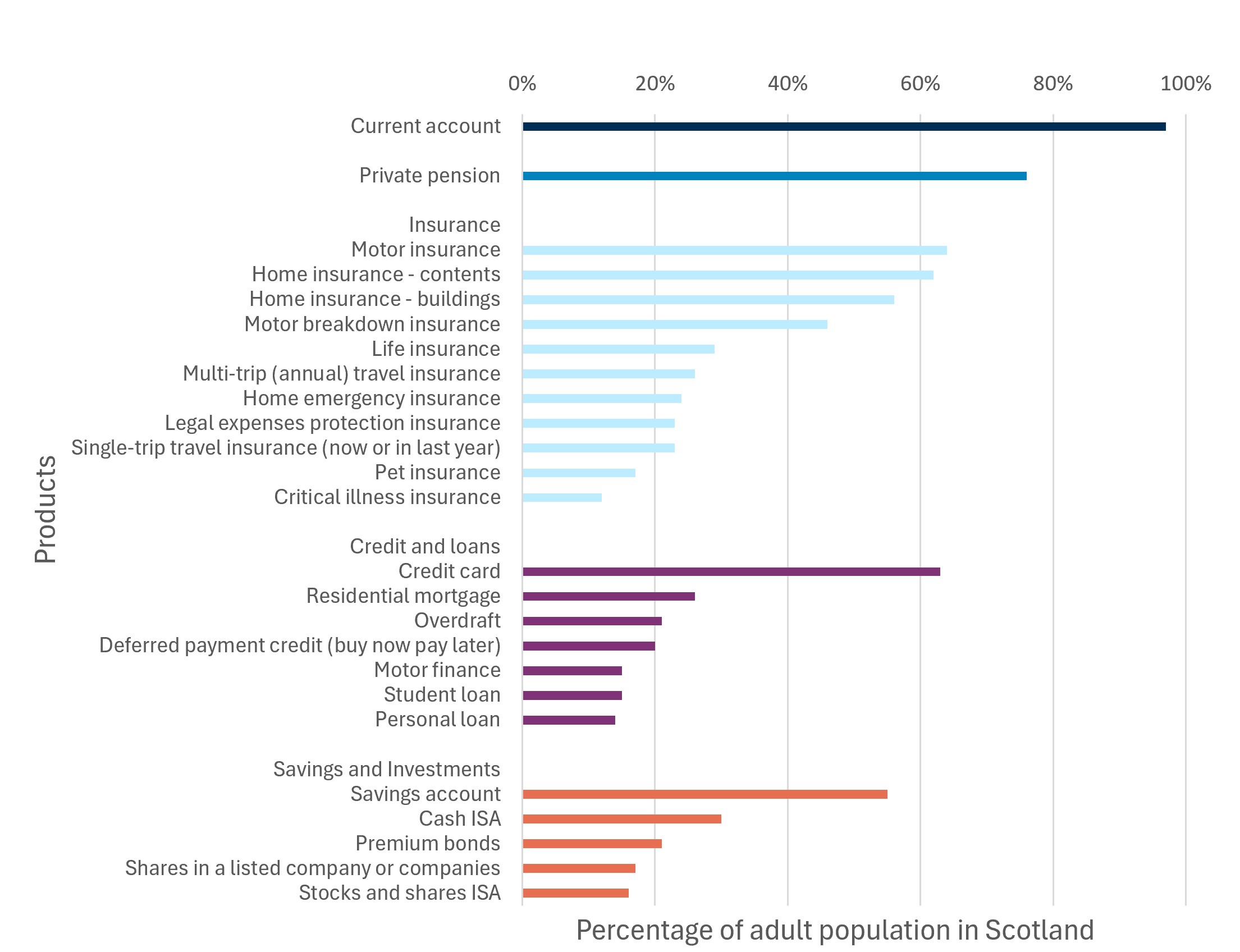
Current accounts, private pensions, motor insurance, credit cards, home insurance and saving accounts are held by the majority of consumers in Scotland
Chart 1: the 25 most commonly held financial products in Scotland - % of adult (aged 18 and over) population holding these products
Source: Financial Lives Survey 2024, Product Holding Annex
Weighted Base: Scotland, n = 1,475
Current accounts with a bank, building society or credit union are by far the most commonly held product. An estimated 97% of consumers in Scotland hold these products, a further 1% have some other form of day-to-day account and 2% are ‘unbanked’. The survey estimates that more than half of adults have access to a savings account.[14]
A number of the top 25 products are insurance products, with the most common products being motor and home insurance. Over 60% of respondents hold these products.
Credit cards are the most commonly held credit or loan product with over 60% of respondents stating that they have one, followed by residential mortgages at just over a quarter of respondents.[15]
The following sections of this report take a more in-depth look at access to cash and banking services, access to credit and insurance products. The report focusses on these products due to them being the most commonly held by consumers in Scotland.
6. Financial Inclusion
Financial inclusion and wellbeing in Scotland
Financial inclusion means that consumers are able to access the financial products and services that they need. Access to these services enables people to manage their money well, plan for the future and participate in the economy.[16]
The Money and Pensions Service’s MoneyView Scotland report found that around half of adults in Scotland are struggling to keep up with bills, don’t understand how to make decisions about retirement and aren’t saving regularly.[17]
The MoneyView Scotland report found that while some metrics, particularly consumer perception of their financial circumstances, are beginning to return to pre-pandemic levels, many are not. The report found that the percentage of people not saving remains notably higher than it was in 2021, as does the percentage of people who are struggling with bills.[18]
The report found that the groups that are consistently most in need of support include renters, single parents and working-age adults, people with a disability or limiting long term condition, and people who have experienced recent problems with mental health.[19]
The report compared differences between those with lower financial wellbeing and all adults in a number of areas, noting differences including:[20]
- 26% of adults with lower financial wellbeing needed debt advice compared to 13% of all adults
- 36% of adults with lower financial wellbeing reported finding it difficult to borrow in an affordable way compared to 15% of all adults
- 45% of adults with lower financial wellbeing do not have a savings accounts compared to 19% of all adults
- 82% of adults with lower financial wellbeing reported not being confident making decisions about financial products and services compared to 46% of all adults.
UK policy and legislative landscape
The UK Government’s Financial Inclusion Strategy, published in November 2025, sets out the approach to improving the financial inclusion and wellbeing of households across the UK.[21] The Strategy has a particular focus on:
- Enabling consumers to access banking services and benefit from the opportunities created by a digitally inclusive approach
- Creating a culture where everyone is supported to build a savings habit to build financial resilience
- Ensuring the insurance market supports the financial wellbeing of households and consumers in vulnerable circumstances
- Ensuring access to safe, affordable and responsible credit, and protecting consumers from unaffordable or illegal lending
- Enabling consumers to get back on track with financing by ensuring that people in problem debt get fair treatment and the right support from creditors
- Embedding financial education for young people, supporting families to build confidence at home and expanding access to guidance and support.
The UK Treasury Committee published a report on their inquiry into whether the Financial Inclusion Strategy was likely to make a meaningful difference to the lives of consumers in July 2026. The report concluded that while the Strategy is a welcome first step, it is not yet a complete plan for reducing financial exclusion across the UK.[22]
The Treasury Committee called for:[23]
- More analysis on who is excluded, where exclusion is concentrated and which products and services people are excluded from to establish if the interventions are correct and if they are reaching those who need them the most
- The publication of a fuller analysis of the scale, causes and distribution of financial exclusion, with clearer targets, data and accountability for implementation
- HM Treasury to set triggers for further intervention and publish a pilot-to-scale plan
- Consumer and lived-experiences voices to have a clear and continuing role in shaping the delivery of the Strategy.
The Money and Pensions Service (MaPS), an arms-length body sponsored by the Department for Work and Pensions tasked with improving financial guidance and information to consumers, oversees the UK Strategy for Financial Wellbeing 2020-2030, which is a ten-year framework designed to improve financial wellbeing across the UK. [24] The strategy vision is “everyone making the most of their money and pensions”. Financial wellbeing is defined as people being able to meet current commitments, deal with financial shocks, and be preparing for a financially secure future. Key themes in the strategy include financial education, saving, access to debt advice, appropriate use of credit, and financial planning.
5.10 The Financial Inclusion Commission, the UK independent body working to ensure everyone can access the financial services they need to build a stable financial life, published their 2026 Plan For Change in July 2026. The Plan calls for a ten-year cross-party, cross-sector commitment to putting full financial inclusion at the heart of financial services policy and practice.[25]
Financial inclusion activity in Scotland
Financial inclusion initiatives in Scotland are taken forward across a number of different policy domains, including anti-poverty interventions, financial services, digital inclusion, advice provision and education. Interventions such as investment in credit unions and affordable credit providers, innovation in digital tools to help people access banking services, funding for money and debt advice, and the embedding of financial education with the Curriculum for Excellence, are all examples of recent financial inclusion activity in Scotland.
Financial Inclusion for Scotland, a cross-sector group that brings together representatives from the financial services sector, government, regulators, charities and social lenders, have set out a vision for financial inclusion in Scotland. This includes goals around easy access to fair loans, savings, insurance products, financial wellbeing tools for everyone and the ability to acquire help when needed.[26]
A number of measures in the UK Government Financial Inclusion Strategy described above will benefit consumers in Scotland. However, the Strategy also includes a number of measures and associated investments that are specific to England and will not currently apply to consumers in Scotland. These investments particularly relate to supporting the development alternatives to high-cost credit and include:
- a new £30 million fund to support credit union transformation in England
- support for a small sum lending pilot led by Fair4All Finance to help expand access to affordable credit in England
- a further £132.5 million committed to Fair4All Finance for work that improves access to financial products and develops individuals’ ability to manage their finances in England.[27]
This follows on from a previous difference between the jurisdictions in terms of the allocation of funds dedicated to financial inclusion. In particular, since 2019 Fair4All Finance has received funding though allocation of a proportion of the English share of Dormant Assets Scheme to deliver a range of strategic financial inclusion interventions in England. [28]
Dormant Asset funding in Scotland has not been allocated to financial inclusion during this period. However, this funding gap is set to be reduced as the Scottish Government has updated Ministerial Guidance on the use of dormant assets funds to include financial inclusion as one of the purposes on which these funds can be spent.[29] The Scottish Government intends to use a proportion of these funds to improve consumers’ financial resilience, access to affordable credit, and participation in the economy. In March 2026 the National Lottery Community Fund launched a consultation to gather insight about financial support in Scotland to support the development of the new financial inclusion funding programmes, under the Dormant Assets Scheme Scotland.[30]
The Scottish Government's revised directions on use of dormant assets funding to improve consumers’ financial resilience, access to affordable credit, and participation in the economy is a positive step towards improving financial inclusion for consumers in Scotland. This funding will also support community lending to boost access to affordable credit.
While these are positive practical steps, at a strategic level Scotland does not currently have its own dedicated financial inclusion strategy or plan, to bring together the range of devolved and reserved activities being advanced to improve consumer outcomes.
Key themes and recommendations
Despite positive action taking place in a range of areas, there is a need for more joined up action on financial inclusion in Scotland, addressing systemic issues that lie at the heart of financial exclusion. Consumers in Scotland would benefit from a stronger coordination of work that focusses on improving levels of financial inclusion, beyond access to affordable credit. This should include action to improve access to education and advice, along with targeted measures to increase levels of financial resilience and literacy. More also needs to be done to address a lack of financial resilience, gaps in access to banking services and poor financial literacy.
We recommend that the Scottish Government works with a wide range of stakeholders to identify gaps in the Financial Inclusion landscape in Scotland, identifying where greater leadership and coordination is required to improve consumer outcomes. A Financial Inclusion action plan would help to more comprehensively address these issues. It could identify both ongoing and emerging risks to consumers, helping to ensure preventative action is taken where possible and that current gaps in support are addressed. The plan should also clearly set out responsibility for delivering key policy measures, establish how public bodies and other stakeholders can work in partnership, identifying opportunities for collaboration through the public service reform process to achieve shared objectives, and include defined timescales, measurable targets, and clear funding allocations.
7. Banking and Cash Access
Day-to-Day Banking
The Financial Lives Survey 2024 found that around 2% of consumers in the UK are ‘unbanked’. Trend analysis shows that this proportion has been falling in recent years, albeit slowly. The survey data distinguishes between those who are ‘unbanked’ and ‘unbanked+’, as follows:
- Unbanked - adults who do not have a current account with a bank, building society, credit union, payment services institution or an e-money provider. They may have access to a different type of account for their day-to-day needs
- Unbanked+ - adults who do not have a day-to-day account for making payments and transactions at all – i.e. they do not have a current account from a bank, building society, payment services institution or e-money provider or a savings account (with a bank, building society or NS&I), or a credit union savings account.
- Looking at those who are ‘unbanked+’, Scotland is broadly in line with the UK as a whole with 1.6% being unbanked+. Across the UK, evidence suggests that certain groups are more likely to be unbanked than others, with digitally excluded and unemployed people disproportionately more likely to be unbanked.[31]
- The Inclusion Foundation estimates that 1 in 4 adults will experience financial exclusion at least once in their lives and they found that the cost of not having a bank account can be an extra £500 a year.[32] Without access to a bank account, carrying out everyday tasks can become challenging for consumers. Essential services like insurance and energy bills can cost more and access to credit, which can help smooth over temporary income shortfalls, can be restricted.[33] These impacts can also create wider issues for consumers, such as preventing take up of employment opportunities, exacerbating the risk of financial exclusion and potentially pushing them further into debt and poverty.
The Financial Lives Survey 2024 offers a wide range of reasons why consumers may be unbanked, ranging from:
- not needing an account (31%)
- personal choice due to mistrust or concerns (24%)
- had their account closed and were not able to open another account (5%).[34]
“Basic” bank accounts are defined as free, simple accounts that do not have an overdraft facility, so consumers can only spend the money that they have in the account. They are designed for people who do not have a standard bank account and would not qualify for one, perhaps because they have a poor credit rating.[35]
The Financial Lives Survey 2024 found that applications for basic bank accounts have increased, while refusal rates have declined since the previous iteration of the survey in 2022. In the two years to May 2024, 2.4% of adults across the UK recalled applying for a basic bank account, of whom 10% said they were refused. This equates to 1.3 million and 0.1 million UK adults, respectively.[36]
Citizens Advice Scotland has conducted research which has found that out of the 12 banks who now offer a basic bank account, only two of these had processes that consumers would be likely to find accessible.[37] The other 10 banks were found to be inaccessible due to factors including consumers having to apply for a standard bank account despite knowing they will be rejected, reliance on credit checks and inflexible requirements for proof of identity and address verification. Citizens Advice Scotland found that some groups were particularly affected by this, including prisoners and ex-offenders, refugees, those experiencing homelessness, survivors of domestic abuse and undischarged bankrupts.[38]
These difficulties were underlined by the results of a mystery shopping exercise in relation to basic bank accounts, carried out by the FCA to assess how effectively firms promote awareness and help people access these accounts. The FCA tested consumers’ first interactions with firms in 298 mystery shops, where they discussed their needs with a member of staff. They rated 28% of interactions as good or very good, 38% as fair, 20% as poor and 14% as very poor, highlighting inconsistency across the sector and within each firm. Those consumers who struggled to get good outcomes included people facing financial hardship or without standard identification, and especially those with no fixed address. The firms often failed to mention basic bank accounts at all and pushed customers in vulnerable circumstances towards online applications unsuitable for their needs. Working with UK Finance, the FCA has secured a collective commitment for banks and building societies to:
- Provide the right account for customers, first time, with clear communication and minimal friction
- Make it straightforward for customers without standard ID or a fixed address to open an account
- Spot vulnerability early and offer accessible alternatives to online-only journeys.[39]
How consumers access cash and banking services
Many banking products are designed to be digital by default, resulting in some consumers becoming financially excluded as a result of digital exclusion.
Analysis from Audit Scotland in 2024 found that digital exclusion affects consumers who:
- are unable to afford an appropriate device or internet connection
- do not have the skills and confidence to use digital technology
- have a fear or mistrust of using online services or lack the motivation to do it
- have difficulty in accessing digital services and devices or an internet connection
- are unable to keep up with the pace of change of digital technology.[40]
Audit Scotland highlights that 15%, or approximately 1 in 6 adults in Scotland, lack the digital “foundational skills” to do things such as turn on a digital device, connect to the internet, use an internet-browser, or update a password. 9% of households did not have access to the internet. The report also noted strong associations between digital exclusion, poverty and people with certain protected characteristics, including age. Age was a key factor, with people who are retired and aged over 65 years being less likely to use the internet.[41]
Ofcom’s 2025 research on digital disadvantage also found that digital exclusion intersects with a wide range of personal characteristics relevant to other forms of social exclusion, including age, socio-economic status, disability, geography, education, literacy, language and housing circumstances. Ofcom’s research demonstrated that certain groups of consumers are more likely to experience challenges in accessing and using the internet, including:
- Disabled people
- People in insecure housing
- People from minority ethnic groups
- People with Limited English Proficiency and
- Less frequent internet users.[42]
Key challenges identified by Ofcom for consumers when accessing the internet include:
- Logging into online accounts: remembering passwords, PINs, usernames, security information and other login details, and having to manage multiple login credentials
- Complex interfaces: websites with less intuitive or familiar designs that were difficult to navigate
- Online forms: complicated and long online forms that require lots of information (e.g. health registration forms, mortgage application forms, or benefits forms) hosted on online platforms that are deemed difficult to use. This included issues of forms with multiple pages, forms where information could not be saved, or forms where information could only be inserted in a particular format.
- Appointment booking services: where forms have restrictions on how much or what type of information can be provided within it, with no option to speak to an adviser over the phone to clarify required information.[43]
Ofcom further reported that previous negative consumer experiences with online services, such as online scams, fraud and data breaches also contributed significantly to digital exclusion. Online banking was a particular concern for some consumers, along with websites that required consumers to provide personal or financial information, such as e-commerce websites. Anxiety about identity theft, risks and banking safety contributed to a general mistrust of online services and a tendency to avoid using unfamiliar websites.[44]
The Financial Lives Survey 2024 has shown that 7% of day‑to‑day account holders across the UK (3.3m) did not bank online or use a mobile app, which was a significant reduction from 22% (10.6m) in 2017.[45] This indicates that despite a major shift toward digital banking, many consumers still rely on access to branches and in-person services.
In the year to May 2024, the Financial Lives Survey 2024 also indicated that 9.7 million (18%) UK adults regularly used a branch – rising to 37% of digitally excluded adults, and 31% from low‑income households.[46] Research by WPI for the Post Office found that 51% of adults in Scotland use in-person banking at least once a month (vs 48% in UK) with 78% saying it is important to access at least one in-person banking service in future (vs. 82% in UK). 70% of adults in Scotland agreed that it is important to them that in-person banking services are available within a reasonable distance of their home[47] (vs. 68% in UK).[48]
Rurality can pose additional challenges for consumers in Scotland
Consumers living in rural and island areas of Scotland can face additional and compounding disadvantages compared to most other areas of the UK such as poorer digital connectivity,[49] and greater travel distances to services which can make accessing financial services more challenging. The ‘cost of remoteness’ can result in it being more expensive to meet a minimum acceptable living standard in rural areas of Scotland.[50]
Given the relatively poorer levels of digital connectivity in rural Scotland compared to most other parts of the UK, digital exclusion is likely to be a more significant issue for consumers in Scotland.[51] Audit Scotland’s 2024 report on tackling digital exclusion found that poor or limited connectivity can prevent rural communities from participating in the digital economy and society.[52] Similarly, the Financial Lives Survey 2024 also illustrates the linkages between access to banking and digital exclusion. It found that:[53]
- Only 74% of digitally excluded consumers held any day-to-day account, compared to 98% for those were digitally active
- Only 72% of digitally excluded consumers held any current account, compared to 98% for those digitally active
The impact of reduced cash and banking facilities
Research by Which? has shown that Scotland was the first part of the UK to see over half of its bank and building society branches close, with 751 of 1,041 branches closed between January 2015 and the end of 2025 and another 13 due to close as of July 2026.[54]
Access to cash remains important to many consumers. According to the Financial Lives Survey 2024, 2.6 million adults across the UK (4.8%) were “heavy users of cash” in 2024, and approximately 6%, or just over 280,000 adults in Scotland, depend on access to cash.[55] [56] Research by WPI for the Post Office found that 25% of adults used cash for at least half of their transactions while 77% used cash at least once a month. 60% said it was important that they were able to access cash withdrawal facilities in the future.[57]
Heavy users of cash in 2024 were more likely to be from the following demographic groups:[58]
- The digitally excluded (24%)
- Those with no qualifications (15%)
- The unemployed (11%)
- Low‑income householders (11%)
- Adults aged 85+ (10%).
Many consumers who reported that they wanted to deposit or withdraw cash noted that they had been impacted by reduced access to facilities in their local area such as bank branches, ATMs or post offices.[59] For rural and island communities in Scotland the impact of branch closures and reduction in cash access can be disproportionately higher. Accessing alternative sources of cash may require longer and more complex trips for consumers living in these areas, particularly for those living on islands, potentially requiring access to a car or multiple public transport journeys including the use of ferries.
Some communities affected by branch closures have been able to access banking hubs. These are shared banking spaces, run by Cash Access UK, that have a counter service where customers of all main banks can withdraw and deposit cash, make bill payments, and carry out regular banking transactions.[60] When a participating bank or building society makes a change to its network, for example the closure or reduction of opening hours of a branch, it notifies LINK in advance. LINK will then assess the needs of the location, consider the other services available locally and the number of people and shops and determine whether the community needs a new hub. In addition, a community is also able to request a review by LINK itself, resulting in LINK assessing the needs of that community using the same criteria.
In addition to hubs, Post Offices can play an important role in maintaining access to cash and banking services in Scotland. Consumer Scotland has recently conducted research on the role of post offices which found that:[61]
- 63% of consumers in Scotland had used the Post Office at least once in the past year for financial or administrative services
- 41% had used it for withdrawing or paying in cash and 23% had used it to pay bills
- The percentage of people using financial or administrative services was highest among 18–24-year-olds (83%) and 25–34-year-olds (71%).
For a number of consumers there are few, if any, alternative services if the Post Office is not available. This highlights the important role of the Post Office in ensuring appropriate access to banking and cash services for consumers, particularly in rural and island areas and in locations affected by bank branch closures.
Advice and complaints data
A review of data on requests made to consumeradvice.scot (run by Advice Direct Scotland) for advice during the 12 months to July 2025 found that just under 20% of financial services cases were linked to ‘banking & credit’ and ‘investment, financial planning and advice’[62].
Requests for help with investment / financial planning / advice and banking and credit account for around four in ten of all requests for advice from Scotland based consumers for financial services
Table 1: Requests to consumeradvice.scot relating to specific financial services products during the 12 months to 17 June 2025
| Sector | % of total financial services cases |
| Investment / financial planning / advice | 19% |
| Banking & credit: | 19% |
| Banking & credit services | 15% |
| Money transfer services | 1% |
| Foreign currency exchange | 1% |
| Pawnbrokers & Buy Back Services | 1% |
| Illegal lenders/loan sharks | 1% |
Base: 581 Advice Direct Scotland financial services cases
Within banking and credit, many of the cases related to fraud concerns and related disputes such as unauthorised payments and accounts or loans being opened without consent. Other cases related to payment disputes such as delays or non-receipt of payments and account applications being rejected.
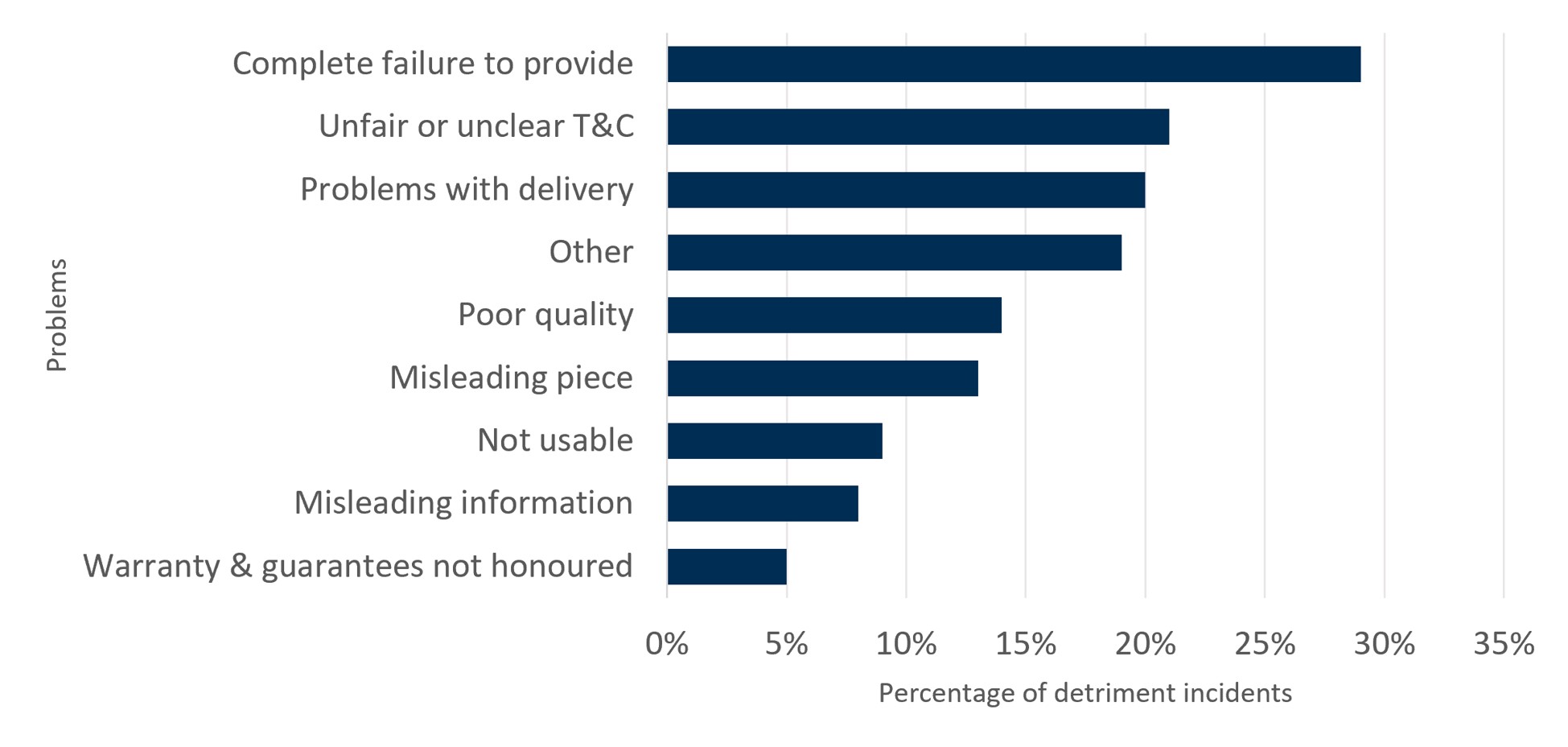
The Department for Business and Trade’s Consumer Detriment Survey 2024 found that 9% of those who purchased or used current accounts, loans & bank services had experienced at least one problem in the last 12 months; these figures were the same for both Scotland and the UK as a whole.[63] The Consumer Detriment Survey also provides some insights into the types of problems that consumers experienced relating to current accounts, loans and bank services.
Failure to provide the purchased service was the most common detriment cause for current accounts, loans and bank services
Chart 2: The nature of the problem for detriment incidents with current accounts, loans, and bank services in the UK in the 12 months prior to April / May 2024
Source: Consumer Detriment Survey 2024, Table DA4.1 Nature of the problem experienced by the consumer (close-ended question)
Weighted base: UK, n = 716
8. Policy and legislative landscape
Consumers increasingly pay for key services such as public transport, parking, fuel, food and government services by digital means. Currently, acceptance of physical currency in the UK is not mandated by legislation, allowing businesses and organisations to choose which payment methods they accept.
In July 2024 the FCA published an access to cash policy statement, with rules that aimed to address the cash access needs of consumers and businesses by requiring designated firms to address and plug gaps in local cash provision.[64] These new rules came into force in September 2024. The FCA has committed to undertaking a review of the access to cash regime following the publication of the findings of the HM Treasury review, expected in October 2026.[65] The review will examine how the policy is operating and its success in preventing significant gaps in cash access for consumers and businesses. It aims to assess the costs and benefits of the rules and consider whether the approach to maintaining sustainable cash access services is proportionate and effective.
The House of Commons Treasury Committee published a report in April 2025 on acceptance of cash in the UK. The Committee recommended that the UK Government should act to manage the decline in cash acceptance and that cash acceptance levels in the UK should be monitored. The Committee requested that HM Treasury provide them with annual reporting on cash acceptance levels and an analysis of the tolerable level of cash acceptance in society.[66]
In May 2026 HM Treasury commissioned an independent Review on Access to Banking Services, assessing how changes to in-person banking services are affecting consumers. This review aims to understand the impact of the current trajectory of access to in-person services, including the scale of detriment to consumers, along with exploring the impacts it may have on vulnerable groups. The Financial Services and Markets Bill, introduced in the House of Lords in May 2026, contains measures enabling the UK Government to enact a new framework, in the event that the Review finds this is necessary.[67]
Key themes and recommendations
Access to bank accounts, including basic bank accounts, is necessary for consumers to participate fully in modern society. As recent FCA investigations show, further action is still needed to make basic bank accounts more accessible to consumers in vulnerable circumstances. We support the actions taken by the FCA to ensure that more consumers are able to access accounts in ways that work for them, including avoiding financial exclusion due to digital exclusion.
The geography and demographics of Scotland, particularly remote and rural Scotland, means that consumers in Scotland face additional challenges accessing financial products and services that meet their needs. The impact of bank branch closures and reductions in cash access services can be disproportionately severe. It is important that branch closures, decisions relating to the implementation of banking hubs and other measures relating to access to cash take into account the needs of consumers in rural and island communities who can face unique barriers to accessing services.
Consumer Scotland recommends that the UK Government and FCA examine the options and opportunities for taking a different approach to determining criteria for access to banking and cash facilities in these areas, when compared to the rest of the UK. This means that they must take account of:
- the different approach to defining rural and urban areas in Scotland
- the unique circumstances of Scotland’s many island communities in relation to cash access assessments and assessing the adequacy of banking facilities
- the cumulative and practical impact of the loss of banking services across neighbouring rural communities
- the specific difficulties that extreme weather events may cause for accessing cash and banking services via isolated transport routes.
While we understand that there may be a desire to take a UK-wide approach, this must be capable of adapting to local circumstances to fully consider the differing needs of consumers across the UK as a whole, but especially in remote and island communities. In addition, there is a need to consider the overall resilience and models of provision for Post Office services in those areas when considering what appropriate access to cash and banking services looks like in Scotland.
We note that while the FCA does have powers and has made Rules to ensure access to cash, they do not currently have powers to ensure that other banking services are provided.[68] Action on this would require intervention from the UK Government. We welcome the UK Government commissioning an Independent Review into access to banking services, which we have provided input into. As part of this review, we recommend that the UK Government acts swiftly to implement any new framework to secure equitable consumer access to banking services. This should include consideration being given to the strengths and weaknesses of the framework that currently exists for access to cash and developing an enhanced framework for access to banking services. Alongside recognising the distinct issues for Scotland’s rural and remote communities, this should recognise the more complex set of considerations involved in access to banking, given the range of services this involves, build on aspects of the access to cash framework that are assessed as working effectively, and draw learning from aspects of that framework that assessed as being less effective, in order to deliver a robust and comprehensive approach. Consideration should also be given to granting the FCA additional powers in relation to branch closures, given the interplay between access to cash and access to banking and the impact that these issues have on consumers.
We also welcome the FCA’s commitment to evaluating the access to cash regime. Consumer Scotland will contribute to this review, providing insight drawn from this scoping work and from fresh polling research that we intend to commission later this year.
9. Access to credit
For many consumers, access to the right credit products can help them access products and services that they would not otherwise be able to. Credit is often used to finance larger purchases such as cars and houses and to help those who may have fluctuating or seasonal incomes budget and maintain cashflow during the year. Different products cater to these different needs and have different timescales and costs (in terms of interest) attached. These different products can raise different issues for consumers, depending on their specific circumstances.
All credit arrangements involve some degree of risk for consumers and for lenders. Taking on debt can have important consequences, especially where debt is secured over important items such as houses or cars. Unmanaged debts can impact on consumer credit ratings, affecting future access to products,[69] so it is important that access to these products is appropriate and that the repayment terms are affordable and sustainable.
Often the first place consumers turn to for credit is their existing bank or building society. Banks or building societies may provide credit cards and overdrafts for shorter term needs and loans for longer term needs. Where consumers are unable to access more mainstream credit due to low incomes or limited credit history, this can result in people using high cost, higher-risk products or even illegal lenders.
Given the risks to consumers arising from this, considerable efforts have been planned and made by Governments and third sector bodies to create viable, affordable alternatives in this space, such as credit facilities available from co-operatives, community lenders and credit unions.[70]
Commonly held credit products
The Financial Lives Survey 2024 found that 83% of the Scottish population holds some sort of credit or loan (excluding mortgages). This includes 76% with a regulated credit agreement or loan, 28% with some form of retail finance and 6% with a high-cost credit or loan product. The survey also provides insight into the most commonly held specific consumer debt instruments.[71]
The most commonly held consumer debt instruments in Scotland generally mirror those in the rest of the UK, with credit cards the most common
Table 2: The percentage of Scottish and UK adults holding the most commonly reported consumer debt instruments
| Product | Scotland - % of population holding consumer debt instrument | UK - % of population holding consumer debt instrument |
|---|---|---|
| Credit Card | 63% | 65% |
| Residential mortgage on property currently lived in | 26% | 27% |
| Overdraft | 21% | 21% |
| Deferred payment credit | 20% | 20% |
| Motor finance | 15%* | 11% |
| Personal loan | 14% | 14% |
| Retail instalment credit | 12% | 12% |
| Store card | 11% | 12% |
| Catalogue credit or shopping account | 10% | 11% |
Source: Financial Lives Survey 2024, Product Holding Annex.
Weighted Bases: UK, n =17,950; Scotland, n = 1,475
Only products held by more than 5% of the Scottish adult population are listed
A * denotes where the Scottish percentage is significantly different to the UK average
The survey found that credit cards are the most commonly held credit or loan product, held by 63% of respondents in Scotland and 65% in the UK, followed by residential mortgages at 26% for Scotland and 27% for the UK.[72] Other commonly held or used products are overdrafts, deferred credit and motor finance products - with the latter being more commonly held in Scotland than in the UK.
Motor finance
Data from the Financial Lives Survey 2024 also found that 15% of respondents from Scotland had used a motor finance type product in the previous 12 months, which was higher than the UK as a whole at 11%. However, the median value of outstanding balances was £7,500 for Scotland, which was substantially lower than the £12,500 for the UK as a whole.[73]
In October 2025 the FCA consulted on an industry-wide compensation scheme for motor finance customers who were treated unfairly.[74] This came as a result of an FCA review, covering data from 32 million agreements, which found widespread failings in how motor finance firms disclosed commission payments and commercial ties between lenders and brokers. The review found that inadequate disclosure of commission resulted in consumers being less likely to make informed decisions, negotiate or shop around for a better deal and that many consumers may have overpaid on their motor finance as a result of this.
In March 2026, the FCA announced that millions of motor finance customers who had agreements between 2017 and 2024 would receive compensation under a mass redress scheme for those treated unfairly by firms who broke the law by failing to disclose important information. Recent legal challenges to this scheme have cast doubt on the next steps, with timetables for court hearings and eventual decisions currently unclear.[75]
Mortgages
During 2025, the FCA reviewed mortgage requirements through the Mortgage Rule Review.[76] The review was proposed as house prices had been growing faster than wages, making mortgage affordability a significant barrier to home ownership. First‑time buyers are now generally older and borrowing for longer and more mortgage holders will, in future, borrow beyond state pension age. Access to later life mortgages is therefore important in helping consumers achieve their financial goals in later life. The review set out areas where changes were needed to support sustainable home ownership and economic growth, and where increased flexibility could allow firms to innovate and tailor their product offerings to consumers’ evolving needs.
Following this review changes have been implemented to ensure that consumers can more easily reduce their mortgage term or remortgage with a new lender and can discuss options with their mortgage provider and get advice when they need it. The FCA has also set out a plan for longer term actions over the next few years. These longer-term actions aim to support expanded mortgage market access for first time buyers and underserved consumers, offering enhanced later life lending, innovation and protection of vulnerable consumers.
Credit Cards
Previous FCA research in 2015 found that the main card issuers are banks and building societies, mono-lines (i.e. non-banks specialising in issuing cards) and specialised lenders focusing on certain sectors, such as sub-prime borrowers.[77]
The FCA found strong competition in the credit card market, with numerous providers and evidence that some consumers shop around and switch actively, particularly those seeking 0% balance transfers. However, they also found issues with consumer understanding of key aspects of products including interest rates, credit limits, and the length of 0% promotional periods. Overall, combined with the complexity of some credit card features, this presented a barrier to consumers in assessing the overall value of cards[78]. As noted further below, the FCA has indicated that a focus of its future Consumer Duty work will be considering the approach firms have taken to testing consumer understanding and this work is likely to have a positive effect on the future development of this market, helping to ensure better consumer understanding and awareness of key features of products.
Overdrafts
The FCA conducted a review of high-cost credit in 2019. In relation to overdrafts, it found that the market was dysfunctional, causing significant consumer harm. It found that vulnerable consumers were disproportionately hit by excessive charges for unarranged overdrafts and that it was difficult for consumers to meaningfully compare or work out the cost of borrowing as a result of complex and opaque charges. The FCA put in place a package of remedies aimed at making overdrafts fairer, simpler and easier to manage. These remedies included reforms to charging, ways of helping consumers understand charges more easily and measures to promote competition in the market, making it easier for consumers to find deals that suit their circumstances.[79]
Consumer credit and loans
When looking at the proportion of consumers who have experienced a problem with financial products, the Financial Lives Survey 2024 found that one of the most problematic categories was consumer credit and loans, with over 20% of respondents experiencing a problem with products in this category during the 12 months to May 2024.[80] The most problematic credit or loan product according to the survey was credit cards, responsible for over 50% of the most serious problems, followed by personal loans at 6%. The survey provides limited insight into the specific nature of the credit card problems, but it suggests that many were linked to debt management and affordability issues for those who revolve a credit card balance and do not pay in full each month.
Use of deferred payment credit
The Financial Lives Survey 2024 found that 20% of adults in Scotland used deferred payment credit or ‘buy now, pay later’ products at least once in the 12 months to May 2024 with 45% of these having used it 2-4 times during the period.[81] The survey also found that 60% of respondents had an outstanding balance of less than £100, while the median outstanding balance was £75, which may indicate that this product was used for relatively small amounts or that balances were paid off relatively quickly.
The survey found that, in Scotland, the two most common reasons for consumers using this product were “because it’s interest free” (55%) and “it enables purchases that could not have been afforded otherwise” (45%). The survey also found that 14% of respondents who had used this product incorrectly reported that a reason was that “it does not affect my credit score”. There was also evidence of a significant minority of users of these products in Scotland not being aware that fees would be payable if they missed a scheduled payment (18%).[82]
The 2024 survey found an increase in the use of buy now pay later products since 2022. At a UK level, usage of the products was particularly prominent among lone parents (40%), women aged 25-34 (35%) and black adults (26%). While most users of ‘buy now, pay later’ products did so relatively infrequently, 17% did so at least ten times over the 12-month period. Of this group:
- over three quarters were women
- 67% had a personal income of less than £30,000
- 54% had low financial resilience,
- 26% were in financial difficulty because they had missed paying domestic bills and/or credit commitments in three or more of the previous six months.[83]
The Financial Lives Survey 2024 found a range of different impacts on consumers as a result of using buy now, pay later products including:
- Levels of regret arising from spending more than they could afford
- Being encouraged to spend more than they had intended, and a lack of awareness that it is a credit product
- Consumers’ financial situation worsening as a result of late fees, missed payments or consumers putting payments on credit cards to avoid missing payments
- The risk of it being a ‘gateway’ to other forms of credit, with borrowing being perceived as being easy, resulting in consumers considering other forms of credit that they otherwise would not have
- A lack of awareness from some consumers that they are using a credit product and some accidentally using it as a result of it being the default payment option at the checkout.
Research from 2021 by Citizens Advice Scotland found that 39% of consumers who had used buy now, pay later products did so without realising, 40% thought that it was not proper borrowing and 42% did not fully understand what they were signing up for.[84] This research also found that 25% of respondents who had used buy now, pay later regretted doing so, around half of buy now, pay later customers have another debt to manage alongside their buy now, pay later repayments and 41% of users have struggled to make a repayment.[85]
The UK Government consulted in 2024 on proposals to bring previously unregulated buy now, pay later products into regulation.[86] The proposals were designed to ensure people using these products receive clear information, avoid unaffordable borrowing and have stronger rights when issues arise. Buy now, pay later products has fallen within the FCA’s regulatory jurisdiction since July 2026. The FCA’s final rules[87] introduce five core protections:
- Mandatory affordability checks for every transaction
- Clear, upfront disclosures prior to purchase
- Support for consumers in financial difficulty
- Access to the Financial Ombudsman Service
- A requirement for full FCA authorisation for firms
Consumer Scotland supports these measures which should reduce the risk of harm to consumers while still allowing the market to innovate and grow, allowing consumers to continue to access these products where appropriate. It is important that consumers who use these products get the right information, in the right way and at the right time, so that they can make good decisions. The FCA should continue to monitor access and use of these products following reforms to ensure these aims are met. In particular, we recommend that:
- Providers should implement user testing to ensure consumer understanding
- The FCA should require firms to monitor levels of missed payments
- The FCA should provide guidance to firms on the operation of affordability measures to avoid unnecessary restriction of access to products
- The FCA should closely monitor use of higher cost or unregulated credit options that people may use as alternatives to these products to ensure these changes are not resulting in unintended consequences
- The FCA should monitor the use and availability of in-house deferred payment credit arrangements which are not within the scope these regulatory changes.
Reliance on high-cost credit
Although widespread market reforms were introduced in the high cost lending sector in 2019, the Financial Lives Survey 2024 found that use of high-cost credit increased from 2.8 million users in the UK (5.3%) in 2022 to 3.5 million (6.4%) in 2024, with many users opting for high-cost credit due to the ease of applying and the likelihood of being approved.[88] Two‑thirds (65%) of high‑cost credit holders in May 2024 showed one or more characteristics of vulnerability, and around three in ten (28%) were in financial difficulty.
Many consumers responding to the survey reported issues with accessing credit products. In the two years to May 2024, 3.2 million adults were declined for one or more regulated credit agreements, up from 2.9 million in 2022. The highest refusal rates in 2024 were among those applying for high‑cost credit or loans, namely payday loans, short‑term instalment loans, pawnbroking loans, logbook loans or home‑collected credit, arranged overdrafts or personal loans. 5.5 million adults avoided applying for credit in the same period, assuming they would not be eligible, would not be able to afford the product, or would be rejected.[89] For some consumers who are declined or avoid applying, this can lead to a reliance on non-regulated lending.
Illegal money lending
The Financial Lives Survey 2024 found that 0.3 million adults (0.6%) across the UK said they had borrowed from an unlicensed moneylender or from another informal lender, such as an illegal moneylender, in the 12 months to May 2024. The Survey also found that 0.2 million adults (0.3%) across the UK had borrowed from a friend or family member who charged interest on the loan. A third (34%) of adults who borrowed in these ways did so because they were unable to get a loan anywhere else (22%), were declined for other types of credit (15%) and/or had reached the limit of other types of credit (9%).[90]
The Scottish Illegal Money Lending Unit is part of Trading Standards Scotland and works in partnership with a range of organisations across Scotland to tackle illegal money lending. It investigates allegations of illegal money lending, provides support for victims and raises awareness of the risks of illegal money lending. The Unit estimates that around 300,000 people in Scotland could be using a loan shark with this amount having considerably increased in the last decade.[91]
Alternatives to high-cost credit
Given the potential risks to consumers around high-cost credit, considerable efforts have been put in to finding affordable alternatives for consumers. These include developing capacity amongst credit unions and other community lenders. Fair4All Finance’s Affordable Credit Scale Up programme is one of a number of initiatives aimed at increasing the provision of affordable credit from community finance lenders to ensure more people in vulnerable financial circumstances who need to borrow, can borrow.[92]
Commercial approaches are also being explored, such as employer-based loans and salary advances and widening mainstream bank provision. However, ‘high risk’, financially vulnerable borrowers can still find themselves excluded from these schemes, as can others with non-typical backgrounds, such as recent migrants or those without a consistent address history or fluctuating finances. There remains a need for clear and coordinated action to build more accessible and affordable credit alternatives for the most financially vulnerable. As advocates for affordable credit note, reducing inappropriate reliance on high-cost credit to cover the cost of basic essentials is central to creating a more financially inclusive society.[93]
Policy and legislative landscape
Access to credit is closely linked to policies designed to promote financial inclusion. These wider policies include measures to promote greater financial resilience, including through increasing savings, promoting financial education and financial literacy and work to prevent illegal money lending.
Scotland has faced relative disadvantage compared to England when it comes to funding for certain affordable credit initiatives recent years. Consumers in England have benefitted from the use of dormant assets funds to support financial inclusion through Fair4All Finance since 2019.[94]
The UK Government’s Financial Inclusion Strategy, published in November 2025 sets out its approach to improving the financial inclusion and wellbeing of households across the UK.[95] In particular, the Strategy includes a greater number of measures and associated spend on developing alternatives to high-cost credit for consumers in England compared to Scotland. These include a new £30 million fund to support credit union transformation in England, support for a small sum lending pilot led by Fair4All Finance to help expand access to affordable credit in England and further £132.5 million committed to Fair4All Finance for work that improves access to financial products and develops individuals’ ability to manage their finances in England. Some aspects, such as the work to support the credit union sector in England may have indirect benefits to credit union customers across the UK by improving back-end operations and use of technology across the sector.
This gap in support for financial inclusion interventions in Scotland is set to narrow as the Scottish Government has updated Ministerial Guidance on the use of dormant assets funds to include financial inclusion as one of the purposes on which these funds can be spent.[96] The Scottish Government intends to use a proportion of these funds to improve financial resilience, access to affordable credit, and participation in the economy. In March 2026 the National Lottery Community Fund launched a consultation to gather insight about financial support in Scotland to support the development of the new financial inclusion funding programmes, under the Dormant Assets Scheme Scotland.[97]
Key themes and recommendations
Access to credit can play an important role in helping many consumers to spread the cost of goods and manage competing financial priorities. Using Dormant Assets Funding to support community lending and boost access to a wider range of alternatives to high-cost credit products for consumers in Scotland will play one part in tackling financial inclusion.
Alongside this, more also needs to be done to address appropriate access to everyday banking services, including bank accounts, mortgages, and mainstream credit such as loans, credit cards and overdrafts.
We support the work of the FCA outlined in this section, which aims to widen access to basic bank accounts by making the process smoother for consumers, improve access to mortgages by responding to changing consumer needs and demographics and ensure that appropriate access to credit is maintained. There is a need to ensure that previous reforms in mortgages, high-cost credit and deferred credit markets are fully implemented and that better consumer outcomes are being delivered. The FCA’s supervisory jurisdiction is important here, in considering the progress being made by individual firms.
We recommend that the FCA continues to develop the application and enforcement of the Consumer Duty in order to drive forward these changes, with regular, transparent reporting on the impact secured through improved consumer outcomes.
10. Insurance
Commonly held products
The Financial Lives Survey 2024 found that insurance products dominated the list of most frequently held products by consumers, with the most common being motor insurance (over 60%) and home insurance (around 60%).[98]
In many cases, the profile of those consumers who hold products follows demographic patterns, for example:
- those consumers of an age to have a mortgage with an outstanding balance are more likely to hold life insurance
- those consumers in rural areas, with poorer access to public transport, are more likely to hold motor insurance
- for motor insurance, consumers in urban areas, on lower incomes, who were unemployed or on low incomes or from a minority ethnic background were less likely to hold products
- for home and contents insurance, consumers who were younger, lived in an urban area, were renting their property, were from an ethnic minority or were unemployed or sick were less likely to hold such products.[99]
Affordability is a general concern, with 13% of consumers cancelling or reducing cover due to rising costs. The Financial Lives Survey also found that certain demographics were more likely to pay for insurance in instalments, including:
- adults in financial difficulty (81%)
- lone parents (72%)
- adults with low financial resilience (69%)
- adults with no investible assets or investible assets of less than £10,000 (69%)
- black adults (65%)
- renters (64%)
- adults aged 25-34 (60%).[100]
Consumers in Scotland purchase a wide variety of insurance products, with motor vehicle, buildings and contents insurance the most common
Table 3: Percentage of Scottish and UK adults holding specific insurance products
| Type of insurance product | Scotland - % of population holding product | UK - % of population holding product |
| Motor insurance | 64% | 64% |
| Combined home contents and buildings insurance | 47% | 45% |
| Motor breakdown cover | 46% * | 49% |
| Life insurance | 29% | 28% |
| Multi trip annual travel insurance | 26% | 27% |
| Home emergency cover | 24% * | 19% |
| Legal expenses or protection insurance | 23% * | 26% |
| Single trip travel insurance | 23% | 23% |
| Pet insurance | 17% | 16% |
| Separate home contents insurance | 15% | 15% |
| Mobile phone insurance | 15% | 15% |
| Critical illness cover | 12% | 13% |
| Extended warranty | 11% | 10% |
Source: Financial Lives Survey 2024, Product Holding Annex.
Weighted Bases: UK, n = 17,950; Scotland, n = 1,475
Only products held by more than 10% of the Scottish adult population are listed
A * denotes where the Scottish percentage is significantly different to the UK average
Research by moneysupermarket found that motor insurance paid monthly can cost consumers an average extra £30 a year by paying monthly for a fully comprehensive policy and an extra over £200 a year by paying monthly for both a third party, fire and theft and third-party only policies.[101] Research by Confused.com found the following differences for monthly vs annual payment of home insurance:[102]
- For contents insurance, policies paid monthly averaged at £57 for the year compared to £52 for one annual payment
- For buildings insurance, policies paid monthly averaged at £191 a year compared to £176 for one annual payment
- For combined insurance, policies paid monthly averaged at £197 a year compared to £180 for one annual payment
The main reasons given for by policyholders choosing to pay in instalments included being unable to pay in a single annual payment or to spread the costs. Many policyholders were uncertain whether paying in instalments was more expensive than paying in full. For example, among contents insurance policyholders paying in instalments:
- 56% said it costs more
- 24% believed it costs the same
- 1% believed it costs less
- 19% did not know.[103]
For many consumers, premium finance is a convenient way to spread the cost of insurance, and a growing proportion of consumers are unable to pay an annual premium in a lump sum. The FCA found that, in 2024, 60% of motor and 41% of home insurance policyholders who paid by instalments did so because they could not afford to pay in a single annual payment.[104] Many of these customers also have a wide range of characteristics that suggest low levels of financial resilience.
The Financial Lives Survey 2024 found that 9.2 million UK adults had issues accessing the most common general insurance and protection policies, motor, home contents, buildings and motor breakdown cover, in the two years to May 2024. The Survey found that 13% of respondents were offered a general insurance or protection policy in the last two years at a price, or with terms and conditions, they felt to be completely unreasonable, while 5% were put off applying for a policy because they thought they would not be eligible or would not be able to afford the policy. The survey also found that 14% of respondents had no general insurance or protection products.[105]
Advice and complaints data
The Financial Lives Survey found that more than 60% of the problems with insurance related to motor insurance, followed by home insurance at 12%.[106] Respondents reported problems including cost increases and additional costs due to paying premiums by instalments, slow or disputed claims processes and inadequate explanations for rejected claims.
Data from Advice Direct Scotland showed that over 60% of their cases relating to financial services issues in the 12 months to June 2025 related to insurance.
Almost half of the insurance cases related to motor insurance, followed by home insurance at 20%.[107] Many cases were claims related, for example:
- consumers seeking help to resolve issues around the time taken to process claims
- time taken to carry out repairs
- quality of repair work
- disputes over rejected or partially rejected claims
- poor customer service.
The Consumer Detriment Survey 2024 found that across the UK, 12% of those who purchased insurance products experienced at least one problem within the preceding 12 months.[108] These issues appeared to relate to consumer perceptions of increasing costs, poor service or unfair or misleading practices.
Motor insurance is the most common insurance product for advice cases received by consumeradvice.scot
Chart 3: Requests to consumeradvice.scot relating to insurance products during the 12 months to 17 June 2025, broken down by product type
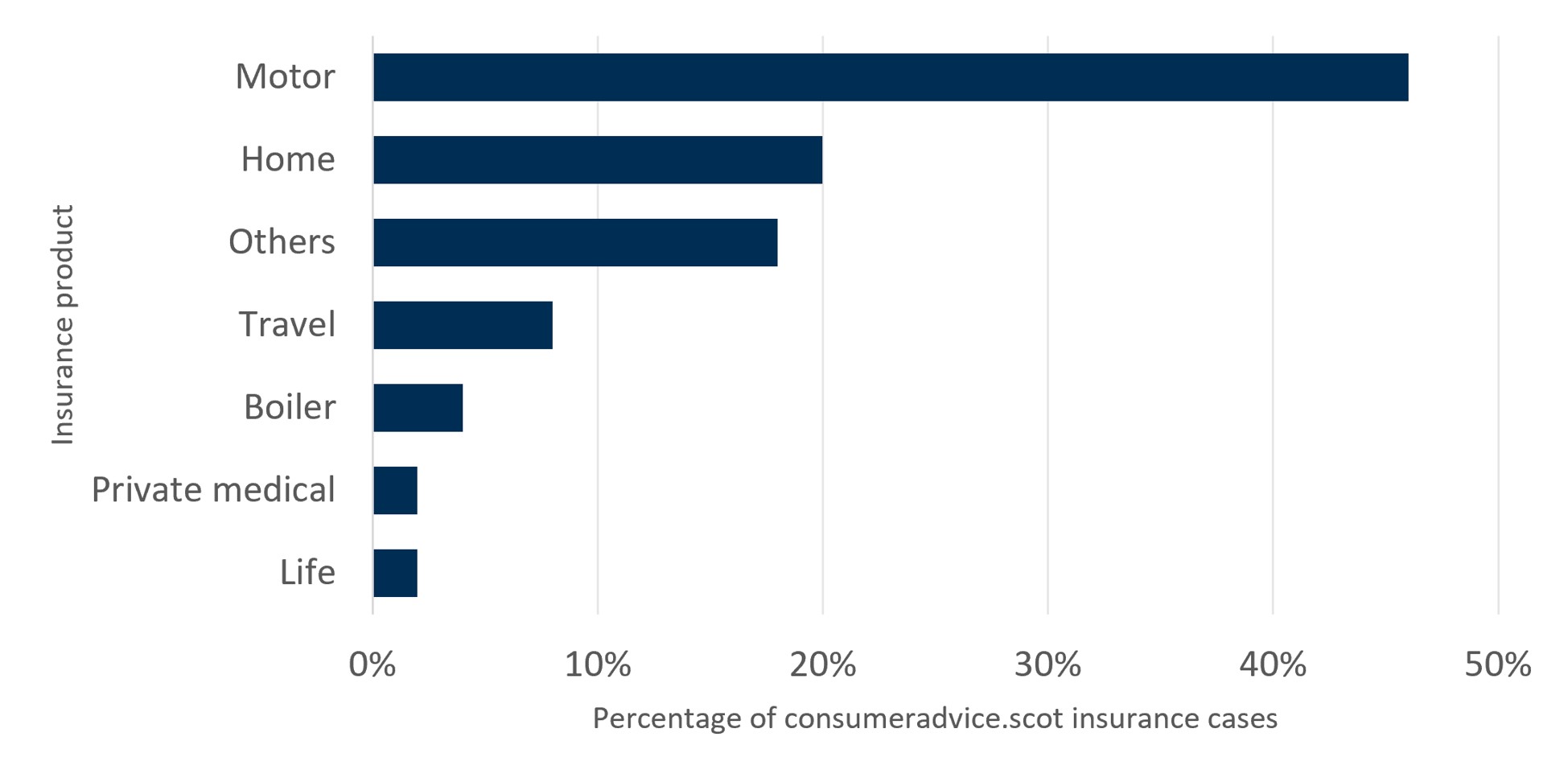
Base: 314 Advice Direct Scotland insurance cases
Policy and legislative landscape
In July 2025 the FCA released analysis which shows that increases in the cost of motor claims have contributed to premium increases.[109] The cost of hire vehicles, number and cost of theft claims and number of claims involving uninsured drivers have also risen significantly. The FCA analysis found that increased costs which were outside of firms’ control, rather than firm profit, were the biggest cause of recent premium rises in motor insurance. However, the FCA’s analysis also found evidence of poor claims handling processes, including:
- Lack of oversight of outsourced services, resulting in poor customer outcomes, delays in settling claims and high complaint volumes
- Insufficient management information resulting in failures to promptly identify and resolve claims handling issues and delays
- High rejection rates for storm damage claims
- Cash settlements being used without sufficient consideration of whether they are most suitable.
Concerns have been expressed that the impacts of climate change may make storm damage more prevalent, especially in rural Scotland. The Scottish Climate Survey shows that of those who had experienced severe weather events in the last 12 months, rural households were more likely than urban households to report property damage (24%, compared to 20%). Concerns regarding handling of storm damage claims may therefore particularly affect rural consumers.[110]
In October 2024, the FCA launched a market study on premium finance as part of wider work on motor and home insurance. This was driven by concerns that premium finance may not represent fair value for some consumers and that competition may not be functioning effectively.
The FCA study found that there is variation in the rates firms charge for paying by instalments. Typically, when firms charge extra for premium finance, the Annual Percentage Rates are in the 20-30% range, but almost 20% of consumers pay over 30%.[111] Concerns have also been raised that in addition to paying finance charges for premium finance, the decision to pay monthly may be factored into the pricing of the underlying insurance premium, where the decision for a consumer to pay monthly may be treated as a risk factor, driving up the price of the policy.
In September 2025 Which? launched a super-complaint relating to standards in the home and travel insurance markets. This was as a result of research and engagement which pointed to systemic problems with how policies are sold and explained, and how claims are then handled.[112] In December 2025 the FCA responded, noting that they are expanding their planned work to improve standards in the home and travel insurance markets, following the super-complaint. The FCA committed to do more to improve claims handling, by reviewing firms’ customer service and delivery and how they oversee third parties that handle claims and improve consumer understanding of what their insurance covers, and by analysing the different ways firms are selling products over the next year.[113]
The FCA found that the cost of paying for insurance monthly has fallen significantly since the Consumer Duty was introduced, however, it did raise concerns around some higher priced products. The FCA challenged some firms to better explain how they’ve considered all aspects of fair value and, if necessary, to explain what changes they would be making to their processes or their products. The FCA has signalled a willingness to use its supervisory jurisdiction to follow up these issues, in preference to making new formal rules.[114]
Key themes and recommendations
Measures to ensure that the insurance market works well for consumers, providing them with access to affordable insurance products that meet their needs, can make this market fairer for consumers, particularly consumers in vulnerable circumstances.
Consumers can currently find it hard to understand the additional costs associated with paying for insurance on a monthly basis. Consumers would benefit from improved understanding of these additional costs and the payment options available to them. The FCA’s current work plan in this area includes a market study and continued monitoring of premium finance. Additionally, the FCA’s response to the Which? super-complaint into home and travel insurance, includes plans to extend current work to look at how home and travel insurance firms are meeting the Consumer Understanding outcome of the Consumer Duty.[115]
More widely, there remains a need to expand access to key insurance products, to address the “protection gap” between those who do and do not hold policies. Analysis by Fair4All Finance has shown that 24% of people in financially vulnerable circumstances do not hold a single insurance or protection product. The national average is 16%.[116] This lack of access can result in consumers who are already at risk of financial vulnerability, and who may lack financial resilience, being more exposed to harm in the event that their assets or possessions are damaged. This can in turn cause consumers in these circumstances to take on more debt as they replace necessary items. Consumer Scotland considers that access to insurance should be considered as part of any wider financial inclusion strategy. The Treasury Committee heard concerns that developing necessary actions in this sector to address access issues may require further powers and we recommend that the FCA address this issue in future Perimeter reports, where it identifies issues on the edge of its regulatory powers.[117]
11. Pensions and Savings
Commonly held products
The Financial Lives Survey 2024 found that over three quarters of UK respondents had some form of private pension provision – 44% with a defined contribution pension and 22% with a defined benefit pension.[118] The survey also found one in four (24%) adults were receiving an income from, or had taken a cash lump sum from, a pension.
The Financial Lives Survey 2024 found that over three quarters (75%) of UK consumers had some form of private pension provision. While a similar proportion (76%) of consumers in Scotland held some form of private pension, the survey also indicates that around 1 in 5 (19%) of Scottish consumers have no private pension provision. This is slightly higher than the percentage for the UK as a whole at 17%. The survey also found that there are also some demographic groups at the UK level that were significantly less likely than average to have a private pension. [119]
Scottish consumers are among demographic groups more likely to have no private pension
Chart 4: Proportion of the adult population without a private pension
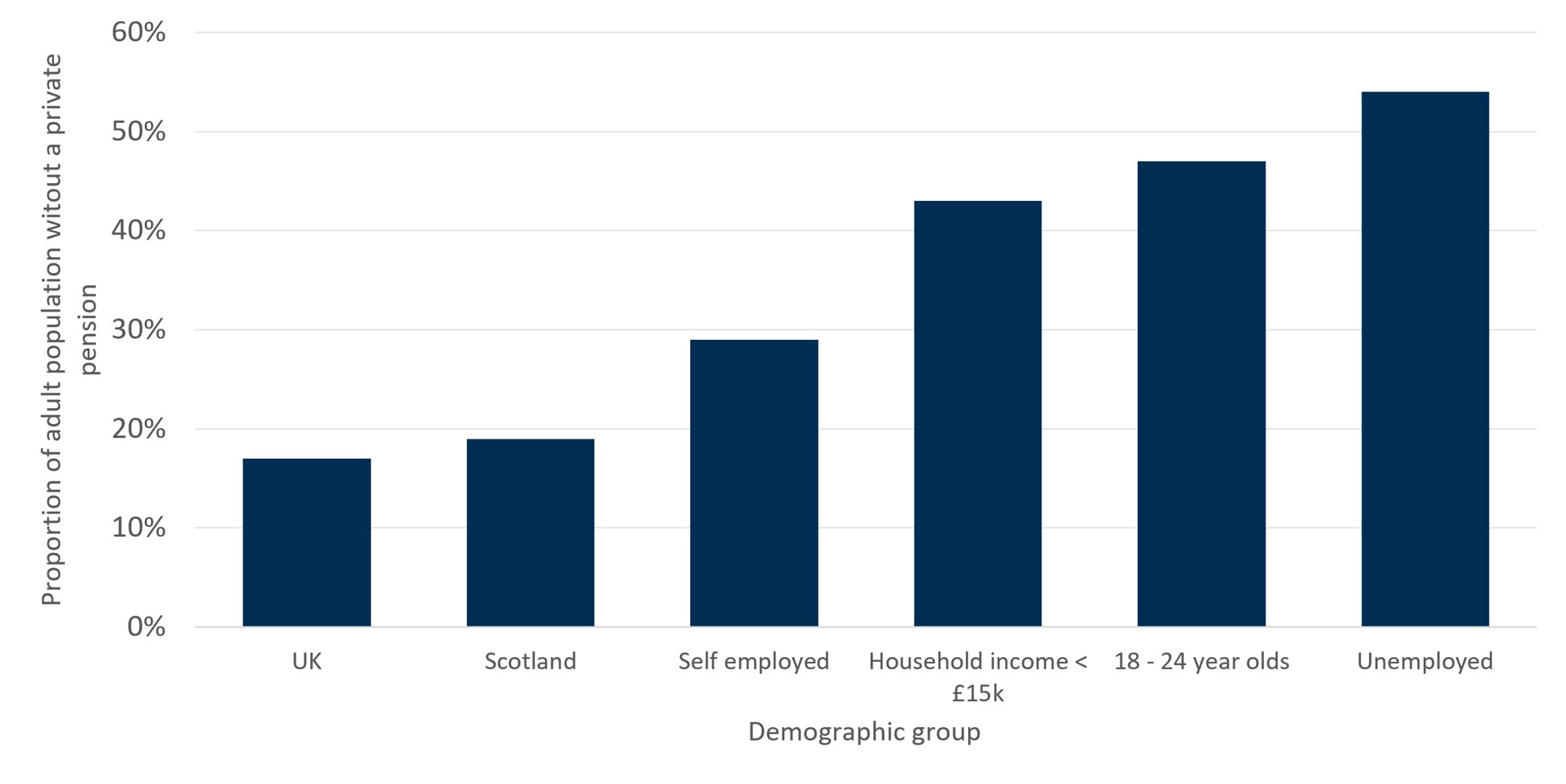
Source: Financial Lives Survey 2024, POsumP1 Pension Summary (1) Private pension provision
Weighted Bases: UK, n = 17,950; Scotland, n = 1,475; Self-employed, n = 1,055; Household income <£15k, n = 2,029; 18-24 year-olds, n = 1,867; unemployed, n = 770
Research by the Money and Pensions Service found that 47% of respondents in Scotland do not have a plan for their finances in retirement and 52% do not understand enough to make decisions about retirement.[120]
In relation to investments, the Financial Lives Survey 2024 found that a relatively small proportion of the UK population held a specific investment product. Directly held shares in a listed company or stocks and share ISAs were the most common, but less than one in five held these products.[121]
The FCA has commissioned consumer research highlighting that 36% of consumers exhibit under-investing behaviours, such as holding excess cash. As a result, these consumers risk missing out on long-term financial gains that they could unlock by investing. Just 27% of those who hold investible assets (meaning £500 or more of cash or investments or a pension) have accessed any regulated or statutory information, advice or support in the last three years.[122]
The FCA acknowledge that decisions about pensions and retail investments are complex and that consumers need support. The advice gap is a longstanding issue, with regulated advice (where firms make recommendations based on individual circumstance) at one end of the spectrum, and sources of support and guidance (general advice, not personalised to consumers’ circumstances) at the other end.
FCA research has shown that 59% of consumers did not access information, guidance or regulated advice on saving, pensions or retirement planning in the 12 months to May 2024.[123] Consumers generally want to see more support for making investment decisions, with 54% of savers saying they would welcome ‘a lot’ or ‘a little support’ in deciding whether to invest excess savings. A lack of knowledge was cited as the main barrier to investing by 40% of consumers.[124]
Survey Data on Detriment
Insight from the Consumer Detriment Survey[125] shows that 6% of the UK adult population experienced detriment with pension funds and investment services. The main issues underlying the detriment failure were:
- service delivery problems
- complete failure to provide
- poor quality service
- misleading information or unfair or unclear terms and conditions.
Policy and legislative landscape
The Pension Schemes Act 2026[126] is designed to support people to plan for retirement by making pensions simpler to understand, easier to manage, and to drive better value over the long term. It introduces a new system to show how well pension schemes are performing, aiming to support consumers to understand whether their scheme is giving them good value and to protect them from getting stuck in underperforming schemes. The Act aims to support the merging of small pension pots, bringing pots together and helping consumers to see their full pension picture in one place.
To facilitate this, and to tackle the challenges consumers may experience in understanding, consolidating and managing pensions, the Money and Pensions Service is working to deliver the Pensions Dashboard Programme. The Pensions Dashboard Programme aims to connect people to their pension information through dashboards, allowing them to see workplace, private and State Pension information together in one place. In March 2026 this was in the second phase of consumer testing to make final modifications before the Dashboard is launched.
On investments, in December 2022, the UK Government launched the Advice Guidance Boundary review which aims to improve consumer access to financial support. A joint initiative between HM Treasury and the FCA, it looked at the regulatory boundary between financial advice and other forms of support.[127]
In June 2025 the FCA consulted on proposals to introduce a new form of support – targeted support.[128] This would enable firms to provide suggestions designed for groups of consumers with common characteristics, for example, a firm could suggest an alternative sustainable withdrawal rate to a consumer drawing down on their pension unsustainably, or it could suggest that a consumer invests their money in an ISA if they are holding excess cash in their account. In February 2026 the FCA Board confirmed the final rules and the scheme went live in April 2026.
Key themes and recommendations
More needs to be done to ensure that consumers have the information that they need to plan for their finances in retirement. The effective implementation of the Pensions Dashboard Programme has the potential to play a significant role in achieving this. The Dashboard must be clear and accessible for consumers, including those in vulnerable circumstances. We welcome the significant degree of testing that has taken place as part of the design and development of this tool.
Research has found that, while there are potential benefits, consumers can face barriers to investing or currently make investment decisions in ways that don’t enable them to meet their financial goals.[129] Consumers need to have information and support to make informed decisions and participate safely in the market. Consumers must understand the relative risks and rewards of investment and the protections they can benefit from when they make investment decisions.
Consumer Scotland supports the aim of closing the current gap that exists in the information and support available for those who could invest and currently do not, through the creation of targeted support.
Targeted support will provide another option for consumers, alongside information or generic guidance and holistic support. It has the potential to improve consumer engagement with the market, particularly for consumers who cannot afford specific and individually tailored advice but would benefit from greater support and guidance than is currently available.
However, we recommend that governments, regulators and firms should put safeguards in place to ensure that consumers, and particularly consumers in vulnerable circumstances, are not negatively impacted by changes:
- Consumers with lower savings and investment pots who are not going to earn firms as much in fees may be viewed by some firms as a commercially less attractive segment. We recommend that governments and regulators should work with firms to ensure that all consumers, regardless of levels of saving and investment, should have an appropriate level of choice in accessing advice
- Firms should be required to address the wide range of potential drivers of and differing experiences of consumer vulnerability, particularly often undisclosed vulnerabilities such as poor mental health
- Firms should do more to incorporate data and insight about vulnerability into their practices
- Clear systems are needed to allow consumers to be exited from processes, with signposting to other sources of support, where it becomes apparent that products or services under consideration will not meet their needs
- The FCA should ensure that firms make consumers aware of the limitations of advice provided through targeted support.
12. Advice and Information
What the data tells us
The Financial Lives Survey 2024 showed that only 9% of UK consumers took up regulated financial advice in the 12 months to May 2024.
The FCA’s perimeter report 2026 has highlighted the risk around AI and provision of information, noting that consumers are increasingly asking ‘general-purpose’ large language model platforms, such as ChatGPT or Claude, for help making financial decisions. This is a risk to consumers as, while these tools can respond to a variety of prompts and topics, they are not set up to help consumers with financial advice, research, or decision making and can be misleading and provide outdated or inaccurate information.[130] The FCA also notes that consumers using these tools are not receiving regulated advice and do not benefit from Financial Ombudsman or FSCS protections.[131]
Consumer research commissioned by the FCA has also found that social media is increasingly regarded as a potential source for financial help among a range of consumers. This is particularly the case in relation to higher-risk investments, with 28% of those holding higher-risk investments saying they use social media as a source of information, guidance or advice when making decisions about these investments, compared with 14% of those who hold traditional investments.[132]
This is consistent with research from Queen Mary University on behalf of Aberdeen PLC, which found that two in five survey respondents reported using social media as a source of financial guidance, citing its relatability, breadth of information and ease of access. Around one third (31%) said they had tried guidance found on social media in the past year, such as applying a financial tip or making a related decision. Consumers showed widespread confusion about consumer protections, with more than half of respondents unaware of the legal distinction between “financial guidance” and regulated “financial advice”, and four in ten being surprised that most financial guidance on social media falls outside existing regulation. Around half of respondents believed responsibility for tackling misleading financial guidance should lie primarily with authorities or social media platforms, rather than individuals. The report called for better signposting to trusted, official content, mandatory disclaimers on posts and more requirements for disclosures around content makers qualifications and experience, financial links and conflicts of interest.[133]
The FCA and Advertising Standards Agency (ASA) have engaged with influencers and their agents, providing them with clear information about what could constitute an illegal financial promotion. They have also taken joint action to tackle poor advertising and promotional practices amongst claims management companies.[134] In addition, Ofcom has also announced a package of measures designed to combat paid-for scam adverts as part of the implementation of the Online Safety Act.[135]
The Money and Pensions service has also found that 13% of adults in Scotland show strong indicators of needing debt advice due to arrears, using high-cost credit or facing creditor action. A further 19% fall into the ‘at risk’ group, showing early indicators of problem debt that suggest they would benefit from money guidance.[136]
The money advice landscape
The Money and Pensions Service provides money guidance to consumers across the UK, including through their annual Talk Money Week, a yearly campaign encouraging people to have more open conversation about their finances. The Money and Pensions Service also provides consumer facing advice on money and pensions through their MoneyHelper service and delivers Money Guiders across the UK, a free programme for advisers and organisations who have money conversations with their customers.
The Financial Inclusion Strategy 2024-26 includes the objective of ‘easy to use and stigma free money management advice and debt services, including via digital channels’, including by working with Money Advice Scotland to promote their ‘Dignity First’ campaign, which aims to reshape conversations around money and debt.[137]
Free to access debt advice in Scotland is provided though a range of organisations funded by the Scottish Government, including Advice Direct Scotland, Citizens Advice Scotland and StepChange.
Financial education
Curriculum for Excellence, the framework used for learners aged 3-18 in schools in Scotland, focusses on the creation of ‘successful learners’, ‘responsible citizens’, ‘effective contributors’ and ‘confident individuals’ in our society. Financial capability is included as a requirement in the broad general education phase curriculum, primarily in the Numeracy and Mathematics curriculum area. Financial education is also part of the Social Studies curriculum mainly as part of learning about business and enterprise, covering topics like shops and services, ethical trading, paying for essential goods, budgeting, saving, borrowing and finance for business.[138]
In Scotland, the place of financial education in schools has been explored through the Curriculum Improvement Cycle which aims to support more consistent learning experiences and higher attainment. Education Scotland has led sessions with a range of stakeholders to explore how financial education can be more effectively integrated into the curriculum. An update on the new approach was due to be published in a draft curriculum technical framework in 2026.[139]
The UK Strategy for Financial Wellbeing has a focus on ‘financial foundations’, which includes a national goal for two million more children and young people getting a meaningful financial education, enabling them to become adults who are able to make the most of their money and pensions.[140] The Money and Pensions Service has produced guidance, which is endorsed by the Scottish Government, which aims to support both primary and secondary schools to play their part in achieving the goal set by the UK Strategy for Financial Wellbeing that 150,000 more children and young people growing up in Scotland receive a meaningful financial education by 2030.[141]
Key themes and recommendations
The FCA’s consumer research indicates that consumers with lower levels of financial knowledge are less likely to seek support than consumers with more knowledge. Without improved access to advice and support there is a risk that these consumers may make poor quality decisions, may be excluded from accessing services or may not receive the support they are entitled to.
Firms must address the wide range of potential drivers of consumer vulnerability, particularly vulnerabilities that are often undisclosed such as poor mental health. In addition, further work is needed to address the differing experiences of consumers. We recommend that the FCA should use its supervisory jurisdiction to ensure that firms are obtaining appropriate insight into their customers and incorporating learning from these data and insights about vulnerability into operating practices.
Consumers need access to clear and accurate information that enables them to make informed choices. To achieve this and minimise the risk of harm, more needs to be done to signpost consumers to sources of trustworthy advice and to address unregulated advice. We recommend that the UK Government considers whether further legislative measures are needed to prevent unregulated advice available on social media platforms causing detriment to consumers. Such measures could include increased disclosure requirements on content creators, requirements to add disclaimers or signposting to trusted advice sites, or clearer labelling of posts.
With an increasing number of consumers using sources such as social media to access financial information and advice, more needs to be done to address the provision of unregulated advice. We recommend that the UK Government considers whether further legislative measures are needed to prevent unregulated advice causing detriment to consumers. Such measures could include increased disclosure requirements on content creators, requirements to add disclaimers or signposting to trusted advice sites, or clearer labelling of posts.
Despite positive action taking place in a range of areas, there is a need for more joined up action on financial inclusion in Scotland. Consumers in Scotland would benefit from a wider programme of work that focusses on improving levels of financial inclusion. This work should include improving access to education and advice, along with targeted measures to increase levels of financial resilience and literacy.
13. Redress and Quality of Service issues
The Role of the FCA’s Consumer Duty
The Consumer Duty, as introduced by the FCA, sets clear expectations and standards of care that financial retail firms should have for their customers, embedding fairness, transparency, and a customer-focused approach across financial services.[142] These principles help drive service standards and provide a basis for identifying and addressing consumer harm where appropriate.
When the Consumer Duty was first introduced by the FCA, it recognised that firms would need some time to embed the Duty and signalled that it did not expect to use its enforcement powers immediately. The FCA aimed to support firms by publishing examples of good practice and areas for improvement, often publishing thematic reports. The FCA notes the importance of “assertive” supervision, noting that where supervision indicates that immediate action is needed to stop ongoing harm, they will intervene. The FCA intervened 382 times in the last reporting year; where it considers that intervention is needed it will undertake active monitoring to ensure any deficiencies are remedied.[143]
The FCA will open investigations where supervision detects serious misconduct and it considers an enforcement investigation is necessary, proportionate, and likely to create impactful deterrence across the industry. The FCA opened its first investigation in August 2024 and now has 11 investigations examining potential breaches of the Consumer Duty. It can also impose a requirement on firms to undertake an independent “skilled person” review and has commissioned around 30 skilled person reviews which reference the Duty. [144]
Consumer Scotland welcomes these actions and the transparent reporting of these investigations and reviews. It is important that supervision can detect where firms are not meeting their obligations, resulting in enforcement action being taken. Effective use of supervisory and enforcement powers can guide future action, helping determine where future market studies are best targeted and ensuring that consumer duty outcomes are more than simply aspirational.
Current Issues for individual consumers
Data from the Financial Lives Survey 2024 shows that the most commonly reported consumer issues in financial services market relate to consumer credit and loans and insurance claims. For credit, the most problematic credit or loan product, responsible for over 50% of the most serious problems, was credit cards. [145]
For insurance, motor insurance was responsible for more than 60% of the insurance problems, followed by home insurance (12%).[146] As noted above, advice service data is dominated by insurance, banking and credit cases along with money advice.[147]
The role of the Financial Ombudsman Service (FOS) is to consider disputes between consumers and firms, making an independent and fair decision based on the facts of each case for individuals, small businesses and charities. Every year the FOS shares a review of their work, providing product or sector specific data and insight from the complaints seen during the year. In 2024/25 it received 305,726 new complaints, with the most frequently complained about products being hire purchase (motor), credit cards, current accounts, car or motorcycle insurance and conditional sale (motor).[148]
Issues for Small Businesses
Consumer Scotland’s Small Businesses as Consumers Survey 2025 examined small business experiences and challenges as consumers. The research included financial services as a broad category, rather a focus on specific products or services.
The research found that the financial services sector was viewed more positively than average across a range of different measures and did not appear to be a significantly problematic market for small businesses. Compared to other markets, 18% of small businesses experienced at least one problem within the financial services sector in 12 months to March 2025 compared against a cross-market average of 24%.[149]
However, the research also found that financial services issues had a high impact when a problem is experienced, with 63% indicating that a financial services problem had impacted business performance such as profit or turnover, compared to a cross-market average of 42%. The research also noted evidence of issues with redress pathways, with 36% of those who experienced a problem stating that the issue was not resolved satisfactorily compared to a cross-market average of 16%.[150] Overall, the impression gained from the survey was that while issues are less frequently experienced in the financial services sector, when such issues do occur they are more commonly impactful and harder to resolve satisfactorily than the average.
Fraud and scams
The Financial Lives Survey 2014 found that in the 12 months to May 2024, 14% of adults across the UK (7.5 million people) reported experiencing a fraud or scam related to banking, payments, pensions or investments.[151] The survey found that card fraud was the most common (6.5% or 3.5 million), followed by ‘money muling’ (5.3% or 2.9 million) and Authorised Push Payment (APP) fraud (3.7% or 2 million).[152] [153] 71% of respondents who had experienced a fraud or scam reported it, mainly to their account provider (62%).[154]
Adults with characteristics of vulnerability (16%) were more likely to report experiencing fraud than those with no such characteristics (12%).[155] This increased risk was particularly driven by those who had recently experienced a negative life event (22%) – such as job loss (25%), relationship breakdown (24%), or bereavement (19%) – and by those in poor health or with a health condition (22%).[156] Those with low financial capability (16%) were slightly more likely to report experiencing fraud than those who did not have low financial capability (14%).[157]
Consumer trust and satisfaction
The Financial Lives Survey 2024 asked respondents about a range of topics relating to attitudes towards and experience of the financial services industry and firms. Just over a third (36%) of adults thought most financial firms were honest and transparent in the way they treat them.[158] Banks were the most trusted of a range of financial institutions, with 21% of respondents expressing high trust and 40% low trust, and insurance companies were the least trusted financial institutions, with 6% expressing high trust and 66% low trust.[159] The survey found that between 2022 and 2024 there was a notable decline in levels of trust for insurance providers and retail lenders, which is attributed to rising premiums and interest rates.[160]
Many consumers struggle to engage fully with financial services as a result of personal circumstances or poor practices by providers. The Financial Lives Survey 2024 found that 6.5 million consumers had low financial capability, rating their confidence with managing money and their knowledge of financial matters as very low.[161] The vast majority (92%) of adults with low financial capability state that this affects how they deal with financial matters or financial firms. They report feeling overwhelmed when they have to interact with providers, find dealing with customer services on the phone confusing and difficult, don’t feel able to shop around for financial products, or put off or avoid making financial decisions.[162]
Poor practices highlighted by the FCA include a lack of appropriate or accessible communication channels for customers in vulnerable circumstances, and a lack of testing of consumer understanding.
The FCA also found room for improvement in:
- firms appropriately supporting staff to identify customers in vulnerable circumstances
- encouraging customer disclosure and providing support promptly and with an appropriate level of care
- demonstrating how they had embedded the needs of customers in vulnerable circumstances into their product and service design
- and providing training on vulnerability for product and design staff. [163]
Research by the FCA has found that the majority of consumers with characteristics of vulnerability have not disclosed their circumstances to their financial services providers. Of the 42% that had disclosed personal circumstances to a financial services provider, 19% did so after being encouraged by their provider.[164] Those consumers who do make disclosures tend to find this a positive experience: three quarters (74%) agreed the provider asked the right questions, nearly 6 in 10 (57%) felt that the provider cared, and a similar proportion (58%) said the provider made changes.[165]
Vulnerability can have an impact on ability to access products. Research by the FCA has found that 25% of consumers with characteristics of vulnerability have reported being turned down for a financial product or service that they felt was suitable for their needs, compared to 11% of those not in vulnerable circumstances.[166]
The Financial Lives Survey 2024 found that 57% of respondents across the UK who attempted to complain found the process difficult or were unable to complain at all. 34% of those who raised a complaint or attempted to do so found the process very or fairly difficult and 23% were unable to raise a complaint.[167] These difficulties may result in some consumers not complaining at all. For example, the survey found that while 23% of consumers holding investment products said they experienced a problem with a product or provider in the 12 months to May 2024, only 4% of all holders complained.
The Financial Lives Survey also found that two-thirds of consumers (67% across the UK) believed there are suitable methods available for contacting financial services providers, however this was significantly lower among adults with low financial capability (45%).[168] Feedback from product holders who had contacted or attempted to contact their financial services providers in the previous 12 months was generally positive, however the survey found evidence of consumers facing challenges contacting providers:[169]
- In 19% of recent contact events adults struggled to find the right contact info
- In 21% of recent contact events adults found it difficult or were unable to get through to someone
- In 21% of recent contact events adults had trouble finding the right person to resolve their query.
Policy and legislative landscape - protection and redress
In March 2025 the Prudential Regulation Authority consulted on the protection levels available under the Financial Services Compensation Scheme. This provides protection where a firm is unable or unlikely to be able to pay compensation. The consultation proposed raising the deposit protection limit from £85,000 to £110,000, and to increase the limit applicable to certain temporary high balance claims from £1 million to £1.4 million.[170] In November 2025 it was confirmed that the deposit protection limit is to be increased to £120,000, providing welcome additional protection for consumers.[171]
As noted above, specific measures have also been proposed to respond to the needs of motor finance customers who were treated unfairly between 2007 and 2024, although progress in implementing these measures remains uncertain following recent legal challenges.[172]
In July 2025 the FCA and FOS consulted on modernising the redress system more generally. These consultations have included a focus on effective management of mass redress events, such as the motor finance cases, which can cause case management challenges for both firms and FOS, resulting in further consumer detriment.
Additional challenges in complaints management have been experienced due to the use of professional representatives, such as claims management companies and solicitors. While these bodies may support some consumers who might not otherwise access redress pathways to resolve issues, their use can also pose issues. Using professional representative can result in lower awards being paid to consumers, with some firms charging up to 30% of the redress award in fees.[173] In light of this, FOS agreed to introduce a £250 fee for individual professional represented cases, reduced to £75 if the outcome is in the consumer’s favour.[174] The FCA has also indicated that it will undertake a review of claims management practices.
These redress proposals, and a further consultation from HM Treasury, have a wider stated aim of achieving greater predictability, certainty and transparency, with appropriate responsibility for firms to identify and address redress issues early on.[175] The proposals include:[176]
- Amending the current legislative fair and reasonable test for determining individual complaints to the Financial Ombudsman
- The introduction of a pre-registration process and additional rules outlining when a complaint may be dismissed
- Measures to allow FOS to pause cases and seek guidance from the FCA on issues with wider implications or where there is a need for clarity on whether a firm’s approach aligns with FCA expectations
- The introduction of a 10-year time limit, or ‘longstop’ date for referring complaints to FOS, with this timeframe running from the event giving rise to the complaint
- Tools to allow the FCA to better manage Mass Redress Events.
- In March 2026 the FCA consulted on further proposals including finalised guidance setting out good and poor practice on identifying and rectifying harm, guidance clarifying when firms should report issues and rule changes for designed to deliver greater efficiency by FOS and the FCA.[177] A number of measures will require legislative changes and these are incorporated in the Financial Services and Markets Bill currently before the UK Parliament.[178]
Key themes and recommendations
Ensuring that consumers have access to an effective complaints and redress system is essential to provide effective redress when things have gone wrong. It is particularly important in complex markets like financial services where there is often a significant knowledge gap between consumers and firms and where there is significant potential for consumers to experience financial detriment. Given this, it is concerning to us that the existing data shows consumers can experience difficulties in contacting providers and may not find it straightforward to lodge complaints.
We recommend that the FCA should consider making redress a priority area for future work on the implementation of Consumer Duty outcomes. In exercising its supervisory duties, firms should be asked to demonstrate how they have user tested their contact systems and their complaints processes, outline what mechanisms are in place for them to collect user feedback and demonstrate how they have responded to any consistent feedback themes.
The current proposals in relation to changes to the redress system introduce a number of additional, specific rules. Consumer Scotland considers that these may, over time, change the nature of the FOS, moving it from a free, accessible and user-friendly service towards one that is rules based, inflexible and more difficult for consumers to navigate. Overall, we are not persuaded that the proposed changes to the redress system will benefit consumers.
We recommend that FOS should retain the ability to examine what is fair and reasonable in the overall circumstances of each individual case, to determine cases using a broad discretion, and while being required to provide reasons for their decision. We also oppose the implementation of an absolute time limit of 10 years for bringing complaints, as we do not consider that this is in the best interests of consumers. This is because many products such as pensions, bonds, protection products or life insurance are long term or lifetime products. In such cases harm or poor practices may not become apparent until well into the lifetime of the product, which may be longer than the 10 years proposed.
More broadly, there is a need to ensure that consumers, including those in vulnerable circumstances, are not negatively impacted by any changes to the redress system. We recommend that in the event these changes are enacted. FOS puts in place detailed monitoring on their impact, as well as conducting research on user experiences and seeking regular user feedback. In addition, measures should be developed to ensure the FOS service is underpinned by inclusive design, access to plain language guidance and support via a variety of channels. The development of a policy outlining how the FOS will respond to the needs of consumers in vulnerable circumstances should be a priority, alongside implementation of any of these changes.
14. Key messages and recommendations
Financial services play a foundational role in enabling consumers to participate in society and the economy. It is a market that works well for a substantial number of consumers who engage with products and services in a way that enables them to achieve their financial goals. However, there are a number of areas where the sector does not work effectively for some groups of consumers in Scotland, and where further action is required to ensure equitable access to products and services.
This report has examined a range of issues that affect consumers and identifies where the experiences of consumers in Scotland, or the policy and legislative context, may differ from the rest of the UK. This section outlines our key messages and recommendations.
Financial inclusion
Financial inclusion activity in Scotland is delivered across a number of different policy areas, including anti-poverty work, financial services, digital inclusion, advice provision and education.
The UK Government’s Financial Inclusion Strategy sets out its approach to improve financial inclusion and wellbeing across the UK. Much of the strategy activities will benefit consumers in Scotland, however certain measures and investments will only cover England and Wales resulting in a relative gap in provision in Scotland. This follows on from the longstanding use of dormant assets funds in England to support financial inclusion, which has not historically been how these funds have been deployed in Scotland. This is set to change as the Scottish Government has updated Ministerial Guidance to include financial inclusion as one of the purposes on which dormant assets funds can be used.
However, stronger coordination of financial inclusion activities could benefit consumers in Scotland, focus to address systemic issues that lie at the heart of financial exclusion, such as low financial resilience, gaps in access to banking services and poor financial literacy. Leadership will be needed from the Scottish Government, in conjunction with other stakeholders, to bring together the range activities being delivered in Scotland, including those emerging from the UK Financial Inclusion Strategy alongside specific devolved policy interventions, to identify gaps, ensure a joined up approach and target action on areas that will deliver the greatest impact for consumers in Scotland.
We recommend that the Scottish Government works with a wide range of stakeholders to identify gaps in the Financial Inclusion landscape in Scotland, identifying where further leadership is required to improve consumer outcomes and providing this. A Financial Inclusion action plan would help to more comprehensively address these issues. It could identify both ongoing and emerging risks to consumers. Helping to ensure preventative action is taken where possible and that current gaps in support are addressed. The plan should also clearly set out responsibility for delivering key policy measures, establish how public bodies and other stakeholders can work in partnership, identifying opportunities for collaboration through the public service reform process, to achieve shared objectives, and include defined timescales, measurable targets, and clear funding allocations.
Access to cash and banking services
Ensuring that consumers across Scotland have equitable access to cash and banking services is essential. Scotland has a higher proportion of people living in rural and island communities than many other parts of the UK. As a result, reductions in access to cash or local banking facilities can have a disproportionate impact on consumers and businesses in these areas, where alternative services may be less accessible. Accessing alternative sources of cash may require longer and more complex trips for consumers living in such areas, who often also face additional and compounding disadvantages such as poorer digital connectivity, which can make accessing online financial services more challenging.
Consumer Scotland recommends that the UK Government and FCA examine the options and opportunities for taking a different approach to determining criteria for access to banking and cash facilities in these areas, when compared to the rest of the UK. In particular, there is a need for decisions relating to bank branch closures and to the implementation of banking hubs and other measures to fully take into account the particular needs of consumers in Scotland’s rural and island communities.
When making these decisions it is important that there is a clear understanding of what consumers want and need from access to cash and banking services, how these services are being used currently, and what impact any gaps in services are having on consumers. Consumer Scotland intends to carry out consumer research later this year to gather insight and to inform our advocacy work going forward. This will help us provide input and make recommendations about the adequacy of the current rules regarding access to cash and banking facilities. This will include contributing to the FCA’s evaluation of the access to cash regime. We welcome the commitment the regulator has made to undertaking this work.
We also welcome the UK Government commissioning an Independent Review into access to banking services, which we have provided input into. As part of this review, we recommend that the UK Government should act swiftly to implement any new framework to secure equitable consumer access to banking services. Alongside recognising the distinct issues for Scotland’s rural and remote communities, this should include consideration being given to the strengths and weaknesses of the framework that currently exists for access to cash and developing an enhanced framework for access to banking services. This should recognise the more complex set of considerations involved in access to banking, given the range of services this involves, build on aspects of the access to cash framework that are assessed as working effectively, and draw learning from aspects of that framework that assessed as being less effective, in order to deliver a robust and comprehensive approach. Consideration should also be given to granting the FCA additional powers in relation to branch closures, given the interplay between access to cash and access to banking and the impact that these issues have on consumers.
Access to credit
Access to credit can play an important role in helping many consumers to spread the cost of goods and manage competing financial priorities. For many consumers, access to the right credit products can help them access products and services that they would not otherwise be able to.
Using Dormant Assets Funding to support community lending and boost access to a wider range of alternatives to high cost credit products for consumers in Scotland can help widen access to appropriate forms of credit for those currently unable to do so. Alongside this, more also needs to be done to improve access to everyday banking services, including bank accounts, mortgages, and mainstream credit such as loans, credit cards and overdrafts.
We support the work of the FCA to widen access to basic banking, improve access to mortgages and ensure that appropriate access to credit is maintained. There is a need to ensure that previous reforms in mortgages, high cost credit and deferred credit markets are fully implemented and that better consumer outcomes are being delivered. We recommend that the FCA continues to develop the application and enforcement of the Consumer Duty in order to drive forward these changes, with regular, transparent reporting on the impact secured through improved consumer outcomes.
With regards to buy now, pay later products specifically, we welcome the measures recently introduced by the UK Government to strengthen consumer protection in this part of the market. The FCA should continue to monitor access and use of these products to ensure that this achieved. In particular, we recommend that:
- Providers should implement user testing to ensure consumer understanding
- The FCA should require firms to monitor levels of missed payments
- The FCA should provide guidance to firms on the operation of affordability measures to avoid unnecessary restriction of access to products
- The FCA should closely monitor use of higher cost or unregulated credit options that people may use as alternatives to these products to ensure these changes are not resulting in unintended consequences
- The FCA should monitor the use and availability of in-house deferred payment credit arrangements which are not within the scope these regulatory changes.
Insurance
Insurance products dominate the list of frequently held products in the Financial Lives Survey, with the most frequently held products being motor insurance and home insurance. Many consumers, including those with characteristics of low financial resilience, spread the cost of insurance by paying monthly due to being unable to pay in a lump sum. Research has shown that many consumers are unaware of the additional costs of paying in this way.
Further measures to ensure that the insurance market works well for consumers, providing them with access to affordable insurance products that meet their needs, will help to make this market fairer for consumers, particularly consumers in vulnerable circumstances. Many consumers with characteristics of financial vulnerability struggle to access insurance or protection products at all. Access to these products is an important part of wider financial inclusion policies and achieving this may require additional regulatory intervention.
We recommend that the FCA consider whether it has appropriate powers to ensure fair access to insurance and protection products and addresses this issue in future Perimeter Reports.
Pensions and savings
More needs to be done to ensure that consumers have the information that they need to plan for their finances in retirement.
The Financial Lives Survey 2024 found that 59% of consumers did not access information, guidance or regulated advice on saving, pensions or retirement planning in the 12 months to May 2024. Consumers generally welcome increased support for making investment decisions, with a lack of knowledge or support frequently cited as a key barrier to investing.
The effective implementation of the Pensions Dashboard Programme has the potential to play a significant role in helping to tackle these issues. Targeted support will provide another option for consumers, alongside information or generic guidance and holistic support. However, we recommend that governments, regulators and firms should put safeguards in place to ensure that consumers, and particularly consumers in vulnerable circumstances, are not negatively impacted by changes:
- Consumers with lower savings and investment pots who are not going to earn firms as much in fees may be viewed by some firms as a commercially less attractive segment. Governments and regulators should work with firms to ensure that all consumers, regardless of levels of saving and investment, should have an appropriate level of choice in accessing advice
- Firms should be required to address the wide range of potential drivers of and differing experiences of consumer vulnerability, particularly often undisclosed vulnerabilities such as poor mental health
- Firms should do more to incorporate data and insight about vulnerability into their practices
- Clear systems are needed to allow consumers to be exited from processes, with signposting to other sources of support, where it becomes apparent that products or services under consideration will not meet their needs
- The FCA should ensure that firms make consumers aware of the limitations of advice provided through targeted support.
Access to information
Consumers need clear and accessible information about products and services to determine whether products are right for them. This is particularly important in financial services, where there is often a substantial knowledge and power imbalance between consumers and providers. The innovative and fast paced nature of products accentuates consumer needs for access to information. There is room to improve signposting to trusted information, and to reduce the presence of harmful misinformation so that consumers can get information they can trust and are protected from unregulated and inaccurate advice.
The UK Government is implementing measures to encourage more engagement from consumers in investing. Ensuring that consumers have the information and support they need to make informed decisions is key to enabling fair and safe participation in this market. Consumers must understand the relative risks and rewards of investment and how to maximise the consumer protections available.
The introduction of targeted support has the potential to improve consumer engagement in the market, particularly for consumers who cannot afford specific and individually tailored advice but who would benefit from greater support and guidance. For this to be effective, consumers must understand the boundaries of this advice and what it can and cannot do. Measures must be put in place to ensure that consumers, particularly consumers in vulnerable circumstances, do not experience detriment as a result of the changes.
Firms must address the wide range of potential drivers of consumer vulnerability, particularly vulnerabilities that are often undisclosed such as poor mental health. In addition, further work is needed to address the differing experiences of consumers. We recommend that the FCA should use its supervisory jurisdiction to ensure that firms are obtaining appropriate insight into their customers and incorporating learning from these data and insights about vulnerability into operating practices.
With an increasing number of consumers using sources such as social media to access financial information and advice, more needs to be done to address the provision of unregulated advice. We recommend that the UK Government considers whether further legislative measures are needed to prevent unregulated advice causing detriment to consumers. Such measures could include increased disclosure requirements on content creators, requirements to add disclaimers or signposting to trusted advice sites, or clearer labelling of posts.
Redress
For consumers to feel confident, willing and able to participate in the market, they need to be able to contact providers and to easily raise issues with them. Existing data shows many consumers having difficulty in contacting their providers or raising complaints. We recommend that the FCA should consider making this a priority area for future work on the implementation of consumer duty outcomes.
Where issues are not resolved at first instance, consumers must be able to access formal systems to resolve any disputes. The proposed changes to the redress system must take the needs and priorities of consumers into account and ensure that consumers do not suffer poorer outcomes as a result of the changes.
Consumer Scotland has substantial concerns about the proposed changes to the redress system. The changes proposed would introduce a much more rules based framework and this risks the system becoming more inflexible and more difficult for consumers to navigate.
We have made a number of recommendations to ensure that the redress system remains accessible, proportionate and user friendly for consumers and that changes do not negatively impact on consumers, particularly those in vulnerable circumstances.
We recommend that the Financial Ombudsman Service should retain an overarching ability to determine each case based on what is fair and reasonable in the overall circumstances. We also oppose the implementation of an absolute time limit of 10 years for bringing complaints, as we do not consider that this is in the best interests of consumers, given the long duration of some products such as pensions, mortgages or protection products.
We also recommend that FOS puts in place detailed monitoring on the impact of these changes and ensures they are informed by user input. Measures should also be developed to ensure the service is accessible for consumers. The development of a policy outlining how the service will respond to the needs of consumers in vulnerable circumstances should be a priority.
15. Endnotes
[1] Which? (2024) Bank branch closures. Available at: https://www.which.co.uk/money/banking/switching-your-bank/bank-branch-closures-is-your-local-bank-closing-ayYyu4i9RdHy#use-our-bank-branch-closure-checker
[2] Consumer Scotland (2025), Response to HM Treasury consultation on the review of the Financial Ombudsman Service | Consumer Scotland
[3] Consumer Scotland (2025) What we do. Available at: https://consumer.scot/about-us/what-we-do/
[4] Treasury Committee (2019) Consumers’ access to financial services. Available at: https://publications.parliament.uk/pa/cm201719/cmselect/cmtreasy/1642/164203.htm#_idTextAnchor000
[5] Money and Pensions Service (2022) UK Strategy for Financial Wellbeing Delivery Plan for Scotland. Available at: https://maps.org.uk/en/our-work/uk-strategy-for-financial-wellbeing/delivery-plan-for-scotland
[6] Financial Conduct Authority (2026) About the Consumer Duty. Available at: https://www.fca.org.uk/firms/consumer-duty/about
[7] Financial Conduct Authority (2021), FG21/1: Guidance for firms on the fair treatment of vulnerable customers
[8] The Financial Conduct Authority ( 2021) Guidance for firms of the fair treatment of vulnerable consumers. Available at: https://www.fca.org.uk/publication/finalised-guidance/fg21-1.pdf
[9] The Financial Conduct Authority ( 2021) Guidance for firms of the fair treatment of vulnerable consumers. Available at: https://www.fca.org.uk/publication/finalised-guidance/fg21-1.pdf
[10] Financial Conduct Authority (2025) Financial Lives Survey 2024. Available at: https://www.fca.org.uk/publication/financial-lives/financial-lives-survey-2024-key-findings.pdf
[11] Department for Business and Trade (2025) Consumer detriment survey 2024. Available at: https://www.gov.uk/government/publications/consumer-detriment-survey-2024
[12] Consumer Scotland (2026) The business of being a consumer: Exploring small business consumer experiences and their impact. Available at: https://consumer.scot/media/cyaghycz/the-business-of-being-a-consumer-exploring-small-business-consumer-experiences-and-their-impact.pdf
[13]Money and Pensions Service MoneyView Scotland 2026 report available at https://maps.org.uk/en/publications/moneyview
[14] Financial Conduct Authority (2025) Financial Lives Survey 2024. Available at: https://www.fca.org.uk/publication/financial-lives/financial-lives-survey-2024-key-findings.pdf
[15] Financial Conduct Authority (2025) Financial Lives Survey 2024. Available at: https://www.fca.org.uk/publication/financial-lives/financial-lives-survey-2024-key-findings.pdf
[16] Money and Pensions Service (2026) MoneyView 2026 report available at https://maps.org.uk/en/publications/moneyview
[17] Money and Service MoneyView Scotland 2026 report available at https://maps.org.uk/en/publications/moneyview
[18] Money and Service MoneyView Scotland 2026 report available at https://maps.org.uk/en/publications/moneyview
[19] Money and Service MoneyView Scotland 2026 report available at https://maps.org.uk/en/publications/moneyview
[20] Money and Service MoneyView Scotland 2026 report available at https://maps.org.uk/en/publications/moneyview
[21] HM Treasury (2025) Financial Inclusion Strategy. Available at: https://assets.publishing.service.gov.uk/media/6909ed8db04a520c5051843f/Financial_Inclusion_Report.pdf
[22] House of Commons Treasury Committee (2026) Financial Inclusion Strategy: Second Report of Session 2026-27. Available at: https://committees.parliament.uk/publications/54171/documents/301539/default/
[23] House of Commons Treasury Committee (2026) Financial Inclusion Strategy: Second Report of Session 2026-27. Available at: https://committees.parliament.uk/publications/54171/documents/301539/default/
[24] Money and Pensions Service (2020) The UK Strategy for Financial Wellbeing. Available at: https://maps.org.uk/en/our-work/uk-strategy-for-financial-wellbeing
[25] Financial Inclusion Commission (2026) 2026 Plan for Change. Available at: https://static1.squarespace.com/static/67af48ca261f382bde7fcba9/t/6a55194077771a46bfcec53b/1783961920410/2026+Plan+For+Change+Financial+Inclusion+Commission.pdf
[26] Social Investment Scotland (no date) Financial Inclusion for Scotland. Available at: https://www.socialinvestmentscotland.com/about/financial-inclusion-for-scotland/
[27] HM Treasury (2025) Financial Inclusion Strategy. Available at: https://assets.publishing.service.gov.uk/media/6909ed8db04a520c5051843f/Financial_Inclusion_Report.pdf
[28] Department for Culture, Media and Sport (2025) Dormant Assets Scheme Strategy. Available at: https://www.gov.uk/government/publications/dormant-assets-scheme-strategy/dormant-assets-scheme-strategy
[29] Social Investment Scotland (2026), Dormant Assets: A major milestone for Financial Inclusion in Scotland | Social Investment Scotland
[30] The National Lottery Community Fund (2026) Tell us about financial support in Scotland. Available at: https://www.tnlcommunityfund.org.uk/news/tell-us-about-financial-support-in-scotland
[31] Financial Conduct Authority (2025) Financial Lives Survey 2024. Available at: https://www.fca.org.uk/publication/financial-lives/financial-lives-survey-2024-key-findings.pdf
[32] The Inclusion Foundation (2020) Financial Inclusion in 2020. Available at: https://theinclusionfoundation.org/wp-content/uploads/2020/04/TIF-Facts-and-Stats-2020.pdf
[33] Citizens Advice Scotland (2025) Holding to Account - Recommendations for Improving Access to Banking Services. Available at: https://www.cas.org.uk/sites/default/files/2025-03/Holding%20to%20Account%20Wider%20Report.pdf
[34] Financial Conduct Authority (2025) Financial Lives Survey 2024. Available at: https://www.fca.org.uk/publication/financial-lives/financial-lives-survey-2024-key-findings.pdf
[35] Financial Conduct Authority (2025) Financial Lives Survey 2024. Available at: https://www.fca.org.uk/publication/financial-lives/financial-lives-survey-2024-key-findings.pdf
[36] Financial Conduct Authority (2025) Financial Lives Survey 2024. Available at: https://www.fca.org.uk/publication/financial-lives/financial-lives-survey-2024-key-findings.pdf
[37] Citizens Advice Scotland (2025) Holding to Account - Recommendations for Improving Access to Banking Services. Available at: https://www.cas.org.uk/sites/default/files/2025-03/Holding%20to%20Account%20Wider%20Report.pdf
[38] Citizens Advice Scotland (2025) Holding to Account - Recommendations for Improving Access to Banking Services. Available at: https://www.cas.org.uk/sites/default/files/2025-03/Holding%20to%20Account%20Wider%20Report.pdf
[39] Financial Conduct Authority (2026) available at Basic Bank Accounts: The problems we found and how industry is committing to change | FCA
[40] Audit Scotland (2024) Tackling digital exclusion, available at https://audit.scot/publications/tackling-digital-exclusion
[41] Audit Scotland (2024) Tackling digital exclusion, available at https://audit.scot/publications/tackling-digital-exclusion
[42] Ofcom (2025) Exploring Digital Disadvantage, available at https://www.ofcom.org.uk/siteassets/resources/documents/internet-based-services/technology/research-digital-disadvantage/exploring-digital-disadvantage-research-report.pdf?v=393692
[43] Ofcom (2025) Exploring Digital Disadvantage, available at https://www.ofcom.org.uk/siteassets/resources/documents/internet-based-services/technology/research-digital-disadvantage/exploring-digital-disadvantage-research-report.pdf?v=393692
[44] Ofcom (2025) Exploring Digital Disadvantage, available at https://www.ofcom.org.uk/siteassets/resources/documents/internet-based-services/technology/research-digital-disadvantage/exploring-digital-disadvantage-research-report.pdf?v=393692
[45] Financial Conduct Authority (2025) Financial Lives Survey 2024. Available at: https://www.fca.org.uk/publication/financial-lives/financial-lives-survey-2024-key-findings.pdf
[46] Financial Conduct Authority (2025) Financial Lives Survey 2024. Available at: https://www.fca.org.uk/publication/financial-lives/financial-lives-survey-2024-key-findings.pdf
[47] Post Office Ltd (2026) letter to Scottish Affairs Committee available at committees.parliament.uk/publications/54246/documents/301692/default/
[48] WPI Economics (2026) Delivery in Partnership available at wpi_postoffice_delivery-in-partnership_june-2026.pdf
[49] Ofcom (2025) Connected Nations: UK report 2025. Available at: https://www.ofcom.org.uk/siteassets/resources/documents/research-and-data/multi-sector/infrastructure-research/connected-nations-2025/connected-nations-uk-report-2025.pdf?v=407947
[50] House of Commons Scottish Affairs Committee (2024) Cost of living: impact on rural communities in Scotland. Available at: https://committees.parliament.uk/publications/42993/documents/213858/default/
[51] Ofcom (2025) Connected Nations: UK report 2025. Available at: https://www.ofcom.org.uk/siteassets/resources/documents/research-and-data/multi-sector/infrastructure-research/connected-nations-2025/connected-nations-uk-report-2025.pdf?v=407947 See also: Consumer Scotland (2026) Connected consumers: Making telecommunications markets work for consumers in Scotland
[52] Audit Scotland (2024) Tackling digital exclusion. Available at: https://audit.scot/uploads/2024-08/nr_240822_tackling_digital_exclusion.pdf
[53] Financial Conduct Authority (2025) Financial Lives Survey 2024. Available at: https://www.fca.org.uk/publication/financial-lives/financial-lives-survey-2024-key-findings.pdf
[54] Which? (2024) Bank branch closures. Available at: https://www.which.co.uk/money/banking/switching-your-bank/bank-branch-closures-is-your-local-bank-closing-ayYyu4i9RdHy#use-our-bank-branch-closure-checker
[55] House of Commons (2022) Access to cash in Scotland. Available at: https://publications.parliament.uk/pa/cm5803/cmselect/cmscotaf/80/report.html#footnote-149-backlink
[56] Financial Conduct Authority (2025) Financial Lives Survey 2024. Available at: https://www.fca.org.uk/publication/financial-lives/financial-lives-survey-2024-key-findings.pdf
[57] WPI Economics (2026) Delivery in Partnership available at wpi_postoffice_delivery-in-partnership_june-2026.pdf
[58] Financial Conduct Authority (2025) Financial Lives Survey 2024. Available at: https://www.fca.org.uk/publication/financial-lives/financial-lives-survey-2024-key-findings.pdf
[59] Financial Conduct Authority (2025) Financial Lives Survey 2024. Available at: https://www.fca.org.uk/publication/financial-lives/financial-lives-survey-2024-key-findings.pdf
[60] LINK (no date) banking hubs. Available at: https://www.link.co.uk/help-centre
[61] Consumer Scotland (2025) Department of Business and Trade Green Paper: Future of Post Office. Available at: https://consumer.scot/publications/department-of-business-and-trade-green-paper-future-of-post-office/
[62] Advice Direct Scotland (2025) Consumer Advice Portal data – 12 months to July 2025
[63] Department for Business and Trade (2025) Consumer detriment survey 2024. Available at: https://www.gov.uk/government/publications/consumer-detriment-survey-2024
[64] Financial Conduct Authority (2024) Access to cash. Available at: https://www.fca.org.uk/publications/policy-statements/ps24-8-access-cash
[65] FCA Update to the Treasury Committee available at committees.parliament.uk/writtenevidence/155491/default/
[66] House of Commons Treasury Committee (2025) Acceptance of cash. Available at: https://committees.parliament.uk/publications/47610/documents/248855/default/
[67] HM Treasury (2026) Access to Banking Services Review. Available at: https://www.gov.uk/government/publications/hm-treasury-access-to-banking-services-review
[68] Financial Conduct Authority (2026) FCA perimeter report. Available at: https://www.fca.org.uk/publications/corporate-documents/fca-perimeter-report#recent
[69] Money Helper (2025), How long does a default stay on your credit file? | MoneyHelper
[70] HM Treasury (2026), Credit Union Common Bond Reform Call for Evidence Response - GOV.UK; Fair 4 All Finance (2026), Scaling affordable credit – growth, impact and what comes next - Fair4All Finance
[71] Financial Conduct Authority (2025) Financial Lives Survey 2024. Available at: https://www.fca.org.uk/publication/financial-lives/financial-lives-survey-2024-key-findings.pdf
[72] Financial Conduct Authority (2025) Financial Lives Survey 2024. Available at: https://www.fca.org.uk/publication/financial-lives/financial-lives-survey-2024-key-findings.pdf
[73] Financial Conduct Authority (2025) Financial Lives Survey 2024. Available at: https://www.fca.org.uk/publication/financial-lives/financial-lives-survey-2024-key-findings.pdf
[74] Financial Conduct Authority (2025), CP25/27: Motor finance consumer redress scheme | FCA
[75] Financial Conduct Authority (2026) News Release available at Legal challenges to motor finance compensation scheme - update for firms and consumers | FCA
[76] Financial Conduct Authority (2025) Mortgage Rule Review: Feedback to DP25/2 and Roadmap. Available at: https://www.fca.org.uk/publication/feedback/fs25-6.pdf
[77] Financial Conduct Authority (2015), How the credit card market is working | FCA
[78] Financial Conduct Authority (2015) Credit Card Market Study available at How the credit card market is working | FCA
[79] Financial Conduct Authority (2019) High Cost Credit Review: Overdraft Policy Statement available at PS19/16: High-Cost Credit Review: Overdraft policy statement | FCA
[80] Financial Conduct Authority (2025) Financial Lives Survey 2024. Available at: https://www.fca.org.uk/publication/financial-lives/financial-lives-survey-2024-key-findings.pdf
[81] Financial Conduct Authority (2025) Financial Lives Survey 2024. Available at: https://www.fca.org.uk/publication/financial-lives/financial-lives-survey-2024-key-findings.pdf
[82] Financial Conduct Authority (2025) Financial Lives Survey 2024. Available at: https://www.fca.org.uk/publication/financial-lives/financial-lives-survey-2024-key-findings.pdf
[83] Financial Conduct Authority (2025) Financial Lives Survey 2024. Available at: https://www.fca.org.uk/publication/financial-lives/financial-lives-survey-2024-key-findings.pdf
[84] Citizens Advice Scotland (2021) Buy now… pain later? Available at: https://assets.ctfassets.net/mfz4nbgura3g/1YG7ZltPP1JfBXDLfAIPgI/132a8617c04231d32eca733af7cdbcfe/BNPL_20report_20_FINAL_.pdf
[85] Citizens Advice Scotland (2021) Buy now… pain later? Available at: https://assets.ctfassets.net/mfz4nbgura3g/1YG7ZltPP1JfBXDLfAIPgI/132a8617c04231d32eca733af7cdbcfe/BNPL_20report_20_FINAL_.pdf
[86] HM Treasury (2024), Regulation of Buy-Now, Pay-Later: consultation on draft legislation (October 2024) - GOV.UK
[87] Financial Conduct Authority (2026), New protections confirmed for Buy Now Pay Later borrowers | FCA
[88] Financial Conduct Authority (2025) Financial Lives Survey 2024. Available at: https://www.fca.org.uk/publication/financial-lives/financial-lives-survey-2024-key-findings.pdf
[89] Financial Conduct Authority (2025) Financial Lives Survey 2024. Available at: https://www.fca.org.uk/publication/financial-lives/financial-lives-survey-2024-key-findings.pdf
[90] Financial Conduct Authority (2025) Financial Lives Survey 2024. Available at: https://www.fca.org.uk/publication/financial-lives/financial-lives-survey-2024-key-findings.pdf
[91] Scottish Illegal Money Lending Unit (no date) About the Scottish Illegal Money Lending Unit. Available at: https://stopillegallending.co.uk/about-simlu/
[92] Fair4All Finance (2026) Scaling affordable credit – growth, impact and what comes next - Fair4All Finance
[93] StepChange (2017) The need for more affordable alternatives to high cost credit | by StepChange Debt Charity | Medium
[94] Department for Culture, Media and Sport (2025) Dormant Assets Scheme Strategy. Available at: https://www.gov.uk/government/publications/dormant-assets-scheme-strategy/dormant-assets-scheme-strategy
[95] HM Treasury (2025) Financial Inclusion Strategy. Available at: https://assets.publishing.service.gov.uk/media/6909ed8db04a520c5051843f/Financial_Inclusion_Report.pdf
[96] Social Investment Scotland (2026), Dormant Assets: A major milestone for Financial Inclusion in Scotland | Social Investment Scotland
[97] The National Lottery Community Fund (2026) Tell us about financial support in Scotland. Available at: https://www.tnlcommunityfund.org.uk/news/tell-us-about-financial-support-in-scotland
[98] Financial Conduct Authority (2025) Financial Lives Survey 2024. Available at: https://www.fca.org.uk/publication/financial-lives/financial-lives-survey-2024-key-findings.pdf
[99] Financial Conduct Authority (2025) Financial Lives Survey 2024. Available at: https://www.fca.org.uk/publication/financial-lives/financial-lives-survey-2024-key-findings.pdf
[100] Financial Conduct Authority (2025) Financial Lives Survey 2024. Available at: https://www.fca.org.uk/publication/financial-lives/financial-lives-survey-2024-key-findings.pdf
[101] Moneysupermarket (2026) Car insurance facts, trends and stats. Available at: https://www.moneysupermarket.com/car-insurance/car-insurance-statistics/#_price_by_policy_type_
[102] Confused.com (2025) Monthly Home Insurance vs Annual Home Insurance. Available at: https://www.confused.com/home-insurance/guides/monthly-vs-annual-home-insurance
[103] Financial Conduct Authority (2025) Financial Lives Survey 2024. Available at: https://www.fca.org.uk/publication/financial-lives/financial-lives-survey-2024-key-findings.pdf
[104] Financial Conduct Authority (2025) Premium Finance Market Study Update Paper. Available at: https://www.fca.org.uk/publication/market-studies/ms24-2-2-premium-finance-market-study-update-paper.pdf
[105] Financial Conduct Authority (2025) Financial Lives Survey 2024. Available at: https://www.fca.org.uk/publication/financial-lives/financial-lives-survey-2024-key-findings.pdf
[106] Financial Conduct Authority (2025) Financial Lives Survey 2024. Available at: https://www.fca.org.uk/publication/financial-lives/financial-lives-survey-2024-key-findings.pdf
[107] Advice Direct Scotland (2025) Consumer Advice Portal data – 12 months to July 2025
[108] National Centre for Social Research (2025) Consumer Detriment Survey. Available at: https://www.gov.uk/government/publications/consumer-detriment-survey-2024
[109] Financial Conduct Authority (2025) Roadmap for retail insurance – empowering consumers and strengthening markets. Available at: https://www.fca.org.uk/publications/corporate-documents/roadmap-retail-insurance
[110] Scottish Climate survey (2025) available at Experience of severe weather events - Scottish Climate Survey 2024 to 2025: main findings - gov.scot, see also SLE warns storms now more frequent in Scotland | The Scottish Farmer
[111] Financial Conduct Authority (2025) Premium Finance Market Study Update Paper. Available at: https://www.fca.org.uk/publication/market-studies/ms24-2-2-premium-finance-market-study-update-paper.pdf
[112] Which? (2025) Which? launches insurance 'super-complaint'. Available at: https://www.which.co.uk/news/article/which-launches-insurance-super-complaint-aJK2b1K3M55T
[113] Financial Conduct Authority (2025) Response to the Which? super‑complaint on addressing poor consumer outcomes in home and travel insurance. Available at: https://www.fca.org.uk/publication/corporate/fca-response-which-super-complaint.pdf
[114]Financial Conduct Authority (2025) Premium Finance Market Study available at: https://www.fca.org.uk/publications/market-studies/ms24-2-premium-finance
[115] Financial Conduct Authority (2026) Our Consumer Duty Focus Areas. Available at: https://www.fca.org.uk/publications/corporate-documents/consumer-duty-focus-areas
[116] Fiar4All Finance (2026) Closing the Protection Gap available at Closing the protection gap: Expanding home contents insurance for social renters - Fair4All Finance
[117] Treasury Committee (2026) Financial Inclusion Strategy available at Financial Inclusion Strategy
[118] Financial Conduct Authority (2025) Financial Lives Survey 2024. Available at: https://www.fca.org.uk/publication/financial-lives/financial-lives-survey-2024-key-findings.pdf
[119] ‘Private pension provision’ is defined in the FCA’s Financial Lives Survey as: “All adults who have a pension in accumulation (i.e. a pension they have not yet accessed) and/or in decumulation (i.e. they are receiving an income from a pension or have taken a cash lump sum from any pension they have or have had in the past). Those without private pension provision may only have a pension from the State.” See Financial Conduct Authority (2025) Financial Lives Survey 2024. Available at: https://www.fca.org.uk/publication/financial-lives/financial-lives-survey-2024-key-findings.pdf
[120] Money and Pension Service (206) Scotland MoneyView available at: https://maps.org.uk/en/publications/moneyview#Download-MoneyView-2026
[121] Financial Conduct Authority (2025) Financial Lives Survey 2024. Available at: https://www.fca.org.uk/publication/financial-lives/financial-lives-survey-2024-key-findings.pdf
[122] Thinks Insight & Strategy (2025) Advice Guidance Boundary Review: Retail Investments Consumer Research. Available at: https://www.fca.org.uk/publication/external-research/agbr-retail-investments-consumer-research.pdf
[123] Financial Conduct Authority (2025) Financial Lives Survey 2024. Available at: https://www.fca.org.uk/publication/financial-lives/financial-lives-survey-2024-key-findings.pdf
[124] Thinks Insight & Strategy (2025) Advice Guidance Boundary Review: Retail Investments Consumer Research. Available at: https://www.fca.org.uk/publication/external-research/agbr-retail-investments-consumer-research.pdf
[125] National Centre for Social Research (2024) Consumer detriment survey 2024
[126] UK Parliament (2025) Pension Schemes Bill. Available at: https://bills.parliament.uk/bills/3982#timeline
[127] Financial Conduct Authority (2024), DP23/5: Advice Guidance Boundary Review – proposals for closing the advice gap | FCA
[128] Financial Conduct Authority (2025), PS25/22: Supporting consumers’ pensions and investment decisions: rules for targeted support | FCA
[129] Thinks Insight and Strategy (2025) Advice Guidance Boundary Review: Retail Investments Consumer Research. Available at: https://www.fca.org.uk/publication/external-research/agbr-retail-investments-consumer-research.pdf
[130] Financial Conduct Authority (2026) FCA perimeter report. Available at: https://www.fca.org.uk/publications/corporate-documents/fca-perimeter-report#recent
[131] Financial Conduct Authority (2026) FCA perimeter report. Available at: https://www.fca.org.uk/publications/corporate-documents/fca-perimeter-report#recent
[132] Thinks Insight & Strategy (2025) Advice Guidance Boundary Review: Retail Investments Consumer Research. Available at: https://www.fca.org.uk/publication/external-research/agbr-retail-investments-consumer-research.pdf
[133] Queen Mary University (2026) Financial guidance on social media platforms: Quality assessment and individual experiences available at https://www.aberdeenplc.com/docs?editionid=c81a6056-a39d-4dfd-9ed1-b43c00e818ee
[134] FCA News Releases (2023) and (2025) Available at FCA and ASA team up with Sharon Gaffka to warn fin-fluencers of risks of promoting illegal ‘get rich quick’ schemes | FCA and Regulators launch joint taskforce to crack down on poor practice in motor finance claims | FCA
[135] Ofcom (2026) Available at Big Tech must tackle scourge of scam adverts, says Ofcom
[136] Money and Pensions Service MoneyView Scotland 2026 report available at https://maps.org.uk/en/publications/moneyview
[137] Financial Inclusion for Scotland (2024) Financial Inclusion for Scotland Strategy 2024-26. Available at: https://www.socialinvestmentscotland.com/media/1mthg45r/fis-strategy-2024-2026_final.pdf
[138] Money and Pensions Service (2020) Financial Education Guidance for Secondary Schools in Scotland. Available at: https://maps.org.uk/en/publications/research/2020/financial-education-in-scotland
[139] HM Treasury (2025) Financial Inclusion Strategy. Available at: https://assets.publishing.service.gov.uk/media/6909ed8db04a520c5051843f/Financial_Inclusion_Report.pdf
[140] Money and Pensions Service (2020) The UK Strategy for Financial Wellbeing. Available at: https://maps.org.uk/en/our-work/uk-strategy-for-financial-wellbeing
[141] Money and Pensions Service (2020) Financial Education Guidance for Secondary Schools in Scotland. Available at: https://maps.org.uk/en/publications/research/2020/financial-education-in-scotland
[142] Financial Conduct Authority (2026) About the Consumer Duty | FCA
[143] Financial Conduct Authority (2026) Enforcement Watch 2 available at Enforcement Watch 2 | FCA
[144] Financial Conduct Authority (2026) Enforcement Watch 2 available at Enforcement Watch 2 | FCA
[145] Financial Conduct Authority (2025) Financial Lives Survey 2024. Available at: https://www.fca.org.uk/publication/financial-lives/financial-lives-survey-2024-key-findings.pdf
[146] Financial Conduct Authority (2025) Financial Lives Survey 2024. Available at: https://www.fca.org.uk/publication/financial-lives/financial-lives-survey-2024-key-findings.pdf
[147] Advice Direct Scotland (2025) Consumer Advice Portal data – 12 months to July 2025
[148] Financial Ombudsman Service (2025) Annual complaints data and insight 2024/25. Available at: https://www.financial-ombudsman.org.uk/data-insight/our-insight/annual-complaints-data-insight-2024-25#block-7831
[149] Consumer Scotland (2026) The business of being a consumer: Exploring small business consumer experiences and their impact. Available at: https://consumer.scot/media/cyaghycz/the-business-of-being-a-consumer-exploring-small-business-consumer-experiences-and-their-impact.pdf
[150] Consumer Scotland (2026) The business of being a consumer: Exploring small business consumer experiences and their impact. Available at: https://consumer.scot/media/cyaghycz/the-business-of-being-a-consumer-exploring-small-business-consumer-experiences-and-their-impact.pdf
[151] Financial Conduct Authority (2025) Financial Lives Survey 2024. Available at: https://www.fca.org.uk/publication/financial-lives/financial-lives-survey-2024-key-findings.pdf
[152] Card fraud is defined as ‘when a criminal steals personal information from your credit or debit card, or steals the card itself.’. Money muling is defined as “a money mule is someone who receives illicit money into their bank account and transfers it into another account, often in return for money or an expensive gift.” – UK Finance (2026) Take Five to Stop Fraud. Available at: https://www.takefive-stopfraud.org.uk/about/about-us/
[153] Financial Conduct Authority (2025) Financial Lives Survey 2024. Available at: https://www.fca.org.uk/publication/financial-lives/financial-lives-survey-2024-key-findings.pdf
[154] Financial Conduct Authority (2025) Financial Lives Survey 2024. Available at: https://www.fca.org.uk/publication/financial-lives/financial-lives-survey-2024-key-findings.pdf
[155] Financial Conduct Authority (2025) Financial Lives Survey 2024. Available at: https://www.fca.org.uk/publication/financial-lives/financial-lives-survey-2024-key-findings.pdf
[156] Financial Conduct Authority (2025) Financial Lives Survey 2024. Available at: https://www.fca.org.uk/publication/financial-lives/financial-lives-survey-2024-key-findings.pdf
[157] Financial Conduct Authority (2025) Financial Lives Survey 2024. Available at: https://www.fca.org.uk/publication/financial-lives/financial-lives-survey-2024-key-findings.pdf
[158] Financial Conduct Authority (2025) Financial Lives Survey 2024. Available at: https://www.fca.org.uk/publication/financial-lives/financial-lives-survey-2024-key-findings.pdf
[159] Financial Conduct Authority (2025) Financial Lives Survey 2024. Available at: https://www.fca.org.uk/publication/financial-lives/financial-lives-survey-2024-key-findings.pdf
[160] Financial Conduct Authority (2025) Financial Lives Survey 2024. Available at: https://www.fca.org.uk/publication/financial-lives/financial-lives-survey-2024-key-findings.pdf
[161] Financial Conduct Authority (2025) Financial Lives Survey 2024. Available at: https://www.fca.org.uk/publication/financial-lives/financial-lives-survey-2024-key-findings.pdf
[162] Financial Conduct Authority (2025) Financial Lives Survey 2024. Available at: https://www.fca.org.uk/publication/financial-lives/financial-lives-survey-2024-key-findings.pdf
[163] Financial Conduct Authority (2025) Delivering good outcomes for customers in vulnerable circumstances – good practice and areas for improvement available at Delivering good outcomes for customers in vulnerable circumstances – good practice and areas for improvement | FCA
[164] Financial Conduct Authority (2024) Vulnerability review. Available at: https://www.fca.org.uk/publication/external-research/vulnerability-review-improving-outcomes-consumers-engaging-financial-services-firms.pdf
[165] Financial Conduct Authority (2024) Vulnerability review. Available at: https://www.fca.org.uk/publication/external-research/vulnerability-review-improving-outcomes-consumers-engaging-financial-services-firms.pdf
[166] Financial Conduct Authority (2024) Vulnerability review. Available at: https://www.fca.org.uk/publication/external-research/vulnerability-review-improving-outcomes-consumers-engaging-financial-services-firms.pdf
[167] Financial Conduct Authority (2025) Financial Lives Survey 2024. Available at: https://www.fca.org.uk/publication/financial-lives/financial-lives-survey-2024-key-findings.pdf
[168] Financial Conduct Authority (2025) Financial Lives Survey 2024. Available at: https://www.fca.org.uk/publication/financial-lives/financial-lives-survey-2024-key-findings.pdf
[169] Financial Conduct Authority (2025) Financial Lives Survey 2024. Available at: https://www.fca.org.uk/publication/financial-lives/financial-lives-survey-2024-key-findings.pdf
[170] Bank of England (2025) CP425 Depositor protection. Available at: https://www.bankofengland.co.uk/prudential-regulation/publication/2025/march/depositor-protection-consultation-paper
[171] Bank of England (2025) PS24/25 – Depositor protection. Available at: https://www.bankofengland.co.uk/prudential-regulation/publication/2025/november/depositor-protection-policy-statement
[172] Financial Conduct Authority (2026) Motor finance consumer redress scheme. Available at: https://www.fca.org.uk/publications/policy-statements/ps26-3-motor-finance-consumer-redress-scheme
[173] Financial Conduct Authority (2024) Modernising the Redress System. Available at: https://www.fca.org.uk/publication/call-for-input/call-for-input-modernising-redress-system.pdf
[174] Financial Conduct Authority (2024) Modernising the Redress System. Available at: https://www.fca.org.uk/publication/call-for-input/call-for-input-modernising-redress-system.pdf
[175] Financial Conduct Authority (2025) Consultation Paper CP25/22 Modernising the Redress System. Available at: https://www.fca.org.uk/publication/consultation/cp25-22.pdf
[176] HM Treasury (2025) Review of the Financial Ombudsman Service. Available at: https://assets.publishing.service.gov.uk/media/68752db039d0452326e28e23/20250709_FOS_review_consultation_document_-_FINAL_V4.pdf
[177] Financial Conduct Authority (2026) CP26/9: Modernising the redress system. Available at: https://www.fca.org.uk/publications/consultation-papers/cp26-9-modernising-redress-system
[178] UK Parliament (2026), Financial Services and Markets Bill [HL] - Parliamentary Bills - UK Parliament