Executive Summary
Scotland’s 350,000 micro and small businesses face a wide range of challenges. This report examines small businesses experiences and challenges as consumers – in other words, as purchasers of goods and services that their businesses use.
In this report, we generally use the term ‘small business’ as short hand for micro and small businesses (those employing fewer than 10 and 50 employees respectively), although we distinguish micro and small businesses when it makes sense to.
Small businesses are a vital part of Scotland’s economy, accounting for over 900,000 jobs. Understanding small businesses’ consumer experiences – and the extent to which small businesses act as confident consumers or feel constrained by their consumer experiences – provides important information about the extent to which markets help small businesses to thrive, and are conducive to supporting economic growth more broadly.
Consumer Scotland’s founding legislation, The Consumer Scotland Act 2020, defines ‘consumers’ to include small businesses. This reflects the sense that small businesses often face similar challenges to individual consumers when purchasing or using goods and services.
However, the experience of micro and small businesses as consumers has not been extensively studied. This report aims to help fill that gap, developing a better understanding of the specific issues that micro and small businesses (collectively referred to as ‘small businesses) in Scotland face as consumers, and the impact those issues have on businesses.
Our research, which included a telephone survey of 700 small businesses in Scotland to explore their experiences in 11 consumer markets, found that small businesses engage in a wide range of markets as consumers. In general small business experiences as consumers are broadly positive. Nonetheless, there is also evidence of negative experiences, particularly in some markets, which can sometimes impact business performance.
Key findings
When acting as consumers, micro and small businesses face similar challenges as individual (domestic) consumers
All small business owners or managers experience life as both an individual consumer, and life as a small business consumer. On average, small business respondents to our survey did not think that any aspect of the consumer experience was materially easier or more difficult as a small business compared to being an individual.
And although specific results varied from market to market, small businesses were generally just as likely – if not more likely – to report having experienced a consumer problem within a market when compared to individual consumers.
This suggests that small businesses’ lives as consumers are no easier on average than is the case for individual consumers.
Consumer protections and consumer advice available to micro and small businesses differs across markets
- Despite similarities in the consumer experience, micro and small businesses often have less legal protection, fewer rights and fewer routes to redress than individual consumers. Rather than being able to rely on protections enshrined in legislation, small businesses are generally reliant on contract law, and often implicitly treated as though they bargain with the same market power as a large trader.
- Although protection differs between markets, and micro businesses often have some additional protections, small businesses are often not included in regulatory protections or mandatory ombudsman schemes. They also have less access to advice services to help them resolve problems.
Small businesses are generally fairly satisfied with their experience as consumers – but some markets perform better than others
- Most micro and small businesses in Scotland report reasonably positive consumer experiences: in seven of the eleven markets studied, over 75% of respondents expressed satisfaction with products and services, and fewer than 10% expressed dissatisfaction.
- Energy, water and telecoms markets performed worst across a range of metrics including satisfaction, dissatisfaction, likelihood of experiencing an issue, and the likelihood of an issue impacting business performance.
- Satisfaction was lower and dissatisfaction was higher in the energy market than it was in any other surveyed market. This is likely to be, at least in part, a reflection of high increases in energy prices in 2022 and 2023. But our research also shows that it reveals dissatisfaction in the energy market in relation to underlying challenges in contacting energy suppliers and understanding bills, and a sense that terms and conditions can be unfair. The energy market consistently performed more negatively on these metrics than other markets.
A significant number of small businesses have experienced consumer problems, and these can often impact on business performance
- Almost half of all businesses experienced at least one problem when purchasing or using products during the previous 12 months. Common problems include unclear contractual terms, particularly in the energy, water, financial and telecoms markets, as well as issues of delivery reliability (particularly for postal services), and poor service quality and misleading information (a feature of telecoms issues).
- These issues can have real impacts on business performance. One quarter of surveyed businesses had experienced problems which affected business performance during the past 12 months. Problems were particularly likely to impact business’ turnover or profit in energy, telecoms, and financial services. One fifth of businesses who had engaged in the energy market had experienced a problem which affected business performance, with equivalent figures of 14% and 12% in telecoms and financial services respectively.
Implications and recommendations
Until now, the impact of consumer issues on small businesses have tended to receive less attention than many other challenges facing small businesses. This report has demonstrated how important those consumer issues can be. Given the criticality of micro and small businesses to the Scottish economy, it is imperative that they are not impeded by a lack of information, poor service, or unclear routes for redress.
Our recommendations span both cross-market issues, and specific recommendations in relation to the energy and water markets. Further detail is provided in Chapter 6.
While micro and small businesses share many similar consumer issues as larger firms and domestic consumers, their smaller scale on the one hand and more limited legal protections on the other can leave them particularly exposed to information asymmetry, reliability problems, and unfair contract terms. Given the importance of micro and small businesses to the Scottish economy, it is important that regulators and policy makers regularly review how effectively and fairly markets operate for micro and small businesses.
We acknowledge that getting the balance right is not easy. The freedom to contract has been a fundamental principle of UK law, supporting commercial autonomy, certainty and efficiency. There is sometimes a case for limiting this freedom to protect micro and small business consumers from unfair practices and harm. But policy makers do also need to ensure that any regulatory burden associated with the objective of protecting small business consumers is proportionate.
Recommendation 1: Monitoring small business consumer issues
To inform and further evidence priorities for policy change, regulators including Ofgem, Ofcom and FCA should enhance their monitoring of consumer issues faced by small businesses in order to identify systemic issues and appropriate mitigation measures. This will include systematic monitoring of complaint data held by regulators, suppliers, advice bodies and ombudsmen (where relevant) – which should be published regularly to allow stakeholders to monitor trends – combined with regular surveys of small business sentiment.
Recommendation 2: Reviewing the provision of consumer and contract information for small businesses
A finding from this report is that micro and small businesses do not always feel they can access robust information about accessing goods and services and enforcing their rights when things go wrong in different markets. Enhancing the provision of relevant information is a useful way to improve small businesses consumer experience without requiring new regulation or significant additional investment.
In relation to specific markets, regulators – notably including Ofgem, FCA, and Ofcom – should regularly review the appropriateness and effectiveness of information provided specifically for micro and small businesses.
In terms of consumer issues more generally, the Scottish Government should work with small businesses representatives, consumer advocacy organisations and advice bodies to explore the scope to enhance access to consumer and contract law information for small businesses, and the organisation best placed to deliver this.
Recommendation 3: Improving standards in energy and water
This report finds consistent evidence of lower business satisfaction with the energy and water markets compared to other markets, with satisfaction particularly low in relation to issues around billing and the ability to contact suppliers.
While recent reforms have extended consumer protections to small businesses in energy, more work needs to be done. We make recommendations to the UK government, Ofgem, and advice providers covering enforcement of existing regulations, improving the third party intermediaries (TPI) regulatory framework, and improved signposting to existing advice services. Consumer Scotland intends to produce a follow-up report looking in more detail at recommendations for the energy market.
In water, our priority is ensuring that the new Code of Practice delivers on its potential to address many of the issues expressed by businesses in this report. Through our role as the Chair of the Code’s governance group, Consumer Scotland will work with other market stakeholders to ensure that the Code continues to evolve and deliver an improved experience for business customers.
1. Introduction
Small businesses and the Scottish economy
Small businesses – generally defined as businesses which employ fewer than 50 people – are a key component of the Scottish economy. There are around 352,000 small businesses in Scotland. These account for the vast majority of all businesses in Scotland. Collectively, small businesses employ around 917,000 people, representing 43% of total private sector employment in Scotland.[i]
There is, rightly, a large amount of research and analysis considering the issues and challenges that small businesses face to develop and grow. However, relatively little of this research considers the specific challenges that small businesses face as consumers – that is to say, when they purchase or use goods or services during any stage of their business operations. Most of the research that does exist on small businesses’ consumer experiences focusses on specific markets, with virtually no evidence on their holistic experiences across multiple markets.
Understanding small businesses’ consumer experiences is important, as it is indicative of the extent to which markets operate dynamically in a way that is conducive to economic growth. Where small businesses engage in markets as confident consumers – knowing how to identify and access the goods and services they need; willing to try new products or suppliers; and able to address problems when things go wrong – this can support the conditions for a dynamic, competitive economy.
Defining small businesses as consumers
Consumer Scotland’s founding legislation, The Consumer Scotland Act 2020, defines ‘consumers’ to include small businesses.[ii] The Act itself does not define small businesses but in common with accepted definitions we have interpreted it to include micro-businesses (which in broad terms are those which employ fewer than ten people) and small businesses (which employ 10-49 people). The definitions are discussed in more detail in Chapter 2, which also discusses how the distinction between micro and small businesses can be an important factor in determining the level of consumer protection provided to businesses in legislation. In this report, we generally use the term ‘small business’ as short hand for micro and small businesses, although we distinguish micro and small businesses when it makes sense to.
The rationale for including small businesses in the definition of ‘consumers’ in The Consumer Scotland Act was the sense that small businesses often face similar challenges to individual consumers. Additionally, that small business owners who are experiencing issues with goods and services often have limited resources to pursue complaints and may also be suffering additional detrimental impact on the ability to run their own business.[iii]
However, whilst the roots of the challenges facing small businesses as consumers may share similarities with those of ‘individual consumers’, there are also notable differences between small business experiences as consumers compared to individuals.[iv]
The context for small business consumers
Most obviously, whilst small businesses face similar challenges to individual consumers, the way these issues can be experienced by small businesses as consumers can be different given that the type and composition of the goods and services a small business consumer purchases can differ from those purchased by domestic consumers.
More significantly, small businesses can have less legal protection, fewer rights, and fewer routes to redress when buying goods and services compared to ‘individual’ consumers. For example, individual consumers enjoy very specific safeguards and implied rights from the Digital Markets, Competition and Consumers Act 2024 and the Consumer Rights Act 2015 - both of which specifically exclude the circumstances in which an individual is acting primarily for their business or profession.[v] Furthermore, small businesses are not as protected against unfavourable and prejudicial contract terms when purchasing goods and services compared to individual consumers.[vi] In essence therefore, apart from in some specific circumstances, the law can implicitly treat small businesses as if they bargain with equal market power to larger traders.
It is apparent that there is a lack of robust evidence as to the challenges that small businesses face as consumers, and how these differ across different types of small businesses, and in different markets. There is also a lack of evidence on how the consumer issues faced by small businesses differ from those faced by individual consumers.
In late 2024 and early 2025, Consumer Scotland undertook a programme of research to fill gaps in wider understanding about the issues that micro and small businesses face as consumers – and the impact of those issues on business performance.
Aims and objectives
The aim of this research is to develop a better understanding of the specific issues that micro and small businesses (collectively referred to as small businesses) in Scotland face as consumers, and the impact those issues have on businesses.
The objectives of the research are to:
- Understand the key problems and challenges that small businesses in Scotland experience in relation to products which are supplied to them or used by them.
- Identify the markets or products which are most likely to give rise to problems or challenges for small businesses in Scotland.
- Understand how the characteristics of a business (e.g. size, sector, legal structure, geographical location) are related to small businesses’ ability to engage in markets to secure appropriate goods and services.
- Quantify the extent to which small businesses experience detriment in different markets, and the nature and cause of that detriment.
- Understand how small businesses resolve issues and problems that arise, and the extent to which they can secure appropriate redress.
At the core of the research was a telephone survey of 700 small businesses in Scotland, which is described in more detail in Chapter 2. The research has also involved a review of existing research and policy, and discussion with key stakeholders.
Report structure
The remainder of this report is structured as follows:
- Chapter 2 provides important contextual background. It describes the characteristics of small businesses in Scotland; it provides more detail about what we mean by small businesses as consumers and what a good consumer experience looks like; and it describes the characteristics of consumer protection for small businesses in the eleven broad markets that we focus on in this report.
- Chapter 3 provides more detail on the approach and methodology that we adopted in this work, including our approach to surveying 700 micro and small businesses in Scotland.
- In Chapter 4 we examine small businesses’ overall experiences of being consumers, and their overall satisfaction with those experiences, including their experiences of and satisfaction with Third Party Intermediaries.
- Chapter 5 assesses the extent to which small businesses in Scotland experience issues or problems when they engage in markets, and the impact of these issues on their business performance. It considers some of the factors that might underly these trends, and explores businesses’ experience of redress when things go wrong.
- Chapter 6 compares small businesses’ experiences as consumers with individual (domestic) consumers’ experiences.
- Chapter 7 provides conclusions and recommendations for policy-makers.
2. Small businesses as consumers
Small businesses engage as consumers in a wide variety of markets, although they often face different legal protections compared to individual consumers. This section describes what distinguishes a consumer issue from other issues businesses might face, it describes the legal protections provided to small businesses when they engage as consumers, and it sets out where small businesses can go for consumer advice. It begins by outlining the nature of the small business landscape in Scotland.
The small business landscape in Scotland
In UK legislation, companies are classified as micro, small, medium, or large primarily for accounting and financial reporting purposes. Small business is not defined in the Consumer Scotland Act 2020 and no single definition of small business exists in other legislation. The Companies Act 2006 for example classifies ‘companies’ (limited businesses) as micro, small, medium, or large primarily for accounting and financial reporting purposes:[vii]
- As of April 2025, a company is defined as ‘micro’ if two of the following three criteria are met: turnover not more than £1m; balance sheet total of not more than £500,000m; no more than 10 employees.
- A company is defined as ‘small’ if two of the following three criteria are met: turnover not more than £15m; balance sheet total of not more than £7.5m; no more than 50 employees.
It is important to note that other definitions of micro and small businesses exist in other legislation. Different thresholds can apply for example in relation to specific tax or procurement legislation; and slightly different definitions can exist in certain sectors – in energy for example, company size is defined by energy consumption as well as employees.
It is common to define business size by reference to employees only, rather than by reference to turnover or balance sheet; this reflects the inherent difficulty in asking businesses to disclose this information. The main UK and Scottish government research publications on small business for example define businesses by employees only. In common with this approach, we define:
- ‘Micro’ businesses as employing 0-9 employees; and
- ‘Small’ businesses as employing 10-49 employees, regardless of other aspects of business ‘size’.
This research encompassed both micro businesses and small businesses. We use the term ‘small business’ as short-hand for any business with fewer than 50 employees, implicitly including micro businesses in the definition.
Small businesses can operate under a number of different legal forms: sole trader, partnership, and limited company. This research encompasses all legal forms.
The Scottish Government’s Businesses in Scotland 2024 publication estimates that there are some 352,000 small and micro businesses in Scotland, representing 98% of all businesses.[viii]
Of these 352,000 small and micro businesses, just under a half (168,000) are registered, and just over a half (184,000) are unregistered (Table 2.1). Unregistered businesses are those that are neither VAT-registered nor registered for PAYE; in other words, they are businesses with a declared turnover below £90,000 and who do not employ others.
Of the 352,000 small and micro businesses, the majority – 335,000 – are micro businesses. And of these, 250,000 have zero employees.
There are more than 350,000 registered and unregistered small and micro businesses in Scotland
Table 2.1: Number of micro and small businesses in Scotland, 2024
|
Micro and small businesses |
Number |
|
Registered businesses |
167,710 |
|
Of which: |
|
|
Limited companies (incl. Building Societies) |
113,280 |
|
Sole proprietors |
30,400 |
|
Partnerships |
16,535 |
|
Non-profit making bodies and mutual associations |
7,485 |
|
Others[ix] |
55 |
|
Unregistered businesses |
184,145 |
|
Total |
351,900 |
Source: Scottish Government, Businesses in Scotland: 2024
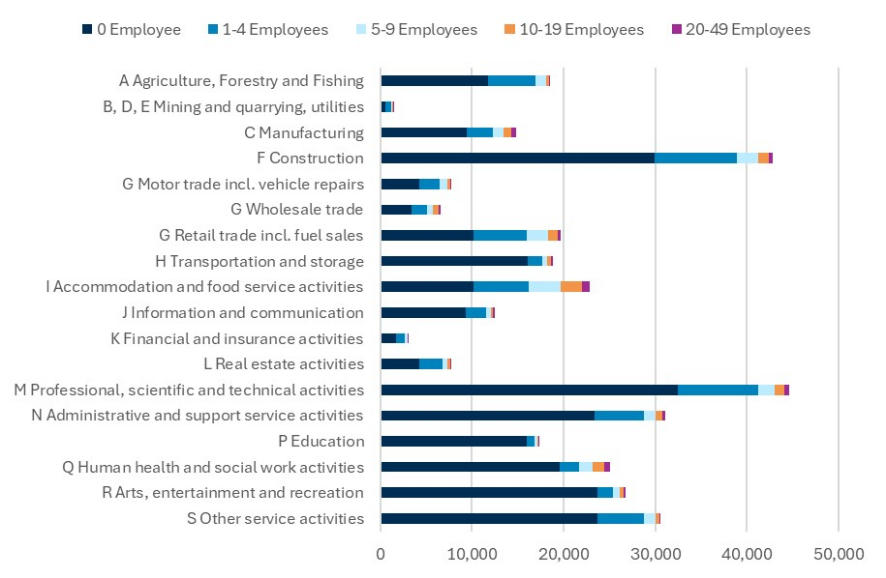
As shown in Chart 2.1, small businesses in Scotland operate in a diverse range of industrial sectors (as defined in the UK Standard Industrial Classification of Economic Activities 2007[x])
The vast majority of micro and small businesses in Scotland across all sectors have zero employees
Chart 2.1: Number of small businesses in Scotland by number of employees
Source: Scottish Government, Businesses in Scotland: 2024
What are consumer issues for small businesses?
This report considers the experience of small businesses as consumers. When we talk about this, we are referring to any occasions where small businesses purchase or use goods or services as part of their business operations.
This could include for example small businesses procuring physical goods that they use as part of a production process or as part of their day-to-day operations (whether office stationery or a vehicle). But it could also include the procurement of professional services such as legal, accountancy, marketing, financial or communications services (e.g. broadband, telephony, or postal services), procurement of utilities such as water or energy, and the rental or purchase of business property.
Businesses might purchase these services directly from a supplier, or in some circumstances, they may purchase these services via a landlord (particularly in the case of energy and water), or via a broker or third-party intermediary.
When thinking about how effectively these markets work for small businesses as consumers, the international consumer principles provide a useful framing. The consumer principles set out what good consumer outcomes look like for any given market or service.[xi] The seven consumer principles if adapted for small businesses would be:
- Access: Can small businesses access the goods or services they need, or do some small businesses face barriers to access based on their location or market power?
- Choice: Do small businesses have a sufficient range of choice (not just in the range of products but how these are provided) to meet their needs?
- Safety: Are the goods or services dangerous to health or welfare?
- Information: Do small businesses have access to accurate and useful information that enables them to make informed choices?
- Fairness: Are some small businesses unfairly discriminated against by virtue of their size, location or status?
- Representation: Do small businesses have a say in how the goods or services are provided?
- Redress: When goods and services are unreliable or do not meet needs, are there systems in place for enabling small business to put things right?
As well as considering the range of issues that small businesses face as consumers, it is also helpful to consider the sorts of issues that are not consumer issues.
Small businesses face a wide range of issues. They have to ensure that their products conform to any relevant regulations, standards and codes of practice; they have to manage relationships with their customers; they have to ensure that they have sufficient turnover and cash-flow. Many small businesses do not have employees, but for those which do, issues of recruitment, skills and HR are important. Small businesses also need to ensure that they pay any taxes that they are liable for.
Small businesses therefore face a range of important issues in their roles as sellers, employers, taxpayers, exporters and more. We distinguish these issues from their roles as consumers, but there are potentially overlaps. For example, whilst issues around recruitment, financial reporting or regulation are not considered consumer issues, small businesses might procure a range of professional services to support them in meeting their legal, regulatory and financial requirements; and small businesses for the purposes of this research would be considered consumers in using those services.
How important are consumer issues for small businesses, in the context of other challenges they face? The main official surveys of small businesses in the UK and Scotland ask small businesses what they consider to be the major obstacles to business success.
Whether considering the results for small businesses with employees or those without, and whether considering the UK-wide results[xii] or Scotland-specific results[xiii], the latest findings are broadly similar. Many of the main obstacles to business success are not directly consumer issues – they include taxation, issues related to the UK leaving the European Union, staff recruitment and skills, levels of competition, late payment of invoices by customers. However, in both 2022 and 2023 (the latest year for which data is available), the level of energy prices has been the most frequently cited barrier to small businesses success. Moreover, costs generally have been a frequently cited factor for small businesses since the cost of living crisis in 2022, with the literature often referring to this as a ’cost of doing business crisis’.[xiv]
As well as cost-related issues, there is also evidence that some small businesses face inadequate access in some markets. For example, the main UK-wide survey of small businesses finds that issues around access to finance are an obstacle to some small businesses.[xv] The FSB’s 2023 Small Business Survey found that 17% of small businesses didn’t have access to adequate broadband and one third could not access adequate financial advice.14
This suggests that, whilst certainly not the only challenges facing small businesses, consumer issues can have important impacts, and these have become more prominent following the cost increases of 2022 and 2023.
However, most of the research on small businesses necessarily provides a fairly high level assessment of the issues that small businesses face as consumers – what those issues are, what difficulties they create, and how small businesses seek to resolve them. The purpose of this new research is to shed more light on these issues.
Consumer protections for micro and small businesses
Micro and small businesses engage with a wide range of markets as consumers. However, the consumer protections afforded to these businesses differ considerably depending on the sector, reflecting factors such as the varying regulatory frameworks and extent of market oversight.
We identified eleven markets to focus on in this research. These markets are defined broadly in order to capture the range of different products that micro and small businesses might engage with. The markets themselves were largely selected to reflect those which small businesses are most likely to engage in. The eleven markets covered in this research are:
- Energy
- Telecommunications
- Financial services
- Legal and accountancy services
- Water services
- Postal services
- Digital services, IT and software
- Renting / leasing property
- Building repairs, improvements or maintenance
- Vehicles
- Any goods other than vehicles
This analysis section considers the extent to which consumer protections for micro and small businesses align or differ from those available to individual consumers in each of these eleven markets.
Regulatory oversight
A key differentiator across markets is the presence (or absence) of dedicated regulatory bodies and independent redress schemes. In regulated sectors such as energy, telecommunications, financial services, and water, micro businesses often benefit from protections similar to those afforded to individual consumers. These may include access to ombudsman services, transparency requirements, and contractual safeguards. However, the extent of these protections is often significantly lower for small businesses than for individual domestic consumers.
In energy, recent reforms by Ofgem have extended important protections—including access to the Energy Ombudsman and mandatory use of redress scheme-affiliated brokers—to small businesses from 2024 onwards.[xvi] This represents an instance where small businesses are being brought closer in line with individual consumer protections. Similarly, in financial services, while only micro businesses tend to benefit from measures such as cooling-off periods in some circumstances, broader FCA oversight through the Consumer Duty also extends to small businesses (again in some circumstances) and they can access the Financial Services Ombudsman.[xvii]
In contrast, in telecommunications, regulatory protections are mostly limited to micro businesses (fewer than 10 employees).[xviii]
In markets such as vehicles, digital services, and building services, regulatory oversight is minimal. Consumer protections in these sectors are typically derived from general contract law.
Contractual transparency and mis-selling protections
Protections around transparency, mis-selling, and fair contract terms are unevenly applied across markets. In telecommunications and energy, regulators such as Ofcom and Ofgem enforce transparency and prohibit unfair practices, but again, micro businesses benefit more than small businesses. Ofcom, for example, extends rules on switching and exit rights to micro businesses, whereas small businesses must secure such protections contractually.
Financial services also offer some mis-selling protections—particularly where regulated advice is provided—but the extent to which these apply to small businesses is limited and context-specific. In property leasing and building services, businesses receive little formal protection against mis-selling, relying instead on basic contract law or pursuing legal recourse.
Cooling-off periods and switching rights
Individual consumers benefit from statutory cooling-off periods under consumer law—typically 14 days for distance or off-premises sales. Such protections are seldom extended to businesses. In financial services, micro businesses may sometimes access cooling-off rights, though less consistently than individual consumers, and small businesses rarely can.
Switching rights are supported in regulated markets such as energy and telecoms (for micro businesses), where ease of switching is seen as a means of driving competition. However, in most other markets no such switching rights exist beyond what is agreed contractually.
Ombudsman and alternative dispute resolution services
While ombudsman schemes can be mandatory in regulated consumer markets, participation is patchier for business-facing services. For example:
- In energy, the Energy Ombudsman now covers both micro and small businesses.[xix]
- In telecoms, only micro businesses have access to dispute resolution services via schemes like the Communications Ombudsman or the Communication and Internet Services Adjudication Scheme (CISAS).[xx]
- In financial services, both micro and small businesses may complain to the Financial Ombudsman, but eligibility depends on size, turnover, and complaint nature.[xxi]
- In postal services, small business consumers using Royal Mail’s USO (Universal Service Obligation) services can access the CEDR’s (Centre for Effective Dispute Resolution) ‘Postal Redress Service’ (POSTRS) to attempt to resolve disputes. However, non-USO services provided by other postal services providers do not benefit from the same level of regulatory consumer protections as the USO services do.[xxii]
- Vehicle disputes generally fall outside the Motor Ombudsman’s scope for businesses, unless linked to warranties or FCA-regulated finance.[xxiii]
- Legal, accounting, and property services may offer redress through sectoral regulators (e.g., Scottish Legal Complaints Commission[xxiv] or Financial Reporting Council[xxv]), but access for small businesses is less clear-cut and often limited. Where the dispute relates to building services there are a number of options relating to alternative dispute resolution but they are not free.
Consumer advice services for small businesses
When individual consumers in Scotland experience a problem with goods and services they are able to seek free advice and information from a number of organisations, including Advice Direct Scotland’s ‘Consumer Advice’[xxvi] helpline and Citizens Advice Bureaux.[xxvii] In contrast, the options for small businesses relating to free information and advice are more limited.
If the issue relates to Energy then ‘Energy Advice’[xxviii], a service provided by Advice Direct Scotland , can provide free information and advice for micro and small businesses. ’Business Debtline’[xxix] is a registered charity who also provide free expert debt advice to small businesses in England, Wales and Scotland.
Where the small business needs advice relating to other consumer issues there are no funded specialist free advice and information services like there are for individual consumers, although in practice ‘Consumer Advice’ and local Citizens Advice Bureaux may provide some advice depending on the nature of the query.
‘Business Companion’, from the Chartered Trading Standards Institute provides free legal guidance to businesses on consumer protection law.[xxx] However, its focus is on businesses’ own responsibilities under the law as sellers rather than what their rights are if they experience a problem themselves.[xxxi] Local authority Trading Standards Services may also provide advice on consumer issues as part of their general business advice role but this will vary according to individual local authority priorities.[xxxii]
Advice may be available from other sources. ‘Business Gateway’ has local offices all over Scotland and can be an important source of general advice for small businesses.[xxxiii] If the business is a member of a trade body or similar, they can also be an important source of general business information and advice. However, these bodies may not have the same expertise on consumer issues that consumer advice bodies can provide. If a small business needs specialist legal advice on a consumer issue their only option may be to pay for advice from a solicitor.
There does not appear to be any Scottish specific research on legal issues for small businesses. In England and Wales the Legal Services Board undertake a regular Small Business Legal Needs survey. Its most recent survey (2021) found that nearly one third (32%) of small businesses experience a legal issue annually.[xxxiv] Interestingly, ‘trading issues’ which seem to be closely related to what we have called consumer issues in this report were experienced most often (21%).[xxxv]
This survey also found that only a quarter (25%) of small businesses in England and Wales with a legal issue used professional help in response to a legal issue, with accountants, membership or trade bodies, and advice organisations such as Citizens Advice Bureau all also providing support.
Summary
Across all markets, individual (non-domestic) consumers typically receive a higher baseline of consumer protections. These include:
- Universal access to ombudsman and redress schemes where they exist
- Statutory rights to information, cooling-off, and cancellation
- Stronger protection from unfair contract terms and mis-selling
- Access to free consumer advice
Micro businesses are sometimes granted similar protections, particularly in regulated sectors, but small businesses are more commonly treated as commercial actors expected to negotiate their own safeguards.
Energy, financial services and water stand out as sectors where some protections are being extended to small businesses, reflecting recent reforms and a recognition of small businesses’ vulnerability to rising costs and unfair practices. Even in these markets however, the degree of protections on matters such as pricing is lower than for individual consumers; for example in energy, there is no equivalent for business consumers of the ‘price cap’ that has been extended to individual consumers.
Telecommunications offer some protections for micro businesses, but less so for small businesses.
Most other markets are less regulated in the business-to-business space, with redress relying heavily on contract law and with minimal statutory support.
3. Methodological approach
At the heart of this research is a large-scale, cross-market survey of micro and small businesses in Scotland. The survey was conducted by telephone, with 700 small businesses participating. This chapter describes the approach to questionnaire development and sampling strategy.
Scoping research
At the outset of the research, we held a series of semi-structured discussions with key stakeholder organisations including business membership organisations (both sector specific and cross market), regulators, advice bodies, trading standards bodies, and enterprise agencies. The purpose of these discussions was to gather stakeholder perspectives on the issues that micro and small businesses face as consumers and how these might differ by business type or over time; the strengths and gaps of the existing evidence base; and the status of any ongoing or emerging policy debates.
The discussions were combined with a review of existing research and evidence on the issues that micro and small businesses face generally, as well as in relation to their status as consumers specifically. These evidence sources were typically produced by sector regulators, business representative organisations, government and enterprise agencies. We also received some data on complaints made by small businesses to a specific local trading standards service; and on advice provided to small businesses in the energy market by Advice Direct Scotland, both of which provided useful context.
Questionnaire development and delivery
A decision was taken to adopt a telephone survey rather than an online survey for several reasons. It partly reflected the complexity of the subject, and the sense that the target audience would be more likely to engage with a telephone survey compared to an online survey. It also reflected the importance of being able to monitor and control the composition of the surveyed participants.
IFF was commissioned by Consumer Scotland to co-design the questionnaire and undertake the initial analysis and reporting. IFF’s report of the findings is published alongside this Consumer Scotland report.
The questionnaire was developed to cover the following issues:
- Business demographics: industrial classification, legal form, number of employees, years of operation, location
- Markets that businesses had purchased from, their experiences and perceptions of these markets and the extent to which they were satisfied or dissatisfied with them
- Problems experienced by businesses in relation to market purchases and the impact of these experiences on business performance
- Actions taken to attempt to resolve problems and whether issues were resolved satisfactorily
- Use of Brokers or Third Party Intermediaries in different markets and satisfaction with these services
- Whether businesses found it difficult to access certain products
- If businesses thought it was easier or more difficult being a business consumer than being an individual domestic consumer
For most of the questions, respondents were asked to consider their experiences during the previous 12 months.
Given the time constraints of the audience, a decision was taken to ensure that the survey could generally be completed in 20 minutes or less.
In general, businesses’ responses to these questions are likely to be specific to the market that the questions relate to. In other words, business’ views on fairness of terms and conditions might be quite different for market X compared to market Y.
A key challenge in developing the survey was to achieve the desire to cover a broad range of markets, but at the same time to ensure that the questions that businesses were asked in each of these markets went into sufficient depth as to not merely provide a superficial picture of businesses’ experiences.
To achieve this, respondents to the survey answered questions for a subset of the markets that they had participated in during the past 12 months, drawn from the eleven markets that were covered in the research.
Specifically, participating businesses answered questions on up to a maximum of four specific markets that they had engaged in. If a business had engaged in four markets, it would complete the loop of questions for each of those markets; if a business had participated in more than four markets, it would answer the questions for a selection of four of those markets. The four markets the business answered questions on was determined in such a way as to ensure that the sample size of businesses answering questions on each market was largely consistent across the 700 participants as a whole.
The eleven markets covered in the research were set out in chapter 2. To reiterate, these eleven were selected to achieve a balance of breadth versus specificity; to reflect the markets small businesses were most likely to engage in, or in which detriment was most likely to occur in.
A pilot survey was administered to 19 small businesses in January 2025. The findings from the pilot served to refine the survey items and produce a final questionnaire of an appropriate length and scope.
In February and March 2025, a CATI (‘Computer Assisted Telephone Interviewing’) method was used to administer the survey to 700 small businesses.
Sampling
The research used a sampling approach known as ‘Probability Proportionate to Size’. This approach was taken with a view to achieving a sample that would provide a nationally representative mix of businesses based on their size, industrial sector, legal form, years of operation and regional location.
The sample was drawn from ‘Market Location’, which is a business-to-business data service and email marketing provider.[xxxvi] Market Location maintains a database of actively trading businesses which is regularly verified and stored in compliance with GDPR and legal requirements.
Table 3.1 contains details of the sampled businesses by their key demographic characteristics. The table also shows how the proportions of sampled businesses by demographic characteristics compares to the overall small business population in Scotland. Although the survey sample does not mirror the national small business population in terms of demographic characteristics, the achieved sample was considered to be appropriate given time constraints and the markets that the survey focused on – especially in relation to obtaining the views of larger small businesses with a number of employees who are more likely to formally engage in markets as small businesses, rather than as individuals who may be receiving some essential services through household contracts.
Market based quotas were agreed and, as the data collection phase progressed, businesses were allocated to answering ‘loop’ questions on specific markets to avoid the under representation of individual markets.
Table 3.1: Size, sector, legal form, years of operation of small businesses that took part in the mainstage survey
|
Completed interviews |
Percentage of sample |
Overall percentage of small businesses[xxxvii] |
||
|
Establishment size (number of employees) |
||||
|
0 |
104 |
14.8% |
73.9% |
|
|
1-4 |
191 |
27.3% |
16.3% |
|
|
5-9 |
163 |
23.3% |
5.4% |
|
|
10-49 |
242 |
34.6% |
4.5% |
|
|
Sector[xxxviii] |
||||
|
Agriculture /Mining /Energy/ Manufacturing/ Water (A B C D E) |
100 |
14.3% |
[C][xxxix] |
|
|
Construction (F) |
74 |
10.6% |
14.3% |
|
|
Retail /Distribution (G) |
108 |
15.4% |
79.6% |
|
|
Transport and Storage (H) |
83 |
11.9% |
7.4% |
|
|
Hotel/Catering (I) |
54 |
7.7% |
6% |
|
|
Property/Finance/Management/ Business Services (J K L M) |
166 |
23.7% |
[C] |
|
|
Public administration /Other (N P Q R S) |
115 |
16.4% |
C] |
|
|
Legal Form |
||||
|
Partnership |
66 |
9.4% |
[C] |
|
|
Sole trader |
122 |
17.4% |
[C] |
|
|
Private Limited Company |
408 |
58.3% |
[C] |
|
|
Public Limited Company |
20 |
2.9% |
[C] |
|
|
Limited liability partnership (LLP) |
18 |
2.6% |
[C] |
|
|
Charity |
29 |
4.1% |
23.9% |
|
|
Other |
12 |
1.6% |
[C] |
|
|
Don’t know |
25 |
3.6% |
[C] |
|
|
Years of operation |
||||
|
Less than a year |
5 |
0.7% |
[C] |
|
|
1-4 years |
39 |
5.6% |
[C] |
|
|
5-9 years |
80 |
11.4% |
[C] |
|
|
10-19 years |
150 |
21.4% |
[C] |
|
|
20-49 years |
311 |
44.4% |
[C] |
|
|
50 years or longer |
106 |
15.1% |
[C] |
|
|
Don’t know |
9 |
1.3% |
[C] |
|
|
Region |
||||
|
Urban |
498 |
71.1% |
[C] |
|
|
Rural |
202 |
28.9% |
[C] |
|
4. Experiences and satisfaction
Micro and small businesses are extremely diverse, and likely to participate in various markets to differing extents. This chapter considers which markets small businesses engage in. It then considers small businesses’ satisfaction with engaging in those markets, and their experiences of engaging in those markets. It reveals some significant differences between markets in terms of experiences and satisfaction. Finally, the chapter examines businesses’ use of, and satisfaction with, brokers or intermediaries.
Small business participation in different markets
The survey asked participants if their business had purchased goods or services (collectively referred to as ‘products’ in this report) in any of eleven markets during the previous twelve months. The question and its explanation was framed to reiterate that the interest was in understanding where products had been purchased explicitly for business use, rather than circumstances where a personal contract or product had been used for business purposes.
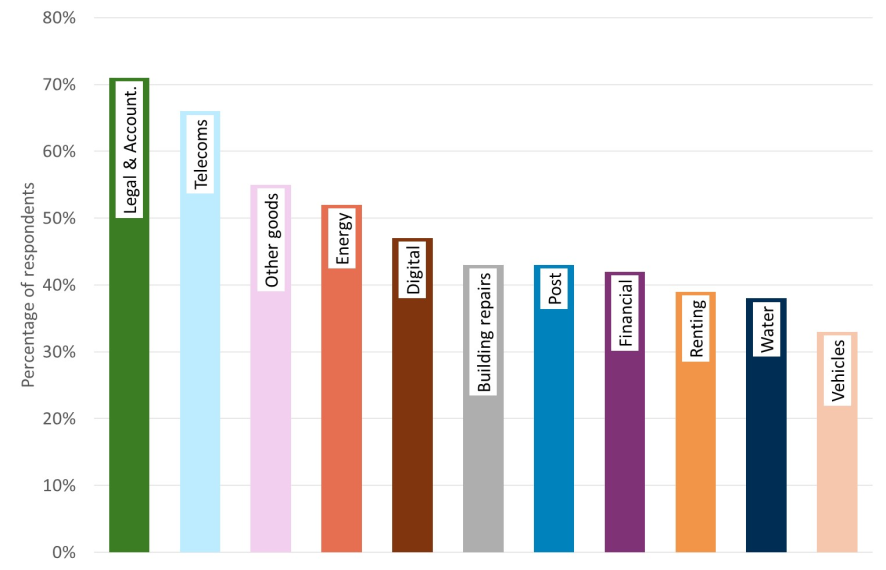
Small businesses engaged in some markets more frequently than others (Chart 4.1). The markets most frequently engaged in were legal and accountancy services (71%) and telecommunications (66%).
Arguably, we might have anticipated higher participation rates in telecommunications given the current prevalence of digital forms of communication. The lower than anticipated participation rates might reflect that some businesses use their personal (non-domestic) contract for business purposes. Indeed, Ofcom research in 2022 indicated that the majority of micro businesses – around 60% - used only a personal contract for accessing landline, mobile and internet services.[xl]
Just over 50% of small businesses had engaged in the market for energy as a business. This likely reflects that many small businesses do not operate from a specific business premises, and if they do work from home, may decide not to supplement their domestic energy contract with a non-domestic contract. The fact that just under 40% of respondents said they engaged in the water market as a business is broadly in line with the observation that there are 160,000 non-domestic water supply points in Scotland (recognising that not all of these supply points will equate to separate businesses, but may reflect the same business operating from several sites).[xli]
Legal and accountancy and telecommunications services are the markets that small businesses most commonly engage in
Chart 4.1: Percentage of small business who have purchased products in a given market during the past 12 months
In the past 12 months, has your business purchased goods or services in any of the following areas? Energy; water services; postal services; vehicles; any goods other than vehicles; digital services, IT and software; financial services; legal and accountancy services; renting / leasing property; building repairs, improvements or maintenance; telecommunications; none of these . Weighted and unweighted base: all participants, n = 700
How do small businesses perceive their experiences in different markets?
For each of the market loops that they participated in, small businesses were asked to indicate the extent to which they were satisfied or dissatisfied with their overall experience of engaging in that market. Respondents were then asked the extent of their agreement with seven statements that were designed to provide further insights into their experiences of engaging in those markets. The statements were designed to provide a measure of small businesses’ confidence in engaging in the markets, their experience in relation to specific aspects of the consumer experience such as the reliability of a product and clarity of billing, and their perceptions of the extent to which they were treated fairly when engaging in markets. (Businesses’ experience of specific problems in each market was covered in subsequent questions, and is described in Chapter 5.)
Some statements were framed positively, while others were framed negatively. This reflected a conscious effort to maintain cognitive attention during the survey.
The positively framed statements were:
- The products we have procured meet the businesses’ needs and aspirations
- We pay a fair and reasonable price for the products we receive
- When I need to purchase or renew a product in the future, I'm confident I know how to secure the best product at the best deal for my business
- Billing arrangements are easy to understand
- It is easy to contact the supplier to resolve issues with the product or contract
The negatively framed statements, which were interspersed with the positively framed statements, were:
- The terms and conditions are unfair
- The products have not been reliable
The rest of this chapter presents the results of the question on overall satisfaction, and the responses to the seven statements.
Overall satisfaction is generally high, but less so in energy, water and telecoms
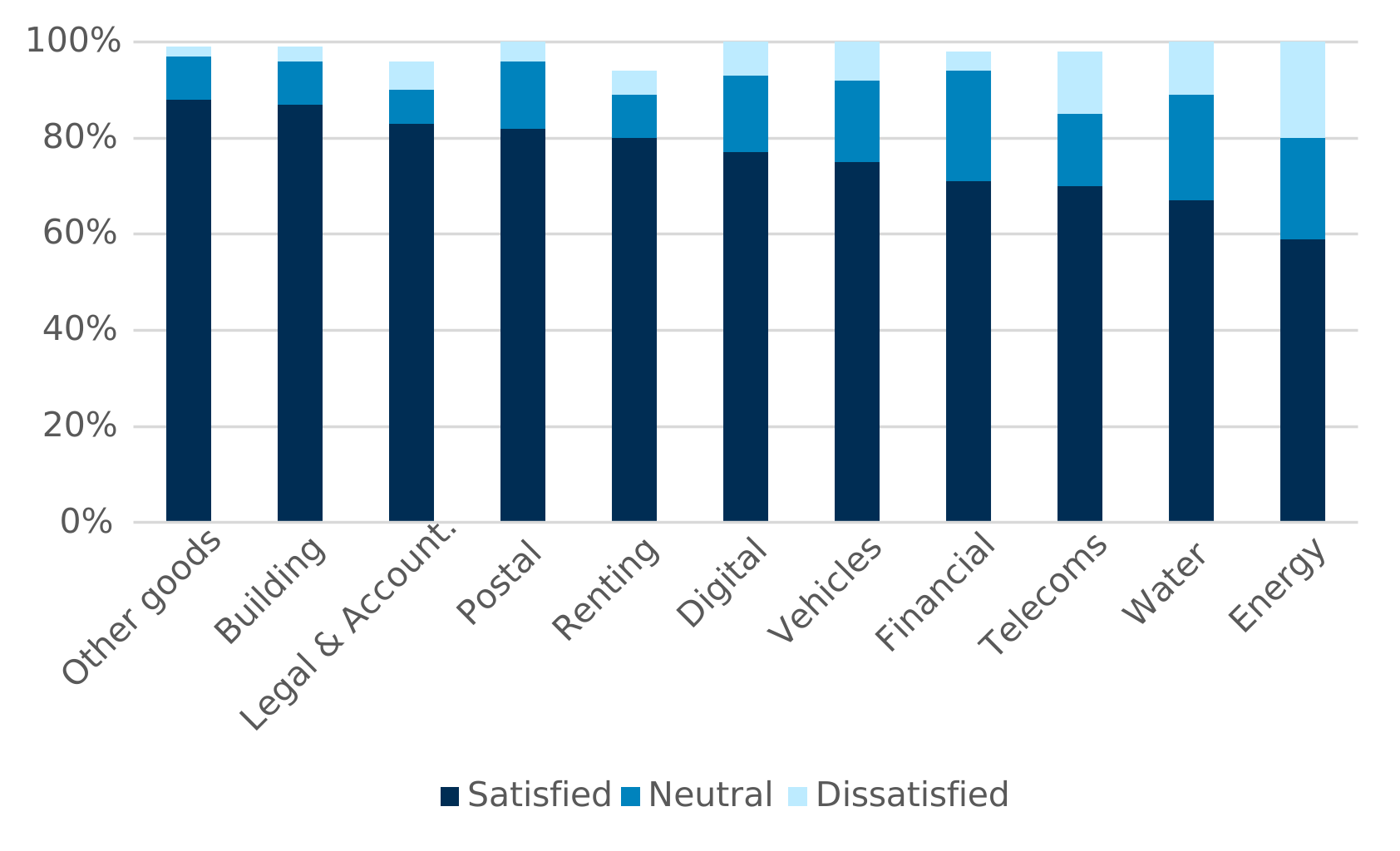
Respondents overall satisfaction of their experience in engaging in different markets is shown in Chart 4.2. In most markets covered, over three quarters of respondents were satisfied with their experience of engaging in the market, and fewer than ten per cent were dissatisfied.
The lowest level of satisfaction was in the energy market where fewer than 60 per cent of businesses were satisfied with their experience. The energy market was also the market with the highest levels of dissatisfaction, at 20 per cent.
Other than energy, the markets with the lowest levels of satisfaction were water, telecoms, and financial services, Dissatisfaction was also relatively high in water and telecoms (although less so in financial services).
Small businesses were least satisfied with the energy market, followed by water services and telecommunications
Chart 4.2: Percentage of small business consumers who had purchased in a market and indicated that they were satisfied, dissatisfied or neutral about their experiences of the market
Overall, thinking about your experience of purchasing and using products in market X in the past 12 months, how satisfied were you with the product or products? Scale of 1 (very satisfied) to 5 (very dissatisfied). Scores of 1 and 2 interpreted as satisfied; score of 3 interpreted as neutral; scores of 4 and 5 interpreted as dissatisfied
Unweighted base, all who purchased in market x in last 12 months: energy, n = 240; water, n = 175; post, n = 169; vehicles, n = 173; other goods, n = 271; digital, n = 233; financial, n = 189; legal & account., n = 298; renting, n = 185; building repairs, n = 217; telecoms, n = 299
The majority of small businesses feel that products procured meet their needs
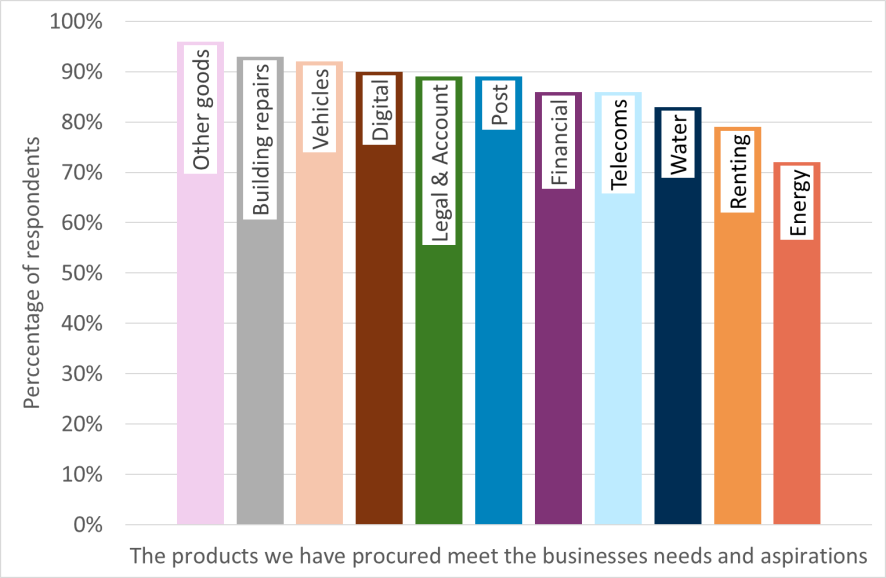
In all markets, the majority of businesses agreed that the products they have purchased meet their needs and aspirations. Typically, just over 80% of participants agreed with this statement across markets – the lowest level of agreement was in relation to energy (72% agreed).
The results suggest a generally high level of cross-market satisfaction about the suitability of products for business needs. The levels of positive response were perhaps surprisingly high in relation to vehicles and building repairs – markets which are sometimes associated with higher detriment in the non-domestic sector – and in physical goods other than vehicles.
The majority of businesses agreed that products met their needs and expectations in all markets
Chart 4.3: Percentage of small business consumers who agreed with the statement ‘The products we have procured meet the businesses needs and aspirations’
In your experience of purchasing or using goods and services in market X, to what extent do you agree/disagree with the following statements? The products we have procured meet the businesses needs and aspirations. Scale of 1 (strongly disagree) to 7 (strongly agree) - score of 5 to 7 interpreted as agreement
Unweighted base, all who purchased in market x in last 12 months: energy, n = 240; water, n = 175; post, n = 169; vehicles, n = 173; other goods, n = 271; digital, n = 233; financial, n = 189; legal & account., n = 298; renting, n = 185; building repairs, n = 217; telecoms, n = 299
In most markets, a majority of small businesses think they pay a fair price for the product received – but energy is a clear exception
In nearly all markets, between 70 – 80% of participants agreed with the statement that they paid a fair and reasonable price for the products received.
Water was a slight outlier, with only 60% of businesses agreeing with the statement. But the clear outlier was energy, where only 37% of participants agreed that they paid a fair and reasonable price. Indeed, ‘energy’ was the only market where disagreement (46%) outweighed agreement (37%).
In all markets except energy, a majority of small businesses agreed that they pay a fair and reasonable price for products
Chart 4.4: Percentage of small business consumers who agreed with the statement ‘We pay a fair and reasonable price for the products we receive’
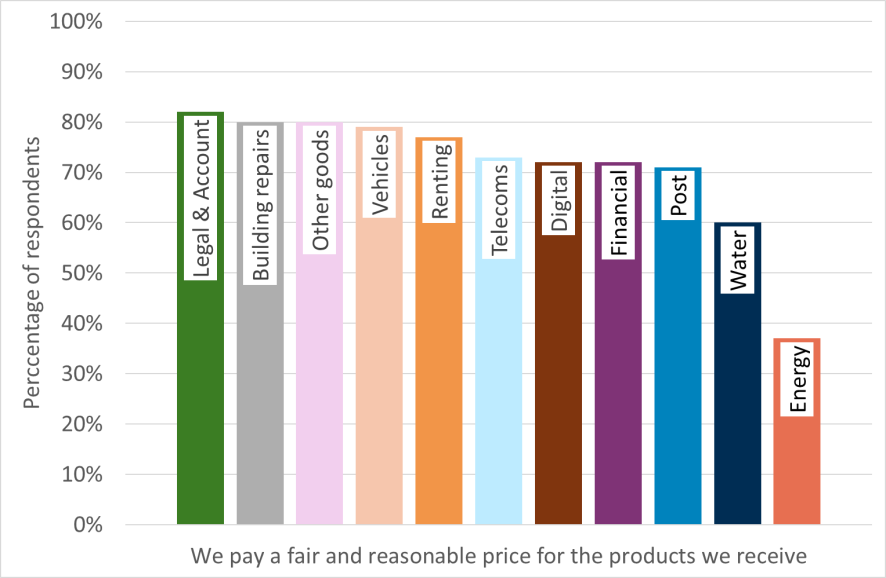
In your experience of purchasing or using goods and services in market X, to what extent do you agree/disagree with the following statements? We pay a fair and reasonable price for the products we receive. Scale of 1 (strongly disagree) to 7 (strongly agree) - score of 5 to 7 interpreted as agreement
Unweighted base, all who purchased in market X in last 12 months: energy, n = 240; water, n = 175; post, n = 169; vehicles, n = 173; other goods, n = 271; digital, n = 233; financial, n = 189; legal & account., n = 298; renting, n = 185; building repairs, n = 217; telecoms, n = 299
Small businesses find it trickier to contact suppliers in the regulated utilities markets
Agreement with the statement ‘It is easy to contact the supplier to resolve issues with the product or contract’ was lowest in water, energy, post and telecoms. These are markets dominated by relatively few large suppliers, overseen by sector-specific regulators.
Agreement with this statement varied between 70% - 80% in other markets – somewhat lower than levels of agreement with most other statements. Agreement was particularly high in relation to legal and accountancy services. This may reflect a tendency of small businesses to establish longer term relationships with their (often smaller) service providers.
Small businesses in the post, energy and water markets were split on whether they agreed it was easy to contact suppliers to resolve issues, a sentiment more commonly agreed with in all other markets
Chart 4.5: Percentage of small business consumers who agreed with the statement ‘It is easy to contact the supplier to resolve issues with the product or contract’
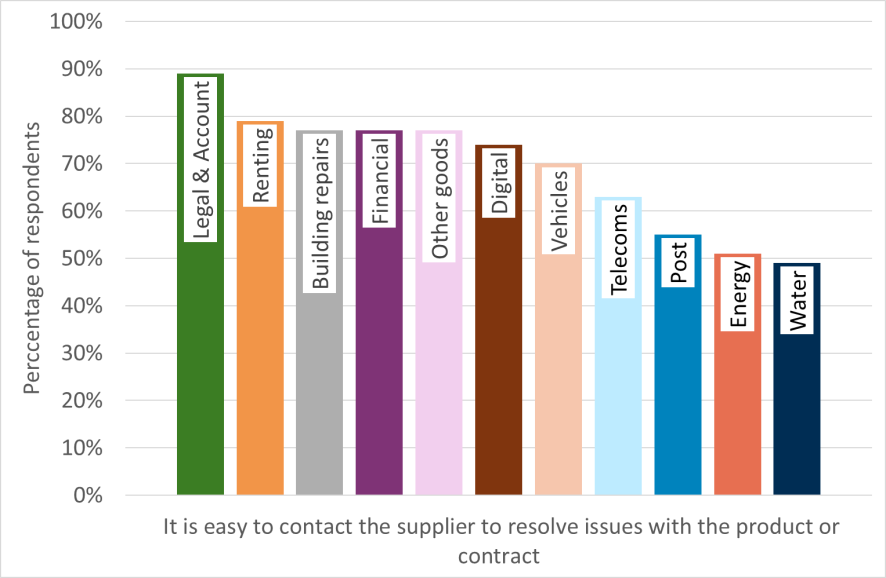
In your experience of purchasing or using goods and services in market X, to what extent do you agree/disagree with the following statements? It is easy to contact the supplier to resolve issues with the product or contract. Scale of 1 (strongly disagree) to 7 (strongly agree) - score of 5 to 7 interpreted as agreement.
Unweighted base, all who purchased in market x in last 12 months: energy, n = 240; water, n = 175; post, n = 169; vehicles, n = 173; other goods, n = 271; digital, n = 233; financial, n = 189; legal & account., n = 298; renting, n = 185; building repairs, n = 217; telecoms, n = 299
Billing arrangements are generally perceived as being easy to understand
Generally, there were fairly high levels of agreement that billing arrangements are easy to understand – with the responses in most markets ranging from 80% to 90%. A lower percentage of respondents agreed with the statement in relation to the energy and water markets. But on the issue of billing, energy was not as much of an outlier as it was for pricing as a whole. However, it should be noted that energy stakeholders confirmed in discussions that billing issues are the commonest form of complaints.
For all markets, the majority of small businesses agreed that billing arrangements were easy to understand
Chart 4.6: Percentage of small business consumers who agreed with the statement ‘Billing arrangements are easy to understand’
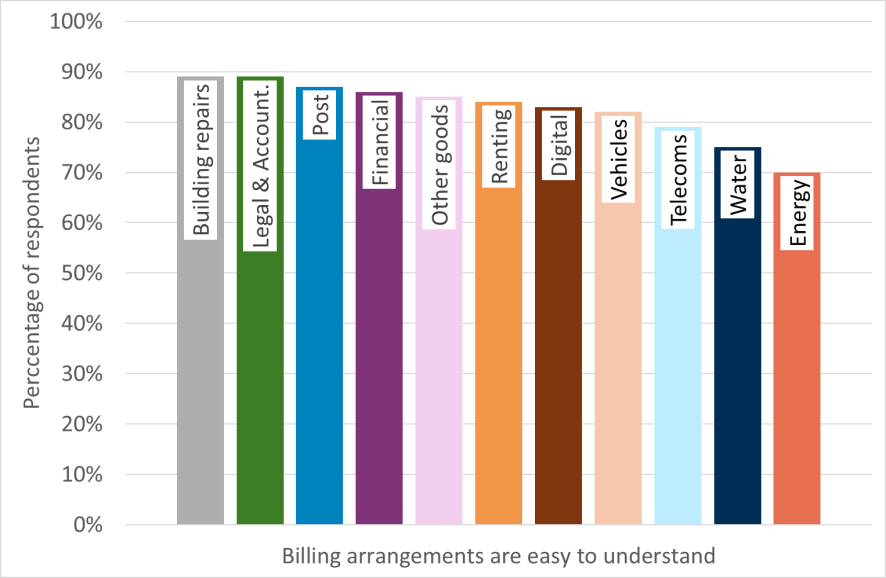
In your experience of purchasing or using goods and services in market X, to what extent do you agree/disagree with the following statements? Billing arrangements are easy to understand. Scale of 1 (strongly disagree) to 7 (strongly agree) - score of 5 to 7 interpreted as agreement.
Unweighted base, all who purchased in market x in last 12 months: energy, n = 240; water, n = 175; post, n = 169; vehicles, n = 173; other goods, n = 271; digital, n = 233; financial, n = 189; legal & account., n = 298; renting, n = 185; building repairs, n = 217; telecoms, n = 299
Small businesses confidence in finding the best deals for their firm is fairly consistent across markets
In terms of having confidence in securing a good deal when purchasing products in the future, a majority of respondents expressed their confidence in relation to all of the markets – ranging from 69% for ‘energy’ to 91% for ‘vehicles’. ‘Energy’ and ‘water services’ (73% agreement) attracted the lowest levels of positive responses.
For all markets, the majority of small businesses were confident that in the future they would be able to secure the best product at the best deal
Chart 4.7: Percentage of small business consumers who agreed with the statement ‘When I need to purchase or renew a product in the future, I’m confident I know how to secure the best product at the best deal for my business’
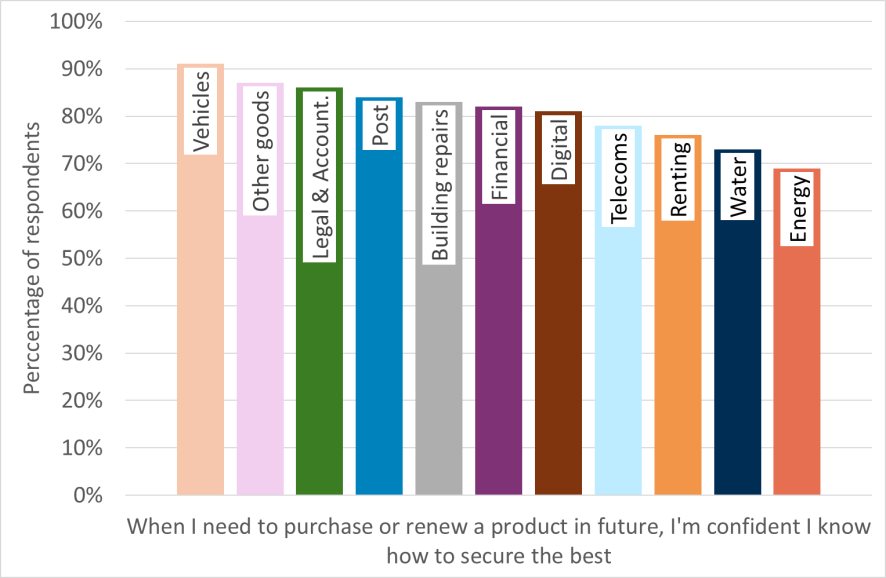
In your experience of purchasing or using goods and services in market X, to what extent do you agree/disagree with the following statements? When I need to purchase or renew a product in the future, I’m confident I know how to secure the best product at the best deal for my business. Scale of 1 (strongly disagree) to 7 (strongly agree) - score of 5 to 7 interpreted as agreement.
Unweighted base, all who purchased in market x in last 12 months: energy, n = 240; water, n = 175; post, n = 169; vehicles, n = 173; other goods, n = 271; digital, n = 233; financial, n = 189; legal & account., n = 298; renting, n = 185; building repairs, n = 217; telecoms, n = 299
Terms and conditions are most likely to be perceived as unfair in the energy market
Unlike the preceding statements, this one and the following statement were phrased negatively.
The energy market featured prominently in relation to terms and conditions being unfair, with 31% of respondents expressing this view. Agreement was also higher than average in relation to water.
In contrast, terms and conditions were less likely to be seen as unfair in legal and accountancy, building repairs, other goods, and financial services.
Just under one third of small businesses active in the energy market agreed that terms and conditions were unfair, with this figure lower in other markets
Chart 4.8: Percentage of small business consumers who agreed with the statement ‘The terms and conditions are unfair’
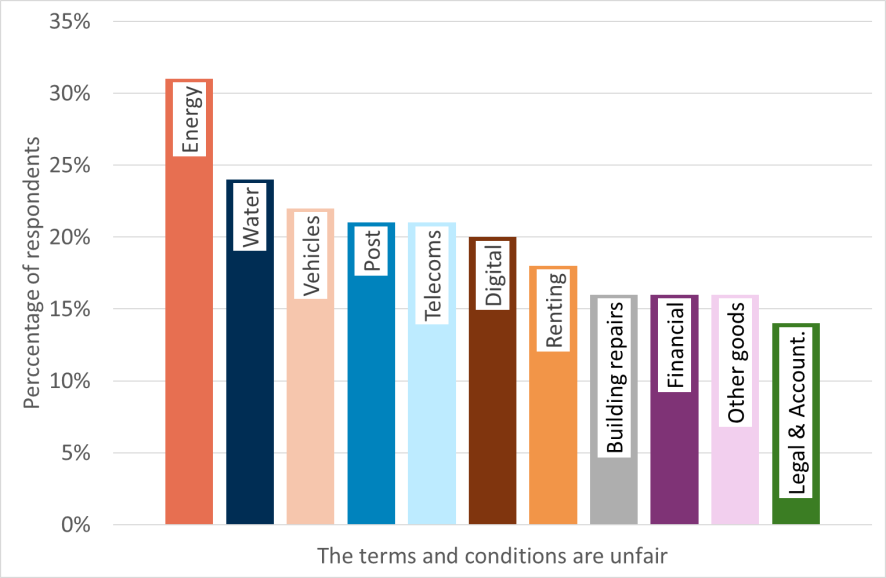
In your experience of purchasing or using goods and services in market X, to what extent do you agree/disagree with the following statements? The terms and conditions are unfair. Scale of 1 (strongly disagree) to 7 (strongly agree) - score of 5 to 7 interpreted as agreement.
Unweighted base, all who purchased in market x in last 12 months: energy, n = 240; water, n = 175; post, n = 169; vehicles, n = 173; other goods, n = 271; digital, n = 233; financial, n = 189; legal & account., n = 298; renting, n = 185; building repairs, n = 217; telecoms, n = 299
In several markets, at least one in four respondents felt that products were unreliable
There were several markets in which a quarter or more of respondents indicated that the products they had used had not been reliable – ‘water services’ (28%), ‘energy’ (27%), ‘postal services’ (25%) and ‘digital services, IT and software’ (25%).
In some of these markets, notably energy and water, it is not clear how respondents have interpreted this question – it seems unlikely that a quarter of respondents in these markets would have regularly experienced loss of power or water services, although it is at least possible that lack of reliability could refer to perceived unreliability of meters or other specific elements of service.
At least one in four small businesses active in post, digital, energy and water markets agreed that products had not been reliable
Chart 4.9: Percentage of small business consumers who agreed with the statement ‘The products have not been reliable’
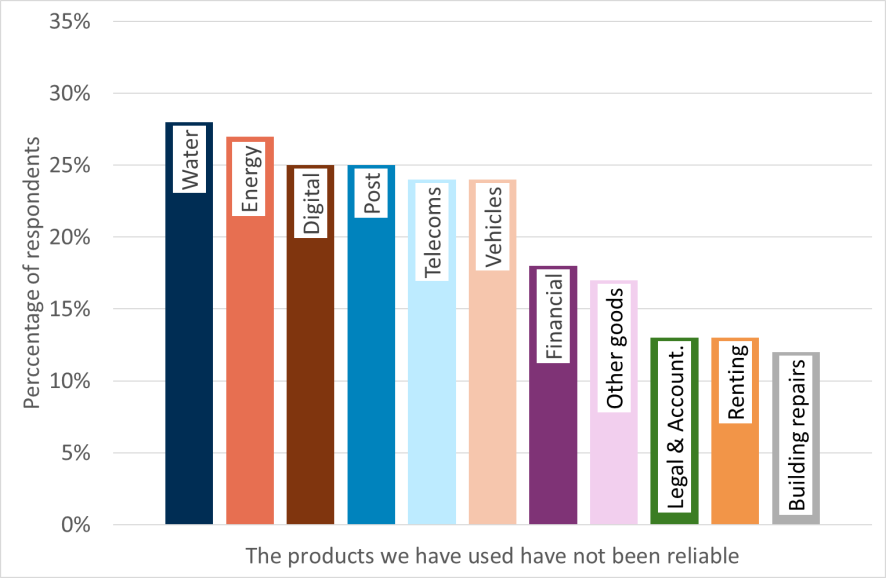
In your experience of purchasing or using goods and services in market X, to what extent do you agree/disagree with the following statements? The products we have used have not been reliable. Scale of 1 (strongly disagree) to 7 (strongly agree) - score of 5 to 7 interpreted as agreement.
Unweighted base, all who purchased in market x in last 12 months: energy, n = 240; water, n = 175; post, n = 169; vehicles, n = 173; other goods, n = 271; digital, n = 233; financial, n = 189; legal & account., n = 298; renting, n = 185; building repairs, n = 217; telecoms, n = 299
In aggregate, small businesses’ experiences are least likely to be positive in regulated utilities markets
To bring the analysis from the preceding seven statements together, we calculated the average rank of each market across all of the seven statements. This approach assigned a score of 1 to the market with the highest percentage of positive responses for each statement and a score of 11 to the market with the lowest percentage, and an average score was then calculated for all seven statements.
The results of this analysis are summarised in table 4.2. This analysis confirms starkly how energy and water services were consistently perceived most negatively across all seven statements. In these two markets, businesses were less likely to think prices are fair, and less likely to think that it is easy to contact suppliers, or understand billing arrangements. In these markets, businesses are also less likely to be confident about their ability to identify the best products for their needs. In energy in particular, terms and conditions were more likely to be perceived as unfair.
The next least positively viewed markets in the context of our seven statements were telecommunications and post. These markets were not viewed as negatively as energy and water, but it is nonetheless striking that the least well perceived markets are regulated utilities markets. However, it should be noted that only Royal Mail’s services are regulated and small businesses’ perceptions of post may be influenced by their experiences of private mail/parcel services.
What is perhaps equally striking is that, across all the statements, ‘legal and accountancy services’ was fairly consistently perceived relatively positively, followed by ‘building repairs, improvements or maintenance’ and ‘any goods other than vehicles’.
‘Legal and accountancy services’ was associated with the most positive perceptions overall, whereas ‘energy’ and ‘water’ were viewed the most negatively
Table 4.2: average perceptions score for each market: score of 1 would mean the market had the highest percentage of positive responses for all 7 statements whereas score of 11 would mean a market had the lowest percentage of positive responses for all 7 statements
|
Market |
Average Score 1 (most positive) to 11 (least positive) |
|---|---|
|
Legal & accountancy services |
2.0 |
|
Building repairs, improvements or maintenance |
2.3 |
|
Any goods other than vehicles |
2.7 |
|
Financial services |
4.9 |
|
Vehicles |
5.4 |
|
Renting / leasing property |
5.6 |
|
Digital services, IT and software |
6.4 |
|
Postal services |
6.4 |
|
Telecommunications |
7.3 |
|
Water services |
10.1 |
|
Energy |
10.7 |
Experiences and satisfaction with using intermediaries
In some markets, many small businesses rely on Third Party Intermediaries to help them secure the right type of contract for their needs. Third Party Intermediaries (TPIs) are companies that help customers find and agree a contract or tariff, or that provide advice and support with service procurement. In the non-domestic sector, TPIs typically include brokers, advisers, consultants and payment aggregators – but they can also include price comparison websites.
TPIs can play an important role for small businesses, helping them engage in complex markets, advising them on products and suppliers, and enabling them to choose options most suited to their needs.
However, TPIs have also been associated with less positive behaviours and negative impacts on small businesses, particularly in the energy[xlii] and water markets.[xliii]. These include some examples of mis-selling and misrepresentation or products, inconsistent approaches to consumer protection, poor customer service and lack of access to dispute resolution.
It is also important to note that the way that TPIs are regulated differs substantially across markets.
In the energy market, TPIs are not regulated. A range of Codes of Practice and accreditation schemes exist, but these are voluntary. The UK government has recently consulted on options for a more comprehensive regulatory framework for TPIs with the intention to “fortify consumer protection and bolster trust, whilst also promoting competition”.[xliv]
In the financial sector, intermediaries are regulated by the FCA. The specific authorisation scheme depends on the nature of the financial products that a firm intends to supply. In some cases, firms require to be directly authorised by the FCA, whereas in other cases, firms need to register with the FCA but are not authorised.[xlv]
In the Scottish non-domestic water market, TPIs are not regulated. A 2021 report highlighted that, whilst TPIs provide a number of benefits to small businesses engaging in the water market, there were significant concerns about inconsistent approaches to consumer protections and standards.[xlvi] A new voluntary Code of Practice commits Licensed Providers to ensure that TPIs acting on their behalf are aware of, and comply with, the provisions of the Code of Practice.[xlvii] This is a positive development and is supported by all Licensed Providers in the market signing up to the Code. However, while these commitments represent welcome steps to strengthen customer protections when engaging with TPIs, they are indirect in that they apply to signatory Licensed Providers. This means that there is significant reliance on Licensed Providers to have visibility of the activities of intermediaries operating on their behalf. The nature of the Code also creates inherent limitations to its scope, as it must focus primarily on TPIs acting on behalf of Licensed Providers or engaging with them directly.
With that in mind, what does our research say about small businesses’ use of and satisfaction with TPIs?
The survey asked which markets respondents had used the services of brokers / TPIs to make purchases in. Chart 4.10 shows the proportions of survey respondents who engaged with third parties when making purchases in different markets.
Small businesses were most likely to use intermediaries in the financial services market
Chart 4.10: Percentage of small business consumers who used the services of a third party to purchase products in different markets
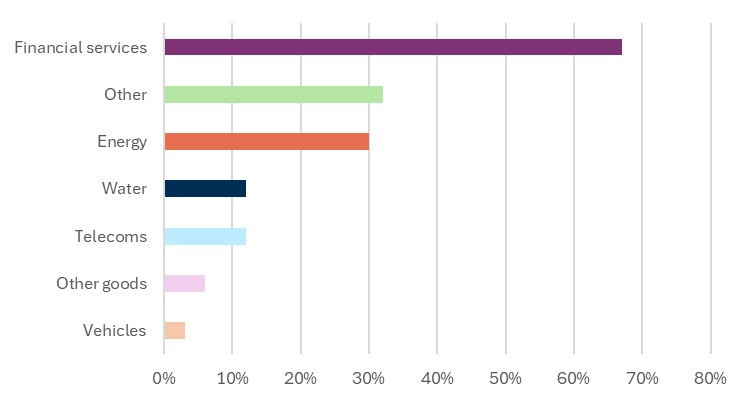
For which of the following markets did you use a broker? energy, water, financial services, telecoms, other (please specify)
Weighted and unweighted base: all who used a broker or TPI in the last 12 months, n = 198
Intermediaries were most often used for ‘financial services’ with over two thirds of respondents citing this market. In ‘energy’, just under a third of respondents said they used brokers. Just over 1 in 10 used third party services in relation to the ‘water services’ and ‘telecommunications’ markets. One third of respondents also said they used TPIs in markets other than those covered here.
Satisfaction with intermediaries
Generally, satisfaction with intermediaries appeared to be fairly high. Chart 4.11 shows the proportion of businesses who suggested that they were dissatisfied with the services provided by intermediaries in relation to different markets.
Dissatisfaction with intermediaries was highest in the energy market
Chart 4.11 : Percentage of small business consumers who used an intermediary to make purchases in a market and reported being very dissatisfied or dissatisfied with the services they received
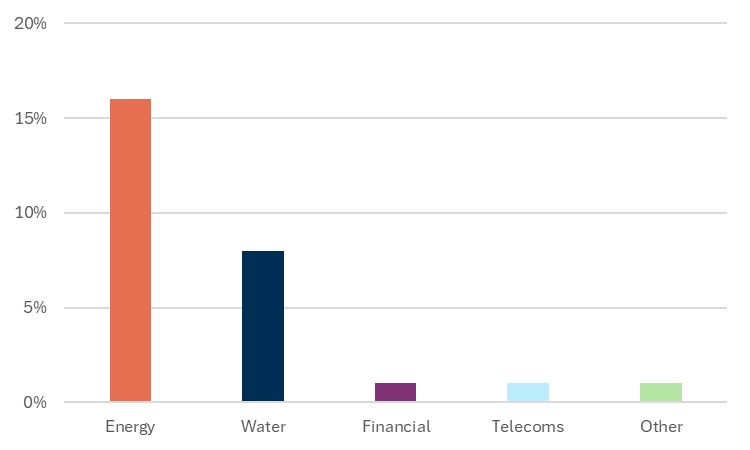
Overall, how satisfied were you with the services provided by the broker? Very satisfied; satisfied; neutral; dissatisfied; very dissatisfied; don’t know
Unweighted base: have used a broker or TPI for market purchases: energy, n = 57; water, n = 24*; financial, n = 95; telecoms, n = 24*; other, n = 63. *Unweighted count too small for population estimates (n < 25)
Dissatisfaction rates were very low in most markets, including ‘financial services’ which was the market that respondents most commonly used third party services to purchase products in.
Respondents were relatively more dissatisfied with these services in relation to the ‘energy’ and, to a lesser extent, the ‘water services’ markets. The level of dissatisfaction in the ‘energy’ market was higher than that found in recent UK SME research from the regulator which found that 9% were dissatisfied with brokers that were used to switch contracts.[xlviii] However the question in this small business survey was broader and did not explicitly refer to switching contracts.
The relatively higher level of dissatisfaction with TPIs in the energy market reiterates the case for regulatory reform, which the UK government and Ofgem are taking forward. In 2024, the energy regulator announced amendments to existing regulations that are designed to give all businesses greater transparency in relation to broker’s fees and non-domestic suppliers can now only work with brokers that are members of a redress scheme when they are arranging contracts with small businesses.[xlix] In our discussions with stakeholders, we heard evidence that the nature of complaints in relation to TPIs in energy is often around sales approaches, rather than billing issues per se.
In the non-domestic water market in Scotland, the debate around TPI regulation is still live. However, the recommendation of a 2021 report to better understand the use of and standards delivered by TPIs in the non-domestic market in Scotland has not yet been implemented.[l]
5. Issues and their impact
This chapter examines the extent to which micro and small businesses experience issues or problems in different markets, and the impact that these issues have on business performance. Around half of businesses surveyed had experienced at least one consumer issue, and a quarter had experienced at least one consumer issue that impacted their turnover or profit. The prevalence of issues, and their impact, varied significantly across markets, with energy, telecoms and financial services experiencing the highest prevalence of problems that impact business performance.
Consumer issues and their impact: overview
In relation to specific markets, respondents were presented with a list of issues and were asked to indicate if they had experienced any of them in the last 12 months. These issues could all be viewed as undesirable experiences that are likely to have taken time to deal with and could have had a negative impact on the businesses’ finances and/or performance. These issues were:
- Poor quality
- Not usable
- Complete failure to provide
- Problems with delivery
- Misleading price
- Misleading information
- Unfair or unclear terms and conditions
- Warranty and guarantees not honoured
The survey also asked participants to consider the extent to which issues that they experienced in different markets had an impact on their businesses’ performance (specified to include turnover and profit).
The incidence of consumer problems by market
Chart 5.1 shows the proportions of respondents who reported experiencing at least one problem in relation to the eleven identified markets in the preceding 12 months.
Overall, around half of the small businesses (49%) surveyed had experienced at least one issue or problem in any market that they answered questions on, whilst 51% did not experience any issue in any market.
The extent to which small businesses experienced issues varied across markets - from 32% of small businesses experiencing at least one problem in relation to ‘telecommunications’ and ‘postal services’ to 12% for ‘legal and accountancy services’. Even at the lowest end of the spectrum, more than one in ten small businesses still experienced a market related issue and, at the highest end, almost a third of small businesses reported a problem.
Telecommunications, postal services and energy were the leading three markets in terms of small businesses experiencing problems
Chart 5.1: Percentage of small business consumers who purchased or used goods or services from a market and reported experiencing at least one problem
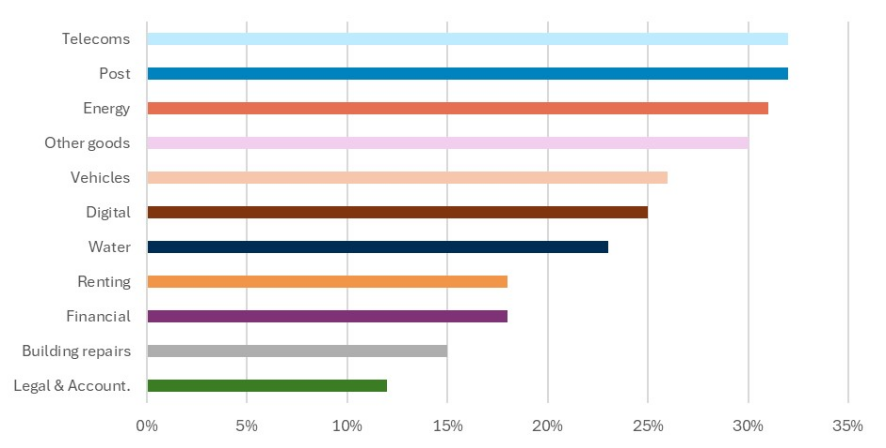
Did you experience any of the following problems when purchasing products in market X? Poor quality; not usable; complete failure to provide; problems with delivery; misleading price; misleading information; unfair or unclear T&C; warranty and guarantees not honoured; other (please specify); I did not experience any problems
Unweighted base: all who purchased from market X in the last 12 months: telecoms, n = 299; post, n = 169; energy, n = 240; other goods, n = 271; vehicles, n = 173; digital, n = 233; water, n = 175; renting, n = 185; financial, n = 189; building repairs, n = 217; legal & account., n = 298
The nature of problems experienced
The type of problems experienced varied across markets. Chart 5.2 shows how experiences of the different issues varied across sectors for the five most prevalent problem types and is based on the proportions of small businesses who experienced an issue rather than all small businesses who purchased in the market.
Table 5.1 provides further detail on the main problems experienced in each market.
- In energy, a range of problems were commonly identified, with misleading price, unfair or unclear terms and conditions, and misleading information all frequently cited. Energy was the only market for which misleading price was the leading problem identified – this is discussed further in the next sub-section.
- Unfair or unclear terms and conditions were the dominant problem identified in water, financial services, and renting/leasing property. The finding that unfair or unclear terms and conditions caused issues in the water market reinforces survey research from 2020, which flagged SME issues in relation to billing and debt management practices, communication, information and customer service. These were all linked to a lack of consumer understanding around how the non-domestic water market is structured and operates, and suboptimal levels of transparency in relation to contractual terms and conditions.[li]
- In telecoms, the dominant problems were poor quality and misleading information. Poor quality was also the dominant issue in vehicles and legal and accounting.
- In post, by far the most widespread problem cited was ‘problems with delivery’. Problems with delivery was also the dominant problem associated with general goods (i.e. goods other than vehicles) and building services.
The prevalence of different types of problems varies across markets. Percentage of small businesses who experienced an issue in a market and attributed it to certain problem types.
Chart 5.2.1: Poor quality
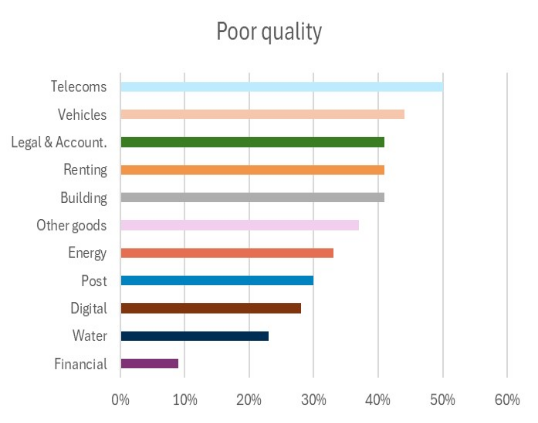
Chart 5.2.2: Problems with delivery
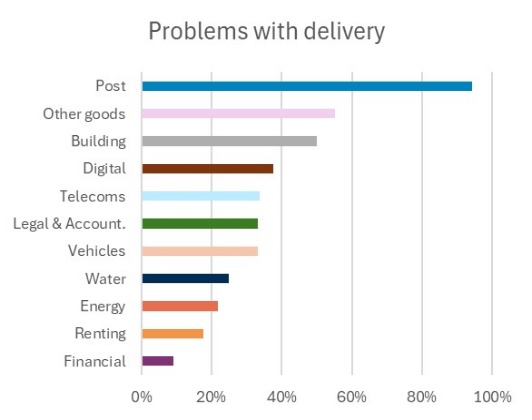
Chart 5.2.3: Misleading information
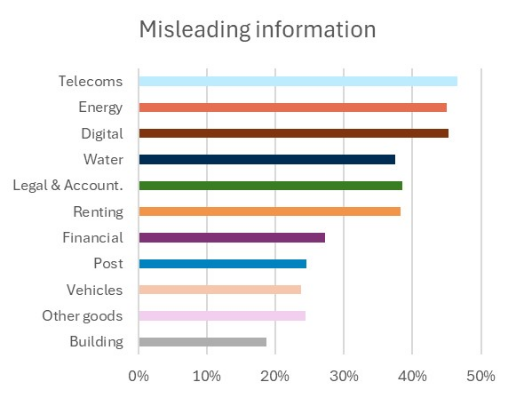
Chart 5.2.4: Misleading price
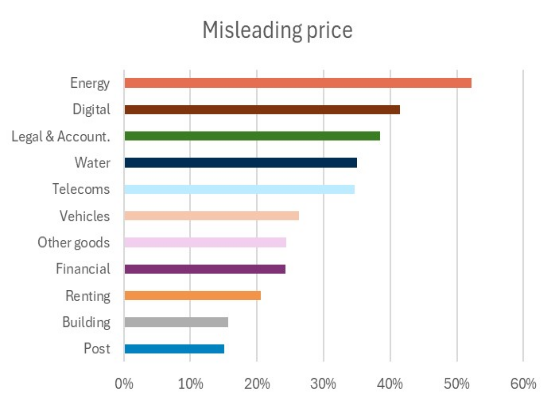
Chart 5.2.5: Unfair or unclear terms and conditions
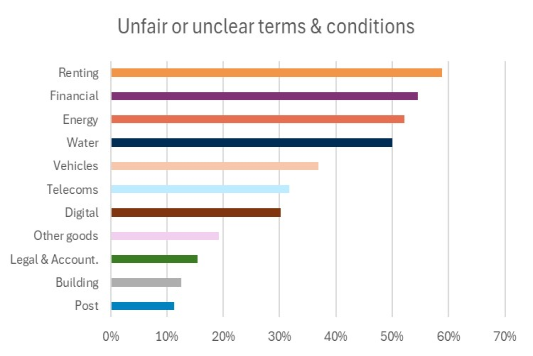
Did you experience any of the following problems when purchasing products in market X?: poor quality; problems with delivery; misleading price; misleading information; unfair or unclear T&C
Unweighted base: all who purchased from market X in the last 12 months and experienced a problem: telecoms, n = 101; post, n = 53; energy, n = 69; other goods, n = 78; vehicles, n = 38; digital, n = 53; water, n = 40; renting, n = 34; financial, n = 33; building repairs, n = 32; legal & account., n = 39
The prevalence of different problems varied across the markets but ‘problems with delivery’ for postal services stands out
Table 5.1: shows the three most prominent problems for each market in terms of the percentage of respondents who purchased from this market and experienced a problem (prevalence column) and all respondents who purchased from this market (% of all businesses column)
|
Sector |
Cause of Issue |
Prevalence |
Percentage of all businesses |
|---|---|---|---|
|
Energy |
Misleading price |
52% |
16% |
|
Unfair or unclear terms & conditions |
52% |
16% |
|
|
Misleading information |
45% |
14% |
|
|
Water |
Unfair or unclear terms & conditions |
50% |
12% |
|
Misleading information |
38% |
9% |
|
|
Misleading price |
35% |
8% |
|
|
Post |
Problems with delivery |
94% |
30% |
|
Poor quality |
30% |
10% |
|
|
Misleading information |
25% |
8% |
|
|
Telecoms |
Poor quality |
50% |
16% |
|
Misleading information |
47% |
15% |
|
|
Complete failure to provide |
37% |
12% |
|
|
Renting / leasing property |
Unfair or unclear terms & conditions |
59% |
11% |
|
Poor quality |
41% |
7% |
|
|
Misleading information |
38% |
7% |
|
|
Financial services |
Unfair or unclear terms & conditions |
55% |
10% |
|
Misleading information |
27% |
5% |
|
|
Misleading price |
24% |
4% |
|
|
Vehicles |
Poor quality |
44% |
11% |
|
Unfair or unclear terms & conditions |
37% |
10% |
|
|
Warranties & guarantees not honoured |
34% |
9% |
|
|
Legal & Accountancy services |
Poor quality |
41% |
5% |
|
Misleading information |
38% |
5% |
|
|
Misleading price |
38% |
5% |
|
|
Any goods other than vehicles |
Problems with delivery |
55% |
17% |
|
Poor quality |
37% |
11% |
|
|
Misleading info, misleading price, not usable |
24% |
7% |
|
|
Digital services, IT and software |
Misleading information |
45% |
11% |
|
Misleading price |
42% |
11% |
|
|
Problems with delivery |
38% |
10% |
|
|
Building repairs, improvement or maintenance |
Problems with delivery |
50% |
8% |
|
Poor quality |
41% |
6% |
|
|
Misleading information |
19% |
3% |
Impact of consumer problems on small business performance
Overall, 24% of small businesses surveyed had experienced at least one issue that had affected their business performance.
To get a sense of the prevalence of consumer issues that impact small businesses in Scotland, Chart 5.3 shows what proportion of small businesses who engaged in each market experienced a consumer problem that impacted their businesses’ performance.
There are three sectors in which more than ten per cent of respondents to our survey reported having experienced an issue which affected business performance – energy, financial services, and telecoms. In other markets, between 5-10% of small businesses had experienced problems which affected their performance.
Whilst this does demonstrate that only a minority of small businesses that participate in each market experience impactful problems in any year, that is a reasonably significant minority.
Small business performance is most likely to be impacted by consumer issues in energy, financial services and telecoms
Chart 5.3: Percentage of small business consumers engaging in a market who have experienced problems that impact business performance
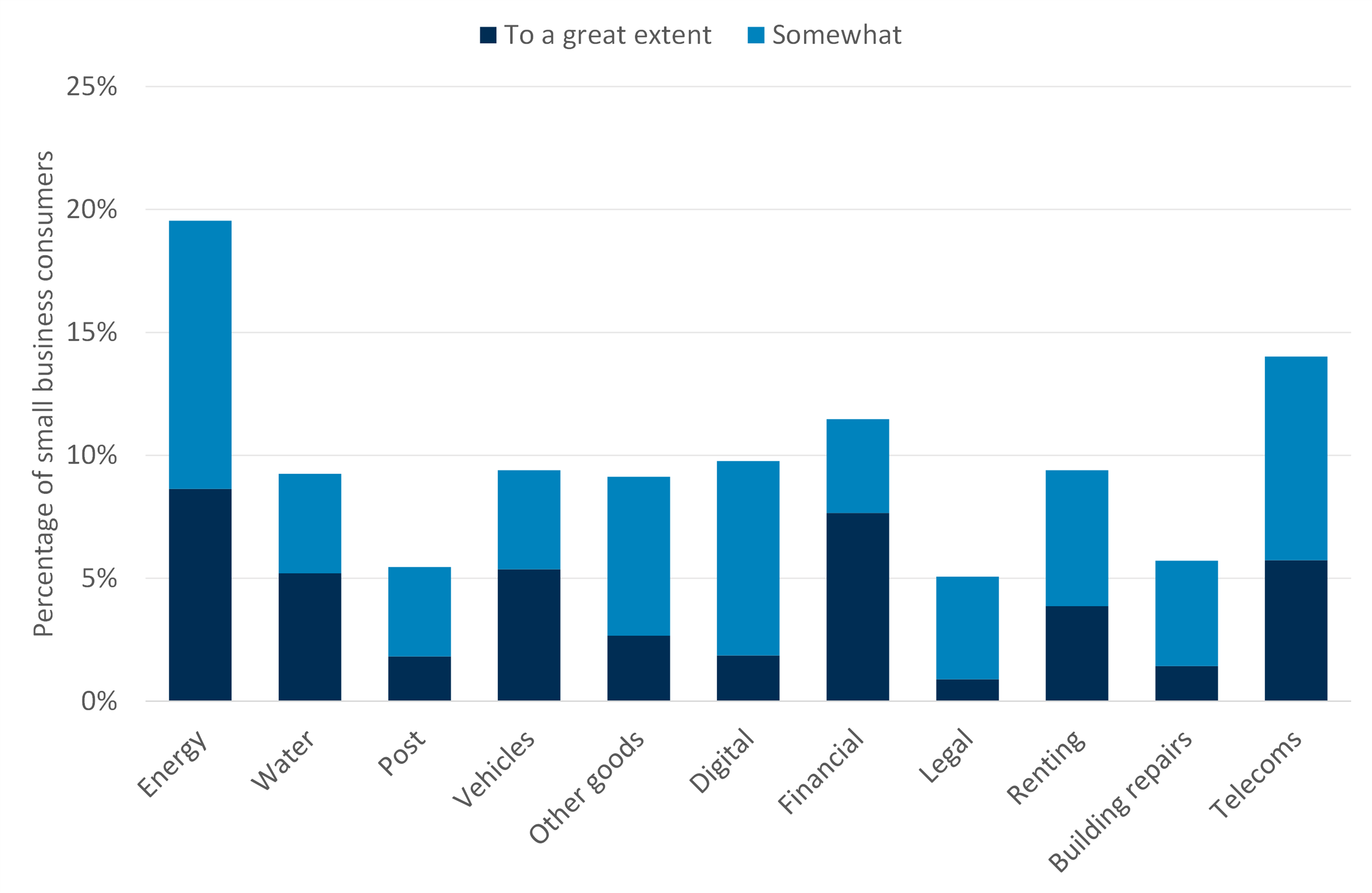
Did you experience any of the following problems when purchasing products in market X? Poor quality; not usable; complete failure to provide; problems with delivery; misleading price; misleading information; unfair or unclear T&C; warranty and guarantees not honoured; other (please specify); I did not experience any problems
Unweighted base: all who purchased from market X in the last 12 months: telecoms, n = 299; post, n = 169; energy, n = 240; other goods, n = 271; vehicles, n = 173; digital, n = 233; water, n = 175; renting, n = 185; financial, n = 189; building repairs, n = 217; legal & account., n = 298
To what extent did the issues you encountered impact on your businesses' performance such as turnover or profit? To a great extent; somewhat; very little; not at all; don’t know
Weighted base: all who purchased from market X in the last 12 months and experienced a problem: telecoms, n = 101; post, n = 53; energy, n = 69; other goods, n = 78; vehicles, n = 38; digital, n = 53; water, n = 40; renting, n = 34; financial, n = 33; building repairs, n = 32; legal & account., n = 39
The proportion of small businesses experiencing impactful issues is highest (above 10 per cent) in energy, financial services and telecoms. The following sub-sections expand on what we know about the nature of these impacts.
Energy
In energy, the relatively high levels of impactful problems, and identification of misleading price, unfair terms and conditions and misleading information as the top three issues chimes to an extent with findings from broader research. A 2023/24 regulatory review of the non-domestic energy market drew attention to issues that small businesses had been experiencing in relation to energy contracts, such as: onerous requirements for security deposits; businesses being locked into high fixed price contracts; and difficulties changing tenancy/occupier status in recently occupied premises. [lii] The regulatory review also drew attention to widespread perceptions of generally poor customer service. Further research by the regulator in 2024/25 found that there had been an increase in business complaints in relation to billing and overcharging, including perceived unfairness around pricing, a lack of transparency around pricing, and one in six businesses feeling that they had been treated unfairly in their dealings with their supplier.[liii]
These findings reflect the type of queries received from small businesses by Advice Direct Scotland’s energy advice service. During 2024, ADS’ energy advice service received around 100 queries per quarter from small businesses.[liv] The most frequent issues raised were: pricing and billing issues, and contract issues. Billing issues largely related to businesses’ struggling to understand their bills, or bills being higher than expected. Contractual issues included misunderstanding of contract terms (exacerbated by a lack of a ‘cooling off’ period for many small businesses), and businesses being moved on to higher ‘deemed contracts’ once their initial contract period comes to an end.
The 2025 ‘Energy Ombudsman Broker Dispute Resolution Scheme Annual Review’ highlights common dispute themes they received for microbusinesses.[lv] Some of these themes may reflect the misleading price, information and unfair terms found in our research. For example, the Review highlights the use of “blend and extend” contracts, where a high-rate supply contract is renegotiated and extended for a lower, but still higher than market rate, price. Issues were also raised in relation to ‘deemed contracts’ following a change in tenancy.[lvi] Micro businesses reported misleading impressions and unrealistic promises in this practice.
The findings also mirror those from research by Citizens Advice in 2024 which found that 75% of micro and small businesses had experienced a billing problem in the past 12 months.[lvii] The same research also found small businesses suffering from poor customer service in the energy sector, characterising customer service in the sector as being ’defined by low expectations’.[lviii] Citizens Advice has called on Ofgem to investigate billing practices for micro and small businesses.
It is difficult to disentangle the likely effect of aspects of the consumer experience, such as contractual terms and billing information, from energy price rises. Business surveys such as the Scottish Government’s ‘Business Insights and Conditions’ survey typically find that energy prices feature prominently in business concerns and they are considered to be key operating cost variables.[lix] But whilst it is difficult to disentangle the effects of price increases from more general consumer issues, affordability issues are likely to be exacerbated by challenges in understanding billing. Ofgem’s 2024/2025 research found that those businesses that had low self-reported energy literacy were more likely to say that they were struggling with payments compared to those with moderate and high energy literacy.[lx]
It is also important to reiterate that the regulator has instigated regulatory and legislative changes (described in chapter 2), but that these did not come fully into effect until December 2024. If these changes are leading to improvements in small businesses’ consumer experiences, those impacts may not have been picked up by our survey - which asked businesses about their experiences in the 12 months up until March 2025.
Financial Services
In financial services, ‘unfair or unclear terms and conditions’ was the most commonly cited problem. Nonetheless, this is a broad market, and small business organisations have drawn attention to a number of general issues in this market.
In recent years, high interest rates and access to credit more generally have been repeatedly flagged in other research. Quarterly survey data from the Federation of Small Businesses suggests that perceptions of credit availability and affordability have been predominantly negative in recent quarters and data for Q1 2025 indicated that-over half of the surveyed businesses had negative attitudes.[lxi] Specific issues include the widespread requirement that many financial institutions have for company directors to provide personal guarantees,[lxii] and the challenges for the self-employed of securing essential financial products.[lxiii] The FSB report argued that there is “a prevailing lender bias and risk-averse culture that fails to adequately consider the contemporary landscape of entrepreneurship, ultimately hindering economic growth”.
Telecoms
In telecoms, the incidence of impactful problems was relatively high, with ‘poor quality’ and ‘misleading information’ as the most frequently cited problems.
Successive reports have highlighted the criticality of telecommunications to micro and small businesses, particularly since the pandemic accelerated the adoption of hybrid working. Issues associated with broadband outages and areas of weak mobile coverage generally have been well publicised and may be behind some of the issues of detriment identified in our survey. FSB research (from 2019) indicated that almost half (47%) of small businesses experience unreliable data connectivity, which rises to 59% of SMEs in rural areas.[lxiv] In August 2024, various business groups, including the FSB and Institute of Directors, wrote to Ofcom to call for an automatic compensation scheme for businesses affected by broadband outages. The letter highlighted research that 51% of businesses in the UK experienced at least one outage of a fixed connectivity line.[lxv]
These issues are likely to be more accentuated in Scotland. There is recent evidence from the regulator that suggests that while the quality of telecommunications services has increased year on year, Ofcom’s 2024 Connected Nations report found that “Scotland remains, by many metrics, the least connected of the UK’s four nations.”[lxvi] Ofcom research indicates that SMEs based in rural areas of the UK, and Scotland, and less likely to be satisfied with the service they receive, and more likely to have experienced issues with slow upload speeds and increased mobile charges, compared to businesses in the UK as a whole.[lxvii]
Are some small businesses more likely to experience problems than others?
It is important to understand whether some types of small businesses are more likely to experience problems than others. We considered this question by examining whether the likelihood of a small business experiencing a problem was associated with the characteristics of that business, in terms of its size (number of employees), its age, its legal form, its geographical location, and the sector that it operates in.
We examined the significance of these characteristics in a multivariate analysis, in other words, by examining the significance of characteristics simultaneously rather than separately. This approach is useful because, by controlling for different characteristics simultaneously, it helps to identify the real characteristic of significance. For example, one might find that rurality was significantly associated with having problems, if considered on its own; but this might simply reflect that rural businesses are more likely to be small, and the smallness might be the ‘real’ factor of significance.
We examined this first by looking at the likelihood of a small business experiencing an issue in any market, and also on a market-by-market basis.
The characteristics were generally not statistically significant (at the 5 per cent level) across markets as a whole (Chart 5.4), nor were they systematically significantly different across individual markets. (The higher likelihood of businesses in retail, distribution and hospitality experiencing a problem was statistically significant at the 10 percent level).
There were no statistically significant or meaningful differences by legal form of small business (sole traders were one percentage point more likely to experience a problem than private limited companies or partnerships), nor by business size (businesses with 1-9 employees were slightly less likely to experience a problem than either businesses without employees, or businesses with 10-49 employees).
Newer small businesses were somewhat less likely to experience a problem; those in retail, distribution and hospitality were somewhat more likely to experience a problem
Chart 5.4: Effect of business characteristics on probability of experiencing a problem or issue
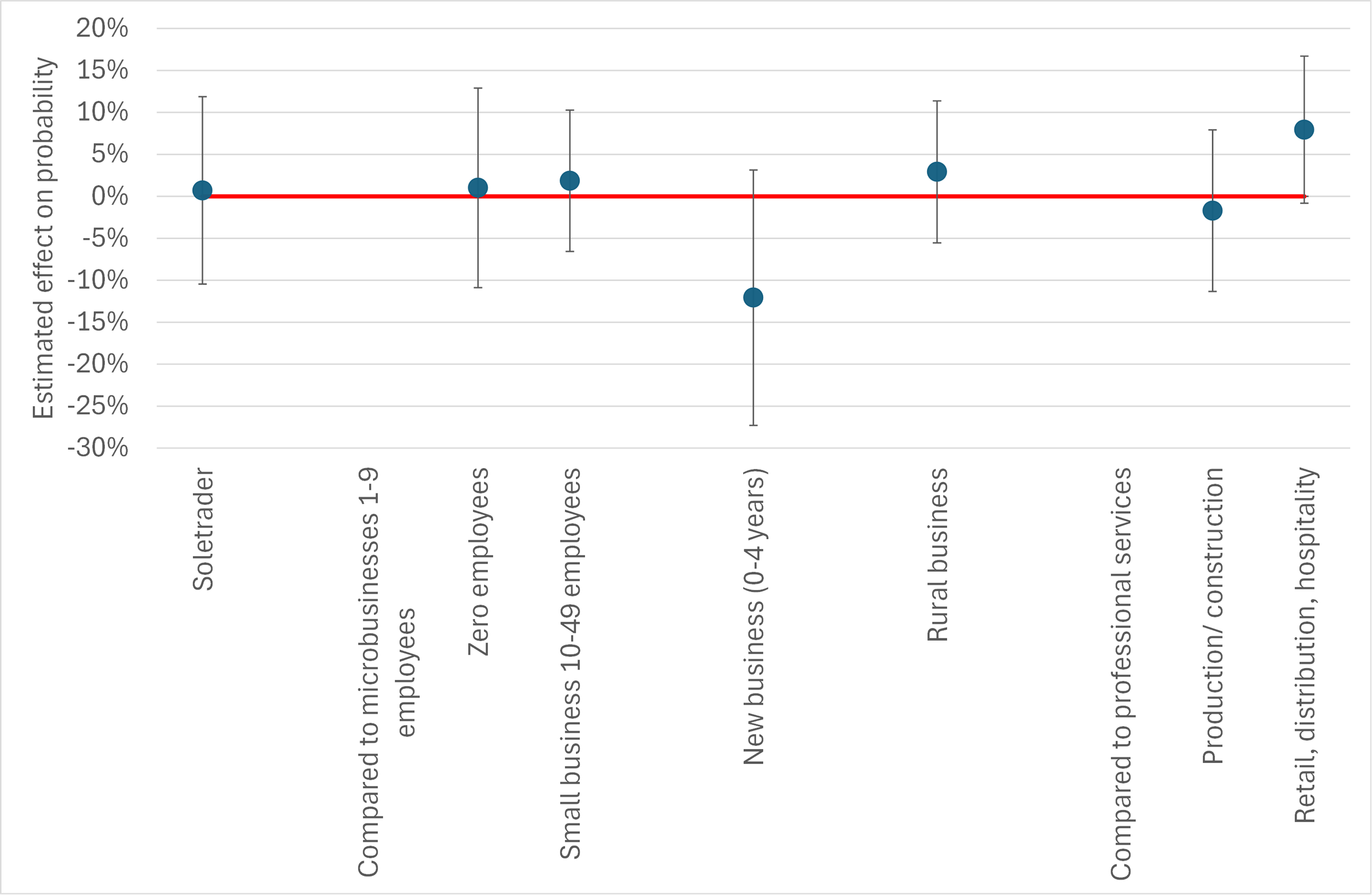
Notes: Chart shows coefficients from a probit regression. Dependent variable is a binary variable indicating whether or not a business experienced an issue in any of the markets they answered questions on. Explanatory variables include various dummy variables to indicate business characteristics. Additional explanatory variable not included here is a variable to control for the number of market loops that a business answered questions on in the survey. The chart shows the effect of the characteristic in question on the probability of experiencing an issue, for example, rural businesses are 3 percentage points more likely to experience an issue than non-rural businesses, controlling for other business characteristics. The error bars show 95% confidence intervals.
We also considered whether any business characteristics influenced the likelihood of a small business experiencing an issue that affected their business performance ‘somewhat’ or ‘to a great extent’.
Overall, the story here is similar as it was to problems generally (Chart 5.5), with most characteristics not associated with statistically significant differences in the likelihood of experiencing impactful issues.
The conclusion from this analysis is that small businesses’ experience of problems is widespread and fairly ubiquitous across all small businesses by business size and legal form. There is some evidence that problems – and problems that impact the business – are somewhat more likely to occur amongst rural small businesses and those in retail, distribution and hospitality. Nonetheless, these differences are not significant enough to suggest that policies should focus on a specific type of small business. Instead the focus should be on finding policy solutions that will improve the situation more widely.
Newer small businesses were somewhat less likely to experience a problem which impacted their business; rural small businesses and those in retail, distribution and hospitality were somewhat more likely to experience a problem
Chart 5.5: Effect of business characteristics on probability of experiencing a problem that impacted business performance
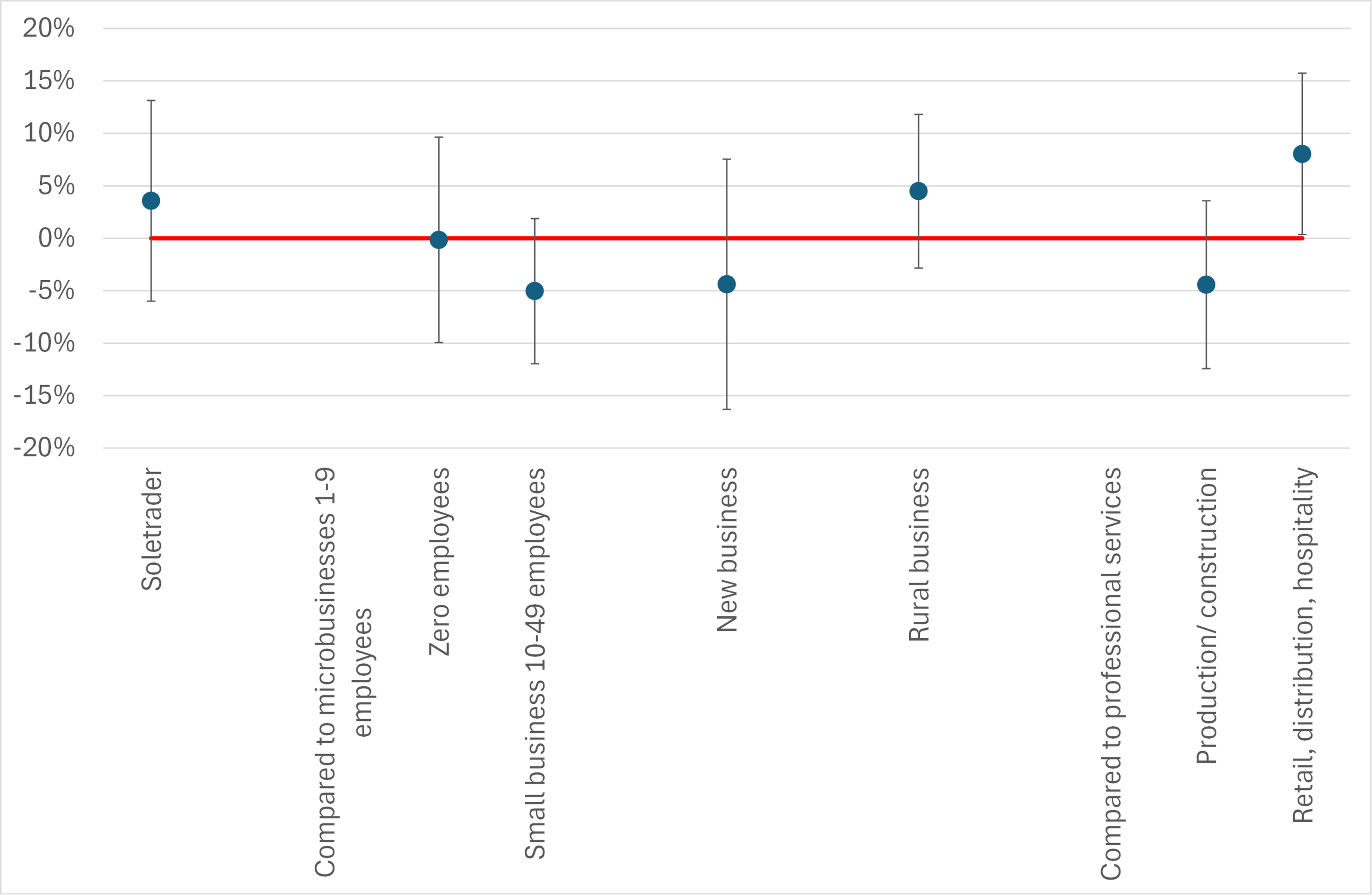
What actions do small businesses take when they experience problems in a market?
The survey asked what actions respondents took to attempt to resolve any issues that they experienced with purchased products. As is demonstrated in chart 5.6, by far the most commonly cited action was to contact the seller/supplier directly – more than 8 in 10 respondents who experienced a problem suggested that they would take this approach (this is legally the ‘correct’ first action). The next two most commonly cited actions were to switch provider (about a quarter of businesses) or contact an organisation for advice (almost 1 in 5 businesses).
Small businesses are most likely to contact the seller/supplier directly when they experience a problem with a product
Chart 5.6 : Percentage of small business consumers who experienced a problem in a market and undertook a specific action to resolve the problem
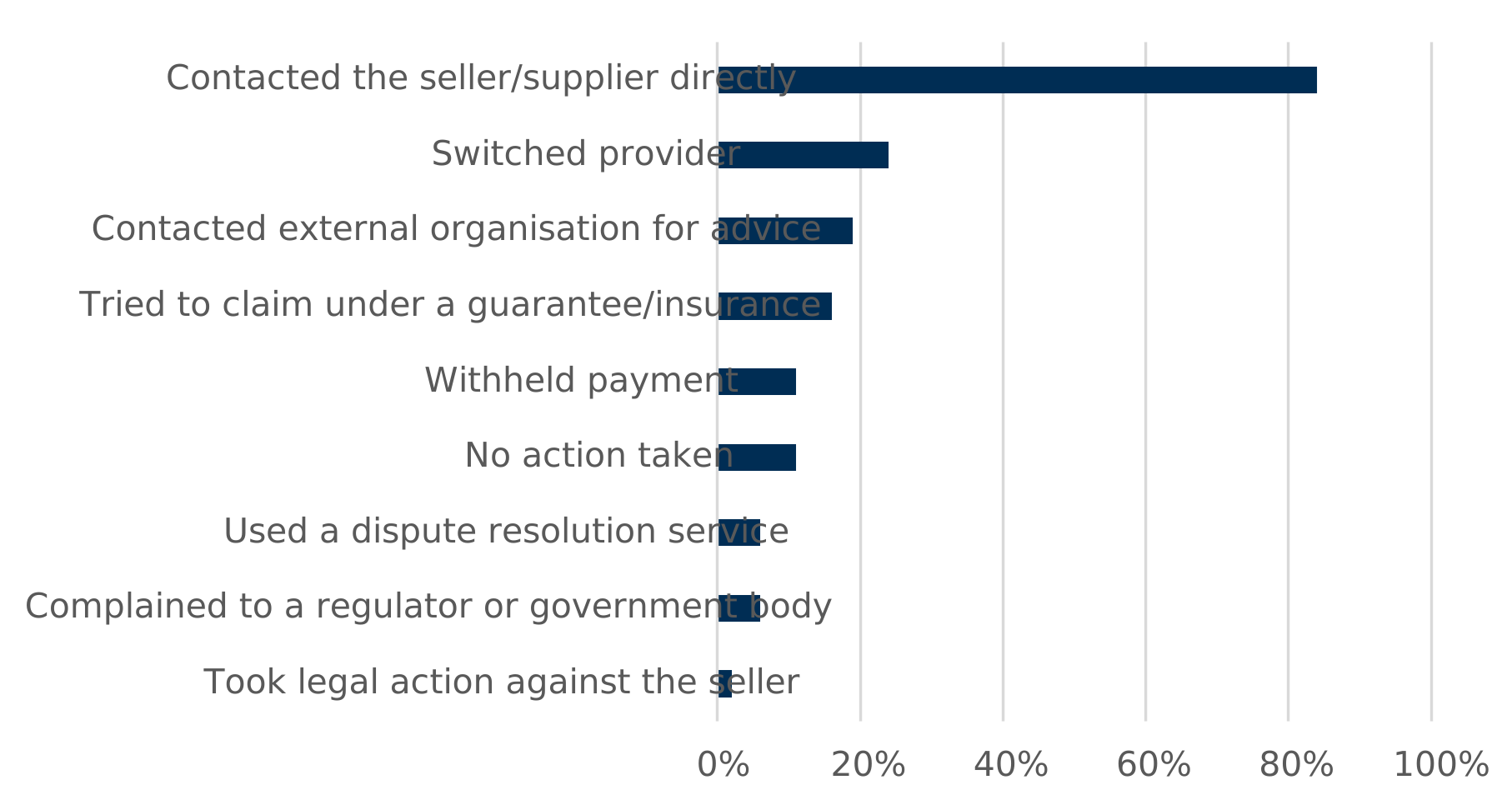
Which of the following approaches did you take to resolve the issue? contacted the seller/supplier directly; tried to claim under a guarantee/insurance; contacted an external organisation to get some advice; used a dispute resolution service; complained to a regulator or government body; withheld payment; took legal action against the seller; switched provider; other (please specify): no action taken; don’t know
Weighted base: all who purchased from market X in the last 12 months and experienced a problem: telecoms, n = 101; post, n = 53; energy, n = 69; other goods, n = 78; vehicles, n = 38; digital, n = 53; water, n = 40; renting, n = 34; financial, n = 33; building repairs, n = 32; legal & account., n = 39
There was some evidence that the approach to resolving problems varied across markets. Contacting the supplier/seller directly was a very common action in all markets - ranging from 94% of small businesses who experienced a problem with ‘digital services, IT and software’ to 69% of those who had an issue with a ‘financial services’ product.
The proportions of respondents suggesting they ‘switched provider’ was a fairly common behaviour (subjectively defined as 20% or more) in all markets apart from ‘water services’ (11%) and ‘vehicles’ (8%).
In terms of the energy market, the finding that 27% switched supplier was broadly in line with recent regulator research which found that about a third of SMEs switched supplier in the UK in 2024.[lxviii] However, it should be noted that the regulator’s research is not directly comparable to this small business survey which asked about switching supplier in the context of experiencing problems rather than switching for other reasons such as alternative terms and conditions or tariffs.
Energy was the market that was most frequently associated with contacting an external organisation for advice with more than a third of small businesses who experienced a problem indicating that they did this. This might reflect the fact that energy is one of the only markets where independent consumer advice is available to small businesses (via ADS). This finding contrasts somewhat with recent SME research from the regulator which found that less than 10% had sought external advice.[lxix]48 However, the regulator’s research focused on seeking advice in general rather than in relation to resolving problems, which could partially explain this discrepancy between the two survey’s findings.
Organisations such as CAS (‘Citizens Advice Scotland’) and ADS (‘Advice Direct Scotland’) currently receive requests for advice and assistance from small businesses with energy market issues, via the ‘Extra Help Unit’ and ‘energyadvice.scot’ respectively.[lxx] The proportion of small businesses seeking advice could increase in the future as the regulator has recently introduced a requirement for non-domestic suppliers to signpost all small businesses (previously limited to micro businesses) to CAS for support and advice.[lxxi]
In other markets, approximately a quarter of small businesses sought advice for ‘financial services’ issues and it was also a prominent action in relation to ‘building repairs, maintenance or improvements’ (23%) and ‘water services’ (22%).
Outcomes
Having collected data around what action respondents typically took when they encountered a problem in a market, the survey also asked if the issues were resolved to their satisfaction.
Across each of the surveyed markets, Chart 5.7 shows the proportion of small businesses who reported that the issues had not been resolved to their satisfaction. It should be noted that fairly large proportions in many of the markets indicated that the problem had not yet been resolved at the time of the survey. However, given that the survey did not ask how long the issues had been unresolved for (days or months, for example), the proportion of unresolved issues may be somewhat exaggerated.
Small businesses were least likely to resolve their problems satisfactorily in the financial and water services markets
Chart 5.7 : Percentage of small business consumers who experienced a problem in a market and reported that the problems had not been resolved satisfactorily
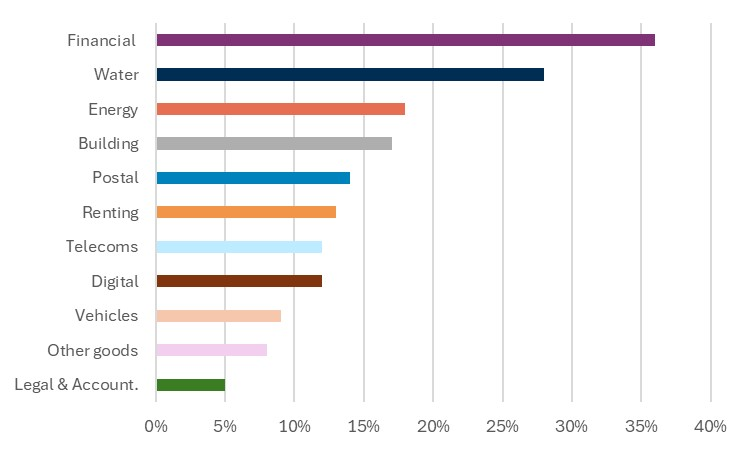
Was the issue resolved to your satisfaction?: yes; no; the issue has not yet been resolved; don’t know
Weighted Base: All who had a problem: Other goods , n =78; telecommunications, n =101; postal, n=53; digital, N=53; energy, n =69; building repairs, n =32) vehicles, n=38; legal and account., n =39; renting, n = 34; financial services, n =33); water, n = 40.
The market with the highest level of unsatisfactory outcomes was ‘financial services’ where more than 1 in 3 small businesses said that the issue had not been resolved to their satisfaction. ‘Water services’ also featured prominently with more than a quarter dissatisfied, and ‘energy’ was the third highest at 18%.
For all markets, further research would be required to understand why small businesses were dissatisfied with the outcomes.
6. The experience of business compared to individual consumers
Small businesses tend to engage in markets in different ways than domestic consumers, and in some markets they face different choices, and have different levels of consumer protection. Yet all small business owners clearly have experience of being an individual, domestic consumer, as well as a small business consumer. This chapter considers how the experiences of small businesses compare with those of individual consumers.
How does being a small business consumer compare to being a domestic consumer?
Our survey asked respondents to reflect on their experiences of being a business consumer and an individual domestic consumer, and to indicate whether they found it easier or more difficult being a business consumer in relation to five different aspects of being a consumer:
- Ending or changing a contract
- Securing a fair price
- Securing fair terms and conditions
- Resolving problems or issues with a product or contract
- Identifying the product that best meets need.
In the interests of survey length, respondents were not asked about this in relation to specific markets but were asked their perceptions on this in a general / cross-market sense.
Chart 6.1 shows whether respondents found it easier (much or slightly), similar or more difficult (much or slightly) being a business consumer in the context of five different consumer variables.
For all five aspects of being a consumer, approximately half of respondents found being a small business consumer similar (i.e. neither easier nor more difficult) to being a domestic consumer.
The remaining half of respondents tended to be split with a slight balance on the side of it being ‘easier’ to be a consumer as a business compared to an individual. Only in relation to ‘ending or changing a contract’ did the proportion opining that it was ‘more difficult’ (29%) exceed the proportion who thought it was ‘easier’ (20%).
Small businesses are fairly evenly split on the question of whether it is easier or more difficult being a consumer as a small business compared to an individual
Chart 6.1 : Small businesses’ perceptions on whether it is easier or more difficult being a consumer as a small business compared to being an individual consumer
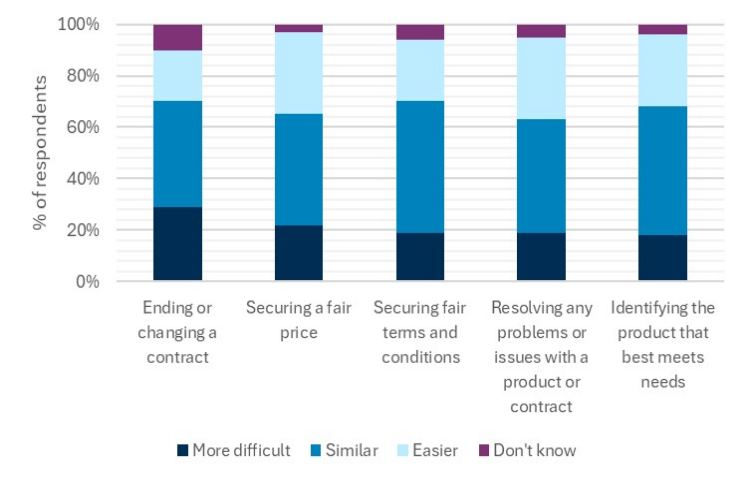
For each of the following statements, please say to what extent it is easier or more difficult being a business consumer than being an individual domestic consumer: securing fair terms and conditions; identifying the product that best meets needs; securing a fair price; ending or changing a contract; resolving any problems or issues with a product or contract
Base: all participants, n = 700
Whilst respondents as a whole were broadly split as to whether it is easier or more difficult to be a small business consumer than a domestic consumer, it is interesting to consider whether responses differ by characteristics of the business. We examined the extent to which respondents’ responses to the five statements – either individually or in combination - were associated with businesses’ legal form, size (employees), age or rurality, when these characteristics were considered individually or together (i.e. in a univariate or multivariate setting).
There were no strong associations between businesses’ characteristics and their responses. Whilst there was some evidence that sole traders were more likely to say that it was more difficult being a small business consumer than an individual consumer, and that rural businesses were slightly less likely to say it was more difficult to be a business consumer, these associations were not statistically significant.
Market Detriment: Small Businesses vs Individual Consumers
In Chapter 5 we described the incidence of problems experienced by small businesses in engaging in specific markets. The results from these questions permit tentative comparisons to be made with a recent survey of consumer detriment experienced by individual consumers – the Consumer Detriment Survey 2024 (‘CDS 24’).[lxxii] Whilst the questions, markets and products in the two surveys cannot be directly compared, the data does permit some assessment of the extent to which small businesses experience more or less detriment than individual consumers.
In the CDS 2024, consumer detriment was highest in the market for second-hand vehicles, at 28%. In our survey, incidence of ‘problems’ was higher than this in four of the surveyed markets – ‘telecommunications’ (32%), ‘postal services’ (32%), ‘energy’ (31%) and ‘any goods other than vehicles’ (30%). While none of the differences are statistically significant, it should be noted that the subgroup sizes are fairly small and in broad terms, this comparison could still suggest that the levels of detriment that small businesses experience in certain markets is fairly substantial and worthy of attention from consumer advocacy/protection organisations.
When comparing specific markets – for which broad comparisons can be made – there is evidence to suggest that detriment incidence could be at least as high amongst small businesses in Scotland as it is for individual consumers. In energy, 31% of businesses in this survey reported problems compared to 21% of individual consumers reporting detriment for ‘electricity and gas services’ in CDS 24. For telecommunications, 32% of small business respondents reported problems in our survey. This compares to 22% of individual consumers for ‘internet provision services’ , 14% for ‘mobile telephone services’ and 10% for ‘fixed telephone services’ in CDS 24.
Although it should be stressed that the two surveys may not be capturing exactly the same products in the surveyed markets, this high level comparison does suggest that small businesses seem to be experiencing similar or slightly higher levels of detriment in some markets than individual consumers are.
7. Conclusions and recommendations
Key findings
Consumer issues matter to small businesses
Scotland’s 350,000 micro and small businesses are diverse and extremely heterogenous in how they engage in a variety of different markets as business consumers. Whilst many small businesses engage in some markets – such as legal and accountancy services, or telecommunications services – not all small businesses engage in these markets, and fewer than half of small businesses engage in markets such as water services or property leasing.
Micro and small business contend with a broad array of operational issues—from recruitment and regulation through to taxation and cash-flow management. Whilst consumer issues tend not to receive the profile of some of these challenges, this report demonstrates that consumer-related problems are both widespread and material to business performance for many micro and small businesses.
Consumer issues are just as prevalent for small businesses as for individuals
Small businesses were roughly split over whether they felt it is easier or more difficult being a consumer as a small business compared to as an individual domestic consumer, across a range of issues. And although specific results varied from market to market, small businesses were generally just as likely – if not more likely – to report having experienced a consumer problem within a market when compared to individual consumers.
This suggests that small businesses’ lives as consumers are no easier on average than is the case for individual consumers.
Consumer protections and consumer advice available to small business is variable
Despite this, the level of consumer protection afforded to micro and small businesses differs from that afforded to individual consumers. It also differs across markets. This creates a complex and at times confusing picture. Small businesses also have far more limited options for accessing advice about consumer issues than individuals.
Whilst micro businesses tend to be afforded stronger protections than small businesses, particularly in regulated markets such as energy, telecoms and financial services, these businesses nonetheless tend to be afforded smaller protections compared to individual consumers. To the extent that most micro businesses are effectively operating as individuals – sole traders – then the argument that they have more resources, expertise or power to engage in markets seems unreasonable.
There are a number of reasons why a sole trader or micro business would choose to take on a non-domestic contract for business purposes rather than use an individual contract – these range from potentially higher service standards, tax efficiency purposes, and clearer separation of work and personal activities. However, it is unclear the extent to which small business owners are aware, when they take out a non-domestic contract, that they are potentially trading off these advantages against a somewhat lower level of consumer protection, or how these trade-offs influence their decision process.
Small businesses’ satisfaction as consumers varies significantly across markets
Our research reveals that, overall, most micro and small businesses in Scotland report reasonably positive consumer experiences: in seven of the eleven markets studied, over 75% of respondents expressed satisfaction with products and services, and fewer than 10% expressed dissatisfaction.
Satisfaction was lower and dissatisfaction was higher in the energy market than it was in any other surveyed market. Recent sharp increases in energy prices, with the average electricity price in Q4 2024 for UK non-domestic users being 75% higher than the average price at the start of 2021[lxxiii], are likely part of the explanation for low satisfaction in energy, with respondents to our survey likely to disagree that they pay a ‘fair price’ for energy.
But whilst high prices are part of the explanation, they should not be an excuse underlying poor practices. Results from our survey show that small businesses often think it is difficult to contact energy suppliers, difficult to understand bills, and that terms and conditions are unfair. This echoes Ofgem’s recent research on non-domestic consumers, with micro and small businesses most likely to rate poor communication, poor customer service, and billing issues as the most common reasons for dissatisfaction with their energy supplier. [lxxiv]
It is important to remember that our survey asked businesses about their experiences in the 12 months prior to being interviewed in early 2025; the survey period covered thus precedes some of the recent changes to the consumer protection framework that were introduced during 2024.
Respondents’ satisfaction was also relatively low in the water market. The survey findings point to a perception of high or unfair pricing, and difficulties in contacting suppliers, as potentially being key drivers of this dissatisfaction.
It is interesting that the markets in which satisfaction is lowest and experiences are least positive – energy, water, post and telecommunications – are utilities markets characterised by a small number of dominant suppliers, and that are relatively strongly regulated. Of course this is not suggesting a causative relationship – these are complex markets dominated by large suppliers, and satisfaction might be lower still if there was an absence of regulation. But it does suggest that there might be more scope for improvement in the small business experience in these markets.
At the other end of the spectrum, our research finds that satisfaction with legal and accountancy services is high. Satisfaction is also relatively high in relation to vehicles and building services – perhaps surprising given that these markets tend to be associated with relatively higher dissatisfaction for individual consumers.
TPIs can play an important role for small businesses, helping them engage in complex markets, advising them on products and suppliers, and enabling them to choose options most suited to their needs. Respondents to our survey were particularly likely to use TPIs to access financial services, energy, and to a lesser extent, water. Satisfaction with TPIs was generally high although again it was notably lower in the energy market compared to other markets. The relatively higher level of dissatisfaction with TPIs in the energy market reiterates the case for regulatory reform, which the UK government and Ofgem are taking forward.
A large number of small businesses have experienced problems as consumers
While most small businesses (with the exception of energy) report reasonably positive consumer experiences, consumer problems amongst small businesses were relatively widespread. Across the eleven markets covered in this report, almost half (49%) of micro and small businesses reported experiencing at least one problem in the previous 12 months.
The nature of problems experienced varied across markets. Unclear contractual terms and/or unclear billing were frequently cited in the energy, water, financial and telecoms markets. In energy, dissatisfaction in general has likely been exacerbated by significant price increases since 2022. Issues with delivery reliability were the big challenge in postal services, whilst poor service quality and misleading information were frequently cited in telecoms.
Consumer problems can impact business performance
Sometimes these consumer issues were little more than irritants for the businesses who experienced them; but in many cases they had real impacts on business performance.
Almost one quarter (24%) of small business respondents had experienced at least one consumer problem that had impacted their business performance in the preceding 12 months.
Problems were particularly likely to impact business turnover or profit in energy, telecoms, and financial services. One fifth of businesses who had engaged in the energy market had experienced a problem which affected business performance, with equivalent figures of 14% and 12% in telecoms and financial services respectively. In other markets, between 5-10% of small businesses experienced a problem which impacted their performance.
Summary against research objectives
Table 7.1 restates the objectives of the research that were set out in the Introduction and summarises the key findings for each.
Table 7.1 : Summary of research findings by objective
|
Objective |
Finding |
|---|---|
|
Understand the key problems and challenges that small businesses in Scotland experience in relation to products which are supplied to them or used by them. |
The nature of consumer problems varies significantly across markets. But misleading price, misleading information, and unfair terms and conditions are the most consistently cited problems. |
|
Identify the markets or products which are most likely to give rise to problems or challenges for small businesses in Scotland. |
Energy and water, and to a slightly lesser extent telecommunications, emerged as sectors which were systematically associated with lower satisfaction. Energy and telecommunications were associated with a higher incidence of problems. |
|
Understand how the characteristics of a business (e.g. size, sector, legal structure, geographical location) are related to small businesses’ ability to engage in markets to secure appropriate goods and services. |
We found limited evidence of an association between small businesses’ characteristics and their satisfaction or incidence of problems. |
|
Quantify the extent to which small businesses experience detriment in different markets, and the nature and cause of that detriment. |
Around half of respondents had experienced at least one consumer problem in the past 12 months, and around one quarter had experienced a problem that had impacted business performance. The incidence of problems which impact the business was highest in energy, followed by telecoms and financial services. |
|
Understand how small businesses resolve issues and problems that arise, and the extent to which they can secure appropriate redress. |
Successful resolution of consumer issues seemed less likely in financial services, energy and water, compared to other sectors. |
Implications and recommendations
Until now, the impact of consumer issues on small businesses have tended to receive less attention than many other challenges facing small businesses. This report has demonstrated how important those consumer issues can be. Given the criticality of micro and small businesses to the Scottish economy, it is imperative that these businesses are not impeded by a lack of information, poor service, or unclear routes for redress.
Improving the consumer experience for Scotland’s micro and small businesses can help these businesses thrive. And when small businesses can engage in markets with confidence – knowledgeably and with a willingness to try new products and suppliers – this helps create the conditions for economic dynamism which support growth.
While micro and small businesses share many similar consumer issues as larger firms and domestic consumers, their smaller scale on the one hand and more limited legal protections on the other can leave them particularly exposed to information asymmetry, reliability problems, and unfair contract terms. Given the importance of micro and small businesses to the Scottish economy, it is important that regulators and policy makers regularly review how effectively and fairly that markets operate for micro and small businesses.
We acknowledge that getting the balance right is not easy. The freedom to contract has been a fundamental principle of UK law, supporting commercial autonomy, certainty and efficiency. There is sometimes a case for limiting this freedom to protect micro and small business consumers from unfair practices and harm. But policy makers do also need to ensure that any regulatory burden associated with the objective of protecting small business consumers is proportionate.
Recommendation 1: Monitoring small business consumer issues
To inform and further evidence priorities for policy change, regulators in all sectors need to enhance their monitoring of consumer issues faced by small businesses in order to identify systemic issues and appropriate mitigation measures. This will include systematic monitoring of complaint data held by regulators, suppliers, advice bodies and ombudsmen (where relevant) – which should be published regularly to allow stakeholders to monitor trends – combined with regular surveys of small business sentiment.
This recommendation is particularly important in relation to the business-critical markets of energy, telecoms, financial services and water. As such, it is aimed particularly at Ofgem, Ofcom, FCA and WICS.
Monitoring is particularly important where regulatory changes have recently been implemented, in order to understand how services are being used and the impact this is having. This includes, for example, the recent extension in access to the Energy Ombudsman to small (previously only micro) businesses.
Recommendation 2: Reviewing the provision of consumer and contract information for small businesses
A finding from this report is that micro and small businesses do not always feel they can access robust information about accessing goods and services or what to do when things go wrong in different markets. Enhancing the provision of relevant information is a useful way to improve small businesses’ consumer experience without requiring new regulation or significant additional investment.
It is important to distinguish between information for small business in relation to specific markets, and information on procurement or contracting more generally.
In relation to specific markets, regulators – notably including Ofgem, FCA, and Ofcom – should regularly review the appropriateness and effectiveness of information provided specifically for micro and small businesses. This should include the effectiveness of information on navigating business choices and choosing products and suppliers, and factors to consider when entering contracts or when circumstances change. Regulators should also regularly review the adequacy of signposting to appropriate sources of advice and redress, including that provided by suppliers themselves.
In terms of consumer issues more generally, our research found that small businesses do not always know where to find information about their contractual rights and obligations. The Scottish Government should work with small business representatives, consumer advocacy organisations and advice bodies to explore the scope to enhance access to consumer and contract law information for small businesses, and the organisation best placed to deliver this. There could be a case for incorporating such advice into existing Business Companion services (delivered by the Chartered Trading Standards Institute), or by extending the remit of Advice Direct Scotland in relation to small businesses.
Recommendation 3: Improving standards in energy and water
This report finds consistent evidence of lower business satisfaction with the energy and water markets compared to other markets, with satisfaction particularly low in relation to issues around billing and ability to contact suppliers.
In energy this points to a number of recommendations for different organisations including:
- Regulator Ofgem should explore how licence conditions could be used to tackle the issues experienced by small businesses relating to poor satisfaction such as misleading pricing, unfair contractual terms, and difficulties in contacting suppliers.
- We welcome that the UK Government is continuing to drive forward efforts to establish a comprehensive regulation framework for TPIs that enhances small businesses and micro businesses access to, and trust in, energy markets and strengthens their abilities to choose and procure affordable, flexible and sustainable energy services.
- The regulator, the energy ombudsman, suppliers, consumer bodies and charities should work together to signpost the services provided by the advice sector and energy ombudsman to small businesses and micro businesses, reduce the time taken to reach resolutions and monitor redress outcomes.
Consumer Scotland intends to produce a follow-up report looking in more detail at recommendations for the energy market.
In relation to the non-household water sector, the evidence in this report reinforces many of the concerns which prompted the development and adoption of the Code of Practice by Licensed Providers across the water sector. The Code itself is at an early stage in the market, being introduced in April 2025 and the ‘Market Health Check’ process (which validates if retailers are meeting their new commitments) will begin in October 2025.
Nevertheless, the Code of Practice was initially developed to address many of the issues highlighted in our research, with provisions focused on areas such as clearer terms and conditions and improved communication between Licensed Providers and customers.
Consumer Scotland are working with the sector to establish a new Governance Group to maintain and update the code and ensure it acts as a foundation for continual service improvement. This group will be chaired by Consumer Scotland and informed by additional consumer research on the experience of businesses in this sector next year.
This upcoming research will be crucial to demonstrate if the Code is beginning to deliver on its potential and is addressing the issues highlighted by firms in this research.
In the meantime, Consumer Scotland will be working with WICS, the Central Markets Agency and retailers to ensure that customers are fully aware of the enhanced service they should expect from Licensed Providers under the Code.
8. Endnotes
[i] Scottish Government (2024). Businesses in Scotland: 2024
[ii] Acts of the Scottish Parliament (2020). Consumer Scotland Act 2020
[iii] The Scottish Parliament (2019). Stage 1 Report on the Consumer Scotland Bill
[iv] Throughout this report we use the term ‘individual consumer’ to refer to a person who consumes goods and services in a personal capacity as opposed to a business capacity. In some sectors, individual consumers are referred to as non-domestic or non-household consumers.
[v] There is a long history of consumers in the UK receiving additional protection using criminal and administrative law. The most recent legislation is the Digital Markets, Competition and Consumers Act 2024 which replicates and updates the Consumer Protection from Unfair Trading Regulations 2008. While business to business marketing is regulated by the Business Protection from Misleading Marketing Regulations 2008 it is more limited and does not include wider fair trading protections other than stopping traders misleading other traders in their advertising
[vi] Again the protections under the Consumer Rights Act 2024 will not apply and small businesses will need to rely on the more limited provisions of the Unfair Contacts Terms Act 1977
[vii] Acts of Parliament (2006). Companies Act 2006
[viii] Scottish Government (2024). Businesses in Scotland: 2024
[ix] Includes public corporation/ nationalised body & central and local government
[x] Office for National Statistics (2009). UK Standard Industrial Classification of Economic Activities 2007 (UK SIC 2007)
[xi] Consumer Scotland (2025). How to meet the consumer duty: guidance for senior decision-makers
[xii] Department for Business and Trade (2024). Small Business Survey reports
[xiii] Scottish Government (2025). Small Business Survey Scotland: 2023-2024
[xiv] Federation of Small Businesses (2023). Big Small Business Survey
[xv] Department for Business and Trade (2024). Small Business Survey reports
[xvi] Ofgem (2024). Non-domestic market review: decision
[xvii] Financial Conduct Authority (2022). FG22/5: Final non-Handbook Guidance for firms on the Consumer Duty
[xviii] Ofcom (2025). General Conditions that protect business customers
[xix] Energy Ombudsman (2024). Energy Ombudsman Extends Access to Small Businesses
[xx] Ofcom (2024). Making a complaint and using ADR schemes
[xxi] Financial Ombudsman Service for small businesses (2025). Who we can help
[xxii] Ofcom (2025). General Conditions that protect business customers - postal services: knowing your rights
[xxiii] The Motor Ombudsman (2019). Does The Motor Ombudsman cover commercial vehicles?
[xxv] Financial Reporting Council (n.d.). Making complaints or referrals to the FRC (overview)
[xxvi] Advice Direct Scotland (n.d.). Consumer advice - about us
[xxvii] Citizens Advice Scotland (n.d.). Get advice
[xxviii] Energy Advice (n.d.). Problems with your energy supplier? We're here to help
[xxix] Business Debtline (n.d.). Free, trusted debt support
[xxx] Chartered Trading Standards Institute (n.d.). Business Companion
[xxxi] Chartered Trading Standards Institute (n.d). Business Companion: In-depth Guides
[xxxii] Trading Standards Scotland (n.d.). Business Advice
[xxxiii] Business Gateway (n.d.). Business support at your fingertips
[xxxiv] Legal Services Board (2022). Small business legal needs
[xxxv] Trading Issues were defined as issues relating to goods or services purchased by your business including issues such as late delivery, not as described and other contact problems
[xxxvi] Market Location (n.d.). GDPR & PECR Compliant Data Solutions
[xxxvii] Uses figures from the Department for Business and Trade’s Business population estimates 2024
[xxxviii] The types of businesses included in these sectors can be found at: UK Standard Industrial Classification (SIC) Hierarchy
[xxxix] [C] is used where data is not available.
[xl] Ofcom (2022). SME consumer experience in the communications market
[xli] Central Market Agency (n.d.). Supply Points Summary
[xlii] Department for Energy Security & Net Zero (2024). Consultation on Regulating Third-Party Intermediaries in the Retail Energy Market
[xliii] Citizens Advice Scotland (2021). Full disclosure: the use of TPIs in Scotland’s water market – report no longer available on website
[xliv] Department for Energy Security & Net Zero (2025). Regulating Third-Party Intermediaries (TPIs) in the retail energy market: consultation document
[xlv] Financial Conduct Authority (n.d.). FCA Handbook
[xlvi] Citizens Advice Scotland (2021). Full disclosure: the use of TPIs in Scotland’s water market – report no longer available on website
[xlviii] Ofgem (2025). Non-domestic 2024 research report
[xlix] Ofgem (2024). Ofgem confirms greater protection for businesses
[l] Citizens Advice Scotland (2021). Full disclosure: the use of TPIs in Scotland’s water market – report no longer available on website
[li] Citizens Advice Scotland (2020). Are you being served? Report no longer available on website
[liii] Ofgem (2025). Businesses’ experiences of the energy market 2024
[liv] Information provided to Consumer Scotland by ADS
[lv] Energy Ombudsmen (2025). Energy Ombudsman Report on Second Year of Broker Scheme
[lvi] According to Ofgem a deemed contract occurs where “a customer moves into a new property and has not agreed contractual terms with a supplier who is supplying energy to that property or where a fixed term contract expires and there are no explicit provisions for terms and conditions for the period immediately after expiry” Ofgem (n.d.) Set up a business contract
[lvii] Citizens Advice (2025). Stunted Growth: How soaring costs and chaotic billing are holding back British business
[lviii] Citizens Advice (2025). Bad for business: How poor customer service is holding back the non-domestic energy market
[lix] Scottish Government (n.d.). Business and innovation statistics
[lx] Ofgem (2025) Businesses’ experiences of the energy market 2024
[lxi] FSB (2025). FSB Scotland Small Business Index, Q1, 2025
[lxiii] FSB (2025). Access to Finance and Mortgages
[lxv] Financial Times (2025). UK business calls for automatic recompense for broadband outages
[lxvi] Ofcom (2024). Connected Nations Scotland report 2024
[lxvii] Ofcom (2022). SME consumer experience in the communications market
[lxviii] Ofgem (2025). Businesses’ experiences of the energy market 2024
[lxix] Ofgem (2025). Businesses’ experiences of the energy market 2024
[lxx] Citizens Advice Scotland (2025) Who we are | Extra Help Unit | Citizens Advice and Advice Direct Scotland (2025). Energy Advice | Energy Advice | energyadvice.scot
[lxxi] Ofgem (2024). Ofgem confirms greater protection for businesses
[lxxii] National Centre for Social Research (2025). Consumer Detriment Survey 2024
[lxxiii] Office for National Statistics (2025). The Impact of Higher Energy Costs on UK Businesses: 2021 to 2024
[lxxiv] Ofgem (2025). Businesses’ experiences of the energy market 2024