1. About this summary
This summary report highlights the main findings, evidence and recommendations from Consumer Scotland's investigation into the used car market in Scotland.
It is intended to provide an accessible overview of the investigation findings, including why the market matters, what the evidence showed as the main issues, and what actions are recommended to improve outcomes for consumers.
For a fairer used-car market in Scotland, consumers need:
- Better Information: Consumers need clear, reliable information before they buy. Traders need compliance advice
- Clearer Redress: When problems arise, people need practical routes to repair, refund or resolve disputes
- Stronger Standards: Licensing, enforcement and industry practice need to keep pace with today's market
The investigation found that Scotland’s used car market works well for many consumers, but that faults, disputes and poor after-sales support can cause significant harm when problems arise. In the context of wider cost-of-living pressures, used cars remain essential for many households, supporting access to work, caring responsibilities, education, healthcare and other commitments.
The evidence showed that harm can extend beyond repair costs. Consumers may face loss of transport, stress and worry, difficulty enforcing their rights, disputes with traders and uncertainty about where to turn for help. These risks are particularly acute for consumers on restricted budgets, those buying older or lower-cost vehicles, and those who rely on a car as essential transport.
Importantly, this report is the start of an ongoing process. Consumer Scotland will continue to convene partners, support delivery, track progress and identify where further action is needed on the recommendations to improve outcomes.
Summary report structure
The summary report broadly mirrors the structure of the full report.
- Why Consumer Scotland investigated: Why the used-car sector was selected for investigation, the evidence that pointed to consumer harm, and the sources used to build the investigation evidence base
- The used-car market in Scotland: The scale, value and geography of Scotland’s used-car market, including market trends, affordability pressures and why used cars matter for everyday life
- Consumer experiences and redress: What consumers told us about buying used cars, what advice case evidence shows about faults and disputes, and why rights can be difficult to enforce in practice
- Standards, licensing and enforcement: What the investigation found about Alternative Dispute Resolution, codes of practice, second-hand vehicle dealer licensing, Trading Standards, self-regulation and system coordination
2. Why Consumer Scotland investigated
Consumer Scotland selected the used car market for investigation because pre-launch evidence pointed to persistent consumer detriment in a high-value sector. National consumer detriment survey evidence identified second-hand vehicles as a significant source of harm, and Advice Direct Scotland (ADS) data showed that used cars were consistently at or near the top of consumer advice cases.
The investigation was designed to understand the nature and scale of that harm, the main causes of disputes, and whether existing rights, redress routes, regulatory arrangements and industry standards support good outcomes for consumers.
Evidence that pointed to consumer harm
- National detriment survey evidence showed 28% of used-car consumers reported detriment
- Scotland's consumer advice service recorded 19,500 cases over five years
- The investigation set out to understand market trends, consumer experiences, advice and complaints evidence, rights and redress, standards, licensing and enforcement
What the investigation set out to understand
The investigation examined:
- the scale and trends within Scotland’s used-car market
- consumer experiences before, during and after purchase
- common problems identified through advice and complaints evidence
- how rights and redress work in practice
- whether standards, licensing and enforcement arrangements support consumers
3. Remit and sources of evidence
Consumer Scotland undertook this investigation through its statutory role to identify consumer harm, assess how markets are working for consumers in Scotland, and make evidence-based recommendations to improve consumer outcomes.
The used car sector was selected because pre-launch evidence pointed to recurring consumer detriment in a high-value market, with potential for financial, practical and emotional harm.
Consumer Scotland investigation evidence base
Six evidence sources were bought together and tested against each other to build a rounded picture of consumer harm.
- Market data analysis: National sales data covering scale, value, geography, vehicle age and fuel type
- Consumer survey: Independent research with 1,002 recent used-car buyers in Scotland
- Advice case analysis: 745 Advice Direct Scotland cases involving serious or escalated disputes
- Stakeholder engagement: Evidence from traders, trade bodies, platforms, finance, warranty, ADR and advice bodies
- Licensing and regulation: Evidence from licensing interests, Police Scotland and civic licensing reform stakeholders
- Trading Standards insights: Compliance and enforcement evidence from the Scottish Trading Standards Car Dealer Project
Scope of the investigation
The investigation focuses on used cars bought by consumers from traders. It does not examine private sales between individuals, where different legal protections apply. In this summary, independent traders means dealers operating outside large franchised or national retail groups.
Franchised, branded or national traders means larger retailers, including manufacturer-franchised dealers, national dealer groups and branded used-car retailers. Online, distance and cross-border sales means purchases where some or all of the buying journey takes place remotely, or where the trader is based outside Scotland.
How the evidence was used
The findings were triangulated across these sources to identify where problems arise, why they persist, and what changes could improve consumer outcomes.
4. The used car market in Scotland
This section summarises the market context from the full report, drawing primarily on Consumer Scotland analysis of used-car transaction data for 2020-2025 from the Society of Motor Manufacturers and Traders. The data helps show why problems in this sector matter. Even a relatively small proportion of problematic transactions can affect a large number of consumers.
- The average number of used car sales in Scotland since 2020 was 589,000
- There were 3.54m used car transactions between 2020 and 2025
- The indicative annual market value in Scotland is around £9.6bn annually
Figure 1
Used car sales in Scotland since 2020
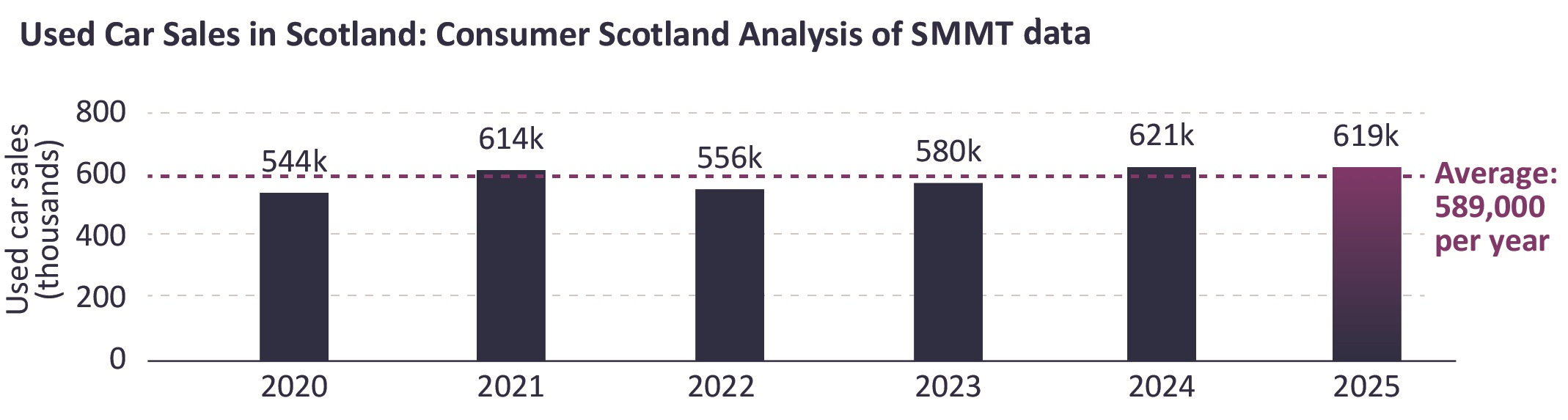
Consumer Scotland analysis of data from the Society of Motor Manufacturers and Traders
Scotland recorded around 3.54 million used-car transactions between 2020 and 2025, averaging around 589,000 per year.
When combined with UK average asking-price data, this suggests an indicative annual market value of around £9.6 billion. This is a broad estimate of market scale, not a precise valuation.
The market is shaped by affordability and supply
- The average age of used cars in Scotland increased by 13.8% between 2020 and 2025
- Older vehicles were more common in rural areas, where travel distances and reliance on private vehicles may be greater
- Petrol and diesel vehicles continued to dominate used-car sales, although hybrid and electric vehicles increased from a relatively low base
Why geography matters
Looking at local authority areas shows why the Scottish context is important. Larger local authorities recorded more transactions overall, but when transactions were adjusted per 1,000 adults, rural and island areas generally had higher rates. This may reflect longer travel distances, more limited public transport links and different patterns of vehicle reliance.
5. What the consumer survey found
Consumer Scotland commissioned independent research with 1,002 recent buyers of used cars in Scotland. The survey gives a broader view of the market than complaints evidence alone, because it includes consumers with positive experiences as well as those who encountered problems.
Key survey findings:
- 87% viewed the car in person before buying
- 90% said their experience met or exceeded expectations
- 29% experienced an issue causing detriment
- 53% reported an issue during or after purchase
- 95% carried out some pre-purchase research
- 70% of respondents chose based on price
A broadly positive market experience
Almost all respondents did some pre-purchase research, most commonly online or through friends and family.
- Many sought advice on buying with confidence or understanding consumer rights, but some relied only on unverified advice/information sources.
- Most respondents viewed the car at the trader’s premises before buying, suggesting in-person inspection is important even if search journeys begin online.
Issues were common enough to matter
Just over half of respondents reported at least one issue during or after purchase. While many issues were resolved, this still points to a significant risk of detriment in a high-value market. The survey also found that 29% experienced an issue causing detriment, meaning an issue that cost money, caused stress or took time to resolve.
Rights awareness was generally positive, but uneven
Respondents generally felt aware of their rights and many felt confident about seeking advice or complaining. Awareness was lower for some groups, including rural, lower value and older-car buyers. This reinforces the need for clear, accessible and trusted guidance before and after purchase.
Quotes from survey respondents
“Made me lose sleep and affected my mental health.”
“Unexpected repairs led to unplanned costs and disrupted my routine, especially when I needed the car for work or daily travel.”
“I trusted the seller and got answers to all my questions in a timely and truthful manner.”
“I live in a rural area, and a car is [the] only reliable means of transport. It is imperative for my everyday living that I have a reliable car.”
6. Evidence from consumer advice cases
While the consumer survey gives the broadest picture of recent used-car buyer experiences, Advice Direct Scotland case analysis provides a different view: what happens when some problems become serious, unresolved or contested enough for consumers to seek advice. For this investigation, Consumer Scotland analysed 745 cases where consumers sought advice about their used-car purchase.
- 57% of recorded trader-type cases involved independent traders
- 32% of recorded trader-location cases involved traders in England
- 80% of sampled cases arose within the first sixth months
Distance sales can make redress harder
Independent traders and cross-border purchases:
- Cross-border sales: Around 1 in 3 recorded trader-location ADS cases involved traders based in England highlighting that detriment is not confined to Scotland.
- Consumers buy at distance because of choice, lower prices and access: Some buyers travel or buy partly remotely to widen options or reduce cost.
- Our survey and ADS data align: Distance buying was more common among rural and independent-trader buyers, and linked to lower satisfaction.
- Implication: Clearer advice is needed before purchase on complaints, repairs and ADR.
Escalated cases centred on faults and disputed remedies
The ADS evidence shows that many cases involved more than minor dissatisfaction. Consumers often sought advice after a vehicle developed a fault, became unusable or required repair work, creating repair costs, loss of transport and uncertainty about responsibility.
Independent traders featured prominently in the sampled ADS cases. This does not show outcomes across the whole independent sector, as ADS cases only reflect consumers who sought advice. However, within the sample, independent traders were associated with higher levels of major faults, remedy refusals, misleading descriptions and court escalation.
Cross-border and distance sales
Around a third of sampled ADS cases with a recorded trader location involved traders based in England. This shows that detriment affecting Scottish consumers can arise beyond Scotland.
Consumers may travel or buy partly remotely to access choice or lower prices, but distance can make return, repair, inspection and rejection more difficult. Survey evidence supports this: distance purchasing was more common among rural respondents and independent-trader buyers, and was linked to lower satisfaction.
7. Consumer rights in practice
The full report explains that the Consumer Rights Act 2015 provides the core legal framework for used car sales by traders.
The issues identified by the investigation are not the absence of rights, but how difficult they can be to apply in practice when a second-hand vehicle develops a fault.
- Satisfactory quality: The key test is that used cars must be of satisfactory quality, i.e. what a reasonable person would consider acceptable, taking account of description, price, age, mileage, history and other relevant circumstances
- Fit for purpose and safe: A vehicle should be capable of normal use as safe and reliable transport, and fit for any specific purpose made known by the consumer to the trader
- As described: The vehicle must match the description, advertising and key information provided by the trader, including condition, specification and history
Satisfactory quality is the key test
For used cars, the standard of satisfactory quality is highly contextual. The goods have been used and will naturally come with wear-and-tear and unclear histories.
A lower-cost older vehicle will not be assessed in the same way as a newer or more expensive vehicle. However, consumers should still be able to expect a vehicle that is safe, drivable, reasonably durable and not materially different from what was represented at sale.
Relevant factors include the vehicle description, price, age, mileage, history, advertising and public statements.
Durability matters - but is often an area of dispute: the vehicle should last for a reasonable period considering all relevant circumstances.
Warranties add protection, but do not replace statutory rights.
Remedies depend highly on timescales
The remedy available depends on timing and circumstances. The short-term right to reject is particularly important, but many disputes arise after the first 30 days, when repair, replacement, price reduction or final rejection may become relevant. A key consumer protection is the six-month burden of proof. If a fault appears within the first six months after purchase - it is for the trader to prove that the fault was not present at the time of sale.
- Within the first 30 days, consumers may be able to reject a vehicle that does not conform to the contract
- After that period, the trader normally has one opportunity to repair or replace the vehicle
- If repair or replacement is unsuccessful or not provided, the consumer may be able to reject the vehicle or keep it with a price reduction
A simplified statutory remedies timeline for cars not of satisfactory quality
- 0-30 days - short-term right to reject: A consumer may be able to reject the vehicle and receive a refund where it does not conform to the contract
- After 30 days - Repair or replacement: The trader normally has one opportunity to repair or replace the vehicle before further remedies apply
- If not resolved - Final rejection or price reduction: If repair or replacement is not successful, the consumer may be entitled to reject the vehicle or keep the car with a price reduction
- First 6 months - Burden of proof: This period is important, but disputes can still arise about diagnosis, evidence and responsibility
8. Barriers to redress
The full report finds that consumer rights are important, but they do not always translate into a quick or practical remedy. Once a used-car fault is disputed, consumers may face evidence problems, delay, cost and uncertainty about who is responsible.
- Evidence: A consumer may be able to reject the vehicle and receive a refund where it does not conform to the contract
- Responsibility: The trader normally has one opportunity to repair or replace the vehicle before further remedies apply
- Delay: If repair or replacement is not successful, the consumer may be entitled to reject the car or keep the car with a price reduction
- Cost: This period is important, but disputes can still arise about diagnosis, evidence and responsibility
The gap between rights and remedy
The ADS case analysis shows a recurring gap between what consumers expected to happen when a fault arose and what happened in practice. Consumers often sought help after a trader refused, delayed or disputed a requested repair, refund or rejection. Bridging this gap requires better information, stronger standards and clearer redress.
Evidence and diagnosis
Used-car disputes often depend on technical evidence. Consumers and traders may disagree about whether a fault was present at sale, whether it reflects wear and tear, and what evidence is needed. Inspections and expert reports can be costly, and delays can leave consumers without transport. Trader evidence suggested that cars are increasingly complex products and that consumer expectations should align with modern realities of the issues.
Complex routes to resolution
Redress can become harder where consumers must deal with several organisations, including traders, finance providers, warranty providers, ADR bodies, advice services or courts. Finance and warranty cases can be particularly confusing where consumers are unsure who is responsible or whether warranty terms affect statutory rights.
Distance and vulnerability can intensify harm
Distance, lower-value purchases and limited financial resilience can make problems worse. Cross-border or distance purchases can make return, inspection, repair and rejection harder, while the impact is greatest for consumers who rely on their car for work, caring responsibilities or essential journeys.
Used cars create an expectation gap
Consumer expectation and trader context can differ with consumers seeking reliable everyday use and clear remedies while the wider context may be that the condition of the vehicle is variable and wear and tear may emerge.
9. Consumer experiences: when disputes become difficult to resolve
Advice case evidence shows how used-car disputes can quickly move beyond a technical disagreement about a vehicle fault. Problems can affect household finances, transport, work, caring responsibilities and confidence in the complaints process.
1. Fault soon after purchase dispute
A consumer bought a used car from a trader, but faults, warning lights, noise, and key issues appeared almost immediately. They tried to reject it within 30 days with evidence, but the trader refused. A garage later confirmed major faults. The situation caused anxiety, as the consumer needed the car for a new job and could not afford another.
What this shows: how faults soon after purchase can quickly become wider financial, practical and emotional harm.
2. Distance or cross-border purchase problem
A consumer bought a vehicle from a trader based outside Scotland. When problems arose, return, inspection and repair became harder because of distance, transport costs and uncertainty about the most practical route to redress.
What this shows: Distance and cross-border sales can widen the gap between legal rights and practical remedies.
3. Finance adding complexity
A consumer bought a used car on Hire Purchase from an independent trader. A fault appeared almost immediately, although the clutch was replaced, the issue returned. The consumer dealt with the trader, but ADS later advised the finance provider should handle the complaint, meaning time had been spent pursuing the wrong route.
What this shows: How finance agreements can make redress harder to navigate, especially where consumers are unsure who is responsible.
What these cases show: The strongest harms arise where faults, evidence, delay and limited redress combine
Better information: Clearer advice before and after purchase can help consumers understand checks, rights, warranties and complaint routes.
Stronger standards: Clearer expectations for trader conduct can support earlier resolution and reduce avoidable disputes.
Clearer redress: More visible complaint routes and ADR signposting can help consumers resolve problems without relying on court action.
10. ADR, codes and standards
The full report finds that ADR, recognised codes and trusted trader schemes can help turn consumer rights into practical outcomes. However, access is uneven across the used-car market, particularly where consumers buy from smaller or independent traders.
- ADR: Alternative Dispute Resolution can provide an important route short of court where trader complaint handling has not resolved the issue
- Coverage: Access is inconsistent where participation is voluntary or linked to membership of a code, trade body or scheme
- Codes: Codes of practice and trusted trader schemes can set clearer expectations, but only where they are visible and understood
- Standards: Practical guidance is needed so traders apply consumer law consistently in real-world used-car disputes
ADR as a practical route to redress
The report identifies ADR as crucial part of the consumer protection framework. It can help consumers and traders resolve disputes without relying on formal court action, particularly where faults, remedies or complaint handling have become contested.
- ADR can support earlier resolution and more consistent outcomes where consumers know how and when to use it
- The new ADR framework strengthens the policy context and creates an opportunity to improve consistency and accreditation
- Stakeholders also reported pressure on ADR systems, including more complex evidence and increasing case volumes
Uneven access across the market
The report highlights that ADR is not equally available across the used-car sector. Access can depend on trader membership of a code, trade body, finance route or other scheme.
This is particularly relevant for independent trader disputes, where sampled ADS cases showed serious faults, contested remedies and limited access to structured complaint processes.
Where ADR is unavailable, consumers may be left with advice, negotiation or court action, widening the gap between rights and enforceability.
Codes and trusted trader schemes
Codes of practice and trusted trader arrangements can raise standards and provide clearer expectations for traders and consumers. Their impact depends on coverage, awareness and signposting at the point of sale and when complaints arise.
- Codes can set standards on complaint handling, ADR, advertising, vehicle information and trader conduct
- Consumers may not know whether a trader is part of a code or what protections membership provides.
- Wider uptake among independent traders and new licence holders could help reduce inconsistency across the market
Clearer standards for trader conduct
The report also points to the need for practical guidance for traders on how consumer law applies in everyday used-car sales, including satisfactory quality, durability, warranties, finance agreements, distance sales and complaint handling.
- Clearer guidance should support responsible traders and reduce avoidable disputes
- Better signposting could help consumers identify complaint routes and understand when ADR may be appropriate
11. Scotland’s licensing and enforcement
The full report finds that Scotland’s regulatory and standards framework is broad but fragmented. Civic licensing of second-hand dealers remains important, but it has not kept pace with the modern used-car market, including online and multi-site retailers. Local trading standards services are central to prevention, compliance and enforcement, but their resources are critically limited. As a result, responsibilities are spread across several bodies, leaving consumers with gaps in protection.
- Enforcement capacity is constrained: Scottish trading standards evidence identifies compliance gaps, including pricing, distance-selling information, cancellation rights, complaints and ADR signposting. Resource pressures on local services limit routine proactive checks and market surveillance.
- Licences give limited consumer assurance: The “fit and proper person” test can exclude unsuitable traders, but does not consistently assess trader competence, complaint handling, consumer law knowledge or future compliance. Consumers may therefore overestimate what a licence means.
- Licensing has not kept pace: Scotland's second-hand dealer licensing framework was designed for a more local and analogue market. The report finds it is not well aligned with modern consumer risks such as online sales, cross-boundary trading, faults, complaints and access to redress.
- Coordination can be improved: The report identified the need for a prompt overall review of civic licensing. At present there is inconsistent local authority practice, limited intelligence sharing and unclear routes for raising concerns, particularly where traders operate online or across boundaries.
Second hand vehicle dealing licencing
How the current framework compares with a more consumer-focused modern approach
| Key factor | Current licensing framework | Modernised approach |
| Purpose |
Focused mainly on administration, record-keeping and basic gatekeeping
|
Clearer consumer protection role alongside local oversight
|
| Scope |
Designed for a more local, analogue market; weaker fit for online and cross-border sales
|
Better aligned with digital sales, online advertising and cross-border trading
|
| Consistency |
Practice and licence conditions vary across local authorities
|
More consistent standards through national guidance and a best-practice model
|
| Protection |
No common expectation on complaints handling, ADR signposting or consumer information
|
Stronger expectations on transparency, complaints handling and ADR signposting
|
| Overall role |
Can screen out some poor actors, but does not consistently operate as a proactive consumer protection tool
|
Better able to support responsible traders, clearer standards and improved consumer outcomes
|
12. Key findings
The investigation found that Scotland’s used-car market works well for many consumers - but when problems arise they can cause serious financial, practical and emotional harm.
1. A large and vital market: Used cars are financially significant and central to everyday life, supporting access to work, education, caring responsibilities and services, but when problems occur they are serious.
2. Faults cause the most disputes: Complaints most commonly arise when faults develop after purchase, often involving serious mechanical issues and immediate repair or transport pressures.
3. Consumer rights can be hard to apply: Consumer rights are strong in principle, but disputes often turn on a gap in perceptions of satisfactory quality, durability, wear and tear, or remedies.
4. Redress is fragmented: Consumers may need to deal with barriers across traders, finance providers, warranty providers, ADR bodies, advice organisations or courts, causing delay and confusion.
5. Some consumers face greater harm: Lower financial resilience, lower-value purchases, rural circumstances and reliance on a car can make faults and disputes harder to absorb.
6. Serious disputes point to risk areas: Sampled ADS cases suggest independent traders and distance purchases were prominent in more serious disputes, including major faults and remedy refusals.
7. Cross-border purchases add complexity: Around a third of sampled ADS cases involved traders based in England, underlining the need for clearer pre-purchase advice and baseline standards.
8. Licensing has not kept pace: Scotland’s second-hand vehicle dealer licensing regime provides a basic gatekeeping function but is not fully aligned with the modern market.
9. Trading Standards remain vital: Trading Standards services support compliance and respond to harm, but recurring issues and resource pressures affect what can be achieved.
10. Codes can help where accessible: Self-regulating codes of practice and trusted trader schemes can support better standards, but their impact depends on coverage, awareness and clear signposting.
What this means
The findings point to a market where clearer advice, stronger standards and more accessible redress are needed when problems arise. Consumers need better information before and after purchase, while traders need practical guidance on how consumer law applies in used-car sales.
13. Recommendations at a glance
The full report makes ten recommendations. To make the actions easier to navigate, they are grouped around three main opportunities for impact: better information, stronger standards and clearer redress. Together, these changes are intended to reduce avoidable disputes, improve trader practice and make it easier for consumers to resolve problems when faults arise.
Better information
Consumers and traders need clearer, more practical information on rights, remedies, warranties, finance responsibilities and distance sales including:
- Practical guidance on used-car rights and remedies
- Strengthening consumer advice case intelligence on used-car complaints
- Updated business guidance on distance and cross-border sales
- Stronger support and protections for consumers in vulnerable financial circumstances
Intended impact: Better-informed decisions, fewer avoidable disputes and clearer expectations when faults arise.
Clearer redress
Consumers need complaint and redress routes that are visible, trusted and easier to use, particularly where disputes involve independent traders.
- Improved access to ADR
- Dissemination of Trading Standards Car Dealer Project findings
- Wider uptake of recognised motor industry codes of practice
Intended impact: Earlier resolution, better complaint handling and fewer consumers left relying on court action.
Stronger standards
Licensing, enforcement and oversight need to keep pace with online, cross-border and modern used-car sales.
- Examination of subprime motor finance pricing and access
- Wider reform of Scotland’s civic licensing framework as a priority
- Best-practice licence conditions for second-hand vehicle dealers
Intended impact: Consistent standards, better prevention and protections where consumer risks are greatest.
How the recommendations fit together
Clearer information should reduce avoidable disputes; stronger standards should improve trader practice; and more accessible redress should help consumers resolve problems earlier when faults arise.
14. Recommended actions and lead bodies
The recommendations identify the organisations best placed to lead each action, with others supporting delivery where needed. Lead bodies are expected to consider the recommendation, agree proportionate next steps with relevant partners, and support practical progress over the short to medium term. This table summarises the action and intended consumer benefit.
| No | Recommended action | Lead body | Intended impact |
| 1 | Examine whether subprime motor finance consumers in rural and remote Scotland face higher prices, reduced availability or other access issues | Financial Conduct Authority | Tests whether finance access issues create unfair outcomes for consumers |
| 2 | Develop practical guidance on used-car rights, remedies, warranties, complaint handling and point-of-sale information | SMTA with Consumer Scotland, SCOTSS, Advice Direct Scotland, ADR bodies and partners | Helps traders apply the law consistently and helps consumers understand their rights |
| 3 | Strengthen use of consumer advice case data to identify recurring issues and patterns in used-car complaints | Advice Direct Scotland and Consumer Scotland | Better evidence on consumer harm and more targeted guidance, compliance and enforcement |
| 4 | Update Business Companion guidance on online, distance, semi-distance and cross-border used-car sales | Chartered Trading Standards Institute | Gives traders clearer guidance on sales models and cancellation rights |
| 5 | Develop targeted measures for consumers with lower financial resilience or greater exposure to harm | UK Government / DBT with CPP partners | Improves support for consumers least able to absorb the cost and disruption of disputes |
| 6 | Explore how accredited ADR can be made more practical, visible and trusted across the used-car market | CTSI with CPP, ADR providers and industry bodies | Gives consumers more accessible routes to redress, especially outside recognised schemes |
| 7 | Consider wider reform of Scotland’s civic licensing framework as a priority | Scottish Government | Makes licensing clearer, more consistent and better suited to modern markets |
| 8 | Develop best-practice licence conditions for second-hand vehicle dealers promptly | Licensing Leaders Group with SCOTSS, SMTA and Consumer Scotland | Supports more consistent local standards and clearer consumer protection expectations |
| 9 | Share Trading Standards Car Dealer Project findings with traders | SCOTSS with Consumer Scotland and SMTA | Turns enforcement intelligence into practical compliance messages |
| 10 | Promote wider uptake and awareness of recognised motor industry codes | Code operators and trade bodies | Improves visibility of standards, complaint handling and ADR protection |
Summary message
Taken together, these recommendations are intended to make the market easier to navigate, improve early resolution when faults or disputes arise, and strengthen the standards that support responsible trading. Consumer Scotland will use its convening role to support follow-up with lead bodies and partners after publication.
15. Conclusion: What needs to change
The full report concludes that Scotland’s used-car market works well for many consumers, but that when problems arise they can cause serious financial, practical and emotional harm. The recommendations are designed to support a market where consumers have clearer information, traders understand and meet their obligations, and routes to redress are easier to access.
Better information
Consumers should be better supported before and after purchase, with clearer guidance on checks, rights, warranties, finance responsibilities and complaint routes.
Stronger standards
Traders should have clearer guidance around point-of-sale information, complaint handling, consumer law compliance, codes of practice and fair trading.
Clearer redress
Consumers need practical, accessible routes to resolve disputes, including better signposting to advice, ADR and proportionate remedies when faults arise.
Overall message
A fairer used-car market in Scotland should be one where consumers can make informed choices, traders meet clear standards, and people have practical routes to resolve problems when things go wrong.
Why this matters
A used car can be an essential purchase, supporting work, education, caring responsibilities, family life and access to services. When a vehicle develops a serious fault, the impact can extend well beyond the cost of repair: consumers may face loss of transport, ongoing finance payments, stress, delay and uncertainty over who is responsible. These impacts are often greatest for consumers with lower financial resilience or those who rely heavily on their car.
How progress will be measured and Consumer Scotland’s next steps
Consumer Scotland will continue to play an active role by convening and working with partners to support delivery and track progress with the recommendations. This work will recognise that this is an ongoing process rather than publication of this report being an endpoint.
This will include assessing impact and identifying where further action is required. Progress will be monitored through indicators such as clearer consumer and trader guidance, improved use of advice case intelligence, stronger ADR signposting, wider uptake of recognised industry standards, and evidence of progress on licensing reform and compliance expectations.