1. Introduction
Consumer Scotland is the statutory body for consumers in Scotland. Established by the Consumer Scotland Act 2020, they are a Non-Ministerial Office accountable to the Scottish Parliament, set up to provide consumer advocacy and advice in Scotland.
Under section 19 of the Consumer Scotland Act 2020[1] (the Act), Consumer Scotland must commission a review of the performance of its functions. The first review is required to cover the first 3 years of operations of the organisation, with subsequent performance reviews taking place every 5 years.
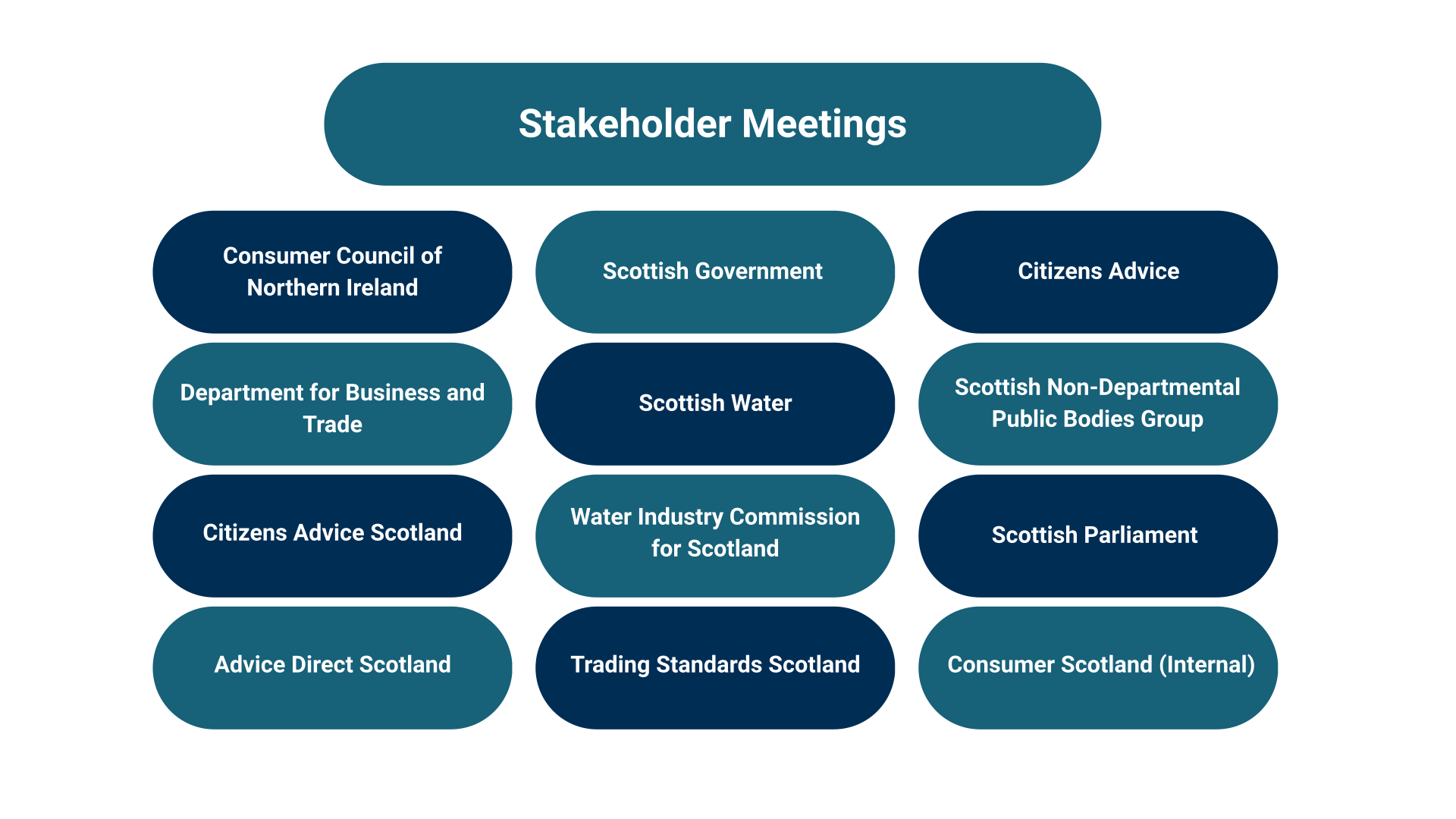
This is the first performance review, covering the period April 2022 - March 2025, which therefore covers the initial set up of the organisation and its early years of operations. Following a procurement exercise, Elaine Lorimer was appointed by Consumer Scotland to undertake the review. It was undertaken in the first 3 months of 2026 and consisted of desktop research and a significant number of stakeholder meetings which were designed to seek feedback on the performance of Consumer Scotland. Input and advice have also been provided from the Chair of the Consumer Council for Northern Ireland, who has peer reviewed the report and findings, given their sectoral experience.
Summary of Findings and Recommendations
-
- Consumer Scotland has built a strong base from which to develop. It has developed from start up in 2022 to being a small, expert organisation with capability in research into consumer markets, analysis of data, policy making and investigations, to support its approach to evidence based advocacy and the provision of information and advice. Its ethos is founded on collaboration.
- The next performance period will be essential in firmly establishing its strategic role and evidencing the value it brings to consumers in Scotland. Consumer Scotland has adopted a set of internationally recognised consumer principles [2]which set out what good consumer outcomes look like for any market or service. These principles should continue to inform priorities for work plans and recommendations for change.
- The creation of the Advisory Committee for Consumers in Vulnerable Circumstances has been a valuable initiative in keeping Consumer Scotland grounded and informed of the needs of consumers and also as a useful knowledgeable sounding board for its work. The Committee will be important in the ongoing development of the culture and collaborative approach of the organisation.
- More broadly, the collaborative approach taken to engaging consumer groups and representative bodies in its work is necessary to assist in prioritisation and gain support for its recommendations for change.
- There is growing evidence of the organisation making a positive impact in the improvement of lives of consumers in Scotland. More should be done to bring this to light to demonstrate where Consumer Scotland has delivered impact and made a difference.
- There are several players in the consumer advisory and advocacy landscape in Scotland and Consumer Scotland should continue to develop as the strategic leader in the field in Scotland. The sector CEO group and the Consumer Network for Scotland have the potential to be used to deliver tangible change.
- For matters reserved to the UK government, it should continue to develop and be known for having deep expertise in issues relating to consumers in Scotland.
- Since it was set up in 2022, the responsibilities of Consumer Scotland have increased with the addition of Heat Networks and grant funding responsibilities for Advice Direct Scotland, Citizen’s Advice Scotland and Citizen’s Advice. Grant funding brings new challenges and risks in terms of leadership, management capacity and stakeholder engagement in order for this to have a positive impact on the advisory services provided to consumers. Leadership, stakeholder engagement and collaboration will be key.
- The balance of the funding model of the organisation has also changed, with an increasing proportion of funding for the organisation coming from levy funded responsibilities for Water, Energy and Post, with Heat Networks being added to this in 2025. There is a risk the imbalance of funding and constraints around the use of the levy funding will drive activity and priorities over potentially wider, more critical consumer issues and activities such as investigations, recall of goods and the statutory responsibility for consumer duty guidance.
- The operating model, including funding and capabilities required of the organisation for the future, are different from what the organisation required in set up and early years. It is recommended that this is reviewed by Consumer Scotland as part of the building blocks for delivery of the next Strategic Plan.
- While there is no requirement for Consumer Scotland to have a Strategic Plan in its legislation, it is positive that it recognised the need for one and published its Strategic Plan 2023-2027 [3]in 2023. It is important that it takes time to produce its second strategic plan for the next operating period and beyond. The plan should provide a longer-term vision for the organisation, the clear outcomes Consumer Scotland is seeking to achieve and how it will deliver them. It should provide a framework for annual work plans, a structure for delivery and a rationale for funding. The strategic plan should be underpinned by a risk framework, funding model, people strategy, strategic external engagement and data strategies to deliver the outcomes sought. The strategic plan should be developed in collaboration with key stakeholders, including Scottish Ministers, the Scottish Parliament, the UK government, delivery bodies where relevant and be published. The Board should ensure there are mechanisms in place to provide it with sufficient assurance as to the delivery of the outcomes it sets in the plan.
- The Consumer Duty obligation on Consumer Scotland is to provide guidance to those public bodies affected by it. The Scottish Public Service Reform Strategy provides an opportunity for Consumer Scotland to reframe the Consumer Duty obligation on public bodies towards consumer centred design of public services. Examples of good practice in other sectors of placing customers at the heart of service design and prioritisation would help shift the duty away from being perceived as an unnecessary additional burden and compliance-based tick box exercise.
- The investigatory function is small, with minimal resource to be able to perform more than one investigation at a time. As part of its consideration of its next strategic plan, Consumer Scotland should consider the resourcing of this function alongside whether there is a need for further legislative powers, particularly around information gathering, to be granted to it to enable to perform its role well.
- The recall of goods function is currently delivered via signposting on the Consumer Scotland website and information campaigns. This function should also be reviewed in terms of prioritisation and delivery to ensure Consumer Scotland is able to perform its statutory duty adequately.
2. Background to findings and recommendations
Consumer Scotland legislative remit
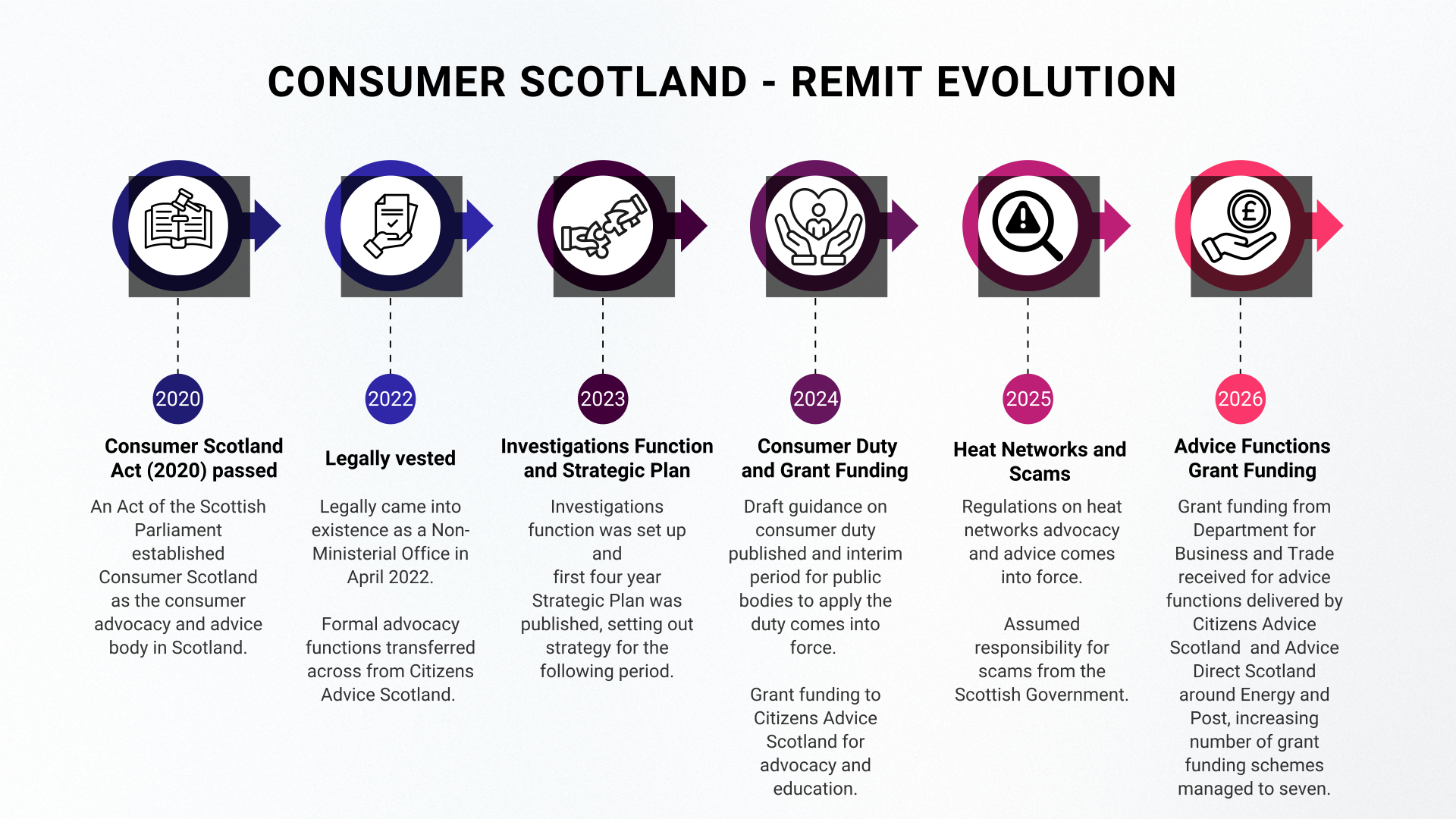
Consumer Scotland was established by the Consumer Scotland Act 2020 (the Act) and commenced its operations on 1 April 2022. Since 2022 the organisation has not stood still. Its responsibilities have increased and evolved. The timeline below highlights key changes.
Figure 1: Timeline of remit evolution
A non-ministerial office, comprising a Chair and up to 4 members, the body is accountable to the Scottish Parliament for its performance. It has delivered unqualified accounts for each performance year and reasonable assurance from internal audit for its systems of internal control. This is to be commended.
The Act sets out general and particular functions for Consumer Scotland. It has the general function of providing consumer advocacy and advice and particular functions, including: a representative function (which enables the provision of advice and information about consumer matters, make proposals and represent the views of consumers on consumer matters to the Scottish Ministers, a Minister of the Crown or government department, local authorities, a statutory regulatory body or any other person who might have an interest in the matter); functions in relation to research and investigations; the provision of information, which includes the power to provide financial support or facilitate or coordinate the activities of other persons and functions in relation to the recall of goods.
Importantly, that Act states that Consumer Scotland is not under an obligation to exercise any of its functions at, or on behalf of, the request of a particular consumer.
A strategic leader
It is clear from the legislation that Consumer Scotland was set up to be a strategic body, advocating for consumers and providing advice based on expertise in consumer issues, informed by data, evidence and investigations.
Stakeholders identified this strategic role as one which was needed in Scotland and was yet to be fully embraced by Consumer Scotland. The consumer advocacy and advisory landscape was described as “cluttered” and that Consumer Scotland, being the statutory public body with the powers and responsibilities it has, should continue to develop and evolve into being a strategic leader, working collaboratively to bring greater coherence to the tackling of consumer issues in markets in Scotland.
Consumer Scotland has taken a leadership role in encouraging the establishment of a CEOs group for consumer bodies and relaunching the Consumer Network for Scotland. This is welcome and these fora could be developed to move towards joint working on projects which are of a national priority or tackling wider issues such as data quality for example.
A remit which extends to UK markets
The remit of Consumer Scotland extends to representing the interests of Scottish based consumers in UK Markets too. As part of this, they currently have a role in relation to Energy and Post, both of which attract levy funding from industry via the UK government. In 2025/2026, this has also been extended to Heat Networks, with further levy funding coming from the UK government to support the work of Consumer Scotland in this new market.
This model puts Consumer Scotland in a position where it is negotiating funding for work plans with both the Scottish and UK governments. Although this could lead to potential for Consumer Scotland being caught between conflicting priorities, it also puts Consumer Scotland in a role where it has strategic influence over matters which will affect Scottish based consumers. It will require to continue to develop and mature its expertise to be able to fulfil its potential and have the support of Scottish and UK Ministers in being recognised as the strategic expert body for consumer matters in Scotland.
Grant funding
Since 2024 Consumer Scotland has taken on significant responsibility from Scottish Government for grant funding advisory services, notably for Advice Direct Scotland, Citizen’s Advice Scotland and Citizen’s Advice. Thus far, the funding letter from Scottish Ministers in relation to the Scottish Government funding provision has been prescriptive as to the amount of funding to be provided and its purpose. It is too early to assess the success of this change. This new responsibility should work in a complementary way to the strategic role envisaged for Consumer Scotland by its legislation, providing Consumer Scotland with a funding lever to effect change. However, this is a sensitive area, introducing new risks to Consumer Scotland to manage. It will require leadership, collaboration and collective endeavour by all parties for it to produce the benefits anticipated by Scottish Government of the change. Currently the oversight and management of these relationships is funded out of core funding, which constrains the time made available to it.
Funding and operating model
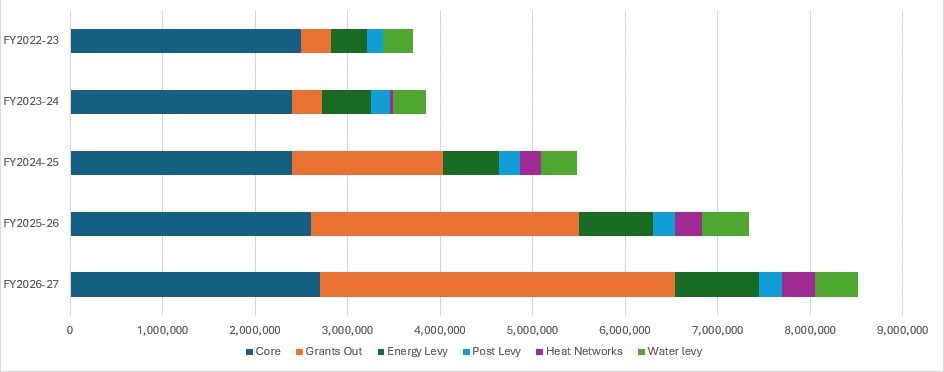
The funding model for Consumer Scotland is complex, with income being drawn from regulated industries of Water, Energy, Post and in 2025 Heat Networks (“levy funding”) in addition to “core funding” from Scottish Ministers, which is intended to cover their wider remit.
The graphic below shows the sources of funding and how they have evolved over the first 3 years of operations. While the overall package of funding has increased over the years, the “core funding” has remained mostly static, representing a cut in real terms of approximately 25%.
Figure 2: Consumer Scotland funding, split by year
Section 14 of the Act requires Consumer Scotland to produce an annual forward work programme, which should be consulted upon and laid before the Scottish Parliament. There is no requirement for a plan which is longer than one year. Consumer Scotland has, each year, to agree its funding allocation with each funder, based on a work plan with deliverables.
Allocation of staff and other resources are currently aligned to the work plans agreed with each levy funder. The requirement for transparency and accountability to the levy funder, coupled with the need for expertise in specific markets to be retained alongside a reducing amount of core funding has introduced an imbalance into the operating model of the organisation. There is limited ability to share resources across teams and a risk of lack of resilience. The annularity of work plans, which are tied to funding, doesn’t promote longer term planning of work or resourcing.
The core funding provided by Scottish Ministers is currently used to cover all other costs which are not otherwise levy funded. This means that any work in relation to: wider markets, investigations, consumer duty guidance, recall of goods, management of external stakeholder relationships (including grant funding of Citizens Advice Scotland, Advice Direct Scotland and Citizen’s Advice) communications to support their advocacy work, oversight of grant funding, corporate strategy and essential corporate functions including governance support are currently funded out of core funding. This funding has been cut in real terms by circa 25% in recent years.
The funding model presents risks and opportunities to Consumer Scotland. While levy funding can be protected from wider cuts being felt across the public service and could allow for longer term planning, the risk to Consumer Scotland is that the funding source drives its priorities and work plans, leading to an imbalance, with wider consumer issues and markets having less resource allocated to them.
While this may be a necessity, borne out of fiscal constraint in the public finances, it is recommended that Consumer Scotland review its funding and operating model, engaging with the Scottish Government as it does so, to ensure that it is aligned to its statutory remit and longer-term strategy. A review would also enable it to be clear about the choices it is making to keep within its funding envelope and, perhaps more importantly, what it is not able to do.
Demonstrating Impact and Performance
All public bodies are under increasing pressure to demonstrate their value and impact. Consumer Scotland’s role is such that it may take time before their value on individual issues can be demonstrated. This is because consumer issues may be complex to resolve and markets may take time to respond. Given it is a strategic advocacy and advisory body, with no powers of enforcement, how Consumer Scotland demonstrates its impact is not straightforward.
Added to this, there are few analogous organisations with which to benchmark or share good practice. The closest organisation in remit is the Consumer Council for Northern Ireland. It is a larger organisation and has 40 years’ experience behind it in the delivery of its responsibilities. It too is looking for clearer ways with which to demonstrate impact and are commencing work in this area as part of their corporate strategy. This work is something Consumer Scotland could benefit from joining or sharing, building on the existing excellent working relationships between the two organisations.
Consumer Scotland exercises its representative function by engaging with and providing evidence-led insight and recommendations to government, regulators and other strategic decision-makers. Key methods used to deliver this work include production of reports and policy briefings, regular engagement with policymakers and highlighting its findings and recommendations through the media.
Consumer Scotland deploys a number of research and analysis approaches to gather the consumer views and experiences that inform its evidence-based recommendations. This includes internal and commissioned research projects and data sharing agreements with key partners.
Since 2022 Consumer Scotland has published over 140 reports or positions on consumer related issues. It has sought to adopt an approach based on principles, analytical and research expertise to guide its priorities for topics and to inform its recommendations.
It has contributed to Parliamentary consideration of relevant legislation, seeking to bring their expertise to bear. There are good examples of where its work has made a positive difference directly to consumers in Scotland, for example their work in relation to the Radio Tele Switch Meters, widening access to the Warm Home Discount, Water Affordability and the switch to voice over internet protocol in telecoms. However, it is unclear whether consumers who have benefited from their work or stakeholders would be able to credit Consumer Scotland with the changes achieved.
Internally, it has developed a process for recording recommendations and tracking progress with implementation of these. It has also developed a list of key performance indicators, and it uses its annual report each year to report on progress.
Feedback from stakeholders commented on the high quality of the work produced by Consumer Scotland but suggested that, perhaps, delivering less with more focus on key issues and follow up on these would potentially bear greater fruit in terms of outcomes.
How to demonstrate impact and effect change is without doubt one of the matters that Consumer Scotland should continue to develop over the next performance period.
It is recommended that Consumer Scotland further develop how it will demonstrate the impact of its work in its next strategic plan.
People and Culture
Over the first 3 years of operations, Consumer Scotland has established an operating model which is primarily structured around its sources of funding. It has staff who are passionate about their work and keen to make a difference to the lives of consumers in Scotland. The People Survey results bear this out. However, in a small organisation with such a wide remit, there is a risk that there are single points of failure and staff, particularly in functions which are core funded, covering multiple remits. As Consumer Scotland matures, having a strategic, longer-term view of the capabilities it will need to deliver the outcomes set out in its strategic plan, will help with workforce planning, the approach to learning and development and career development and the ongoing evolution of its culture.
It is recommended that Consumer Scotland develop a people strategy to underpin its next strategic plan.
Vulnerable Consumers
Section 7(4) of the Act requires Consumer Scotland to have regard to: the interests of vulnerable consumers; the environmental impact of actions on consumers; and the importance of communicating in an inclusive way.
In order to fulfil its obligations in relation to vulnerable consumers, Consumer Scotland set up an Advisory Committee on Consumers in Vulnerable Circumstances. This Committee is chaired by a member of the Consumer Scotland Board and is deliberately advisory in nature. It does not currently form a formal part of the governance of the organisation, in that it does not have decision-making authority or specific delegated authority to act on behalf of the Board. Membership is by invitation and in the first 3 years of operations, the committee has had an important role in contributing to the annual work plans, input into policy work, providing stakeholder insight including the impact of climate change and sustainability policy on consumers in vulnerable circumstances.
The Committee has been key to the approach taken by Consumer Scotland in managing stakeholders and in helping keep their work grounded. As it runs in an advisory capacity it can only be used as an important corporate sounding board. It may be over the course of time, the role of the group will become more firmly established in the corporate governance of the organisation but equally, the Board may decide that the benefits of it remaining advisory outweigh it becoming more formal. What is clear is that its potential for being more central to the work of the organisation should not be lost.
It is recommended that the role of the Advisory Committee on Vulnerable Consumers continues to be reviewed and developed over the next performance period.
Investigations
Since 2022, Consumer Scotland has completed one investigation, in relation to conversion of home heating in Scotland[4]. A second investigation into the used car market is underway in 2025/26.
The investigation function of Consumer Scotland is set out in Section 15 of the Act. The organisation has limited powers to support its investigation function relying on the general information seeking powers of Consumer Scotland being limited to specified organisations set out in Section 9 of the Act, with recourse to the Court of Session should the information required by notice not be provided. While Scottish Ministers may by regulation alter the information powers or organisations covered by them, it has, as yet, not done so. The investigation report produced must be provided to Scottish Ministers, with there being no response required in response.
The investigations function is therefore part of the wider evidence gathering, information providing, advocacy role of Consumer Scotland. With limited resources allocated to investigations, prioritisation of subject matter will be key, coupled with broad stakeholder support. Gaining traction on any findings will also require stakeholder support.
It is recommended that as part of the Strategic Plan, Consumer Scotland consider its approach to its investigations function, whether any legislative change to information powers would be helpful to assist in this aspect of their work and how it intends to take forward ongoing advocacy for the adoption of recommendations made.
Consumer duty and public service reform
Section 21 of the Act created a duty on relevant public bodies to have regard to the interests of consumers in their work. This obligation on public bodies fully came into force on 1 April 2025. The role that Consumer Scotland has in relation to this duty is to provide guidance to relevant public bodies as to how it should be applied to their circumstances. It has no oversight or enforcement power.
Consumer Scotland published guidance for relevant public bodies in 2025[5] after a consultation exercise. It has undertaken follow-up work with a number of public bodies, seeking feedback on the impact of the guidance with a view to keeping it under review.
There is an opportunity for Consumer Scotland to align their role in relation to guidance on the consumer duty to public service reform, and to showcase good examples of where consumer interests have been embedded in the way public bodies make strategic decisions on investment or in service design. This could help reinforce the need for consumers to be considered in the shaping of public services and move the duty away from being perceived as an unnecessary “tick box” exercise.
It is recommended that the approach taken to the consumer duty guidance is refreshed to align with public service reform priorities and examples of good practice shared in an engaging way to encourage consumer interests to be embedded in the design and delivery of public services.
Recall of goods
Section 6 of the Act places an obligation on Consumer Scotland to establish or secure the provision and operation of a database of recall of goods in Scotland. Following the passing of the Act, the Office for Product Safety and Standards was established and created a UK-wide public database for recall of goods. Thus far, the delivery of Consumer Scotland’s obligation has been via the Consumer Scotland website and by signposting to other organisations for information and advice, notably the Office for Product Safety and Standards (OPSS). It has also undertaken an information campaign reminding consumers of the need to register goods purchased[6].
The Act anticipates Consumer Scotland having a view on those goods which should be identified on the basis of risk or scale of the recall and grants the organisation powers to provide or secure the provision of information to consumers about such recalls. The Act therefore anticipates a proactive approach.
Given the constraints in core funding and the potential cost of alternative solutions, it may be that this statutory duty is one which Consumer Scotland is content it is satisfying via the relationship it has with the OPSS, the signposting mechanism on its website and information sharing it has in place.
It is recommended that a decision on how ongoing performance against this statutory duty is satisfied is made and included in the next strategic plan.
The Strategic Plan
There is no statutory obligation on Consumer Scotland to produce a Strategic Plan. Recognising the value of planning for a longer period than the annual work plan cycle, Consumer Scotland produced its first Strategic Plan in 2023, which runs to 2027.
The next Strategic Plan provides Consumer Scotland with the opportunity to clarify, in the light of its experience, its vision for the organisation, the outcomes and deliverables it seeks to achieve over the next performance period and how it intends to achieve them.
The role of the Board is key in setting the strategy for the organisation and gaining assurance as to the organisational capability and capacity being in place to deliver it.
It is recommended that the next strategic plan should provide a framework for annual work plans and prioritisation, a structure for delivery and a rationale for funding. The strategic plan should be underpinned by a risk framework, funding model, people and capabilities strategy, external engagement and data strategies to deliver the outcomes sought.
The strategic plan should be developed in collaboration with key stakeholders, including Scottish Ministers, the Scottish Parliament and the UK government where relevant and be published.
The Board should ensure it has the mechanisms in place to oversee the development of the Strategic plan and its delivery.
3. Annex A - Stakeholder Engagement
Figure 3: Stakeholders approached as part of the review