1. Outlining Consumer Scotland’s approach to producing a Consumer Welfare Report in 2026
The Consumer Scotland Act requires Consumer Scotland to publish a Consumer Welfare Report (CWR) every three years, with the first one due in 2026. This short paper sets out the detail of the statutory requirement, and describes how Consumer Scotland intends to approach the requirement.
The statutory requirement
Section 17 of the Consumer Scotland Act, entitled ‘Consumer welfare report’, sets out that:
- “(1) Consumer Scotland must, as soon as reasonably practicable after the end of each reporting period, prepare and publish a report on:
- (a) how well the interests of consumers are being served in Scotland, and
- (b) where harm is being caused to the interests of consumers in Scotland, the nature and extent of that harm.”
- (2) A report under subsection (1) must set out how Consumer Scotland has had regard to the interests of vulnerable consumers.
- (3) In preparing a report under subsection (1), Consumer Scotland must have regard to the views of consumers and other persons, bodies and organisations having an interest in consumer matters.
- (4) Consumer Scotland must:
- (a) lay a copy of each report prepared under subsection (1) before the Scottish Parliament, and
- (b) send a copy of it to the Scottish Ministers.”
Timescales
The first CWR is due ‘as soon as reasonably practicable’ after ‘the end of the reporting period’. The reporting period is the three year period ending March 2026.
Given the likelihood of a Scottish Parliament election in May 2026, we will be bound by rules governing the pre-election period during April and May. Furthermore, given that Ministers and MSPs are a key audience for the CWR, we have decided to publish the CWR 2026 in September, following the summer recess. This will allow the new cohort of MSPs to settle in, and the membership of parliamentary committees to become established.
Vision and principles
Neither the Act nor various supporting documents provides further detail as to the anticipated objectives or content of the CWR. There is therefore some flexibility to determine the vision for and approach to the CWR.
Through a range of scoping activities carried out in 2024 and 2025 we have agreed on a key vision for the CWR, in terms of its purpose, objectives, audience and style. This is set out below:
Consumer Welfare Report – vision statement
Purpose
To bring key consumer issues to the forefront of the minds of politicians and policy-makers, drawing on good quality and robust evidence, and using this to inform debate’
The objectives for the CWR are:
- To robustly answer the ‘exam questions’ set out in the legislation
- Inform and shape debate consumer issues by engaging a wide audience of policymakers, politicians and the public
- To raise the profile of Consumer Scotland
Audience
- The audience is politicians, media and policy-makers broadly defined (i.e. not just specialist consumer landscape bodies and regulators)
Style
- The report should be engaging and digestible, and directly relevant to topical policy and societal debates relating to consumers
- In presenting data, it should go beyond a simple description of data trends, articulating explanations and drivers for trends, and discussing the implications for consumers and policy-makers
Evidence
- The CWR will draw on primary research with consumers in Scotland, including consumers in vulnerable circumstances
- The CWR will also draw on a wide body of evidence collated and published by other bodies, including national statistics agencies, regulators, consumer advocacy organisations, and private sector businesses
A framework for delivery
Having established some broad principles, it is necessary to set out a framework for delivering against those principles. There is a potential tension between:
- On the one hand, the aspiration to adopt a rigorous and systematic approach to answering the statutory question, in a way that befits the statutory status of the report
- On the other hand, a desire that the report is engaging and meaningful for policy-makers, rather than being overly long, abstract or formal
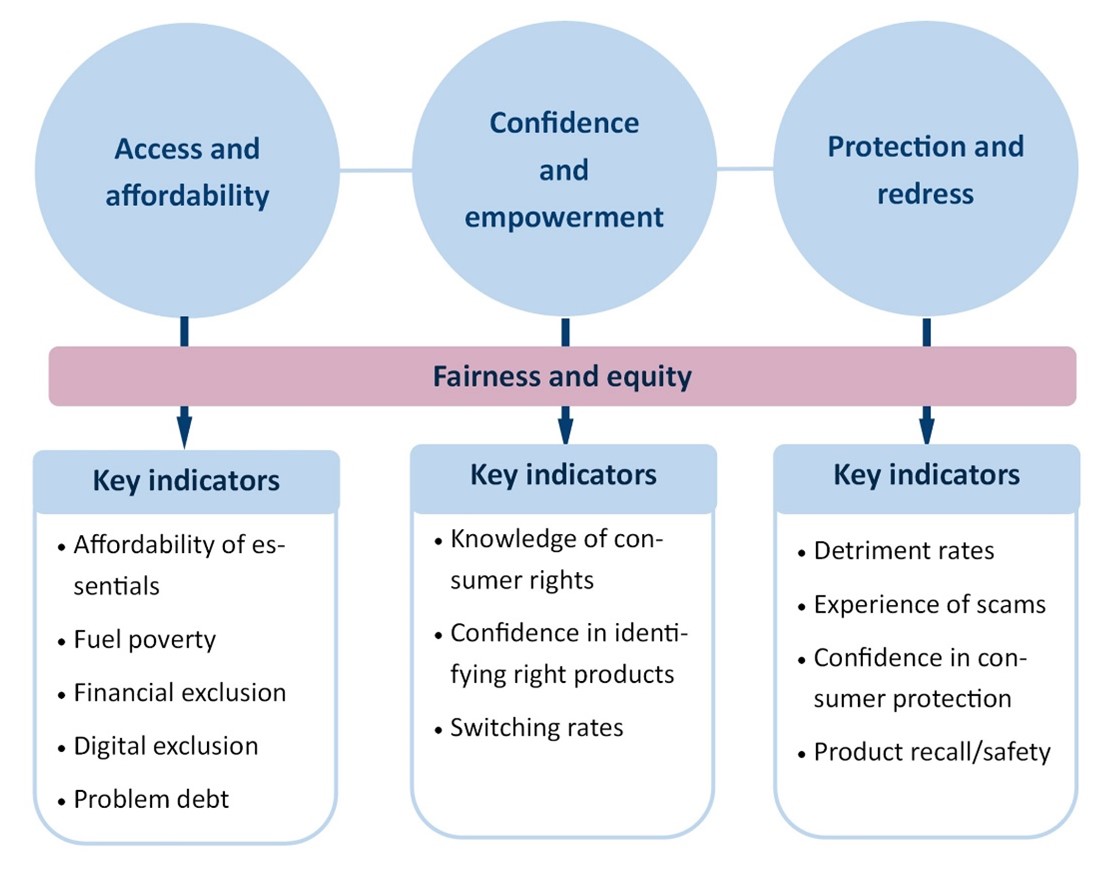
To address these challenges, we propose to structure our approach to the CWR around an outcomes based consumer welfare framework. This approach provides a framing for the assessment of the interests of consumers in a way that allows for both quantitative indicators of the interests of consumers with evidence based analysis of specific policy issues that affect those consumer interests.
Our proposed Consumer Welfare Framework consists of three core outcomes and one cross-cutting theme (Box 2). These outcomes provide the framing for the presentation of both quantitative indicators and policy analysis.
An outcomes based framework for assessing how well the interests of consumers are served
We propose to adopt a framework for characterising the interests of consumers which argues that the interests of consumers are served when:
- Consumers can access the goods and services – fairly and without discrimination – they need to participate fully in society
- Consumers are confident and empowered to engage in markets
- Consumers are protected from harm and detriment and can secure redress
The three statements above form three core consumer outcomes, the achievement of which informs the extent to which the interests of consumers are served. In addition to these three core outcomes, we identify a fourth, cross-cutting theme of fairness and equity. The interests of consumers are served when:
- Consumers do not experience different outcomes due to discrimination or inequities in the way that markets operate
Indicators
For each of the three core outcomes, we will identify a small number of key indicators that provide high level evidence with narrative on the extent to which consumer interests are being served in relation to that outcome – and importantly, the extent to which those outcomes are experienced differently for different groups of consumers.
We are in the process of appraising what those indicators will be. The indicators will draw on a range of existing data sources, including data published or collected by UK and Scottish governments, regulators, and third sector organisations.
We also intend to commission a representative survey of consumers in Scotland to capture data for some of the key indicators. The field work for this survey will take place in February/ March 2026.
Figure 1: Consumer Welfare Framework with illustrative key indicators
Policy analyses
For each of the core outcomes, we will supplement the quantitative indicator analysis with more in-depth analysis of specific policy issues. These evidence-based policy analyses will be selected to illustrate the ways in which consumers’ interests are or are not being served in more specific contexts.
The aim would be for these analyses to be relatively short (a few pages), and follow a similar format: what is the issue, why is this relevant to the interests of consumers; what action needs to happen.
We are in the process of scoping what these policy issues will cover. Illustratively, those issues might include, for example:
- Access outcome:
o Trends and issues in consumer debt
o Addressing financial exclusion
o Targeting affordability policy effectively
- Confidence and empowerment outcome:
o Supporting consumers in a flexible energy market
o Building consumer confidence in the markets for green technologies
- Protection outcome
o Protecting consumers from harm in unregulated markets
o Empowering consumers to exercise their rights
What the CWR won’t do
It will be apparent from this note, but it is worth saying explicitly, that we are not proposing the CWR to attempt to assess the extent to which the interests of consumers are being served systematically across different markets. There are two factors that mitigate against this.
- First, comparable data on key indicators tends not to be available across different markets – so there’s a real risk of comparing apples with pears
- Second, even if we could limit analysis to 8-12 specific markets to focus on, it becomes quite difficult to keep analysis tractable, meaningful and digestible if the same analysis is undertaken systematically across those different markets
It is also worth noting that we are implicitly not attempting to cover every single issue that might be affecting how well consumers are served. Our aim is to focus on the issues that are most relevant, topical and important to consumers in the context of Consumer Scotland’s role and expertise.
Some other principles of what the CWR is not are:
- The CWR is not part of Consumer Scotland’s existing performance framework – it is a broader statement about how consumer welfare is evolving, including in some areas in which Consumer Scotland is not directly active
- The CWR should not be long, dry, or technical
- Whilst the CWR is firmly grounded in evidence, the emphasis is on analysing and interpreting that evidence – not on publishing reams of data for its own sake
Next steps and feedback
We are in the process of identifying the specific indicators and topics for policy analyses to include in the CWR 2026. We are also firming up plans for our Consumer Welfare Survey, which will be in the field in the first quarter of 2026.
Consumer Scotland welcomes feedback or comment on the approach outlined here. We would also welcome the opportunity to engage with stakeholders on specific indicators or policy analyses for inclusion in the report. Please do not hesitate to reach out to us.