1. About us
Consumer Scotland is the statutory body for consumers in Scotland. Established by the Consumer Scotland Act 2020, we are accountable to the Scottish Parliament. The Act defines consumers as individuals and small businesses that purchase, use or receive in Scotland goods or services supplied by a business, profession, not for profit enterprise, or public body.
Our purpose is to improve outcomes for current and future consumers, and our strategic objectives are:
- to enhance understanding and awareness of consumer issues by strengthening the evidence base
- to serve the needs and aspirations of current and future consumers by inspiring and influencing the public, private and third sectors
- to enable the active participation of consumers in a fairer economy by improving access to information and support
Consumer Scotland uses data, research and analysis to inform our work on the key issues facing consumers in Scotland. In conjunction with that evidence base we seek a consumer perspective through the application of the consumer principles of access, choice, safety, information, fairness, representation, sustainability and redress.
Consumer Principles
The Consumer Principles are a set of principles developed by consumer organisations in the UK and overseas.
Consumer Scotland uses the Consumer Principles as a framework through which to analyse the evidence on markets and related issues from a consumer perspective.
The Consumer Principles are:
- Access: Can people get the goods or services they need or want?
- Choice: Is there any?
- Safety: Are the goods or services dangerous to health or welfare?
- Information: Is it available, accurate and useful?
- Fairness: Are some or all consumers unfairly discriminated against?
- Representation: Do consumers have a say in how goods or services are provided?
- Redress: If things go wrong, is there a system for making things right?
- Sustainability: Are consumers enabled to make sustainable choices?
We have identified Access, Choice, Information, and Fairness as being particularly relevant to the consultation proposal that we are responding to.
2. Our response
Consumer Scotland welcomes the opportunity to respond to this call for evidence on access to banking in the UK and to provide insights on in-person banking services for Scottish consumers. While digital banking use continues to grow, many consumers and small businesses still prefer or rely on in-person services. As banking evolves, it is important to maintain access to the range of channels consumers need, including face-to-face services. Scotland’s geography, with its large remote rural and island populations and less reliable network connectivity, means access to in-person banking remains particularly important for some groups of Scottish consumers. Our key messages include:
- We consider that many groups may be more likely to rely on in-person banking, including people in remote rural and island communities, digitally excluded consumers, older and younger consumers, those with limited English proficiency, domestic abuse victim-survivors, disabled people and those with long-term health conditions, low-income consumers, and people in insecure housing.
- The loss of local banking services can create significant detriment. Consumers may face reduced access to cash and longer travel times, or even not being able to access cash at all, and so have reduced access to some goods and services. Small businesses can face additional costs and time burdens if they or their consumers are use cash. Consumers are also starting to have limited access to personalised, trusted advice and support to access wider financial services to better manage and maximise the potential of their finances.
- We are concerned that the current access-to-cash framework may not fully meet consumer needs if current trends continue. Future provision of services should focus on access to banking services more broadly, and not just cash. If current trends continue, consumers may be locked out of significant parts of the economy based on whether they are reliant on cash.
- We support continued development of alternatives to bank branches through partnership and hybrid models that maximise access to in-person services. This could include provision of targeted support, assisted digital services, and an expanded role for Post Offices in providing personalised services and wider financial products. We also propose that consumers would benefit from increased information and competition if the details of local banking services and which banks help provide them are made available to consumers to consult with.
Customer Needs and Use of In-Person Banking Services
What specific in-person services remain essential?
Are there any services for which digital alternatives are insufficient? What are they?
What are the benefits of being able to access banking services in person?
Specific in-person banking services remain important for different groups of consumers. Recent research by WPI Economics found that many consumers prefer face-to-face support for complex transactions that they feel are high-risk or to help resolve a problem. SMEs also continue to rely heavily on in-person services, particularly for cash deposits and day-to-day operations.[1]
Being able to access and deposit cash is a key service. While just 5% of UK adults are classified by the FCA as heavy cash users (paying for everything or most things in cash), many more consumers require regular cash access.[2] A quarter of UK adults (25%) use cash frequently, accounting for at least half of their payments/purchases. In Scotland, around 500,000 people rely on accessing cash, representing approximately 10% of the population,[3] while a reported 85% of Scottish consumers use cash at least monthly, compared to 77% of the wider UK population.[4] While people in rural and island areas of Scotland are disproportionately affected by barriers to access to cash,[5] consumers from all over Scotland may have a reliance on cash.
In qualitative research for WPI Economics, consumers noted that using cash could help with budget control and managing personal finances. Spending cash-only can facilitate significantly more oversight on spending than digital spending and can make spending decisions more visible and transparent. It can also ease fears about overuse of digital spending, and the risk of fraud.
The ability to deposit cash into accounts can also be important for some consumers, with 1% of UK adults frequently making deposits to day-to-day accounts.[6] Small businesses deposit cash, on average, 25 times per year[7] as part of their day-to-day operations. SME consumers participating in the WPI Economics research noted that being able to take, access and deposit cash was essential to meet their own and customers’ needs. This was the case where a higher proportion of their clients may prefer to use cash or where contractors or casual workers wish to be paid in cash. Holding large volumes of cash is seen as a safety risk, so being able to deposit and withdraw cash locally helps reduce this risk.[8]
Considering wider banking services, a reported 81% of UK consumers (rising to 84% in Scotland) have used at least one in-person banking service in the last two years; while 48% of UK consumers (rising to 51% in Scotland) use in-person banking at least once per month.[9] The FCA’s Financial Lives survey found that one in four people (26%) have undertaken at least one of a list of seven key banking activities face-to-face in a branch over the last year. These services were: checking account balances; paying bills; depositing cash; transferring money to another account they hold; transferring money to other people; making an international money transfer; or withdrawing cash.[10]
Beyond these core services, some consumers find in-person support and advice necessary for more complex, personalised services. YouGov polling shows that:
- 64% of consumers prefer in-person contact when seeking advice or solving specific issues.
- 28% preferred this while for applying for loans or credit cards.
- 32% preferred this when opening new accounts. [11]
Other processes may also be easier to navigate at in-person settings, such as registering or changing a Power of Attorney. This requires the provision of certified copies of the legal document, and for some providers, this may only be allowed to happen in-person at branches, or through limited channels.[12] Consumers undertaking this service, or registering a bereavement or opening or closing accounts due to relationship breakdown may be in vulnerable circumstances and digital services may not meet their needs.
For a significant group of consumers, face-to-face banking services are both very useful, and for some, essential. Access to cash and deposit services provides an alternative for consumer who struggle, for either personal or technical reasons, to use digital channels. Cash use can be the foundation of budget management and can help consumers feel more protected from fraud. These and other everyday banking tasks such as checking account balances, paying bills and transferring money is, for some, simpler and more accessible when done at in-person settings. Some consumers also value a similar sense of familiarity and confidence when accessing more complex, personalised services, such as debt advice or applying for financial products, via face-to-face engagement. Some tasks, such as registering or changing a power of attorney, may be undertaken when consumers are in particular vulnerable circumstances, and may require dedicated in-person support to guide consumers through the process.
Groups Requiring In-Person Access
Which customer groups most require in-person banking and why?
Different groups of consumers may rely on in-person banking services for different reasons. For some, digital services may be hard to access because of digital exclusion. Audit Scotland research has found that digital exclusion affects consumers who:
- Are unable to afford an appropriate device or internet connection
- Do not have the skills and confidence to use digital technology
- Have a fear or mistrust of using online services or lack the motivation to do it
- Have difficulty in accessing digital services and devices or an internet connection
- Are unable to keep up with the pace of change of digital technology.[13]
Approximately 15%, or 1 in 6 adults in Scotland lack the digital “foundational skills” to do things such as turn on a digital device, connect to the internet, use an internet-browser, or update a password.[14] 9% of households do not have access to the internet. The Audit Scotland report also noted strong associations between digital exclusion, poverty and people with certain protected characteristics,[15] including age. Age was a key factor, with people who are retired and aged over 65 years being less likely to use the internet.[16]
Access to superfast broadband and mobile networks is poorer in Scotland than in other parts of the UK, especially in rural and island communities.[17] Where connectivity is inconsistent or unavailable, consumers are likely to require access to in-person banking or to services, such as assisted digital services, which facilitate their engagement.
Evidence shows that specific groups, and especially consumers in vulnerable circumstances, may be more likely to require access to in-person banking services.
Older people may be more likely to feel digitally excluded and need more support to use digital banking services safely, or at all. They may also have limited mobility, meaning local access to in-person banking is a requirement.[18]
For some younger people, access to in-person services may be important, with 18-24 year olds being more likely than average to consider using in-person services for access to cash withdrawals, notification of changes of circumstances, requesting a new bank card, getting advice about and applying for products and services, opening accounts, and setting up regular payments. [19]
For people with Limited English Proficiency (LEP) communicating about more complex topics can be challenging, especially when engaging with digital services. The inability to engage with body language and nuances in language can make it harder to understand the service and possibly make them more vulnerable to scams.[20]
Victim-survivors of domestic abuse may have been subject to financial abuse. While banks allow the sharing of information online, 24% of victim-survivors have reported that using these online systems make them feel more vulnerable.[21] Advocates for victim-survivors have argued that for some, the ability to speak to a professional in private may be more personalised, and provide better safeguarding.[22]
Consumers with disabilities or health conditions may struggle to access digital services for a number of reasons, including information overload, confusing online architecture, and the need for support to engage with digital platforms.[23]
Consumers on low incomes are more likely than others to not have access to a digital device and/or data, while the affordability of data can also be a concern, restricting access to digital services.[24] Similar challenges can be faced by people in insecure housing situations, who may have less secure access to data depending on their living situation and sharing homes and networks.
Analysis of the FCA’s Financial Lives survey data by WPI Economics also showed that those with low financial capability or confidence, the digitally-excluded, and people with accessibility requirements have a high demand for in-person banking services.
For consumers in these circumstances, the ability to consistently and securely utilise digital platforms for banking may be more limited, meaning the option to access banking services in person is more important.
Is there any geographic variation (rural, urban, deprived areas) to dependency on in-person banking?
Scotland has a unique geography compared to the wider UK, with significantly more rural landmass than the rest of the UK.[25] Scotland has 94 inhabited islands with a population of more than 100,000 people.[26] While the proportion of the population living in rural areas in both England and Scotland is comparable (c. 17%),[27] significantly more people (c. 6%) in Scotland live in ‘remote rural’ locations,[28] than in England (c. 0.3%).[29]
Consumers may have to travel large distances to access in-person banking, while for some island consumers, it may require ferry travel,[30] making accessing these services especially onerous. The lower levels of digital connectivity, higher costs of living and fragile public transport services may mean that some consumers in these areas may experience multiple disadvantages.[31]
More generally, there is evidence that consumers living in the most deprived areas of the UK were amongst the most likely to frequently withdraw cash.[32] Around half of the people who report using cash do so for budgeting reasons,[33] suggesting that there is greater dependency on in-person banking in the most deprived areas in the country.
Is there any clear evidence of unmet needs for particular groups?
One group which struggles to have their needs met is unbanked people. Around 2% of consumers in Scotland are considered unbanked.[34] While for some consumers this is a personal choice, for others (c. 18%) would like to open a current account, but face barriers, including c. 11% of the unbanked population stating that the lack of a local branch was a barrier for them.[35]
Consumer Detriment
What evidence is there of detriment arising from reduced access to in-person banking services?
Financial Lives demonstrated that some providers do not offer appropriate or accessible channel choices for consumers to contact them, and that there was room for improvement in identifying consumers in vulnerable circumstances, to encourage disclosure of their circumstances in order that support can be provided.[36]
The evidence already cited in our response suggests that some consumers, and especially those in vulnerable circumstances, may benefit from in-person guidance and support. A reduction in in-person banking services may leave some consumers more vulnerable to harm.
What are the quantitative and qualitative impacts?
Research by WPI Economics for Post Office Ltd showed that 32% of consumers said that if cash services were harder to access, this would negatively impact their quality of life, while 34% reported that it would reduce their independence.[37] They have also found that nearly one in 5 people (18%) who reported being unable to access in-person banking services in the last two years had given up and not completed the task they were attempting.[38]
WPI’s analysis of FCA Financial Lives Survey data shows that that:
- 26% of UK adults have found it more difficult to withdraw cash in the last 12 months because a local branch, ATM or post office has closed or reduced its hours.
- Nearly six in 10 heavy cash users (56%) say that they are finding it harder to withdraw cash.
- One in five (21%) report having to travel further for cash as a result, and
- A small number (6%) have started paying fees to access cash. [39]
Business impacts were also significant with SME consumers citing examples of reduced access to local banking services requiring them to put aside a half day of work time to visit more further away branches, affecting efficiency and reducing time available to conduct core business activities. [40][41] In some cases, they had also reduced the frequency of their cash deposits and were concerned about the risks they faced holding and transporting large volumes of cash.
The Financial Lives data provides clear evidence of the importance some consumers place on getting dedicated support in face-to-face settings, allowing them to receive personalised advice, get support to manage their money and make informed choices. While some consumers are more comfortable managing their finance through digital channels, for others, and especially those in potentially vulnerable circumstances, access to in-person support plays a significant role in them being able to engage with their finances with confidence.[42]
Are there any particular impacts on financial inclusion, ability to manage finances or business operations?
When considering financial inclusion, it is important to consider the impact of local bank branch closures on overall access to services.
While the FCA’s rules have helped communities maintain access to cash, it remains more difficult for consumers to access the personalised advice and support once offered by a local bank branch. This support can help consumers manage their finances, resolve problems, support wider financial literacy, facilitate access to services through the provision of basic accounts and generally contributes to financial inclusion.
Small businesses are having to travel further to withdraw and deposit cash, and maintain floats for the day-to-day running of their business, affecting their efficiency. They may feel under increasing pressure to adopt digital payment systems, and may face detriment from not fully understanding the technology and having to incur switching and familiarisation costs.[43]
What evidence is there of detriment arising from any particular geographic distribution?
As noted, Scotland’s unique geographical make-up means that proportionally more consumers live in remote rural or island communities than the rest of the UK. This creates particular challenges for consumers in accessing cash and banking services.
As noted previously, along with comparatively poorer network connectivity,[44] poorer access to public transport in these areas can mean longer, more complicated journeys to places where they can access cash and banking services.[45] Barriers can be especially onerous for island communities if they do not have access to these services on their island and have to take at least one ferry to access them.[46]
There are also proportionally more small and micro businesses in rural and island Scotland, compared to the UK overall,[47] and in some rural and island areas cash may be more commonly used, in part, due to the role tourism plays in these communities.[48] In these areas, small business may have wider worries about the effects of reduced access to cash on other businesses that accept cash.[49] Where cash acceptance remains crucial, the potential effects of reduced access to cash and banking can have wider impacts on these fragile local ecosystems.
Considering the existence of, and potential for consumer detriment, there are clear issues some consumers face due to not being able to access cash, from having to travel further to access cash, small businesses losing increased time to access cash, some paying fees for access, or otherwise not being able to access cash at all and consequently finding it harder to access specific goods and services. But overall, limited access to banking services more broadly than just access to cash has led to potentially greater detriment for consumers. As well as access to cash and similar everyday services, consumers are also starting to have limited access to personalised, trusted support that can help them to access wider financial advice and support to manage their finances. This may potentially leave some consumers more exposed to future detriment than may otherwise have been the case.
Current Provision and Market Trends
What role do alternative channels play in providing services? How effective have they been, including banking hubs, Post Office branches and mobile branches?
Since 2015, 6,700 bank and building society branches have closed in the UK, the equivalent of 68% of branches. Scotland was the first part of the UK where over 50% of its branches closed (751 of 1,041 branches in 2015).[50] In the same time period, the number of available ATMs in the UK has fallen by 40%. [51] The number of Post Office branches open has remained reasonably stable and these have been supplemented by banking hubs.[52]
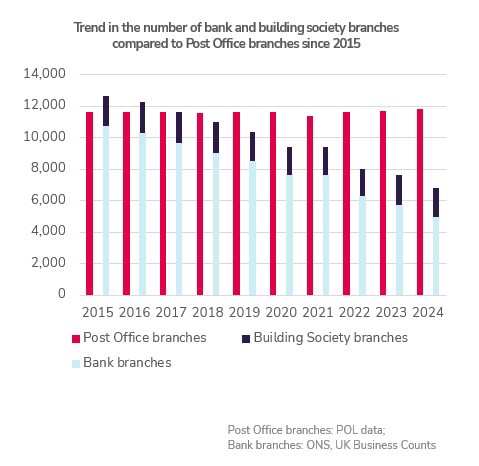
Although many more are planned, just 225 banking hubs were operational in the UK as of March 2026,[53] with 33 currently listed as operational in Scotland.[54] While these banking hubs and other alternatives such as ATMs and Post Office branches have helped 95% of consumers maintain access to cash, it is not clear how well these facilities are meeting consumers’ wider banking needs.[55]
Each banking hub may offer a different combination of services, and not every bank participates in banking hubs.[56]
There has not yet been significant quantitative evaluation of the services offered by banking hubs from a consumer perspective. As their number grows, banking hubs are likely to play an increasingly important role in the future of access to cash and banking and there are plans for 350 to be open by the end of the UK Parliamentary term,[57] 30 of which are planned for Scotland.[58] While these services are welcome, this number does not come close to matching the number of bank branches lost and are unlikely to meet levels of unmet consumer demand. And with services being dispersed across a range of providers or brands, consumers may struggle to know how to access cash and everyday banking services near them.[59]
There is also concern that the current focus on access to cash as part of the criteria in assessing where banking hubs should be located is leading to some communities missing out on access to wider banking services. Citizens Advice Scotland have cited examples of communities in need of banking services not being able to benefit from banking hubs because there are said to be sufficient means of accessing cash already in the area.[60]
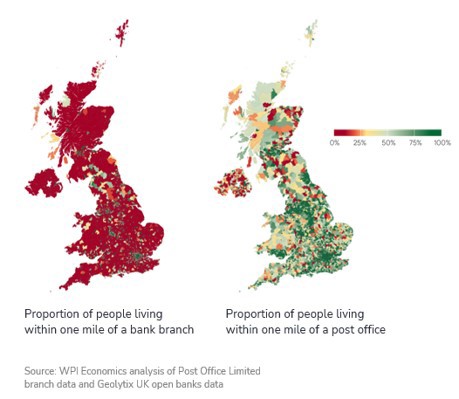
Post offices also help fill the gaps in service availability that consumers face when bank branches close, primarily by offering everyday banking services such as cash withdrawal and deposits and balance enquiries. The availability of Post Office services has helped maintain access to everyday banking with 82% of consumers living within a mile of a Post Office compared to 42% living within a mile of a bank branch. Around 40% of consumers use the Post Office for banking services at least once a month and of those who experienced a bank branch closure in the last 12 months, one in five (18%) said that they turned to their local post office to access their account.[61] Services that are frequently on offer include everyday banking tasks such as withdrawing and depositing cash, balance enquiries, paying bills, or transferring money. The WPI Economics report showed that 47% of those who are digitally or financially excluded report using Post Office banking services at least once a month,[62] meaning that some of the groups we have highlighted as being affected by bank branch closures will be supported by Post Office services.
As with banking hubs, these services will help support access to everyday banking, but the ability to access wider and more personalised financial products is limited. 50% of respondents to the WPI Economics research on behalf of Post Office Ltd wanted to see a larger range of banking services available at their local Post Office. [63] There remains a gap between services currently offered by High Street bank branches and those available at Post Offices and banking hubs. This suggests that for Post Offices and banking hubs to meet consumer needs, there would need to be an expansion of services offered. Any such expansion would also require consideration as to how to ensure issues of importance to consumers when accessing these services, such as accessibility, privacy and confidentiality, would be ensured within appropriate settings.
Mobile branches offer an alternative to traditional bank branches, generally for remote communities. Their mobility may offer a more flexible means to provide in-person banking to consumers in the rural areas of Scotland we have highlighted as having particular needs.
However, there can be significant challenges for consumers in accessing mobile branches, given the very limited time windows in which consumers in each area have access to these services.[64] While some consumers have benefitted from being able to utilise mobile banking services, the practical limitations on reliability and access has led to lower engagement with them for some consumers,[65] and the lower footfall has led to many banks reducing or removing mobile services.[66] However, mobile banking may remain an accessible channel for consumers to access face to face banking in some circumstances, such as island communities with sparsely populated areas and limited access to alternative services.
Future Trajectory and Innovation
What is the likely future (including 5-10 years and 10+ years in the future) of in-person banking services provision under current regulation?
Based on current trends, more bank branches are likely to close across the UK, and in Scotland, in the coming years, with more services being provided online, including through the likes of “challenger” banks without physical premises. Alternative access points for everyday banking, and especially cash, will continue to develop, most likely as joint endeavours between banks, Link, and the Post Office. In some areas, there may also be appetite for community run ventures.
What is the role digital, hybrid, and assisted digital models can play in the provision of in-person banking services?
Are there different roles to be played by digital challenger banks and traditional retail banks?
Our focus in this response has largely been based on the needs of consumers, often in vulnerable circumstances, who may feel more secure utilising traditional, face to face personal banking or consumers who may struggle to access services due to geographic characteristics.
If partnership models are to develop and evolve, there may be opportunities to incorporate new services that could further benefit these consumers. For example, while personalised guidance for consumers may not always be available for consumers, the onset of ‘targeted support’, which provides some advice and suggestions for consumers based on common characteristics[67] could be incorporated into services at banking hubs and Post Offices, and may help improve the offering available to consumers accessing face-to-face services at these venues.
Similarly, for digitally excluded consumers, assisted digital support could be introduced to physical venues in the community to support consumers to utilise digital platforms.[68] Banking hubs, Post Offices, or other public and community venues could be used to provide personal support for people to access online banking where they may not otherwise have the confidence to engage with digital platforms. Locating or co-locating services in the local community could help consumers be involved in the development of services they need, feel more confident when engaging with banking services, and increase partnership work and efficiency between different bodies, in line with the public service reform agenda.
We would support the development of digital, hybrid, assisted digital, services from a diverse range of providers, including both challenger and traditional banks. This would provide a range of options for consumers to engage with banking and financial services. Providing self-service stations for consumers in face-to-face banking facilities may allow banks to deploy in-person support in a more targeted way for consumers who need more personal or complex support.[69]
How can or should competition be maintained between different business models in offering banking services?
In line with our previous answers, we have focused our response to this question on the role of competition for consumers when considering local service provision.
For competition to be effective, consumers need to understand what services are on offer, how they can access them and what differentiates the different offerings. Examples exist in other sectors such as telecoms where Ofcom publishes Map Your Mobile, a crowdsourced information tool that allows consumers to look up the strength and consistency of their mobile connectivity, and that of other providers.[70]
Applying a similar tool to allow consumers to see which banking services they can access locally, based on whoever they bank with, and compared with what is available for other providers may both help improve consumer information about local services, but also encourage competition between providers if consumers are tempted to change provider based on local service provision.
In practice, a tool like this, overseen by the FCA and providers of banking services, could allow consumers to search by post code, and see which banking facilities are available in the local area, including Post Offices, Banking Hubs, and ATMs, and provide information about what specific services they can access as a member of specific banks, and where they can be accessed. This would help inform consumer choice and improve the information available to consumers about whether the services they require are available in their local area.
These services could be supplemented by clear links to information on how to switch providers along with suggesting sources of help for consumers who need assistance to do so. Further efforts could also be made to publicise the Current Account Switching Guarantee to promote consumer confidence in switching and help encourage switching.[71]
What are the potential risks of further reductions to in-person access?
We identified earlier in this response specific consumer groups who may be at risk of detriment from reduced access to face-to-face banking services, and we consider that it is likely that these risks would increase if access to services continue to decline.
Consumer Scotland shares the concerns of HM Treasury Select Committee that further reduction in access to these services risk creating a two-tier economy where digitally excluded consumers are locked out of important services.[72] While alternative provision can help some consumers access the services they need, we have concerns that the scale, range and consistency of provision, and placement of alternative in-person services are unlikely to meet consumer need. This is, in part, due to their primary focus on cash provision above the need for wider in-person banking services. If consumers are unable to confidently and consistently utilise digital payments and services, they may find it increasingly difficult to engage with goods and services only available via digital means, while also having limited access to a full range of financial services that might be available in face-to-face settings.
Small businesses may also experience severe effects if they, or their potential customers, have less access to face-to-face services. While cash use is declining, predictions are that by 2034, £2 billion worth, the equivalent of 4% of all payments, will still be in cash,[73] while evidence from the Post Office suggests that around 25% of consumers still use cash for at least half of their payments and purchases.[74] Cash is likely to remain a significant method of payment for consumers, and as a result, many small businesses are motivated to keep offering it as a payment option.[75] Further reductions in access to cash withdrawal and depositing services may exacerbate the costs of holding and trading in cash, especially if services are located further away. It may risk the possible loss of customers who prefer to pay in cash, negatively affecting the income of small businesses.
Fears have been expressed by some small businesses that merchant fees linked to digital payment options are currently being kept lower by cash remaining a viable alternative,[76] and that reduction in the availability of cash may cause merchant fees to rise.
Cross-Cutting Themes
Further evidence regarding interactions with wider financial services policy and regulation
HM Treasury considers that access to in-person banking services is foundational to the UK financial inclusion strategy.[77] However, supporting people who require such services is only one part of the equation. Continued action to remove barriers for consumers to access digital banking services, will be necessary. This will require collaboration between providers, businesses, the third sector, regulators, and government.
Action is also needed to combat barriers in relation to remoteness and connectivity challenges, which can have a disproportionate impact on consumers in Scotland. The UK financial inclusion strategy also covers wider issues such as access to insurance products, affordable credit, and debt advice.[78] In the UK, a reported 33% (and 57% of those in financial difficulty) do not have home contents insurance,[79] 22% of consumers who applied for one or more credit product in the two years to May 2024 were declined,[80] and an estimated 8.4 million adults in the UK have strong indications of needing debt advice.[81] Some of these services can be accessed via bank branches. This suggests the potential wider value that access to in-person services may have as part of the overall financial inclusion strategy, be it in bank branches, or via other venues such as Post Offices, hubs or community finance providers to support consumers with access to these regulated services.
In relation to unbanked consumers, while applications for basic bank accounts have risen and refusal rates declined, an estimated 10% (c. 100,000) of those who applied for a basic bank account in the two years until May 2024 were refused.[82] While the lack of a local bank branch was identified as a barrier to them having a bank account, there are other reported barriers too, including not feeling they wanted or needed an account, concerns around privacy, not believing they have the required documentation, or having an account closed and not being able to re-open one.[83] In order to help unbanked consumers become more financially included further action will be needed to support those who cannot access basic bank accounts. This may range from action to help support people in the application process through to actions to address underlying financial issues by provision of money or debt advice or access to affordable credit.
It is estimated that only 52% of children in Scotland had received a meaningful financial education from 2019 to 2023.[84] Increasing consumer confidence in dealing with money may not only improve consumers overall financial position but also allow them to contribute to wider economic growth through participating in the economy in a safe, supported and positive way.
3. Endnotes
[1] WPI Economics (2026) Delivery in partnership Securing sustainable access to cash and in-person banking services in the UK – available at https://corporate.postoffice.co.uk/media/n4yomw4v/wpi_postoffice_delivery-in-partnership_june-2026.pdf
[2] Financial Conduct Authority (2025) Financial Lives Survey 2024. Available at: https://www.fca.org.uk/publication/financial-lives/financial-lives-survey-2024-key-findings.pdf
[3] House of Commons Scottish Affairs Committee (2022) Access to cash in Scotland. Available at: Access to cash in Scotland
[4] Post Office Ltd (2026) Correspondence to the Scottish Affairs Select Committee, available atcommittees.parliament.uk/publications/54246/documents/301692/default/
[5] House of Commons Scottish Affairs Committee (2022) Access to cash in Scotland. Available at: Access to cash in Scotland
[6] Financial Conduct Authority (2025) Financial Lives Survey 2024. Available at: https://www.fca.org.uk/publication/financial-lives/financial-lives-survey-2024-key-findings.pdf
[7] House of Commons Library (2026), Access to cash and banking services. Available at: CBP-9453.pdf
[8] WPI Economics (2026) Delivery in partnership Securing sustainable access to cash and in-person banking services in the UK – available at https://corporate.postoffice.co.uk/media/n4yomw4v/wpi_postoffice_delivery-in-partnership_june-2026.pdf
[9] Post Office Ltd (2026) Correspondence to the Scottish Affairs Select Committee, available at committees.parliament.uk/publications/54246/documents/301692/default/
[10] Financial Conduct Authority (2025) Financial Lives Survey 2024. Available at: https://www.fca.org.uk/publication/financial-lives/financial-lives-survey-2024-key-findings.pdf
[11] YouGov (2025), British banking preferences revealed: digital vs in-person
[12] Financial Conduct Authority (2025), Retail banks’ treatment of customers in vulnerable circumstances Multi-Firm Review: good practice and areas for improvement | FCA
[13] Audit Scotland (2024) Tackling digital exclusion, available at https://audit.scot/publications/tackling-digital-exclusion
[14] Audit Scotland (2024) Tackling digital exclusion, available at https://audit.scot/publications/tackling-digital-exclusion
[15] Audit Scotland (2024) Tackling digital exclusion, available at https://audit.scot/publications/tackling-digital-exclusion
[16] Audit Scotland (2024) Tackling digital exclusion, available at https://audit.scot/publications/tackling-digital-exclusion
[17] Ofcom (2025) Connected Nations: UK report 2025. Available at: https://www.ofcom.org.uk/siteassets/resources/documents/research-and-data/multi-sector/infrastructure-research/connected-nations-2025/connected-nations-uk-report-2025.pdf?v=407947
[18] Age UK (2023), “You can’t bank on it anymore” The impact of the rise of online banking on older people the-impact-of-the-rise-of-online-banking-on-older-people-may-2023.pdf
[19] Post Office (2026), Delivery in partnership: Securing sustainable access to cash and in-person banking services in the UK wpi_postoffice_delivery-in-partnership_june-2026.pdf
[20] Ofcom (2025), Exploring digital disadvantage research report
[21] Refuge (2022), Know-Economic-Abuse-report-A-safe-online-tool-for-contacting-banks-about-economic-abuse.pdf
[22] Surviving Economic Abuse, How banks can help - Surviving Economic Abuse
[23] Ofcom (2025), Exploring digital disadvantage research report
[24] Centre for Social Justice (2023), Left Out: How to tackle digital exclusion and reduce the poverty premium
[25] House of Lords Library (2020), Fact file: Rural economy - House of Lords Library
[26] Scottish Government (2025), Supporting Scotland's Transition - Land use and Agriculture (Technical Supporting Document)
[27] House of Commons Library (2024), Depopulation in rural areas - House of Commons Library
[28] House of Commons Library (2024), Depopulation in rural areas - House of Commons Library
[29] Department for Environment Food & Rural Affairs (2026), Statistical Digest of Rural England 1_Population_14_01_26.pdf
[30] House of Commons Scottish Affairs Committee (2022) Access to cash in Scotland
[31] Consumer Scotland (2025), Disabled consumers living in rural Scotland: Experiences of transport, health and social care and leisure disabled-consumers-living-in-rural-scotland-experiences-of-transport-health-and-social-care-and-leisure.pdf; Ofcom (2025), Connected Nations UK Report 2025
[32] Financial Conduct Authority (2025) Financial Lives Survey 2024. Available at: https://www.fca.org.uk/publication/financial-lives/financial-lives-survey-2024-key-findings.pdf
[33] Financial Conduct Authority (2025) Financial Lives Survey 2024. Available at: https://www.fca.org.uk/publication/financial-lives/financial-lives-survey-2024-key-findings.pdf
[34] Financial Conduct Authority (2025) Financial Lives Survey 2024. Available at: https://www.fca.org.uk/publication/financial-lives/financial-lives-survey-2024-key-findings.pdf
[35] Financial Conduct Authority (2025) Financial Lives Survey 2024. Available at: https://www.fca.org.uk/publication/financial-lives/financial-lives-survey-2024-key-findings.pdf
[36] Financial Conduct Authority (2025) Financial Lives Survey 2024. Available at: https://www.fca.org.uk/publication/financial-lives/financial-lives-survey-2024-key-findings.pdf
[37] Post Office (2026), Delivery in partnership: Securing sustainable access to cash and in-person banking services in the UK wpi_postoffice_delivery-in-partnership_june-2026.pdf
[38] Nationally representative survey of 2,000 UK adults conducted by Censuswide in June 2026 for Post Office and WPI Economics
[39] WPI Economics (2026) Delivery in partnership Securing sustainable access to cash and in-person banking services in the UK – available at https://corporate.postoffice.co.uk/media/n4yomw4v/wpi_postoffice_delivery-in-partnership_june-2026.pdf
[40] WPI Economics (2026) Delivery in partnership Securing sustainable access to cash and in-person banking services in the UK – available at https://corporate.postoffice.co.uk/media/n4yomw4v/wpi_postoffice_delivery-in-partnership_june-2026.pdf
[41] Post Office (2026), Delivery in partnership: Securing sustainable access to cash and in-person banking services in the UK wpi_postoffice_delivery-in-partnership_june-2026.pdf
[42] Financial Conduct Authority (2025) Financial Lives Survey 2024. Available at: https://www.fca.org.uk/publication/financial-lives/financial-lives-survey-2024-key-findings.pdf
[43] FCA (2023) Costs to consumers and SMEs of a loss of access to in-person cash and banking services: Narrative report
[44] Ofcom (2025) Connected Nations: UK report 2025. Available at: https://www.ofcom.org.uk/siteassets/resources/documents/research-and-data/multi-sector/infrastructure-research/connected-nations-2025/connected-nations-uk-report-2025.pdf?v=407947
[45] House of Lords Library (2025) Closure of bank branches: Impact on rural communities - House of Lords Library see also Consumer Scotland (2025) disabled-consumers-living-in-rural-scotland-experiences-of-transport-health-and-social-care-and-leisure.pdf
[46] House of Lords Library (2025) Closure of bank branches: Impact on rural communities - House of Lords Library
[47] Scottish Government (2021) Rural Scotland Key Facts 2021; see also Scottish Government (2025), Businesses in Scotland: 2025, Comparisons with the UK Business Stock - Businesses in Scotland: 2025 - gov.scot
[48] House of Lords Library (2025) Closure of bank branches: Impact on rural communities - House of Lords Library see also
[49] Business Comparison (2025), Impact of Bank Closures | BusinessComparison
[50] Which? (2026), Bank branch closures: is your local bank closing? - Which?
[51] Link, LINK / The ATM Network
[52] House of Commons Library (2026), Access to cash and banking services CBP-9453.pdf
[53] House of Commons Library (2026), Access to cash and banking services. Available at: CBP-9453.pdf
[54] Cash Access UK, Cash Access UK - Hubs
[55] Financial Conduct Authority (2025), Access to cash coverage in the UK 2024 Q2 | FCA
[56] Cash Access UK, Cash Access UK - Frequently asked questions (FAQs)
[57] Post Office (2026), Delivery in partnership: Securing sustainable access to cash and in-person banking services in the UK wpi_postoffice_delivery-in-partnership_june-2026.pdf
[58] Citizens Advice Scotland (2026), Are Banking Hubs the answer to bank branch closures? | Citizens Advice Scotland
[59] Post Office (2026), Delivery in partnership: Securing sustainable access to cash and in-person banking services in the UK wpi_postoffice_delivery-in-partnership_june-2026.pdf
[60] Citizens Advice Scotland (2026), Are Banking Hubs the answer to bank branch closures? | Citizens Advice Scotland
[61] Post Office (2026), Delivery in partnership: Securing sustainable access to cash and in-person banking services in the UK wpi_postoffice_delivery-in-partnership_june-2026.pdf
[62] Post Office (2026), Delivery in partnership: Securing sustainable access to cash and in-person banking services in the UK wpi_postoffice_delivery-in-partnership_june-2026.pdf
[63] Post Office (2026), Delivery in partnership: Securing sustainable access to cash and in-person banking services in the UK wpi_postoffice_delivery-in-partnership_june-2026.pdf
[64] Highlands and Islands Enterprise (2018), Microsoft Word - Access to Banking Services in Rural Areas - report (A3104677).docx
[65] Highlands and Islands Enterprise (2018), Microsoft Word - Access to Banking Services in Rural Areas - report (A3104677).docx
[66] BBC (2023), Outcry over Bank of Scotland mobile branch closures - BBC News; BBC (2024), Lloyds to end mobile banking van service - BBC News
[67] Financial Conduct Authority (2026), FCA opens authorisation gateway for targeted support | FCA
[69] Singh, Dr. Gulzar, Hybrid Branch: Bank Models and Consumer Trust. A Strategic Blueprint for Retail Financial Inclusion (August 29, 2025). Available at SSRN: https://ssrn.com/abstract=5417317 or http://dx.doi.org/10.2139/ssrn.5417317; see also Auriga (2026), Hybrid Banking and Branch Transformation
[70] Ofcom, Map Your Mobile
[72] House of Commons Treasury Committee (2025), Acceptance of cash
[73] UK Finance (2025), Payment Markets Report Summary.pdf
[74] Post Office (2026), Delivery in partnership: Securing sustainable access to cash and in-person banking services in the UK wpi_postoffice_delivery-in-partnership_june-2026.pdf
[75] House of Commons Treasury Committee (2025), Acceptance of cash
[76] House of Commons Treasury Committee (2025), Acceptance of cash
[77] HM Treasury (2025), Financial Inclusion Strategy - GOV.UK
[78] HM Treasury (2025), Financial Inclusion Strategy - GOV.UK
[79] Money and Pensions Service (2026), Moneyview 2026 maps-moneyview-2026.pdf
[80] HM Treasury (2025), Financial Inclusion Strategy - GOV.UK
[81] Money and Pensions Service (2026), Moneyview 2026 maps-moneyview-2026.pdf
[82] Financial Conduct Authority (2025) Financial Lives Survey 2024. Available at: https://www.fca.org.uk/publication/financial-lives/financial-lives-survey-2024-key-findings.pdf
[83] Financial Conduct Authority (2025) Financial Lives Survey 2024. Available at: https://www.fca.org.uk/publication/financial-lives/financial-lives-survey-2024-key-findings.pdf
[84] Money and Pensions Service (2023), UK Children and Young People’s Financial Wellbeing Survey: Financial Foundations maps-cyp-financial-wellbeing-survey-2022.pdf