Executive Summary
Consumer complaints are a source of insight into service delivery and performance, and it is considered good practice to publish complaints data. Providing public access to comprehensive and transparent complaints data is essential to ensure accountability, improve services and deliver better service offerings to consumers.
Across service sectors, the publication of complaints data can function as a powerful tool for improving the delivery of essential services. It captures where services fall short, how effectively providers respond, and how consumer engagement drives positive change. The publication of complaints data creates transparency and ownership on behalf of service providers for issues that impact service users and provides an opportunity for them to clearly state what they will do to resolve consumer issues.
Consumer Scotland has examined how complaints data is publicly reported and used across a range of regulated sectors and geographic contexts. This report focuses on how consumer complaint information is collected, published, and communicated. It does not focus on published complaints performance. The sectors we have reviewed are:
- The energy sector
- The communications sector
- The financial sector
- The water sector in England and Wales
- The Scottish water sector, specifically complaints involving Scottish Water
Good practice from other sectors
There is a requirement within the GB energy sector for energy suppliers to collect and report complaints data, and for the Energy Ombudsman to regularly publish detailed supplier complaints data. This provides transparency and understanding of the nature of issues that impact consumers, resolution outcomes and trends over time to support a better understanding of what is improving and what is not.
In the communications sector, transparency is also prioritised through the publication of consistent complaints data by Ofcom and Postal Redress Service (POSTRS). Published data provide service-specific complaints volumes, name of providers, and issue types and outcomes.
In the UK financial sector, transparency is promoted through the regular publication of complaints data by the Financial Conduct Authority (FCA)[1] and the Financial Ombudsman Service (FOS)[2]. The FCA publishes firm-specific complaints data while FOS publishes annual and quarterly reports. These publications support accountability and help drive improvements.
The water sector in England and Wales demonstrates a structured and transparent approach towards complaints publication. Data is regularly published and distinguishes between different complaint stages using standardised metrics. This allows fair comparison across service providers and provides insight into how complaint handling varies across the sector.
Challenges in the Scottish context
In contrast, Scottish Water does not publish a detailed breakdown of customer complaints nor provide comprehensive narrative and context to explain why some complaints categories may have changed.
In the Scottish water sector, there is no coordinated framework for publishing complaints data that enables a clear, consistent understanding of performance and trends over time.
Information on Scottish Water complaints is difficult to find. While some complaint information is published within its Annual Report, the level of detail is limited. Complaints are categorised only at a high level (e.g. water supply, wastewater) with no consistent breakdown by issue type, no data on resolution outcomes, and no published historical trends that support meaningful analysis or comparison between years.
Additional information on Scottish Water customer contacts is published within the Water Industry Commission for Scotland ‘B Tables’. However, this information source is difficult to find unless there is prior knowledge of its existence.
The Drinking Water Quality Regulator (DWQR) and the Scottish Public Services Ombudsman (SPSO) also report on complaints and investigations; however, these are either limited in scope or focus on only a small number of formal cases. SPSO decisions are published individually and are helpful for case-level transparency, but the volume of cases is low, and the data is not collated in a way that reveals wider trends.
Publication Characteristic by Sector
See table below for an overview of publication characteristic by sector. Please see appendix for publication characteristic by sector table and sector and publication overview table.
|
Publication Characteristic |
Energy |
Communications |
Finance |
Water (England & Wales) |
Water (Scotland) |
|---|---|---|---|---|---|
|
Published quarterly |
Yes |
Partly |
Yes |
Yes |
No |
|
Published annually |
Yes |
Yes |
Yes |
Yes |
Yes |
|
Published biannually |
No |
No |
Yes |
No |
No |
|
Historical data |
Yes |
Yes |
Yes |
Yes |
No |
|
Supplier-specific data |
Yes |
Yes |
Yes |
Yes |
N/A |
|
Complaint volumes |
Yes |
Yes |
Yes |
Yes |
Partly |
|
Resolution outcomes |
Yes |
Yes |
Yes |
Yes |
No |
|
Top complaint types |
Yes |
Yes |
Yes |
Yes |
No |
|
Breakdown by category (e.g., billing, product type) |
Yes |
Yes |
Yes |
Yes |
No |
|
Aggregated data |
Yes |
Yes |
Yes |
Yes |
No |
|
Clear structure and plain English |
Yes |
Yes |
Yes |
Yes |
No |
|
Visual aids (tables, charts, graphs) |
Yes |
Yes |
Yes |
Yes |
No |
|
Downloadable formats (Excel, PDF, etc.) |
Yes |
Yes |
Yes |
Yes |
Partly |
|
Interactive elements (graphs, summaries, links) |
Yes |
No |
Yes |
No |
No |
|
Contextual commentary |
Yes |
Yes |
Yes |
Yes |
No |
|
Case studies |
No |
No |
No |
Yes |
Partly |
|
Rankings or performance comparisons |
Yes |
Yes |
Yes |
Yes |
No |
Recommendations for improvement
This report sets out analysis that was undertaken across the GB energy sector[3], UK[4] communications sector, UK financial sector[5], and the English and Welsh water sectors[6]. It identifies a clear opportunity for the Scottish water sector to enhance its approach to complaints data transparency. More open data will help to reinforce trust, encourage continuous improvement, and ensure that the voices of consumers are at the heart of service delivery and policy development.
Consumer Scotland plans to continue discussions with relevant water sector stakeholders to improve publicly available complaints data. Through this engagement, we seek to support a shared approach across Scotland’s water sector that enables:
- Public accountability, ownership and service improvement
- Better understanding of complaints outcomes and service improvements; and
- Embedding stronger, evidence-based consumer representation
By aligning good practice with other UK sectors and improving complaints data reporting, the Scottish water sector can strengthen trust, transparency and a consumer focus.
To help achieve this, Consumer Scotland specifically recommends:
1. That water sector stakeholders in Scotland, including Scottish Water, WICS and the Scottish Government should work together to:
- Develop a consistent, sector-wide framework for publishing complaints data in Scotland, covering issue categories, complaint stages, resolution outcomes, redress provided and complaint volumes.
- Introduce regular publication of complaint statistics (quarterly and annually), accompanied by clear commentary to explain trends and context.
- Improve accessibility by publishing data in multiple user-friendly formats, including web pages and downloadable datasets, so information is usable for consumers.
- Use complaints data proactively to identify recurring issues, support service improvements and demonstrate accountability to consumers.
2. That the Scottish Government should consider placing the publication of water complaints data in Scotland on a statutory footing, drawing on statutory models from other sectors.
3. In parallel to Recommendations 2, Scottish Water should lead by example by voluntarily publishing richer and more frequent complaints data ahead of any future legislative change.
1. Methodology
This report investigates how consumer complaints data is published and presented across several regulated sectors, with the aim of identifying good practice and opportunities for improvement within the Scottish water sector.
To produce the report, Consumer Scotland identified and reviewed publicly available complaints data, focusing on accessibility, comprehensiveness, and transparency, which align closely with the core consumer principles of information, choice, redress, and representation.
Sector Selection
To provide a relevant and balanced comparison, we selected four regulated sectors for the analysis:
- Energy
- Communications
- Financial
- Water sector in Scotland (devolved), and the water sector in England and Wales
These sectors were chosen for the following reasons:
- Relevance to utility services: similar to water, energy and communications are essential services supplied by regulated entities used by a high proportion of households
- Complaints reporting: these sectors offer established, often statutory mechanisms for the publication of complaints data, allowing for robust analysis of different reporting practices
- Consumer comparability: all four sectors interact with consumers in ways that are broadly similar to Scotland’s water sector, such as service disruptions and the provision of customer service
Analytical Framework
To evaluate complaints data across these sectors, we applied three key criteria:
Accessibility
Definition: The ease with which complaints data can be located and understood.
Assessment considerations:
- Is complaints data published regularly and in a centralised, easy-to-find location?
- Are formats user-friendly (e.g. summary tables, dashboards, plain English)?
- Can data be easily extracted and interpreted?
Comprehensiveness
Definition: The extent to which published complaints information provides an understanding of the underlying causes of the complaint.
Assessment considerations:
- Does the data include explanations or narrative that contextualise spikes or trends in complaint volumes?
- Are the root causes of complaint types discussed?
- Is there sufficient information to help consumers and consumer representatives interpret why complaints occurred?
Transparency
Definition: The clarity and openness with which complaints data is presented.
Assessment considerations:
- Does the data include detailed breakdowns by complaint type, stage, and provider?
- Are providers named and performance compared?
- Are trends over time presented?
- Is there evidence of providers or regulators using complaints data to improve service?
Approach
The analysis was conducted by using online searches to identify and review publicly available reports and data publications from regulators, ombudsman bodies, and service providers within each targeted sector. These included:
- Quarterly and annual complaints data reports
- Regulator and ombudsman performance summaries
- Annual reports and consumer service updates
- Decision databases and online dashboards
Each source was assessed against the above criteria. Comparative observations were made to identify differences in approach, and to highlight examples of good practice that could inform improvements in the Scottish water sector.
2. Introduction
Scottish Water[7] delivers 1.51 billion litres of drinking water and removes 1.07 billion litres of wastewater daily across Scotland, for homes and businesses. However, like any service provider, there are times when performance falls short of customer expectations, which can lead to customer complaints.
Complaints data is a valuable tool for identifying emerging issues, assessing service quality across different areas, and driving improvements, which can help to achieve better consumer outcomes. Transparent reporting of complaints data provides understanding into how well services are performing and, over time, whether service-related issues are being addressed effectively.
This report focuses on how consumer complaint information is collected, published, and communicated. It does not focus on published complaints performance for different sectors.
Consumer Scotland is the statutory body for consumers in Scotland. Established by the Consumer Scotland Act 2020, we are accountable to the Scottish Parliament. The Act defines consumers as individuals and small businesses that purchase, use or receive in Scotland goods or services supplied by a business, profession, not for profit enterprise, or public body.
Our purpose is to improve outcomes for current and future consumers, and our strategic objectives are:
- to enhance understanding and awareness of consumer issues by strengthening the evidence base
- to serve the needs and aspirations of current and future consumers by inspiring and influencing the public, private and third sectors
- to enable the active participation of consumers in a fairer economy by improving access to information and support
Consumer Scotland uses data, research and analysis to inform our work on the key issues facing consumers in Scotland. In conjunction with that evidence base we seek a consumer perspective through the application of the consumer principles of access, choice, safety, information, fairness, representation, sustainability and redress.
Consumer Scotland[8] represents consumer interests and facilitates an improved focus on consumer issues across multiple sectors, including water, energy[9], post and other consumer markets[10]. Access to complaints data provides important insight that informs our understanding of the key issues facing consumers, helps us monitor service quality to customers and supports us to advocate for better consumer outcomes. Complaints data can help to shape our assessment of policy requirements, and by engaging with regulators and Scottish water sector stakeholders, we can highlight good practice and where there may be opportunities for improvement.
The publication of complaints data plays a critical role in supporting transparency, accountability, and consumer trust in regulated sectors. It allows consumers to see how providers are performing, how issues are being resolved, and whether improvements are being made over time. By making this information publicly available, organisations can demonstrate a commitment to openness and continuous improvement. It also allows comparisons to be drawn between sectors and the quality of complaints data published.
The Consumer Principles are a set of principles developed by consumer organisations in the UK and overseas.
Consumer Scotland uses the Consumer Principles as a framework through which to analyse the evidence on markets and related issues from a consumer perspective.
The Consumer Principles are:
- Choice: Is there any?
- Safety: Are the goods or services dangerous to health or welfare?
- Information: Is it available, accurate and useful?
- Fairness: Are some or all consumers unfairly discriminated against?
- Representation: Do consumers have a say in how goods or services are provided?
- Redress: If things go wrong, is there a system for making things right?
- Sustainability: Are consumers enabled to make sustainable choices?
Consumer Scotland has identified information and redress as being particularly relevant principles to this report.
Background and context
Within regulated sectors, complaints data is not only a signal of service quality but also a foundation for accountability, consumer advocacy, and informed policy development. Its transparency and comprehensiveness are central to enabling public scrutiny and driving continuous improvement.
In sectors such as energy, communications and financial, the publication of complaints data is supported by clear legislative and regulatory frameworks. In the communications sector, for example, Ofcom is enabled by Section 26 of the Communications Act 2003 to publish information that supports comparison of performance between providers. In addition, the Communications Ombudsman regularly publishes complaints data relating to the communications sector. This data contributes to transparency and supports broader regulatory oversight.[11]
Similarly, within the energy sector, Ofgem and the Energy Ombudsman collect and publish detailed complaint statistics at both a sectoral and company level. Complaints data is consistent, accessible, and presented in a format that allows for meaningful comparison across providers and over time.
Within the financial sector, the publication of complaints data is underpinned by regulatory frameworks established by the Financial Conduct Authority and the Financial Services Ombudsman. The FCA collects and publishes complaints data (both aggregated and firm specific)[12] under its statutory objectives to protect consumers and promote market integrity. In parallel, the Financial Services Ombudsman publishes annual, biannual and quarterly complaints data[13]. These publications are in accessible formats, support transparency, and enable meaningful comparison.
In the water sector in England and Wales, publication of complaints differs but shares some key features with energy. Water companies are required to report complaints data to the Consumer Council for Water (CCW). CCW publishes comparative reports on the number and type of complaints companies receive, how quickly they are resolved, and how performance changes year-on-year. These reports are used by Ofwat and sector stakeholders to assess company behaviour and performance, and consumer outcomes.
In contrast, the water sector in Scotland operates under a different model. Scottish Water is a public organisation and is the sole provider of water and wastewater services. It is regulated by the Water Industry Commission for Scotland (WICS), and there is no competitive retail market for household consumers.
There is currently no routine publication of complaints data by Scottish Water that is detailed, disaggregated, or comparable over time. This limits transparency and makes it difficult to assess how well the organisation responds to consumer concerns, whether performance is improving, or where persistent service-related issues remain.
The lack of visibility of the consumer experience within Scotland’s water sector contrasts with what is deemed good practice in other regulated sectors and nations. Consumers, advocacy bodies, and policymakers have little publicly available, service-related evidence with which to support their work to hold Scottish Water to account. At a time when public services face growing pressure from climate change, demographic shifts, and infrastructure demands, it is more important than ever to ensure they can meet changing demands and respond to pressures, which otherwise may impact the consumers they serve
3. Legislation
Energy sector
The Consumers, Estate Agents and Redress Act 2007 (The CEAR Act 2007)[14], through its amendments to both[15] the Gas Act 1986[16] and the Electricity Act 1989[17], has played a role in driving transparency in the energy sector, particularly concerning complaints data.
By updating sections such as 33DB of the Gas Act[18] and 42AB of the Electricity Act[19], the CEAR Act established a clear regulatory framework that requires energy companies to systemically collect, and report detailed complaints data. For example, Ofgem now publishes supplier specific data showing the number of complaints per 100,000 customer accounts, the percentage of complaints resolved within eight weeks, and the most common complaint categories- such as billing, metering, customer service, and switching issues.
This enhanced transparency allows for rigorous monitoring of service performance and consumer experiences. It also empowers regulatory bodies and consumer advocates to identify trends, enforce accountability, and drive improvements in customer service. Ultimately, these legal amendments underpin good practice and ensure that stakeholders have access to critical information, fostering a culture of openness and continuous improvement within the industry.
Communications sector
The publication of complaints data in the communications sector is driven by legislative requirements set out in the Communications Act 2003, specifically Section 26[20]. This mandates Ofcom to publish information that helps consumers make informed decisions. It ensures data on complaints regarding broadband, landline, mobile, and pay TV is made publicly available, promoting transparency, comprehensiveness and accessibility among telecoms and pay-TV providers.
Ofcom’s Telecoms and Pay-TV Complaints Methodology meets legal requirements[21] in how complaints data is collected, analysed and shared. By making complaints information accessible, Ofcom upholds its regulatory duty to support the protection of consumers. For instance, Ofcom publishes detailed figures[22] showing the number of complaints per 100,000 customers across broadband, landline, pay-monthly mobile and pay-TV services. The report also names individual providers- including BT, Sky, Virgin Media, and Vodaphone, highlighting the key drivers of complaints such as service faults, problems switching, and billing issues.
The Communications Ombudsman meets its legal and regulatory requirements by publishing complaints information in quarterly and annual reports. This practice ensures transparency, fulfilling obligations set out in the Alternative Dispute Resolution for Consumers Disputes Regulations 2025[23], which require approved ADR bodies to publish annual activity reports detailing the number, type and outcome of complaints.
Postal Redress Service (POSTRS) is the Alternative Dispute Resolution provider for postal services. POSTRS are required to provide an annual report outlining their activity as part of their appointment by Ofcom.[24]
Financial sector
Transparency in the financial sector is supported by a clear regulatory framework established under the Financial Services and Markets Act 2000[25] and reinforced by the Consumer Duty[26] introduced by the FCA. These provisions empower the FCA to require firms to collect complaints data for the FCA to report and publish.
The Financial Services and Markets Act 2000 sets out the statutory objectives of the FCA, including the protection of enhancing public understanding of the financial system (Sections 1B[27] and 1C[28]).
Financial firms that receive over 500 complaints in a six-month period are mandated to publish complaints data[29]. The FCA also publishes firm-specific and aggregated complaints data[30]. In parallel, the Financial Ombudsman Service publishes annual, bi-annual and quarterly complaints data[31].
The FCA carries out these powers through its Dispute Resolution: Complaints (DISP)[32] rules. DISP 1.10[33] requires firms to report complaints data to the FCA every six months, including volumes, outcomes, and redress paid. DISP 1.10A mandates public disclosure by firms receiving 500 or more complaints in a six-month period, with data covering product categories, resolution rates, and redress. The FCA publishes this data in a format that supports comparison across firms over time.
Together, these legislative and regulatory mechanisms ensure that complaints data is collected and published in a consistent and accessible format. The framework established by Financial Services Market Act 2000 and implemented through FCA and FOS practices fosters a culture of openness and transparency.
Water sector England and Wales
The requirement for CCW to publish complaints data is set out within the Water Industry Act 1991, with specific responsibilities in Sections 27F[34] and 27G[35].
These provisions serve as the legislative foundation driving transparency in complaints data, by mandating that CCW collects, reports, and makes information publicly available.
In practice, this means CCW publishes detailed reports, such as the Household Complaint Handling Report, which includes supplier-specific data on complaints per 10,000 connections, the number of complaints received directly by each water and wastewater company, and the number escalated to CCW. Reports also break complaints down by category, for example: billing and charges, water supply issues, wastewater services, and customer service.
Under Section 27G, companies are legally required to provide CCW with the necessary data to compile these reports. This duty is enforced by Ofwat, which has powers to issue enforcement orders or financial penalties if companies fail to comply.
Scottish water sector
A formal complaint is initiated when a customer concern is not resolved satisfactorily, prompting Step 2 (diagram below). If a customer remains dissatisfied with Scottish Water’s response, Step 3 initiates an escalated complaint to the Scottish Public Services Ombudsman (SPSO).
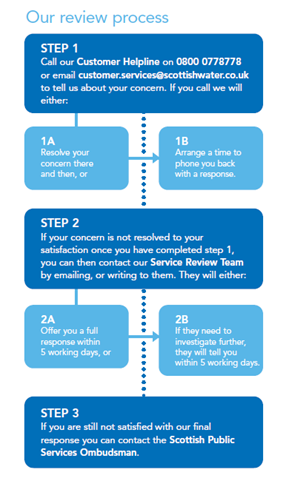
Scottish Water currently lacks a specific legislative mandate for the publication of complaints data. The closest guidance is the SPSO Governance document[36], which advises that such data should be published annually, however, does not specify the level of detail.
Scottish Water meets the minimum requirement specified by SPSO[37] within its annual reports in terms of published complaints data. This requires Scottish Water to publish a document containing information on annual complaints performance which sets out the actions it has taken to improve services. However, the publication obligation does not require Scottish Water to provide the same level of detail or frequency as the energy sector, communications sector, and the water sector in England and Wales.
While the Scottish Water Annual Report, WICS B Tables, DWQR Annual report on Public Supplies, and SPSO Decision Reports are not primarily intended to present detailed customer complaints data, they currently represent the main publicly available sources of information relating to Scottish Water’s complaints. As such, any analysis of complaints data accessibility, comprehensiveness, or transparency in the Scottish water sector must draw from these sources. This is not a critique of their purpose or content, but rather a reflection of the limited availability of standalone, comprehensive and transparent complaints data. These sources have therefore been included in this analysis to assess what insight they offer into customer complaints.
4. Analysis of available complaints data across service sectors, evaluated against key criteria
This section provides an analysis on available data across service sectors in the UK that deliver essential services to consumers. It examines available data against accessibility, comprehensiveness and transparency.
Accessibility
Accessibility: The ease with which complaints data can be located and understood.
Energy sector
Overall, we consider the energy sector’s complaints data to be accessible and note that it is updated on a regular basis in easy-to-understand formats.
In the energy sector, several organisations, including the Energy Ombudsman, Ofgem, and Citizens Advice, provide detailed complaints data. Complaints data is publicly available in: Energy Ombudsman Quarterly Reports, Energy Ombudsman Annual Reports, Ofgem Customer Service Complaints Data, Citizen Advice Customer Service Scores, and energy companies’ published complaints data.
- Energy Ombudsman Quarterly Reports[38] are regularly published on a quarterly basis. The reports are easily accessible on the Energy Ombudsman website and are organised into past and current reports[39]. A consistent format across suppliers makes it easy to compare companies, and the reports are available in widely used PDF format.
- Energy Ombudsman Annual Reports[40] are published on an annual basis as part of the Trust Alliance Group[41]. Reporting includes some complaints data but is focused more on performance. Information is well-structured, using clear headings, tables, and plain English to make complex data understandable to both industry experts and the public. Historical data is available as Annual Reports date from 2016 onwards.[42]
- Ofgem Customer Service Complaints Data[43] is accessible and regularly updated. Data is presented using interactive graphs and summaries to make data engaging and intuitive. Technical language is supported with explanatory links, supporting users unfamiliar with the industry to understand the information provided.
- Citizens Advice Customer Service Scores[44] are published on a quarterly basis. Complaints data is presented in a simple table format with star ratings, allowing easy access to information on supplier performance.
- Energy companies also publish their own complaints data. Data was located for: OVO Energy[45], EDF Energy[46], E. ON Next[47], Octopus Energy[48], ScottishPower[49], British Gas[50], SO Energy[51], and Utility Warehouse[52]. For companies that voluntarily publish complaints data, it is generally easy to access it within in a dedicated section on their websites. Reporting styles for complaints across supplier websites vary.
Communications sector
The communications sector has accessible online complaints data. Data is regularly published in an accessible, easy to understand format.
The communications sector complaints data is published through the regulatory bodies Ofcom, Communications Ombudsman and POSTRS. Complaints data is publicly available in: Ofcom telecoms and pay-tv complaints reports, Communications Ombudsman quarterly complaints data, Communications Ombudsman annual reports, and POSTRS annual reports.
- Ofcom ‘Latest Telecoms and Pay-TV Complaints Revealed:’[53] Ofcom publishes detailed statistics on the number of complaints received per 100,000 customers for major service providers. The webpage uses visual aids, such as the inclusion of tables, illustrating complaint volume.
- Communications Ombudsman Quarterly Complaints Data reports[54] are published on a quarterly basis as part of Trust Alliance Group. The reports include tables and graphs to illustrate data, allowing for easy access. The Communications Ombudsman website offers links to the latest data publications and shows reports from previous quarters. The website is well structured with clear headings, by year, which supports access to reports. Users seeking historical complaints data[55] will find previous reports easy to locate.
- Communications Ombudsman Annual Reports[56] are published on an annual basis as part of Trust Alliance Group. Annual reports set out some complaints information but focus more on performance. The Communications Ombudsman website shows links to previous annual reports[57] with clear headings, organised by year, making it easy for users to locate historical documents.
- POSTRS annual report[58] relates to Royal Mail and is published on an annual basis. The reports include some complaints information which is broken down into tables and written in simple English. Historic reports, dated back to 2017, are listed on the Postal Redress (POSTRS) website. Its clear structure and straightforward language make it user-friendly, allowing readers to quickly locate and understand key information about the Postal Redress Service operations.
- International Distribution Services (IDS, the parent company of Royal Mail [59]) annual reports,[60] which provide detailed information on company performance customer service outcomes, and complaint figures, are published in full each year on their website. These reports are presented in a clear format with structured sections, charts and summaries, making complex information easier for users to read and understand.
Financial sector
Overall, complaints data in the financial sector is accessible and regularly updated. Both the Financial Conduct Authority (FCA) and the Financial Ombudsman Service (FOS) publish data in formats that support public understanding and comparison across firms.
Complaints data is publicly available through several key sources:
- FCA Complaints Data Portal: The FCA publishes firm-specific and aggregated complaints data[61] every six months. Data is presented in sortable tables and downloadable Excel files, allowing users to filter by firm and product category. The FCA also provide interactive dashboards for visualising trends over time.
- Financial Ombudsman Service annual[62], bi-annual[63], and quarterly[64] reports: The FOS publishes detailed complaints on a three-, six- and twelve-monthly basis. Reports include uphold rates, issue types, and product-specific volumes, and are available in Excel and PDF formats. The FOS reports provide trend analysis and commentary to help users interpret the data.
- Firm-level publications: Financial firms that meet the FCA’s reporting threshold are required to publish complaints data on their own websites. While formats vary, most firms provide data in dedicated section often using tables. Examples of firm-level publications include: NFU Mutual[65], Lloyds Banking Group[66], and HSBC UK[67].
These resources collectively ensure that complaints data in the financial sector is available and presented in a way that supports transparency, consumer awareness and shows regulatory oversight. The use of plain language, visual tools, and downloadable formats make the data accessible and easily understood.
Water sector England and Wales
The water sector in England and Wales benefits from structured, centralised complaints reporting through the Consumer Council for Water (CCW) which provides reports and webpages that detail water companies’ complaints data.
- CCW Complaint Performance with Quarterly Data[68] is published on a quarterly basis. Complaints data features user-friendly tables and graphs that make complex data easy to understand. Reports are readily available in downloadable formats on the CCW website, ensuring users can access historical data for comparisons.
- CCW Household Customer Complaint Handling reports[69] are published on an annual basis. The reports are structured with a clear table of contents, headings, and subheadings, making navigation easy. The reports use plain language, ensuring that readers without technical expertise can comprehend the content. Historical reports are available on the CCW website.
Scottish water sector
Information relating to complaints can be found in Scottish Water’s Annual Report, WICS B Tables, Drinking Water Quality Regulator Annual Report Public Supplies, and on the Scottish Public Service Ombudsman’s website.
- Scottish Water Annual Report (2024)[70] contains little information on complaints. Provided information states:
-
-
- There was a reduction in contacts from customers regarding service issues, compared to previous year, due to a reduced number of issues caused by fewer prolonged storms and cold weather
- There was an increase in formal complaints from household customers. For non-household customers the numbers decreased
- In total, there 537 formal complaints and wastewater issues, in particular sewer flooding, has the biggest increase
-
More detailed complaints data, that would be comparable with the type of information published by the other sectors described above, is not provided.
- The Water Industry Commission for Scotland (WICS) publishes B Tables[71] as part of its regulatory framework to monitor and assess the performance of Scottish Water. Among these, Table B2 is specifically designed to show information on customer service performance, including high level metrics related to customer complaints. However, Table B2 is not detailed as to why customers are contacting to complain. The tables are difficult to find as they are not clearly marked ‘complaints’ and the website navigation process is complex.
- The Drinking Water Quality Regulator (DWQR) Annual Report for Public Supplies 2023[72] briefly mentions two formal investigations into customer complaints. No insight into systemic issues affecting customers is available.
- Scottish Public Services Ombudsman (SPSO) Decision Reports[73] are available through their online search tool, allowing users to filter by organisation, key words, sector, outcome, case reference number, and date. However, the search may require users to hold specific information, such as the case reference number or date, to locate particular reports. Decision Reports focus on individual cases and therefore provide no insight into systemic issues or aggregate complaints data under separate headings.
Overall, complaints data for the Scottish water sector is less accessible than the other sectors considered in this report. It is more limited in detail, less frequently updated, and not published in a standardised or easy to compare format.
Comprehensiveness
Comprehensiveness: The extent to which published complaints information provides an understanding of the underlying causes of the complaint.
Energy sector
Complaints data in the energy sector is detailed and comprehensive, with organisations such as Ofgem, the Energy Ombudsman, and Citizens Advice publishing supplier-specific information:
- Energy Ombudsman Quarterly Reports provide supplier-specific data on the number of complaints (per 100,000 customer accounts), complaints resolved, top complaint types, average award, and the percentage of awards with a financial element. The reports also break down issues by supplier, highlighting the top three complaint categories (e.g. billing, customer service, smart meters, and other).
- Energy Ombudsman Annual Reports are more comprehensive than the quarterly reports. In addition to statistics, they offer contextual commentary explaining fluctuations in complaint volumes, the impact of issues on customers, and- in some cases- actions taken to improve service. Key annual results include accepted cases, percentage of cases upheld, total remedy amount awarded, average remedy amount awarded, percentage of cases decided within 56 days, percentage of consumers who reached the Ombudsman through signposting, and the top dispute categories.
- Ofgem Customer Service Data is highly detailed and supplier specific. It includes multiple complaint data graphs such as:
-
- Complaints received by all suppliers per 100,000 customer accounts
- Complaints received by large, medium, and small suppliers (small suppliers are measured per 10,000 accounts)
- Complaints resolved by large, medium, and small suppliers by the end of the next working day (%)
- Complaints resolved by large, medium, and small suppliers within eight weeks (%)
-
Users can click “more info” or scroll beneath each graph for further explanation. The data is broken down by supplier, enabling consumers to compare company performance. The inclusion of historical data enhances the comprehensiveness by allowing users to understand long-term trends.
- Citizens Advice Customer Service Scores include a “Fewer Complaints” category within their supplier rankings. While Citizens Advice offers a helpful high-level view of how suppliers manage complaints, more detailed insights are available from Ofgem and the Energy Ombudsman.
- Energy Companies’ own reports (contents vary by company). Some energy companies publish their own complaint metrics, including total complaints received, complaints resolved within specific timeframes, and referrals to the Ombudsman. These indicators provide valuable insights into customer service performance. Most companies publish these reports quarterly or annually, offering some consistency in performance tracking over time.
Ofgem’s complaints data is more comprehensive than the data published directly by energy companies. While company-level reporting demonstrates transparency and accountability, Ofgem’s publications present a fuller and standardised picture across suppliers, allowing for meaningful comparisons. Additionally, Ofgem’s data includes complaints managed by the Energy Ombudsman. Ofgem provides an industry-wide view, whereas suppliers focus solely on their own performance.
Communications sector
Complaints data publications in the communications sector are comprehensive, with regulators such as Ofcom and the Communications Ombudsman providing key details, including complaint category breakdowns and resolution outcomes:
- Ofcom – ‘Latest Telecoms and Pay-TV Complaints Revealed’ reports cover multiple services including broadband, landline, mobile, and pay-TV, offering a broad overview of the telecommunications sector. The data includes the number of complaints per 100,000 customers. Data includes more granular insights (e.g. billing issues, service outages) enhancing the comprehensiveness of the data. Ofcom publishes these reports regularly, enabling comparisons over time and helping to identify trends and patterns in complaint volumes.
- Communications Ombudsman Quarterly Complaints Data reports also cover broadband, landline, and mobile services, providing a similarly wide sectoral view. These reports include a detailed breakdown of complaint categories such as billing, contact issues, customer service, equipment, mis-selling, security, and service quality. The reports also include case outcomes, indicating the percentage of complaints that were upheld, settled, or not upheld- offering insights into how complaints are resolved.
- Communications Ombudsman Annual Reports are included within the broader Trust Alliance Group Annual Report, which covers multiple sectors including energy and communications. This integrated format offers a cross-sector perspective, which can be beneficial for understanding common consumer issues across industries. The report lists the top four dispute categories (service quality, billing, contact issues, and customer service).
- POSTRS annual reports provide detailed insights into the nature and volume of complaints handled by POSTRS during the reporting period. It categorises complaints into specific types, such as loss of item, damage to item, delay to item, and customer service issues, offering a clear breakdown.
- The IDS annual report provides a detailed overview of the company’s performance, including specific data on customer complaints. For instance, it discloses that Royal Mail received 910,303 customer complaints during the 2023-24 period.
Financial sector
Complaints data in the financial sector is detailed and comprehensive, with organisations such as the Financial Conduct Authority and the Financial Ombudsman Service publishing firm-specific and sector wide information.
- Financial Conduct Authority Aggregated Complaints data is published biannually and includes: complaints opened and closed, complaints upheld, redress paid, and breakdown by product group (e.g. banking, insurance, pensions, investments). Additionally, historical comparisons and trend analysis is available as data is presented in sortable tables and downloadable Excel files, allowing users to filter by firm and product type.
- FCA Firm-Level Complaints Data includes: complaints per 1,000 accounts or policies, percentage resolved within three days and within eight weeks, and percentage upheld by firms. This data is broken down by firm and product category enabling meaningful comparisons across providers.
- Financial Services Ombudsman Service Quarterly Reports provide product-specific data on: number of enquiries and new complaints received, proportion of complaints resolved in favour of customers, breakdown by financial product, and historical data going back several years. These reports are available in spreadsheet format and are updated quarterly.
- FOS Biannual Reports details include: total complaints received and resolved, uphold rates across product categories, commentary on emerging issues, and breakdown of top complaint types and systemic issues.
- FOS Annual Reports details include: total complaints received and resolved, uphold rates across product categories, commentary on emerging issues, top five most complained about products, trends across the year and systemic issues. These reports help contextualise complaint volumes and highlight the impact of issues on customers.
- Financial firms’ own reports: Many firms publish their own complaints data in line with the FCA DISP 1.10A requirements, examples mentioned previously include NFU Mutual, Lloyds Banking Group and HSBC UK. These reports typically include complaint volumes, resolution times, uphold rates, and product breakdowns. Formats vary, but most firms provide data in tables or within summaries.
The FOS reports and the FCA structured datasets provide a comprehensive view of complaints across the financial sector. While firm-level reporting supports transparency and accountability, the FCA and FOS publications offer standardised, sector-wide insights that allow for meaningful comparisons.
Water sector England and Wales
Complaints data in the water sector in England and Wales is highly comprehensive, offering both detailed insights and a broader overview of customer issues and service performance. Regulators CCW and Ofwat publish regular complaints data in various formats:
- CCW Complaint Performance with Quarterly Data includes complaints made directly to water companies as well as those escalated to CCW, offering a more complete picture of the complaints landscape. CCW also publishes annual reports- such as the Household Complaint Handling Report 2024- which provide in-depth analysis of complaint trends and company performance.
Companies are categorised into good, better than median, worse than median, and poor based on their complaint performance. This ranking system gives a clear view of how companies compare to each other. Complaints are broken down into key areas such as billing and charges, water services, and wastewater services, helping to highlight specific areas of strength or concern.
The data tables include water and sewerage companies’ performance (year to date for 2024–25) as well as water-only companies. Categories within the tables include company name, number of household connections, complaints to the company (total and per 10,000 connections), complaints to CCW (total and per 10,000 connections). Graphs show complaints to companies and to CCW by quarter, further enhancing visibility of trends over time.
- CCW Annual Reports include detailed performance data, such as: the main causes of customer complaints; breakdowns of complaints made to CCW by category; types of billing complaints; complaints about water and wastewater services; and administration-related complaints. These reports also assess the performance of individual companies by comparing them to others delivering the same main services. One key metric is the number of complaints to companies per 10,000 connections versus CCW’s own complaint handling performance. The complaint handling statistics offer a transparent and holistic view of the state of customer service across the sector.
Complaints are categorised into key areas, with billing consistently identified as the primary issue. This helps pinpoint where companies need to improve. The inclusion of case studies further enriches the reports by illustrating common problems and their resolutions, offering practical, real-world insight into the nature of complaints and how they are addressed.
Scottish water sector
In contrast to other sectors, Scottish Water’s published complaints data provides only a limited view of customer issues, lacking detailed breakdown and contextual insights:
- Scottish Water Annual Report 2024 includes customer experience measures for both household and non-household customers, reflecting an attempt to assess satisfaction across demographics. However, the report lacks detailed analysis- it does not explore specific categories of complaints, their root causes, or the nature of resolutions. This absence limits understanding of the challenges customers face and the effectiveness of Scottish Water’s responses. The only specific issue mentioned is an increase in sewer flooding incidents, but no explanation is given regarding the causes of those incidents.
- WICS B Tables contain only high-level complaint data and do not categorise complaints beyond broad classifications. For example, there is no detailed breakdown into specific causes of complaints such as water quality or service interruptions. Key information is missing, such as complaint resolution rates, regional variations, reoccurring complaints, contacts for the same issue, or explanations for complaint causes. The data represents a single snapshot in time without historical context, making it difficult to track trends or assess improvement over time. While Table B2 offers a limited glimpse into customer complaint performance, it lacks the detail required for comprehensive analysis.
- WICS Scottish Water Performance Report 2023–24 includes the Customer Experience Measure (CEM) and the redefined Overall Performance Assessment (OPA), covering aspects of customer satisfaction and operational performance. However, the CEM only provides a general overview of satisfaction. It does not reveal how many customers submitted complaints, the severity of those complaints, or whether they were resolved. In comparison, other water regulators such as Ofwat include more detailed and granular customer complaint data within their performance reporting.
- DWQR Annual Report - Public Supplies 2023 provides limited information about complaints. The absence of detailed discussion regarding formal investigations and general complaints managing processes highlights a gap in comprehensiveness. A more thorough examination of these areas would help stakeholders better understand how customer complaints are managed and whether they contribute to service improvement.
Additionally, the report does not contextualise the formal investigations- offering background on what prompted them, their outcomes, and any follow-up actions would enhance transparency and utility.
- Scottish Public Services Ombudsman (SPSO) Decision Reports offer detailed insights into individual complaints, but SPSO does not publish aggregated data or analysis on Scottish Water complaints. The lack of summary data on trends or recurring issues limit’s ability to identify systemic problems or monitor complaint trends across the sector.
Transparency
Transparency: The clarity and openness with which complaints data is presented.
Energy sector
In the energy sector, complaints data is highly transparent. Organisations such as Ofgem and the Energy Ombudsman publish detailed, supplier-specific figures and performance rankings:
- Energy Ombudsman Quarterly Reports are a key example of transparency in practice. The Ombudsman consistently publishes quarterly statistics that detail the number and types of complaints handled, including supplier-specific data for major companies such as Centrica, OVO Energy, EDF Energy, E.ON Next, and Octopus Energy.
- The data includes:
-
-
- Total complaints accepted (per 100,000 customer accounts)
- Top complaint types, providing figures for categories like billing, customer service, and smart meters
- Top complaint types resolved, showing resolution rates by category
- Average financial award for each complaint type
- Resolution outcomes, categorised as financial, non-financial, both, or no action taken
-
This detailed breakdown enhances transparency by clearly showing how energy suppliers are performing in handling different complaint types.
- Energy Ombudsman Explaining Our Complaints Data Webpage further strengthens transparency. It offers quarterly data sheets showing complaint volumes and resolution data for the largest suppliers (those with over one million customer accounts). The Ombudsman shares this data with Ofgem and Citizens Advice, ensuring that it contributes to sector-wide monitoring and improvement.
The webpage clearly explains the purpose of the data and contextualises it with a disclaimer:
“Where our published data contains company names, it does not represent a league table and does not imply that one company is better or worse than another.”
It also lists factors that can affect complaint volumes and encourages users to explore broader sources like Citizens Advice and Ofgem. Additionally, the Ombudsman is transparent about data accuracy, noting that while it strives for accuracy at the time of publication, amendments may occasionally be required.
- Energy Ombudsman Annual Reports demonstrate a high level of transparency and accessibility. These reports provide key performance highlights, detailed complaint statistics, and narrative sections that explain trends and context. By making this information publicly available over several years, the Ombudsman allows stakeholders to evaluate long-term performance and track improvements or recurring challenges.
- Ofgem Customer Service Data presents supplier-specific data on how complaints and customer service issues are managed. The platform is user-friendly and regularly updated, enabling users to identify trends over time and compare performance between suppliers. This level of openness supports both consumer choice and regulatory accountability.
- Citizens Advice Customer Service Scores provide easily understandable supplier rankings, with each supplier given an overall score out of five. This scoring system offers a quick snapshot of supplier performance, including complaints handling.
- Energy Companies’ Own Reports (content varies by company). Many energy suppliers publish complaints data on their websites, often categorising complaints by issue type (e.g. billing, metering, customer service). This practice promotes transparency by allowing customers and stakeholders to assess how suppliers handle complaints. For a complete picture, users can also consult Ofgem’s complaint performance publications.
Communications sector
Complaints data in the communications sector is fairly transparent, with regulators regularly publishing reasonably detailed information:
- Ofcom – ‘Latest Telecoms and Pay-TV Complaints Revealed’ offers detailed statistics on complaints received per 100,000 customers for major service providers. The webpage presents “main findings” alongside breakdowns by service category:
-
- Fixed broadband complaints per 100,000 and key drivers of complaints
- Landline complaints per 100,000 and key drivers of complaints
- Mobile (pay monthly) complaints per 100,000 and key drivers of complaints
- Pay-TV complaints per 100,000 and key drivers of complaints
The report explicitly names providers with the highest and lowest complaint volumes. This approach increases transparency by allowing consumers to compare provider performance clearly
-
- Communications Ombudsman- Quarterly Complaints Data provides detailed insights into complaint volumes, categories, and outcomes across various service providers. The report includes:
-
- Breakdown of complaint types (e.g. billing, service quality, equipment issues)
- Outcome statistics (e.g. upheld, settled, not upheld)
- Provider-specific performance data
By explicitly naming providers and offering this level of detail, the Ombudsman supports transparency and accountability across the sector.
-
- Communications Ombudsman Annual Reports give an overview of the organisation’s broader activities, including dispute volumes and resolution rates. For example, the 2023 report highlights that 24,500 communication disputes were accepted, up from 12,400 in 2022.
- POSTRS annual report demonstrates a strong commitment to transparency by openly sharing detailed statistics and operational insights. By disclosing the number of disputes received, types of complaints, reasons for case refusals, and procedural outcomes, the report provides users with a clear understanding of performance.
- The IDS reports share statistics and operational insights. By disclosing the number of disputes received, types of complaints, reasons for case refusals, and procedural outcomes, the reports provide users with a clear understanding of performance and areas of focus.
Finance sector
In the financial sector, complaints data is highly transparent. The Financial Conduct Authority and the Financial Ombudsman Service publish detailed, firm-specific and sector-wide figures, supported by clear formats and explanatory commentary.
- FCA Aggregated Complaints Data demonstrates transparency by offering a clear, sector-wide view of complaint volumes, outcomes, and redress across financial products. The use of interactive dashboards and downloadable datasets allows users to explore trends over time and compare performance across product categories. This openness enables users to assess how different areas of the financial market are performing and where consumer issues are most prevalent.
- FCA Firm-Level Complaints Data enhances transparency by breaking down complaints data by individual forms. The consistent reporting format and biannual publication allow for meaningful comparisons between providers.
- FOS Quarterly Reports contribute to transparency by regularly publishing complaint volumes and uphold rates across financial products. The consistent structure and availability of historical data allows users to track trends and recurring issues. This regular reporting ensures that users have timely access to information about how complaints are being managed across the sector.
- FOS Biannual Reports strengthen transparency by providing firm-level data for businesses with significant complaint volumes. These reports include contextual commentary making it easier for users to interpret the data. The inclusion of trend analysis and sector-specific insights helps users monitor emerging issues.
- FOS Annual Reports offer a transparent overview of complaint handling across the financial sector by combining statistical data with narrative explanations. These reports help users understand the complaints being made, why they are occurring, and how they are being resolved. The availability of multi-year data supports long-term performance tracking and accountability.
- Financial Firms’ Own Reports promote transparency by allowing users to directly assess how individual firms handle complains. Although formats vary, the reports complement regulatory reports and demonstrate a commitment to openness and accountability at firm-level. Examples include: NFU Mutual, Lloyds Banking Group, and HSBC UK.
The consistency and public availability of complaints data across financial reports and datasets ensure that users can monitor performance, identify trends, and hold firms accountable. The combination of regulatory oversight and firm-level disclosure fosters a culture of transparency and continuous improvement across the financial sector.
Water sector England and Wales
The water sector in England and Wales demonstrates strong transparency, with CCW and Ofwat publishing detailed, supplier-specific information on complaint types and resolution outcomes:
- CCW Complaint Performance with Quarterly Data. This report demonstrates data transparency by sharing regular updates on how water companies handle complaints. It includes data from two sources:
-
- Complaints made directly to water companies
- Complaints escalated to CCW
-
By publishing quarterly updates, CCW ensures data remains current and relevant. To allow fair comparisons between companies of different sizes, performance is measured using “complaints per 10,000 connections.” This standardisation supports transparency and meaningful benchmarking.
- CCW Annual Reports. The reports provide a clear explanation of the complaints process:
-
- Stage 1: Initial complaint and the company’s first formal response
- Stage 2: If unresolved, the complaint escalates within the company
- Escalation to CCW: If still unresolved, customers can bring the issue to CCW for independent review
-
This structured explanation helps consumers and stakeholders understand the full complaints pathway. The reports also include detailed, company-specific performance analysis, enabling side-by-side comparisons of how each water provider addresses and resolves complaints.
Scottish water sector
Scottish Water’s complaints data is notably less transparent than other sectors, offering only high-level information with limited detail on complaint types or resolution outcomes:
- Scottish Water Annual Report 2023/24. Page 20 of the report highlights key customer metrics, indicating some commitment to transparency. However, it lacks a comprehensive analysis of customer complaints. There is no detailed breakdown beyond broad categories such as water supply, wastewater, planned works, and infrastructure.
It reports 284,808 “service issue contacts” during the year. While this figure reflects the volume of customer interactions, it lacks context regarding the nature, severity, or outcomes of these issues.
- WICS B Tables. Table B2 provides some insights into water pressure and interruptions to supply, and includes data on response and resolution times. However, the table provides limited context or explanatory narrative.
- DWQR Annual Report Public Supplies 2023. The report references two formal investigations in 2023 but offers no details on the causes, findings, or resolutions. This lack of context reduces the usefulness of the information. Beyond the investigations, there is no broader customer complaints data provided such as the number of complaints received, their categories, resolution times, or satisfaction levels, representing a significant transparency gap.
- Scottish Public Services Ombudsman (SPSO) – Decision Reports. The SPSO publishes detailed decision reports, which include information on complaints involving Scottish Water, including the subject, outcome, and date. The last upheld decision against Scottish Water was in 2019. This could suggest improved complaint handling or customer service. However, the prolonged absence of upheld complaints may also point to potential barriers in escalating issues to the SPSO, rather than the absence of customer dissatisfaction.
Available complaints data
Publishing detailed and regular complaints data plays a critical role in ensuring transparency and accountability across essential public services. For consumers, it provides clear picture of how well service providers respond to issues, highlights recurring problems and shows whether those issues are being addressed over time. For policy makers, regulators and wider stakeholders, this data is an important evidence base that can reveal systemic strengths and weaknesses, support oversight, and inform targeted improvements. For service providers, it highlights where services need to improve.
In the context of the Scottish water sector, robust complaints data would help illustrate where services fall short of consumer expectations and whether investment and operational decisions re being guided by real consumer experiences. Ultimately, making complaints data more visible and comprehensive is a practical way to build public trust, support good governance, and ensure Scottish Water remains accountable to the people they serve.
Other than what is published online, Consumer Scotland has no access to Scottish Water complaints data. This includes transparency on the volume and nature of complaints received by Scottish Water or on how complaints are informing Scottish Water’s decision making and prioritisation of investment. Regular sight of complaints data would support Consumer Scotland’s understanding of consumer outcomes and inform our representation of consumers’ interests in Scotland’s water sector.
5. Conclusions and recommendations
A comparison of complaints data across the energy sector, communications sector, the financial sector, the water sector in England and Wales, and Scottish Water reveals significant differences in accessibility, comprehensiveness, and transparency.
Scottish Water’s complaints data is less accessible than other sectors, often embedded in technical reports or formats that limit interpretation, such as the Customer Experience Measure (CEM).
Scottish Water’s published complaints data lacks comprehensiveness compared to other sectors, offering no detailed understanding of complaint types and limited insight into trends over time.
Few details are publicly available on how the causes of complaints arise or are addressed within Scottish Water, or on how complaint data supports decision making. There is a clear opportunity for Scottish Water to enhance the visibility and usability of its complaints data so that there is a stronger link between complaints and what is being done to effectively improve services, and thereby the consumer experience.
There is a clear opportunity for the water sector in Scotland to learn from good practice in other regulated sectors across the UK, many of which have statutory duties to publish detailed complaints data, to strengthen transparency and accountability.
Improving the availability, comprehensiveness and transparency of complaints data presents clear benefits for water consumers in Scotland. For Scottish Water, publishing detailed complaints data would signal a strong commitment to openness and ownership of service quality, reinforcing its role as a customer-centric and accountable organisation. Such insight and transparency would strengthen trust within the sector and inform important discussions and decision making. For Consumer Scotland, greater access to complaints data would support more robust monitoring of how consumers experience the water sector, which better informs consumer advocacy.
Consumer Scotland plans to continue our engagement with key stakeholders, including Scottish Water, to examine this issue further and support a way forward.
Consumer Scotland specifically recommends:
1. That water sector stakeholders in Scotland, including Scottish Water, WICS and the Scottish Government should work together to:
- Develop a consistent, sector-wide framework for publishing complaints data in Scotland, covering issue categories, complaint stages, resolution outcomes, redress provided and complaint volumes.
- Introduce regular publication of complaint statistics (quarterly and annually), accompanied by clear commentary to explain trends and context.
- Improve accessibility by publishing data in multiple user-friendly formats, including web pages and downloadable datasets, so information is usable for consumers.
- Use complaints data proactively to identify recurring issues, support service improvements and demonstrate accountability to consumers.
2. That the Scottish Government should consider placing the publication of water complaints data in Scotland on a statutory footing, drawing on statutory models from other sectors.
3. In parallel to Recommendations 2, Scottish Water should lead by example by voluntarily publishing richer and more frequent complaints data ahead of any future legislative change.
6. Appendix
Publication Characteristic by Sector
|
Publication Characteristic |
Energy |
Communications |
Finance |
Water (England & Wales) |
Water (Scotland) |
|---|---|---|---|---|---|
|
Published quarterly |
Yes |
Partly |
Yes |
Yes |
No |
|
Published annually |
Yes |
Yes |
Yes |
Yes |
Yes |
|
Published biannually |
No |
No |
Yes |
No |
No |
|
Historical data |
Yes |
Yes |
Yes |
Yes |
No |
|
Supplier-specific data |
Yes |
Yes |
Yes |
Yes |
N/A |
|
Complaint volumes |
Yes |
Yes |
Yes |
Yes |
Partly |
|
Resolution outcomes |
Yes |
Yes |
Yes |
Yes |
No |
|
Top complaint types |
Yes |
Yes |
Yes |
Yes |
No |
|
Breakdown by category (e.g., billing, product type) |
Yes |
Yes |
Yes |
Yes |
No |
|
Aggregated data |
Yes |
Yes |
Yes |
Yes |
No |
|
Clear structure and plain English |
Yes |
Yes |
Yes |
Yes |
No |
|
Visual aids (tables, charts, graphs) |
Yes |
Yes |
Yes |
Yes |
No |
|
Downloadable formats (Excel, PDF, etc.) |
Yes |
Yes |
Yes |
Yes |
Partly |
|
Interactive elements (graphs, summaries, links) |
Yes |
No |
Yes |
No |
No |
|
Contextual commentary |
Yes |
Yes |
Yes |
Yes |
No |
|
Case studies |
No |
No |
No |
Yes |
Partly |
|
Rankings or performance comparisons |
Yes |
Yes |
Yes |
Yes |
No |
Sector and Publication Overview
|
Sector |
Publication characteristics |
|---|---|
|
Energy |
Published quarterly and annually; uses a consistent format; includes supplier-specific data; well-structured with clear headings, tables, and plain English; provides historical data and contextual commentary; explains purpose and context; includes disclaimers on data interpretation; features interactive graphs, summaries, and explanatory links; includes star ratings; provides organisational complaints reports. Energy Ombudsman: includes complaints resolved, top complaint types, average award, resolution outcomes, and percentage of awards with a financial element; breaks down issues by supplier; highlights top three complaint categories; discusses accepted cases, percentage of cases upheld, total remedy amount awarded, average remedy amount awarded, and percentage of cases decided within 56 days. Ofgem: includes complaints received by all suppliers per 100,000 customer accounts; complaints received by large, medium, and small suppliers (small suppliers measured per 10,000 accounts); complaints resolved by large, medium, and small suppliers by the end of the next working day (%); complaints resolved by large, medium, and small suppliers within eight weeks (%). |
|
Communications |
Published regularly (quarterly and annually); includes historical data; supplier-specific data; uses visual aids such as tables; written in plain English; clear structure and straightforward language; consistent format with structured sections, charts, and summaries. Ofcom: provides statistics on complaints per 100,000 customers for major service providers; offers category insights such as billing issues and service outages; presents “main findings” alongside breakdowns by service category, including fixed broadband complaints per 100,000 and key drivers, landline complaints per 100,000 and key drivers, mobile (pay monthly) complaints per 100,000 and key drivers, and pay-TV complaints per 100,000 and key drivers. Communications Ombudsman: covers broadband, landline, and mobile services; detailed breakdown of complaint categories (billing, contact issues, customer service, equipment, mis-selling, security, service quality); includes case outcomes showing percentage upheld, settled, or not upheld; provides insights into complaint volumes, categories, and outcomes across service providers, including breakdown of complaint types, outcome statistics, and provider-specific performance data; annual report lists top four dispute categories (service quality, billing, contact issues, customer service); includes overview of broader organisational activities such as dispute volumes and resolution rates. |
|
Finance |
Published annually and biannually; includes firm-specific and aggregated data; provides sortable tables and downloadable Excel files; includes historical data; offers simple commentary; includes organisational complaints reports. Financial Conduct Authority: reports complaints opened and closed, complaints upheld, redress paid, and breakdown by product group (e.g., banking, insurance, pensions, investments); includes complaints per 1,000 accounts or policies, percentage resolved within three days and within eight weeks, and percentage upheld by firms; data is broken down by firm and product category. Financial Ombudsman Service: reports number of enquiries and new complaints received, proportion of complaints resolved in favour of customers, and breakdown by financial product; includes total complaints received and resolved, uphold rates across product categories, simple commentary on emerging issues, and breakdown of top complaint types and systemic issues; provides total complaints received and resolved, uphold rates across product categories. |
|
Water (England and Wales) |
Published quarterly and annually; includes historical data; covers complaints made to water companies and those escalated to CCW; data presented in user-friendly tables and graphs; available in downloadable formats; structured with clear headings and plain language; supports side-by-side comparisons; includes case studies for real-world context; highlights main causes of customer complaints and breakdowns of complaints made to CCW by category. CCW: provides company rankings (good, better than median, worse than median, poor); complaints broken down by billing, water services, and wastewater; performance measured per 10,000 connections; includes breakdowns of complaint types (billing, water, wastewater, admin); reports complaint volumes to companies and CCW; supports side-by-side comparisons; includes case studies for real-world context; highlights main causes of customer complaints, breakdowns of complaints made to CCW by category, types of billing complaints, complaints about water and wastewater services, and administration-related complaints. |
|
Water (Scotland) [74] |
Scottish Water Annual Report is published annually. |
Energy sector
|
Organisation |
Publication |
Characteristics |
|
Energy Ombudsman |
Quarterly reports |
Published quarterly; consistent format; provide supplier-specific data on the number of complaints (per 100,000 customer accounts), complaints resolved, top complaint types, average award, resolution outcomes, and the percentage of awards with a financial element; break down issues by supplier; and highlights the top three complaint categories. |
|
Annual reports |
Published annually; well structured using clear headings, tables, and plain English; historical data; contextual commentary, discuss accepted cases, percentage of cases upheld, total remedy amount awarded, average remedy amount awarded, percentage of cases decided within 56 days, percentage of consumers who reached the Ombudsman through signposting, and the top dispute categories. |
|
|
Explaining our complaints data webpage |
Offers quarterly data sheets for large suppliers; explains purpose and context; includes disclaimers about data interpretation; promotes transparency and encourages use of broader sources like Ofgem and Citizens Advice. |
|
|
Ofgem |
Customer Service Complaints Data |
Regularly updated; interactive graphs and summaries, explanatory links, multiple complaint data graphs; Complaints received by all suppliers per 100,000 customer accounts, Complaints received by large, medium, and small suppliers (small suppliers are measured per 10,000 accounts), Complaints resolved by large, medium, and small suppliers by the end of the next working day (%),Complaints resolved by large, medium, and small suppliers within eight weeks (%), supplier specific data, historical data, |
|
Citizens Advice |
Customer Service Scores |
Published quarterly; simple table format; star ratings; and include a “Fewer Complaints” category within their supplier rankings. |
|
Energy Companies |
Organisational Complaints Reports |
Varies by company; typically includes total complaints, resolution timeframes, Ombudsman referrals; published quarterly or annually; accessible via company websites; promotes transparency; categorised by issue type (e.g. billing, metering); complements Ofgem’s broader data. |
Communications sector
|
Organisation |
Publication |
Characteristics |
|
Ofcom |
Telecoms and Pay-TV Complaints Reports |
Published regularly; historical data; statistics on the number of complaints received per 100,000 customers for major service providers; uses visual aids, such as the inclusion of tables, illustrating complaint volume; reports cover multiple services including broadband, landline, mobile, and pay-TV; category insights such as insights billing issues, service outages; shows “main findings” alongside breakdowns by service category such as fixed broadband complaints per 100,000 and key drivers of complaints, landline complaints per 100,000 and key drivers of complaints, mobile (pay monthly) complaints per 100,000 and key drivers of complaints, pay-TV complaints per 100,000 and key drivers of complaints. |
|
Communications Ombudsman |
Quarterly Complaints Data |
Published quarterly; include tables and graphs to illustrate data; historical data, easy to locate; cover broadband, landline, and mobile services; detailed breakdown of complaint categories such as billing, contact issues, customer service, equipment, mis-selling, security, and service quality; also include case outcomes, indicating the percentage of complaints that were upheld, settled, or not upheld; detailed insights into complaint volumes, categories, and outcomes across service providers including breakdown of complaint types (e.g. billing, service quality, equipment issues), outcome statistics (e.g. upheld, settled, not upheld), and provider-specific performance data. |
|
Communications Ombudsman |
Annual Reports |
Published annually; historical data; lists the top four dispute categories (service quality, billing, contact issues, and customer service); overview of the organisation’s broader activities, including dispute volumes and resolution rates. |
|
POSTRS |
Annual Reports |
Published annually; focuses on Royal Mail; broken down into tables and written in simple English; historical data; clear structure and straightforward language; categorises complaints into specific types, such as loss of item, damage to item, delay to item, and customer service issues; |
|
IDS |
Annual Reports |
Published annually; clear format with structured sections, charts and summaries. |
Finance sector
|
Organisation |
Publication |
Characteristics |
|
Financial Conduct Authority |
Complaints Data Portal |
Published biannually; includes firm-specific and aggregated data; sortable tables and downloadable Excel files. |
|
Aggregated Complaints Data |
is published biannually; includes complaints opened and closed, complaints upheld, redress paid, and breakdown by product group (e.g. banking, insurance, pensions, investments); historical data; presented in sortable tables and downloadable Excel files. |
|
|
Firm-Level Complaints Data |
Published biannually; includes complaints per 1,000 accounts or policies, percentage resolved within three days and within eight weeks, and percentage upheld by firms; is broken down by firm and product category; |
|
|
Financial Ombudsman Service |
Quarterly Reports |
Published quarterly; number of enquiries and new complaints received, proportion of complaints resolved in favour of customers, and breakdown by financial product; historical data; spreadsheet format and are updated quarterly. |
|
Biannual Reports |
Published biannually; historical data; includes total complaints received and resolved, uphold rates across product categories, simple commentary on emerging issues, and breakdown of top complaint types and systemic issues. |
|
|
Annual Reports |
Published annually; historical data; total complaints received and resolved, uphold rates across product categories, simple commentary on emerging issues, top five most complained about products, trends across the year and systemic issues. |
|
|
Financial Firms |
Organisational Complaints Reports |
Formats vary; typically include complaint volumes, resolution times, uphold rates, product breakdowns; published on firm websites; examples include NFU Mutual, Lloyds Banking Group, HSBC UK. |
Water sector - England and Wales
|
Organisation |
Publication |
Characteristics |
|
CCW |
Complaint Performance with Quarterly Data |
Published quarterly; historical data; includes complaints made to water companies and those escalated to CCW; data presented in user-friendly tables and graphs; downloadable formats; includes company rankings (good, better than median, worse than median, poor); complaints broken down by billing, water services, wastewater; performance measured per 10,000 connections; supports trend analysis and benchmarking. |
|
Household Customer Complaint Handling Report |
Published annually; historical data; structured with clear headings and plain language; includes detailed performance data by company; breakdowns of complaint types (billing, water, wastewater, admin); includes complaint volumes to companies and CCW; supports side-by-side comparisons; includes case studies for real-world context; includes the main causes of customer complaints, breakdowns of complaints made to CCW by category, types of billing complaints; complaints about water and wastewater services, and administration-related complaints; |
|
|
Ofwat |
Sector-Wide Complaints Data |
While Ofwat does not publish standalone complaints reports, it uses CCW data to inform regulatory oversight; supports transparency and accountability across the sector through collaboration with CCW. |
Water sector - Scotland
|
Organisation |
Publication |
Characteristics |
|
Scottish Water |
Annual Report |
Published annually; highlights key customer metrics, reports number of service issue contacts, information states there was a reduction in contacts from customers regarding service issues, compared to previous year, due to a reduced number of issues caused by fewer prolonged storms and cold weather, an increase in formal complaints from household customers. For non-household customers the numbers decreased, and in total 537 formal complaints and wastewater issues, in particular sewer flooding, has the biggest increase. |
|
Water Industry Commission for Scotland |
B Tables (Table B2) |
Provides some insights into water pressure and interruptions to supply; includes data on response and resolution times; Table B2 is specifically designed to show information on customer service performance, including high level metrics related to customer complaints. |
|
Drinking Water Quality Regulator (DWQR) |
Annual Report - Public Supplies |
Published annually; discusses formal investigations. |
|
Scottish Public Services Ombudsman (SPSO) |
Decision Reports |
Decision reports; include information on complaints involving Scottish Water, including the subject, outcome, and date; the last upheld decision against Scottish Water was in 2019; online search tool allows users to filter by organisation, key words, sector, outcome, case reference number, and date; focus on individual cases. |
7. Endnotes
[1] Financial Conduct Authority (2025). About the FCA. Available at: About the FCA | FCA
[2] Financial Ombudsman Service (2025). Who we are. Available at: Who we are – Financial Ombudsman service
[3] Great Britian includes: England, Scotland and Wales.
[4] United Kingdom includes: England, Scotland, Wales and Northern Ireland.
[5] United Kingdom includes: England, Scotland, Wales and Northern Ireland.
[6] Water sector in England and Wales is not UK wide.
[7] Scottish Water (2025). Our Vital Role. Available at: Our Vital Role - Scottish Water
[8] Consumer Scotland (2025). About us. Available at: About us | Consumer Scotland
[9] Consumer Scotland (2024). Energy Consumers Network minutes and papers. Available at: Energy Consumers Network minutes and papers | Consumer Scotland
[10] Consumer Scotland (2025). Our work. Available at: Our work | Consumer Scotland
[11] The Communications Ombudsman, previously known as Ombudsman Services: Communications, is run by Ombudsman Services. In contrast, CISAS is a separate dispute resolution scheme operated by CEDR.
[12] Financial Conduct Authority (2025). Complaints data. Available at. Complaints data | FCA
[13] Financial Ombudsman Service (2025). Our insight. Available at: Our insight | Page 1 of 12 – Financial Ombudsman service
[14] Consumers, Estate Agents and Redress Act 2007 (2025). Available at: Consumers, Estate Agents and Redress Act 2007
[15] Consumers, Estate Agents and Redress Act 2007 (2025). Available at: Consumers, Estate Agents and Redress Act 2007
[16] Gas Act 1986 (2025). Available at: Gas Act 1986
[17] Electricity Act 1989 (2025). Available at: Electricity Act 1989
[18] Gas Act 1986 (2025). Available at: Gas Act 1986
[19] Electricity Act 1989 (2025). Available at: Electricity Act 1989
[20] Communications Act 2003 (2025). Available at: Communications Act 2003
[21] Communications Act 2003 (2025). Available at: Communications Act 2003
[22] Ofcom (2025. Latest telecoms and pay-TV complaint figures revealed. Available at: Latest telecoms and pay-TV complaints figures revealed - Ofcom
[23] The Alternative Dispute Resolution for Consumer Disputes (Competent Authorities and Information_ Regulations 2015 (2025) The Alternative Dispute Resolution for Consumer Disputes (Competent Authorities and Information) Regulations 2015
[24] POSTRS (2024). ADR Entity Reporting – Annual Report Postal Redress Service. Available at: ADR-Entity-Reporting-POSTRS-AR-2023-24.pdf
[25] Financial Services and Markets Act 2000 (2025). Available at: Financial Services and Markets Act 2000
[26] Financial Conduct Authority (2025). Consumer Duty. Available at: Consumer Duty | FCA
[27] Financial Services and Markets Act 2000 (2025). Available at: Financial Services and Markets Act 2000
[28] Financial Services and Markets Act 2000 (2025). Available at: https://www.legislation.gov.uk/ukpga/2000/8/section/1C
[29] Financial Conduct Authority (2025). Complaints data. Available at: Complaints data | FCA
[30] Financial Conduct Authority (2025). Complaints data. Available at: Complaints data | FCA
[31] Financial Ombudsman Service (2025). Our insight. Available at: Our insight | Page 1 of 12 – Financial Ombudsman service
[32] Financial Conduct Authority (2025). FCA Handbook. Available at: FCA Handbook - DISP INTRO Introduction
[33] Financial Conduct Authority (2025). FCA Handbook, complaints reporting rules. Available at: FCA Handbook - DISP 1.10 Complaints reporting rules
[34] Water Industry Act 1991 (2025). Available at: Water Industry Act 1991
[35] Water Industry Act 1991 (2025). Available at: https://www.legislation.gov.uk/ukpga/1991/56/section/27G
[36] Scottish Public Services Ombudsman (2020). Part 4: Governance. Available at: SGMCHPPart4.pdf
[37] Scottish Public Services Ombudsman (2020). Part 4: Governance. Available at: SGMCHPPart4.pdf
[38] Ofgem (2024). Complaints Data Q3. Available at: 27_11_2024_Ofgem_Complaints_Data_Q3-V2-Revised.pdf
[39] Energy Ombudsman (2025). Complaints Data. Available at: Energy Ombudsman Complaints Data | Insights and… | Energy Ombudsman
[40] Trust Alliance Group (2023). Annual Report. Available at: TAG-A4-Annual-Report-Final-For-Web.pdf
[41] Trust Alliance Group (2025). Our Companies. Available at: Our Companies | Trust Alliance Group
[42] Energy Ombudsman (2025). Annual Reports. Available at: Annual Reports | Energy Ombudsman
[43] Ofgem (2025). Customer service data. Available at: Customer service data | Ofgem
[44] Citizens Advice (2025). Compare energy suppliers’ customer service. Available at: Compare energy suppliers' customer service - Citizens Advice
[45] OVO (2025). Our Complaints Performance. Available at: Our Complaints Performance | OVO
[46] EDF (2025). Complaints Performance. Available at: Complaints Performance | How We're Doing | EDF
[47] EON Next (2025). Our complaints. Available at: Our complaints performance
[48] Octopus Energy (2025). Quarterly Performance Reporting. Available at: Quarterly Performance Reporting | Octopus Energy
[49] ScottishPower (2025). Complaints Performance. Available at: Complaints Performance | Gas and Electricity Company | ScottishPower
[50] British Gas (2025). Our performance. Available at: Our performance - British Gas
[52] UW (2025). Energy complaints handling reports. Available at: making-a-complaint | UW
[53] Ofcom (2025). Latest telecoms and pay-TV complaints figures revealed. Available at: Latest telecoms and pay-TV complaints figures revealed - Ofcom
[55] Communications Ombudsman (2024). Complaints data report. Available at: Complaints data | Communications Ombudsman
[56] Trust Alliance Group (2023). Annual Report. Available at: TAG-A4-Annual-Report-Final-For-Web.pdf
[57] Communications Ombudsman (2025). Annual Reports. Available at: Annual Reports | Communications Ombudsman
[58] CEDR (2025) Postal Redress reports. Available at: Reports - CEDR
[60] International Distribution Services (2023). Annual report and financial statements. Available at: ids_annual-report-2022-23.pdf
[61] Financial Conduct Authority (2025). Complaints data. Available at: Complaints data | FCA
[62] Financial Ombudsman Service (2025). Annual complaints data and insight 2024/25. Available at: Annual complaints data and insight 2024/25 – Financial Ombudsman service
[63] Financial Ombudsman Service (2024). Half yearly complaints data. Available at: Half-yearly complaints data: H2 2024 – Financial Ombudsman service
[64] Financial Ombudsman Service (2025). Quarterly complaints data Q1 2025/26. Available at: Quarterly complaints data: Q1 2025/26 – Financial Ombudsman service
[65] NFU Mutual (2025). Reporting Complaints Data to the FCA. Available at: Reporting Complaints Data to the FCA | NFU Mutual
[66] Lloyds Banking Group plc (2025). Customer complaints data. Available at: Customer complaints data - Lloyds Banking Group plc
[67] HSBC UK (2025). Complaints data. Available at: Complaints data | Help And Support - HSBC UK
[68] CCW (2025). Complaint Performance. Available at: Complaint performance - CCW
[69] CCW (2024). Household complaint handling report. Available at: Household complaint handling report 2024 - CCW
[70] Scottish Water (2024). Annual Report. Available at: Scottish-Water-Annual-Report-2024.pdf
[71] WICS (2024). B tables. Available at: 2023-24 B tables | WICS
[72] DWQR (2023). Public Supplies Annual Report. Available at: Public Supplies Annual Report 2023
[73] SPSO (2025). Decision Reports. Available at: Decision Reports | SPSO
[74] Limited information on Scottish Water customer contacts is published by Water Industry Commission for Scotland (‘B Tables’) & the Drinking Water Quality Regulator (DWQR). The Scottish Public Services Ombudsman (SPSO) publishes individual and upheld second tier complaints