1. Foreword
At a time of continuing cost-of-living pressures, buying a used car is an important decision for many households in Scotland. The market provides essential access to affordable transport and works well for many consumers. But where problems arise, they can have serious financial, practical and emotional consequences.
Consumer Scotland was established to be a strong, evidence-led voice for consumers. This investigation brings together consumer research, advice case evidence, market analysis and stakeholder insight to identify practical improvements that can strengthen confidence, support responsible traders and improve outcomes when disputes occur.
The report finds that many consumers are satisfied, however, it also highlights recurring issues where clearer advice, stronger standards, better use of intelligence and more accessible routes to redress can make a real difference.
We are grateful to the consumers, advice providers, regulators, local authorities, trade bodies, ombudsmen, businesses and other stakeholders who contributed to this investigation. Continued collaboration will be central to delivering the changes needed.
A fairer used-car market in Scotland should be one where consumers can make informed choices, traders meet clear standards, and people have practical routes to resolve problems when things go wrong. This report is an important step towards that goal.
David Wilson, Chair
Sam Ghibaldan, Chief Executive
2. Executive summary
For many consumers, buying a used car is a substantial financial decision made against a backdrop of the current pressures on household budgets. It can also be a necessary purchase, providing access to work, education, caring responsibilities, family life and essential services. When a used car fails, consumers may face not only repair costs, but detriment, stress and wider practical consequences.
Consumer Scotland launched this investigation to understand the nature and scale of consumer harm in Scotland’s used-car sector, the main causes of disputes, and whether current rights, redress routes, regulatory arrangements and industry standards support good outcomes for consumers.
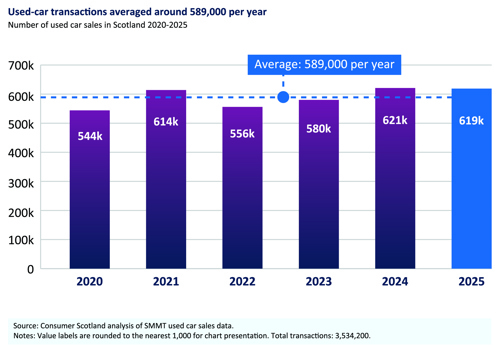
Scotland’s used-car market is large and economically significant. Between 2020 and 2025, Scotland averaged around 589,000 used-car transactions per year and more than 3.5 million in total, representing just over 8% of total UK sales. Most consumers who buy used cars have a positive experience, and complaints account for a small fraction of overall sales.
However, the sector remains a persistent source of consumer complaints and detriment when things go wrong. Consumer Scotland’s investigation survey found that 29% of respondents experienced an issue causing detriment, broadly aligning with the 28% figure reported in the UK Government’s National Consumer Detriment Survey. When asked about wider issues, just over half of survey respondents reported at least one problem during or after purchase. Advice Direct Scotland also consistently identifies used cars as one of the leading sources of consumer advice enquiries and complaints.
While it would be imprecise to place a single financial value on detriment in the used-car market, the scale of the sector means the risk of consumer harm can be significant. The problems identified include not only financial cost, but also loss of transport, stress, delay and uncertainty. In a market worth around £9.6 billion a year in Scotland - survey findings that 29% of respondents experienced detriment and 53% reported at least one issue show that when things go wrong it can have a material impact on consumers.
The findings and recommendations of this investigation draw on a broad evidence base, including national market data, a survey of recent used-car buyers in Scotland, ADS case data analysis, and stakeholder engagement with trade, consumer, and regulatory bodies. The survey provides evidence from consumers with both positive and negative experiences, while ADS case analysis provides detailed insight into more serious and escalated disputes where consumers sought advice. Stakeholder, industry and regulatory evidence helped explain why problems arise in practice and where improvements to guidance, standards, licensing and redress may be needed.
Main findings
The recommendations are grouped under three connected themes: better information, stronger standards and clearer redress. Together, they are intended to improve outcomes for consumers while supporting responsible traders. Within this package, three areas are likely to have the greatest system-wide impact:
- Better information: improving practical guidance for traders and consumers on rights, responsibilities and remedies in used-car sales
- Clearer redress: improving access to effective redress, including through clearer and more accessible ADR
- Stronger standards: strengthening Scotland’s approach to licensing, enforcement and self-regulation so that it better reflects today’s used-car market, including online, distance and cross-border sales
The full set of recommendations below sets out the practical actions needed across advice, guidance, redress, licensing, standards and stakeholder coordination. The investigation found that Scotland’s used-car market works well for many consumers, but that when problems arise they can cause serious financial, practical and emotional harm. The main findings are summarised below.
Scotland's used-car market is large, financially significant and essential to everyday life for many consumers
Market data, consumer survey findings and stakeholder evidence show that used cars play a central role in access to work, education, caring responsibilities and services. Affordability pressures, older vehicles, and increasing digital sales can create additional risks, particularly for lower-income buyers, rural consumers and those who rely heavily on their car.
Most disputes are driven by faults arising after purchase
The evidence shows that complaints most commonly arise when faults develop after sale, often involving serious mechanical issues. These cases can create immediate financial and practical pressure, especially where consumers face repair costs, ongoing finance payments, loss of transport and uncertainty about who is responsible.
Consumer rights are strong in principle, but difficult to apply in practice
Disputes often turn on differing views of what is “satisfactory quality” under the law, including durability, wear and tear, rejection rights, the six-month burden of proof and the responsibilities of traders and finance providers. This can make it difficult for consumers and traders to agree what remedy should be provided.
The redress landscape is fragmented and difficult to navigate
Consumers may need to deal with traders, finance providers, warranty providers, Alternative Dispute Resolution (ADR) bodies, advice organisations or courts. This can cause delay and confusion, particularly where finance agreements, distance sales or cross-border purchases are involved.
Some consumers face greater risk of harm when things go wrong
Consumers with lower financial resilience, those buying lower-value vehicles, rural consumers and those who rely heavily on their car may find it harder to absorb repair costs, pay for independent reports, pursue court action or replace a vehicle while a dispute remains unresolved.
Some types of purchase appear more prominent in serious disputes
Within sampled ADS advice cases, independent traders and cars bought at a distance were associated with a higher proportion of serious complaints, including major faults, remedy refusals, misleading descriptions, poor complaint handling and limited access to ADR. This should not be read as a whole-market finding, but it highlights areas where clearer standards, advice and redress routes may be needed.
Cross-border used-car purchases can create additional complexity
Around a third of sampled ADS used-car cases involved traders based in England. While many traders operate responsibly, this points to the need for clearer consumer advice and baseline standards for distance and cross-border purchases which can be more complex to resolve.
Scotland's second-hand vehicle dealer licensing regime is not aligned with the modern market
The current licensing framework provides a basic gatekeeping function, but does not consistently support trader competence, consumer law awareness, complaint handling, redress signposting or transparency for consumers. It also needs to better reflect online, distance and cross-border sales.
Trading Standards services play a vital role but operate in challenging resource environment
Local Trading Standards services help support compliance and respond to consumer harm, but face resource constraints. Evidence from recent Scottish Trading Standards work identified recurring issues around pricing transparency, distance-selling information, cancellation rights, complaint handling, ADR signposting, regulatory claims and electric vehicle information.
Voluntary codes and trusted trader arrangements can provide additional protection, but their impact depends on coverage and awareness
Codes of Practice and Trusted Trader schemes can help raise standards and provide clearer expectations for traders and consumers. However, their effectiveness depends on trader participation, consumer awareness and clear signposting at the point of sale and when complaints arise.
What needs to change
Overall, the findings point to a market that works well for many consumers, but one where clearer advice, stronger standards and more accessible redress are needed when problems arise. Consumers need clearer information before and after purchase about their rights, the checks they can make, who is responsible when faults arise, and the routes available to resolve disputes. Traders need practical guidance on how consumer law applies in real-world used-car sales, including satisfactory quality, durability, warranties, finance agreements, distance sales and complaint handling.
Taken together, the recommendations are intended to reduce the gap between what consumers expect, what traders understand their obligations to be, and what can realistically be resolved when a used-car fault arises. Better information, stronger standards and clearer redress should help prevent avoidable disputes and support earlier, more consistent resolution when problems occur.
The wider system also needs to better reflect the modern used-car market. This includes improving access to ADR, clarifying and strengthening Scotland’s licensing and compliance expectations, supporting vulnerable consumers and lower-value purchases, and improving awareness and uptake of recognised motor industry Codes of Practice.
The recommendations below are designed to improve outcomes for consumers while supporting responsible traders. They focus on clearer information, better use of advice intelligence, stronger guidance, improved redress, more consistent licensing and wider uptake of recognised standards.
Recommendations
| Key area | Body | Recommendation |
|---|---|---|
| Subprime motor finance access and pricing in rural Scotland | Financial Conduct Authority (FCA) | Examine whether, in line with stakeholder evidence, some rural consumers in Scotland may face higher prices or reduced access to subprime motor finance. If issues are identified, the FCA should consider if this reflects commercial factors, evidence gaps or emerging structural barriers to consumers and take the appropriate action |
| Practical guidance on used-car rights, remedies and complaint handling | Consumer Scotland | Convene Scottish Motor Trade Association (SMTA), Society of Chief Officers in Trading Standards in Scotland (SCOTSS), ADS, ADR bodies and other partners to develop practical guidance on used-car rights, remedies, warranties, finance-provider responsibilities, satisfactory quality and complaint handling |
| Improved use of consumer advice case intelligence | Advice Direct Scotland and Consumer Scotland | Work together to review how used-car advice case information can best support understanding of recurring consumer issues and routes to redress, including online and distance sales, cross- border purchases, trader location, complaint handling and ADR signposting. Any changes with resource implications should be subject to discussion of funding, feasibility and implementation |
| Consumer rights in online, distance and cross-border used-car sales | Chartered Trading Standards Institute | Update Business Companion guidance so traders better understand how consumer rights apply to online, distance, semi-distance and cross-border used-car sales, including cancellation rights and pre-contract information |
| Stronger support for vulnerable consumers and lower-value purchases | Department for Business and Trade and Consumer Protection Partnership | Develop and deliver a package of proportionate, targeted measures to improve outcomes for consumers with lower financial resilience, particularly those buying lower-value vehicles who may struggle to afford repairs, reports, replacement transport or redress |
| Improved access to ADR, particularly for independent trader disputes | CTSI/DBT | Use the new ADR legal framework to explore how access to accredited ADR can be improved in used-car disputes, particularly where consumers buy from independent traders not covered by a recognised scheme |
| Wider reform of Scotland’s civic licensing framework | Scottish Government | As a priority modernise the local civic licensing framework to deliver a clearer, more consistent, and user centred system, aligned with the public service reform agenda and better suited to digital, distance, and cross-border markets, particularly where consumer protection risks arise |
| Best practice conditions for second-hand vehicle dealer licensing | Licensing Leaders Group | Work with SCOTSS, SMTA and Consumer Scotland to develop best-practice licence conditions covering consumer protection compliance, complaint handling, ADR signposting, licensing transparency and expectations around trader competence and fair trading |
| Dissemination of Trading Standards’ Car Dealer Project findings | SCOTSS | Disseminate the 2025–26 project findings to traders, supported by Consumer Scotland and SMTA, to raise awareness of key issues - including pricing transparency, pre-contract information, cancellation rights, delivery costs, and redress routes - along with possible follow-up engagement to assess improvements in trader practices |
| Wider uptake of recognised motor industry Codes of Practice | Code operators and trade bodies | Promote wider awareness and uptake of recognised motor industry codes, particularly among independent traders and new licence holders, with clearer signposting of the protections code membership provide |
Delivering the recommendations
The recommendations identify lead organisations and supporting partners bcause improving outcomes in the used-car market will require coordinated action across advice, regulation, enforcement, industry and government. For each recommendation, Consumer Scotland has set out the intended outcome, the organisations best placed to lead delivery, and the partners whose support or participation will be needed.
Consumer Scotland will use its convening role to bring relevant organisations together following publication, support implementation where appropriate, and monitor progress over the short to medium term. This will include engaging with government, local authorities, Trading Standards, advice providers, industry bodies and ADR providers to understand how recommendations are being taken forward and where further action may be needed.
Measuring outcomes
Consumer Scotland will assess progress against the recommendations by considering whether they lead to clearer information for consumers and traders, stronger and more consistent standards across the sector, and more accessible routes to resolve disputes when problems arise. Relevant indicators may include improvements in consumer-facing advice, updated trader guidance, clearer ADR signposting, wider uptake of recognised motor industry standards, improved recording of advice data, and evidence of progress on licensing reform and compliance expectations.
Consumer Scotland will use stakeholder engagement after publication to agree proportionate ways to track progress, recognising that responsibility for delivery sits across a range of organisations and that some changes will require longer-term policy or regulatory development.
About the investigation
Consumer Scotland's investigations function
Consumer Scotland conducts investigations as part of its statutory role to identify harm, assess how markets are working for consumers in Scotland, and make evidence-based recommendations to improve consumer outcomes.
Investigations allow Consumer Scotland to examine issues in depth, draw together evidence from consumers, advice services, regulators, industry and other stakeholders, and identify practical changes that could improve consumer outcomes.
Why investigate consumer issues in the used car sector?
This investigation was launched in October 2025 in response to evidence of persistent consumer problems in the used-car sector. Used cars are one of the most complained-about consumer issues and the consequences of problems can be significant. As a result, it strongly met the investigation prioritisation criteria in terms of sector or practices that cause, or may cause, consumer harms.
For many consumers, a used car is not a discretionary purchase but a vital means of accessing work, education, caring responsibilities, family life and services. Cost-of-living pressures have increased the importance of access to affordable, reliable transport, particularly for consumers with lower financial resilience and those living in rural or less well-connected areas.
At UK level, partners within the DBT’s Consumer Protection Partnership (CPP) have also continued to focus on sectors where detriment is persistent, rights may be difficult to enforce in practice, and clearer standards, guidance and redress routes may improve outcomes. Used cars have been a consistent area of CPP focus over many years.
How was this investigation carried out?
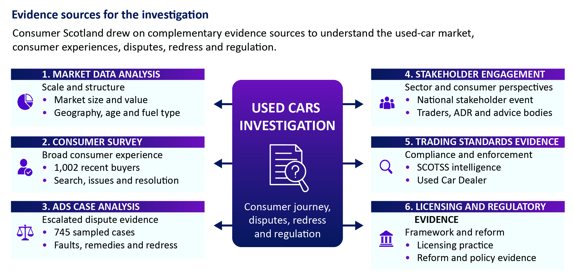
The findings and recommendations in this report are based on a broad range of complementary evidence sources. These were used together to understand the scale of the market, the experiences of recent buyers, the nature of escalated disputes, and the wider regulatory, industry and redress landscape.
The investigation considered the full used-car buying journey: how consumers search for and buy used cars; the information they receive before purchase; their expectations of traders and vehicles; the types of problems that arise; how disputes are handled; and the systems in place to support compliance, complaint handling and redress.
Scale of the market: Statistical data analysis
Consumer Scotland analysed used-car sales data to understand the scale, value and structure of Scotland’s used-car market. This included sales volumes, Scotland’s share of UK transactions, indicative market values, geographic patterns, vehicle age, fuel type and changes over time. This helped place consumer issues and detriment in the context of a large, diverse and economically significant market.
A national consumer survey of Scotland’s used car buyers
Consumer Scotland commissioned independent research with recent used-car buyers in Scotland. The survey explored the full buying journey, including how consumers searched for vehicles, chose traders, checked information, understood their rights, paid for vehicles, experienced problems and sought resolution. This provided evidence from consumers with both positive and negative experiences, rather than only those who had complained.
National consumer advice cases: Advice Direct Scotland case analysis
Consumer Scotland undertook detailed analysis of a sample of Advice Direct Scotland case data to examine consumer complaints and enquiries about used cars. This evidence is not representative of all used-car purchases or all consumer issues in the market. However, it provides insight into serious or escalated cases where consumers sought advice, often after problems with faults, liability, remedies or redress had become contested.
Stakeholder engagement across the sector
Consumer Scotland also engaged with stakeholders across the used-car sector, including through a national trade and consumer stakeholder event. This included trade representatives, independent and larger traders, online platforms and marketplace operators, finance and warranty stakeholders, code operators, ADR providers, consumer advice bodies, regulatory partners and claims-management-style providers. This engagement helped test emerging findings, understand different perspectives and identify practical actions to improve outcomes for consumers and responsible traders.
Licensing and regulatory evidence from key stakeholders
Consumer Scotland heard evidence from local authority licensing interests, Police Scotland and stakeholders involved in the Scottish Government’s Civic Licensing Reform Task Force. This helped assess how second-hand vehicle dealer licensing operates in practice, the limits of the current Civic Government (Scotland) Act 1982 framework, and opportunities to modernise licensing so that it better supports consumer protection, transparency and consistent standards.
Evidence from local trading standards services in Scotland
Consumer Scotland considered evidence from Scotland’s trading standards bodies, including intelligence on recurring compliance issues, enforcement challenges and the findings of the SCOTSS Used Car Dealer Project. This provided practical insight into how consumer protection requirements are applied in the market, including pricing transparency, distance-selling information, cancellation rights, complaint handling, ADR signposting, regulatory status and electric vehicle information.
Key stakeholders
The Scottish Motor Trade Association (SMTA) - Represents over 1,300 motor industry businesses across Scotland, from large motor groups to small garages and MOT stations. Provided strong engagement on trade representation and insight on used-car sales, trader obligations, vehicle faults, warranties and consumer issues.
Advice Direct Scotland (ADS) - Provides free, independent consumer advice across Scotland. Supplied key case evidence and insight on used-car complaints, including vehicle faults, remedy disputes, finance-provider issues and barriers to redress.
Chartered Trading Standards Institute (CTSI) - Provided expert insight on consumer protection, business guidance, Codes of Practice and ADR. Helped inform recommendations on clearer trader guidance, stronger compliance expectations and improved routes to redress.
The Society of Chief Officers of Trading Standards in Scotland (SCOTSS) - Provided Scotland-specific insight on trading standards enforcement, trader compliance, local authority powers and licensing. Helped inform recommendations on strengthening consistency, compliance and consumer protection in the used-car sector.
The report is structured in three sections:
- The scale and characteristics of Scotland’s used-car market and presents findings from the consumer survey
- How consumer rights work in practice, including the causes of disputes, the application of “satisfactory quality”, access to remedies and the redress landscape
- The wider regulatory and standards framework, including licensing, trading standards, Codes of Practice and opportunities to improve compliance and consumer protection
How we use terms in this report
This report focuses on contracts for used cars supplied by traders to consumers. It does not examine private sales between individuals, or cars sold between two businesses although these are part of the wider used-car market. For clarity, the report uses the following terms:
Independent traders - means used-car dealers operating outside large franchised or national retail groups. This can include single-site garages, small dealer groups and small traders selling through online platforms.
Franchised, branded or national traders - means larger retailers, including manufacturer-franchised dealers, national dealer groups and branded used-car retailers.
Online, distance and cross-border sales - means sales where some or all of the buying journey takes place remotely, or where the consumer buys from a trader based outside Scotland. Depending on their nature they may involve statutory cancellation rights and required information - or issues around delivery, remote advertising, online deposits, click- and-collect arrangements or travel to another part of the UK.
Private sellers - means individuals selling a vehicle outside the course of business. Private sales are not the focus of this investigation because different legal protections apply compared with purchases from traders.
Key statistics
- 589,000 used-car transactions on average per year between 2020 and end 2025 - over 3.54 million in total
- C. £9.6 billion broad estimated value of used-car sales on average per year between 2020 and end 2025
- Just over 8% of all UK used car sales took place in Scotland between 2020 and 2025
- 9% of our survey respondents purchased a used electric vehicle and 15% purchased a hybrid
- 53% reported at least one issue during or after purchase
- 29% experienced an issue causing detriment
- Around 9% of sampled ADS cases arose within six months of purchase
- 57% of sampled ADS cases involved independent traders
- 32% of relevant sampled ADS cases involved traders based in England
3. Used cars in Scotland: Sector overview
Key findings: Summary
- Scotland’s used car market is large and economically significant: Scotland accounted for just over 8% of UK used car sales between 2020 and 2025, at 589,000 per year on average, totalling 3.53 million. Our indicative estimate suggests an annual market value of c.£9.6 billion in Scotland.
- Used cars are essential for mobility and access to services: Used cars support work, mobility, family life and access to services, particularly where public transport is limited.
- The market mix is not yet showing strong electric vehicle sales: Petrol and diesel cars continue to dominate, although hybrid and electric vehicle purchases are increasing from a low base.
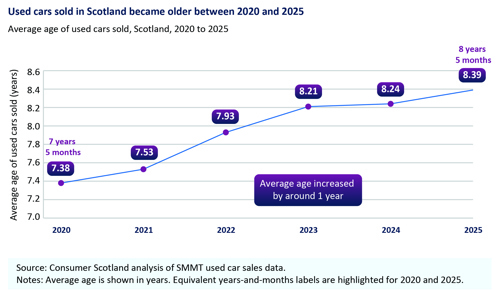
- Used cars purchased in Scotland are getting older: The average age of used cars purchased in Scotland rose by 13.8% between 2020 and 2025, to 8 years and 5 months in 2025.
- Consumers conduct research before buying: Almost all respondents did pre-purchase research, and 87% viewed the car in person before buying.
- Customer satisfaction is high, but issues were common and could be disruptive: Most respondents were satisfied with their experience, but 53% reported at least one issue during or after purchase.
- Respondents generally felt aware of their rights, but less so among some groups: Rights awareness was generally positive, but lower among rural, low- er-value and older-car buyers.
- Motor finance is not used for most used car purchases, but may raise access issues in rural Scotland. Stakeholder evidence suggests geography and recovery costs may affect subprime finance pricing or availability in some rural areas.
Scotland’s used car market
Scale, trends and consumer experiences
This section provides an overview of Scotland’s used-car market: its scale, changing profile, role in consumers’ lives and the experiences of recent buyers.
Consumer Scotland’s investigation focuses on the causes of complaints, disputes and detriment in order to identify opportunities to improve consumer outcomes. To understand the significance of those issues, it is important first to consider the market’s scale, structure and role in everyday life.
Scotland’s used-car market is large, diverse and essential to many consumers. For people on lower incomes, and those living in rural or less well- connected areas, access to an affordable used car can support work, family life, social connection and access to services. The market also spans a wide range of business models, from small independent garages and franchised dealerships to online-only operators. It is also changing as buying journeys become more digital and hybrid and electric vehicles (EVs) gradually enter the used market.
This section first sets out the scale and characteristics of the used-car market in Scotland, drawing on sales data from the Society of Motor Manufacturers and Traders (SMMT). It then presents findings from Consumer Scotland’s commissioned survey of recent used-car buyers in Scotland, covering how consumers search for and buy vehicles, their expectations, their awareness of rights, the information they receive and the issues they experience. These findings provide important evidence for later recommendations on consumer guidance, point-of-sale information, licence visibility, Codes of Practice and access to redress.
The section concludes by considering motor finance. This draws mainly on stakeholder evidence rather than the consumer survey and is therefore treated separately from the main survey findings.
The scale of the used car market in Scotland
In order to set out the scale, structure and recent trends in Scotland’s used car market, Consumer Scotland analysed used-car transaction data from SMMT for the period 2020-20258. This provided a consistent basis for assessing Scotland’s share of UK used car sales, changes over time, and patterns by geography, vehicle age and fuel type.
Scotland had an average of 589,000 used-car transactions per year amounting to a total of 3,534,200 used car transactions between 2020 and the end of 2025, representing just over 8% of the almost 44 million used car sales recorded across the UK over the same period. This broadly reflects Scotland’s share of the UK population.
To deepen this understanding, we also sought to illustrate the broad financial scale of Scotland’s used car market by combining SMMT sales data with Autotrader’s UK average asking price data [12]. There were around 589,000 used-car transactions in Scotland each year on average between 2020 and 2025. Using Autotrader’s UK average asking price data as an indicative proxy for transaction value suggests an annual
market value of around £9.61 billion.
Sales by local authority and per population
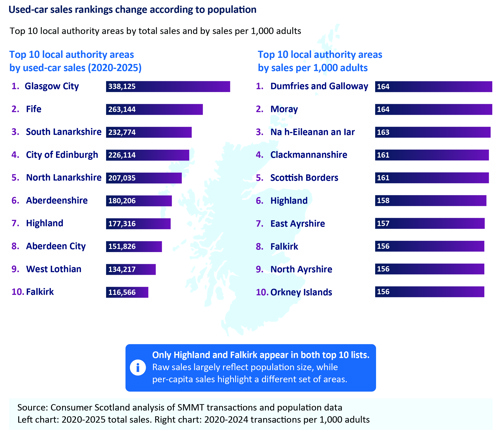
Scotland’s diverse geography also means it is important to look beyond total figures and consider the market relative to population, particularly given the different transport needs and access challenges faced by urban, rural and island communities.
As expected in absolute terms, local authorities with larger populations typically had more transactions than rural and island areas. When adjusted per 1,000 adults, rural areas generally had more transactions, possibly reflecting the relative public transport links, greater travel distances to access services and older populations (Glasgow City Council and City of Edinburgh Council were lowest when adjusted in this way).
The ongoing impact of Covid-19 and demand for more affordable cars
The used car market has also continued to be shaped by the after-effects of the pandemic, as disruption to new car production and sales reduced the number of vehicles entering the market. Autotrader has reported that around 3 million fewer new cars entered the UK market than might otherwise have been expected during the period of Covid-related disruption
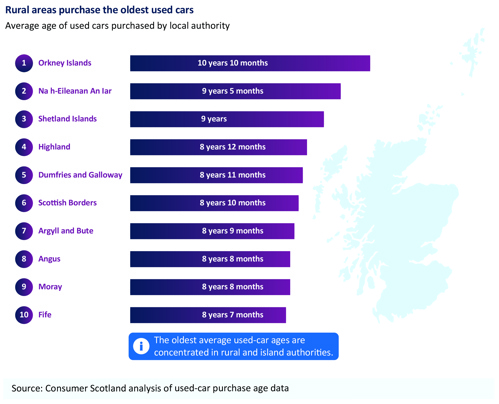
This contributed to a tighter market overall, with traders continuing to report challenges sourcing stock and consumers showing increased demand for older, more affordable vehicles. The SMMT data reflects this shift in Scotland: used car sales were lower in 2022 and 2023, while the average age of used cars purchased increased by 13.8% between 2020 and 2025.
When analysed by local authority area, the SMMT data indicates that used cars tend to be older at time of purchase in more rural areas.
Fuel type: The transition to sustainable used cars
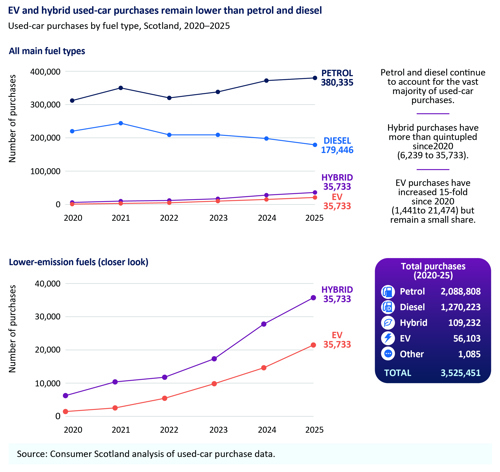
The important sustainability transition to EVs is beginning to be reflected in Scotland’s used car market, but from a relatively low base. Between 2020 and 2025, the vast majority of used car sales remained internal combustion engine (ICE) vehicles, with diesel sales declining and petrol sales increasing. Hybrids and EVs made up a growing but still smaller share of transactions.
Previous Consumer Scotland research highlighted the low proportion of EVs in Scotland. As those cars were typically newer, the used EV market was noted to still be developing and that has been reflected in the continued dominance of ICE cars within the SMMT data. The number of EVs in the used car market will likely grow in future (i.e. as sales of new models increase) and Consumer Scotland anticipates publishing further research into consumer attitudes towards and experiences of EVs later this year.
Summary: The used car market in Scotland
- Scotland’s used car market is large and financially significant. SMMT data shows almost 44 million UK used car sales between 2020 and 2025, with Scotland accounting for just over 8% of transactions at over 3.5 million.
- Consumer Scotland estimates that used-car sales in Scotland had an indicative annual value of around £9.6 billion, based on SMMT sales data and Autotrader UK average asking price data. This should be treated as a broad estimate rather than a precise market valuation.
- The market has continued to be shaped by Covid-19 disruption, with reduced new car supply contributing to tighter stock, lower used car sales in 2022 and 2023, and increased demand for older, more affordable vehicles.
- The average age of used cars purchased in Scotland increased by 13.8% between 2020 and 2025, with older vehicles more common in rural areas.
- Rural areas generally had more used car transactions per adult, likely reflecting Scotland’s geography, longer travel distances and more limited public transport options.
- ICE vehicles continued to dominate used car sales, while hybrids and EVs increased from a relatively low base.
Consumer attitudes and experiences in the used car market
Having examined the scale, value and changing profile of Scotland’s used car market, Consumer Scotland wanted to understand how consumers experienced that market in practice. Independent research was therefore commissioned with recent used-car buyers in Scotland, exploring their attitudes, behaviours and experiences across the buying journey.
The survey was completed by recent used-car buyers rather than by complainants. This is important because it provides a broader view of overall consumer experience, including positive journeys, issues that were resolved without formal advice, and cases where problems arose. Evidence from complaints and advice requests, considered later in this report, provides a different but complementary perspective on more serious and escalated cases.
The research was designed to:
- Identify who buys used cars in Scotland and how they make purchases
- Assess the scale and drivers of consumer detriment.
- Explore consumers’ awareness of rights, redress and advice options
- Evaluate satisfaction with the buying journey and how far it aligned with expectations
The research report, published separately, sets out the full methodology, including the approach to sampling, survey design and the soft launch testing of the online, quantitative survey ahead of wider fieldwork.
The survey captured views from a range of demographics, including representation of consumers in vulnerable circumstances. The published report also details the quality assurance processes, in addition to the considerations around weighting and reporting conventions.
Themes emerging from the survey
As the survey covered the full buying journey, it identified themes around, among others, participants’ pre-purchase steps, the sales process, any issues that arose and how they were addressed. The survey also collected information about the vehicles respondents bought, allowing experiences to be considered alongside factors such as price, age, mileage, fuel type and trader type.
Petrol and diesel vehicles remained the most common purchases among survey respondents
The survey provides useful context on the types of vehicles recently bought by respondents, although SMMT sales data remains the stronger source for overall market trends. Among survey respondents, petrol cars were the most common purchase, followed by diesel cars, hybrids and EVs. Nearly half paid under £15,000, and most bought cars with relatively low to moderate mileage. These findings are most useful for understanding how purchase experiences vary by price, vehicle type, mileage and buyer circumstances, rather than for estimating the overall composition of the Scottish used-car market.
The findings also point to affordability as an important factor in the market. Lower-priced used cars remained in strong demand and, in general, respondents on lower incomes were more likely to have bought older vehicles.
- Petrol cars were the most purchased (57%) among survey respondents, followed by diesel (19%), hybrids (15%) and EVs (9%)
- Although 24% of participants purchased used cars priced at over £30,000, most were cheaper and nearly half (47%) paid under £15,000
- The most common mileage range for used cars bought was 5,001-30,000 (43%), while cars were typically newer; 42% were 1-3 years old, 28% were 4-6 years old and 15% were 7 years or older
Consumers research widely, but rely on mixed sources
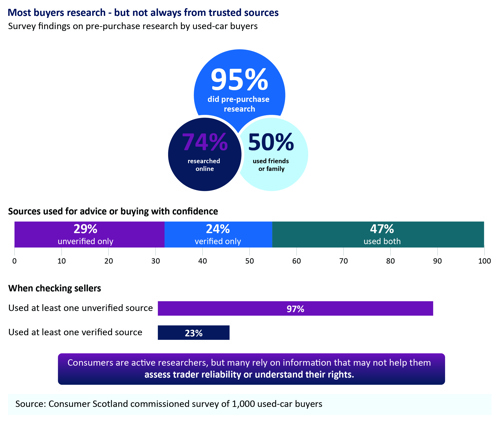
Online research, advice from family and friends, and other sources all play an important role in shaping purchasing decisions. However, the evidence also points to a mixed information environment. While many respondents used verified advice / information sources, a significant proportion relied only on unverified information, particularly when researching sellers. This may limit consumers’ ability to assess the reliability of the trader, understand their rights, or identify potential risks before committing to a purchase.
The greater use of research and advice among buyers of more expensive cars may also suggest that consumers with more at stake, or potentially greater resources, are better able or more motivated to seek information before buying. This reinforces the importance of clear, accessible and trusted pre-purchase advice for all consumers, particularly those buying lower-value vehicles.
- Almost all (95%) respondents did some pre-purchase research, most commonly online (74%) or through friends or family (50%)
- A similarly high proportion (88%) used at least one source of advice specifically around buying with confidence or understanding consumer rights. Of those respondents, 29% relied on unverified advice/information sources only, 24% relied on verified advice/information sources only and 47% used both
- More generally, buyers of more expensive used cars were more likely to do general research and seek pre-purchase advice
- When researching information about sellers, respondents were more likely to use unverified than verified advice / information sources; of those who sought this information, 97% relied on at least one unverified source, while 23% consulted at least one verified source
Most respondents viewed the car in person before buying it
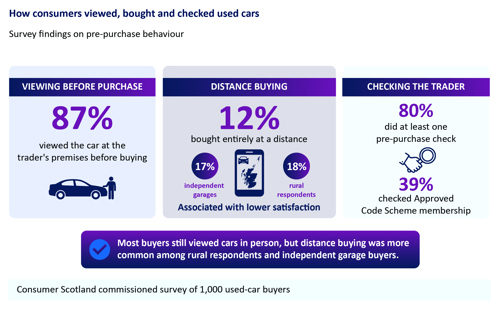
The findings suggest that, although online channels are now central to how consumers search for used cars, the in-person visit remains a key part of the buying journey. Most respondents used a combination of digital and physical routes but still wished to see the vehicle at the trader’s premises before committing to purchase. This reflects the importance consumers place on inspecting the car, speaking to the trader, and gaining confidence before making a significant financial decision.
The higher level of distance purchasing among rural respondents may point to the practical challenges some consumers face in accessing traders in person, although this cannot be assumed from the survey alone. The association between distance purchases and lower satisfaction also suggests that buying without viewing the car may carry greater risks or leave consumers feeling less confident about the transaction.
This finding is important for the recommendations on online, distance and cross-border sales. The survey shows that distance purchasing is a minority route overall, but is more common among rural respondents and independent trader buyers. Later evidence from ADS and stakeholders shows how problems can become harder to resolve where consumers have bought at a distance, particularly where return, repair, cancellation or trader-location issues arise.
The findings also highlight the value consumers place on signals of trader reliability. The fact that many respondents checked Approved Code Scheme membership, and that most felt it would be helpful to verify whether a trader held a used-car licence, suggests there is consumer demand for clearer and more accessible information about trader standards. This reinforces the importance of licensing, Codes of Practice and trusted signposting as part of a better- functioning used car market (see Chapter 3).
- When searching for a car, over half (56%) of respondents looked in person from a trader and 54% used a trader’s website, with most doing both (74%). Smaller – but still significant – proportions used other online sources, such as Autotrader.
- Most respondents (87%) ultimately viewed the car at the trader’s premises before buying it. Only 12% of respondents bought their car entirely at a distance (i.e. it was delivered without an in-person inspection). This was more common among buyers from independent garages (17%) and those who lived in a rural area (18%). It was associated with lower overall satisfaction.
- Most respondents (80%) did at least one pre-purchase check on the trader, with verifying Approved Code Scheme membership the most common (39%).Almost two thirds of participants (64%) said they were aware of used car licensing and a similar proportion (63%) said it would have been helpful for them to check if the trader held a licence.
Price was the key driver for choice of trader
The findings in this area underline the central role of affordability in the used car market. For many respondents, buying ‘used’ was not simply a preference but a practical financial choice, with price shaping both the decision to buy a used vehicle and the choice of trader. This was particularly evident among buyers from independent traders, who were more likely to cite price as a reason for choosing the seller and more likely to pay by cash, bank transfer or debit card.
The survey findings also suggest that different parts of the market may serve different consumer needs. Independent traders appear to play an important role for buyers seeking lower-cost vehicles, while more expensive purchases were less commonly associated with this part of the sector. This may be significant because consumers buying lower-priced vehicles may have less financial resilience if problems arise after purchase.
At the same time, the importance respondents placed on their cars shows why affordability cannot be considered in isolation. For some consumers, particularly in rural areas or places with limited public transport, access to a used car may be essential rather than discretionary. This means that problems with affordability, quality or access to finance can have wider impacts on consumers’ daily lives.
One survey respondent said: "Because it takes my pregnant wife and my boys to school, then I am off to work and back to pick up my family for the day."
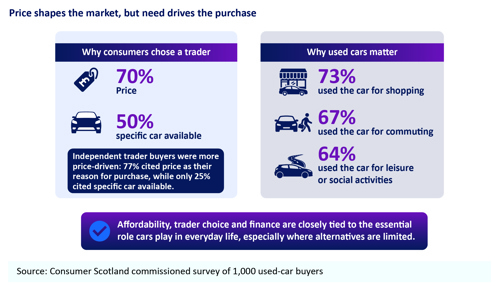
- Price was the most frequently cited reason for choosing a particular trader (70%). Other common factors included availability of a specific car (50%) and reputation or recommendation (44%).
- Respondents bought their used cars from a range of trader types. 40% bought from a branded dealership linked to a specific manufacturer, 29% bought from an independent trader and 28% bought from a car supermarket or large franchise (2% did not know the type of trader used).
- Buyers from independent traders were more likely to cite price as a reason for choosing a trader (77% v. 70% overall), with reputation or recommendation less prevalent (25% v 44% overall).
- The most common payment method overall was cash, bank transfer or debit card (57%), particularly among buyers from independent traders (70%).
- Almost a quarter (24%) of respondents used hire purchase or a conditional sale agreement, 18% paid by credit card and 17% entered a personal contract purchase agreement.
- The most common uses for cars bought were for shopping (73%), commuting (67%), leisure or social activities (64%) and transporting friends or family.
- The vast majority of participants said their car was important to them and, of the 60% who said it was extremely important, work, family transport and inadequate public transport were among the main reasons.
Cost was the main reason for buying a used car over a new one. Almost a fifth (18%) of participants said they either could not afford or get finance for a new car, which was more common among buyers from independent traders (30% v. 18% overall).
One survey respondent said: "I live in a rural area, and a car is [the] only reliable means of transport. It is imperative for my everyday living that I have a reliable car."
Consumers expected standards that reflect core consumer law protections
According to the survey findings, most respondents agreed with expectations that reflect core consumer law protections: that the car should be checked before sale, free from major faults at the point of sale, reliable for everyday use and durable for a reasonable period. The survey did not test every possible expectation consumers may have of used vehicles, so it should not be read as showing that all consumer expectations align with the law. However, it does suggest that many consumers expect the basic protections that consumer law is intended to provide.
However, the findings also point to differing information being provided before purchase. While some respondents recalled being told about key matters such as the trader’s repair policy, others did not. Information about Code of Practice membership was reported much less frequently. This suggests there may be scope for clearer and more consistent pre-purchase information, particularly around trader standards, complaint routes and what consumers can reasonably expect from a used vehicle.
Inconsistent information about complaints procedures, Code of Practice membership, trader policies and ADR can affect consumers’ ability to understand who they are buying from, what protections are available and where to go if something goes wrong. These findings support recommendations on practical trader guidance, clearer point-of-sale information, wider Code of Practice signposting and improved ADR awareness. Better communication at the point of sale could help manage expectations, reduce disputes and support consumers to understand their options if something goes wrong.
Most respondents (90%) felt the trader should check the car thoroughly before sale, that it should be free from major faults when sold and it should last a reasonable time without significant repair costs. A very similar proportion (89%) expected the car to be reliable and durable for everyday use.
Respondents reported variance in the information provided before purchase. For example, 15% said they were told whether the trader was a Code of Practice member, while larger proportions reported being informed of their statutory short term right to reject the car (40%) and the trader’s repairs policy (42%).
Around half of respondents experienced issues of some kind
The survey findings showed that problems in the used car market are not limited to a small group of dissatisfied consumers. While nearly half of respondents reported no issues at all, just over half experienced at least one problem during or after purchase, and almost a third experienced an issue that caused detriment. This suggests that, even in a market where many consumers are satisfied overall, problems occur and can have real consequences
The survey also shows that issues arise at different stages of the buying journey. At the point of sale, the main concerns related to unclear or missing contractual information, pressure selling and misleading information. These are significant because they can affect consumers’ ability to make informed decisions before committing to what is often a major purchase. The higher reporting of misleading information among EV buyers, and unclear contractual information among purchasers of hybrids, may also point to additional risks as the market becomes more technically complex.
Post-purchase issues were more common and, although the severity of these issues varied, engine and technological faults were among the most frequently reported. This is important because these types of problems can be costly, difficult to diagnose and disruptive, especially where consumers rely on the car for work, family responsibilities or access to services.
One female respondent said: "I had to keep hiring a car, as the dealership took too long, so this caused stress and financial problems."
The findings also indicate that the impact of problems is not evenly experienced. Financial cost, lost time, emotional distress and mental health impacts were commonly reported, with consumers affected by long-term illness, disability or health conditions more likely to report some types of impact. The survey did not measure severity in every case, so these findings should not be read as showing that impacts were always more severe for those groups. However, they do indicate that similar problems may be harder for some consumers to absorb or resolve, particularly where they have lower financial resilience, greater reliance on the car or more limited capacity to navigate a dispute.
Higher expectations and a greater likelihood of noticing minor defects may have contributed to the prevalence of post-purchase faults in more expensive cars. Wider stakeholder discussions also highlighted the increasing complexity of modern cars, including greater electronic integration of components and a rising number of manufacturers’ recalls.
In summary:
- 29% of respondents reported experiencing an issue causing detriment, which aligns with the 2024 UK Consumer Detriment Survey (28%).
- In both surveys, detriment covers problems that cause stress, costs money or take up time to resolve; however, when presented with a list of potential issues, just over half of survey respondents (53%) reported experiencing at least one issue during or after the purchase. The remaining 47% experienced no issues at any stage.
Point of sale issues
- 35% of participants experienced at least one issue at this stage. This was less prevalent for buyers from independent traders (28%) and more prevalent for buyers of EVs or hybrids, cars costing over £30,000 and cars with mileages over 60,001 (among others).
- Across all car types, the most commonly reported issues were key contractual information being omitted or not explained clearly (16%), pressure selling (13%) or misleading information (13%).
- EV purchasers were more likely to report misleading information (22% v. 13% overall), while a higher proportion of hybrid purchasers reported that key contractual information was omitted or not explained clearly (24% v. 16% overall).
- The vast majority of those who experienced a purchase issue reported at least one negative impact (90%), rising to 99% among respondents with a physical or mental health condition. The most common impacts were emotional (41%), time lost (40%) and financial cost (38%); 28% reported mental health impacts and 15% reported physical health impacts.
One female survey respondent said: "I trusted the seller and got answers to all my questions in a timely and truthful manner."
One male survey respondent said: "I felt I was rushed into buying the car, like he wanted it off the market as soon as possible, which gave me a bit of mental discomfort because I was quite scared."
- The published report breaks the figures down more fully, showing that financial cost and mental health impacts were more likely to be reported by respondents living in households affected by a long-term illness, physical or mental health problem or disability (58% and 44% respectively). These impacts were also more likely to be reported by respondents with a health condition or a disability.
Post-purchase issues
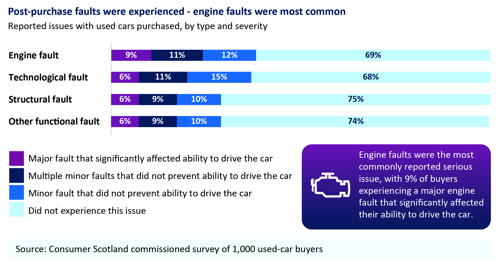
- At least one issue was reported by almost half of respondents (46%). This was most common among cars costing over £50,000, cars used for work related journeys and cars sold with higher mileages (among others). The chart below shows that the severity of the issues reported varied.
- As fault categories were interpreted by respondents, the same issue may have been classified differently. That notwithstanding, engine and technological faults were the most common and were more likely among cars with purchase mileages over 60,001 or prices above £30,000.
- Among those who reported post-purchase vehicle issues, 76% experienced at least one negative impact. The most common impacts were financial cost (45%), time lost (39%), emotional impacts (25%), mental health (22%) and physical health (10%). The vast majority of those respondents considered their car to be important.
- Mental health impacts were more likely to be reported in households affected by long term illness, physical or mental health problem (34% v. 17% overall). The trend was similar for respondents with a health condition or disability.
One male survey respondent said: "The focus is always on the monthly price not the total cost. If you don’t like the monthly price, we can change the time period.... but that drives up the total cost which is never really explained."
One female survey respondent said:"Made me lose sleep and affected my mental health."
One female survey respondent said:"I was very stressed and had to spend more money."
One male survey respondent said: "Unexpected repairs led to unplanned costs and disrupted my routine, especially when I needed the car for work or daily travel."
Consumers generally reported some awareness of their rights
The survey findings show that most respondents felt reasonably confident about their rights, the deal they entered, and where to seek advice. This is positive given the importance and cost of buying a used car.
However, awareness was not evenly shared. It was lower among women, rural consumers, buyers from independent traders, and especially those buying older or lower-value cars. These consumers may be more exposed if something goes wrong.
The survey measured self-reported awareness rather than testing knowledge, so the findings reinforce the need for clear, simple and accessible information before and after purchase.
- 75% of respondents felt at least slightly aware of their statutory consumer rights. This was slightly lower among women (70%), those in rural areas (69%) and buyers from independent traders (68%); it was lower again for buyers of cars priced below £5,000 (56%) or cars over 10 years old (58%).
- Most respondents (87%) felt they had enough advice or information to understand the deal (e.g. payments and charges) before buying the car. This was most commonly attributed to their own research or questions (26%), trusted advice or information (14%) or good customer service (13%).
- Among the smaller group who did not feel sufficiently informed, 23% cited insufficient, confusing or overwhelming information, while 14% pointed to the service experienced from the seller.
- Overall, most respondents (80%) felt confident they knew how and where to seek advice.
Consumers could typically get issues resolved
The survey findings indicate that some respondents who took action short of complaining contacted more than one organisation. That may reflect speaking to an advice body first or uncertainty about the appropriate point of contact but, importantly, most found those interactions helpful. Resolution was, however, lower for those who purchased from independent traders.
Confidence about complaining was generally high and those who felt the need to complain largely did so successfully. Complaints were resolved both locally and at the escalated level, indicating that, while many traders resolve issues, escalation routes remain important.
A small number of respondents either did not complain (despite feeling they had cause to do so) or did not know what action to take more generally. While based on small numbers, it nonetheless reinforces the value of clear, accessible information about complaints processes and the important role of advice bodies with signposting.
The survey also suggests that some consumers may not always identify the most appropriate organisation to contact, particularly where finance or warranty arrangements are involved. This is explored further in Chapter 2, where ADS evidence shows how disputes can become more complex when responsibility is unclear between the trader, finance provider and warranty provider.
- 63% of those who reported a purchase or post-purchase issue took action, such as contacting warranty providers (44%), traders (41%), financial service providers (27%) and advice bodies (24%). Across all four organisations, around three quarters of respondents found their interactions to be helpful[xxvi] and issues were usually resolved. This was, however, lower for those who purchased from independent traders (64% reported their issue was fully resolved overall, but this was 54% among buyers from independent traders).
- Among the smaller group who did not take action, most said the issue was minor or they resolved it themselves (50% and 23% respectively). However, barriers to acting included not knowing what action to take, doubting it would help or avoiding stress or hassle.
- Around a third of respondents with a purchase or post-purchase issue said they had cause to complain and most of that group ultimately did so. The sample of respondents who had cause to complain and went on to complain was relatively small, so these findings should be treated as indicative. For this group, advice services were the most common way respondents found out where to complain, and many complaints were escalated beyond the seller or finance company. Most respondents who complained said their issue was ultimately resolved, and most felt confident exercising their consumer rights in this way.
- Most respondents without cause to complain still broadly knew how to do so. Among the very small number of respondents who said they had cause to complain but did not do so, the most common reason was that they did not think it would help. This finding should be treated as indicative due to the small base size.
Most respondents were satisfied with their experience
Overall, the survey findings point to a broadly positive used car buying experience for most respondents. High levels of satisfaction with the seller and the purchase process, alongside the proportion willing to buy a used car again, suggest that many consumers felt the market worked well for them.
However, satisfaction was closely linked to whether problems arose during or after purchase. Those whose experience fell below expectations were more likely to have encountered issues, reinforcing the importance of preventing problems at the point of sale and resolving them quickly when they occur.
The lower likelihood of buying a used car again, or from the same trader, among respondents with caring responsibilities is also notable. This group was more likely to report issues, suggesting that problems with a used car may have a greater impact where consumers depend on the vehicle to support others as well as themselves.
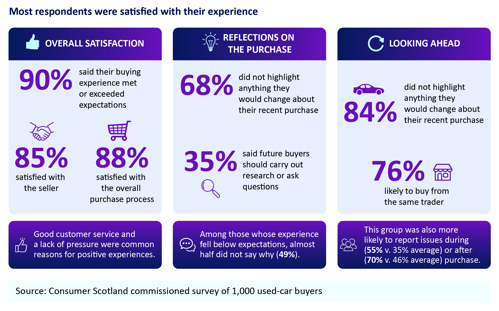
- A clear majority of respondents said their experience of buying a used car met or exceeded expectations (90%), most commonly attributed to good customer service or not experiencing pressure (19%).
- Among the minority whose experience fell below expectations, almost half did not know or preferred not to say why (49%), but they were more likely to have experienced issues during or after purchase.
- Respondents were similarly satisfied with sellers (85%) and with the overall purchase process (88%).
- Around two thirds of respondents (68%) did not highlight anything they would change about their recent purchase, while the most common advice for future buyers was to carry out research or ask questions (35%).
- Looking forward, 84% of respondents said they were likely to buy a used car again and 76% were likely to buy from the same trader. While the full report highlights variation across some groups, both measures were lower among those with caring responsibilities (70% and 65% respectively). This could relate to the greater likelihood of experiencing an issue either during (55% v. 35% average) or after (70% v. 46% average) purchase.
Summary of survey of consumer experiences
- Affordability strongly shapes consumer choice, with nearly half of respondents paying under £15,000 and price the most common reason for choosing a trader
- Lower-income buyers were more likely to buy older cars, suggesting that affordability pressures may push some consumers towards higher-risk purchases
- Most consumers research before buying but the use of verified sources of advice / information varies, particularly when checking sellers
- Consumers value signs of trader reliability, including Approved Code Scheme membership and the ability to check whether a trader holds a used car licence
- Online searching is important, but most respondents viewed the car at the trader’s premises before purchase. Distance buying is less common but appears more frequently among rural respondents and was associated with lower satisfaction
- Most respondents agreed with expectations that reflect core consumer law protections, including that used cars should be checked before sale, free from major faults, reliable for everyday use and durable for a reasonable period
- 29% of respondents reported experiencing an issue causing detriment but, when presented with a list of potential issues, just over half reported at least one issue during or after purchase. Impacts included financial cost, lost time, stress and health impacts, indicating that problems are common and can be disruptive
- Overall satisfaction is high, but is linked to problems being avoided or resolved effectively, reinforcing the importance of prevention and accessible redress
Motor finance and used cars
Motor finance can play an important role in enabling consumers to buy used cars, particularly where they cannot pay the full purchase price upfront. While a detailed review of motor finance was outside the scope of this investigation, the evidence gathered raised a specific question about whether geography may affect the price or availability of some forms of subprime motor finance in rural and remote parts of Scotland.
Whilst the consumer survey provides useful evidence on payment methods, affordability and the importance of access to a car, it did not identify a clear pattern of higher finance use, higher finance costs or reduced access to finance among rural respondents. The concern discussed below was raised primarily through stakeholder evidence and should therefore be treated as an issue requiring further examination, rather than as a finding about the prevalence of harm across the wider market.
Motor finance agreements
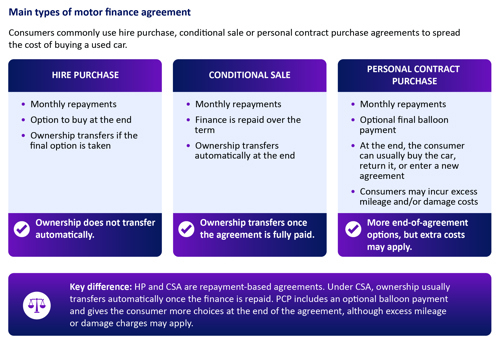
The FCA has indicated that, across the UK, more than 2 million people use motor finance each year. Around 80% of new car purchases and 19% of used car purchases were funded through motor finance in 2024. The most common types of agreement include hire purchase, conditional sale and personal contract purchase.
Hire purchase and conditional sale agreements usually involve the consumer making regular payments while the lender retains ownership of the vehicle until the terms of the agreement are completed. Personal contract purchase agreements also involve regular payments but usually include a much larger final optional payment if the consumer wishes to keep the vehicle. The way ownership, mileage limits, final payments and early termination rights operate can affect both consumer understanding and lender risk.
Rural Scotland and access to affordable motor finance
Stakeholders raised concerns that geography may affect the cost and availability of some forms of motor finance in Scotland, particularly for lower-income or subprime consumers in rural and remote areas.
Some stakeholders suggested that hire purchase may be important for consumers who cannot access mainstream credit, because the lender retains ownership of the vehicle until the agreement is completed. In principle, this can reduce lender risk. However, stakeholders also noted that vehicle recovery can be more difficult and less economical in remote parts of Scotland, particularly where lower-value vehicles are involved.
An industry finance specialist suggested that these asset recovery challenges may make subprime motor finance more expensive in some parts of Scotland than elsewhere in Great Britain. They pointed to higher recovery costs outside the Central Belt, potentially compounded by the use of recovery agents travelling from England and the cost of transporting recovered vehicles to auction sites.
The same respondent also suggested that there may be less certainty in Scotland than in England and Wales around the court orders required to recover vehicles. If recovery costs or operational uncertainty are reflected in lender pricing or risk appetite, this could contribute to higher charges, increased APRs, fewer lender options or reduced availability of some subprime finance products.
However, this evidence should be interpreted cautiously. The consumer survey did not identify the same pattern, and one large national franchise told Consumer Scotland that it applies a uniform APR across all locations. The evidence therefore does not establish that rural consumers in Scotland generally pay more for motor finance. Rather, it identifies a potential issue that may merit further examination because of the importance of car access in rural areas and the potential impact on lower-income consumers if affordable finance is harder to obtain.
For consumers, the issue matters because access to a reliable used car may be essential for work, caring responsibilities and access to services, particularly where public transport alternatives are limited. If geography, recovery costs or lender risk appetite affect the availability or cost of finance, this could reduce consumer choice and make access to essential transport less affordable.
Recommendation: Examination of pricing or access issues for subprime motor finance
Lead: Financial Conduct Authority
As part of its ongoing supervision of motor finance firms, the FCA should examine whether subprime motor finance consumers in rural and remote parts of Scotland face higher prices, reduced product availability or other access issues compared with consumers elsewhere in Great Britain.
This recommendation reflects stakeholder evidence that geography, vehicle recovery costs and lender risk appetite may affect some forms of subprime motor finance. The consumer survey did not establish the prevalence of this issue, and evidence from one national franchise suggested uniform APRs across its locations. The purpose of the recommendation is therefore to test whether such issues exist and, if they do, whether they reflect legitimate commercial cost and risk factors or emerging structural barriers to fair access to motor finance that require action.
4. Resolving complaints: Consumer rights in practice
Key findings - summary
1. Post-purchase faults are a major driver of escalated disputes: Survey evidence shows that post-purchase vehicle issues are common, while sampled ADS cases show how some faults escalate into serious disputes about liability, remedies and redress.
2. Many ADS cases arise early in ownership, when consumer rights should be strongest: Around 80% of sampled cases arose within six months of purchase, when the burden of proof is particularly important, yet disputes still frequently escalated.
3. Engine faults are the most common issue in sampled ADS cases: Engine faults were common and often serious, suggesting that many cases involved breakdowns or significant failures rather than minor dissatisfaction.
4. Consumer rights are strong in principle but difficult to apply in practice: Disputes often centre on “satisfactory quality”, particularly durability, wear and tear, rejection rights, remedies and the burden of proof.
5. Securing remedies can be difficult: Consumers often face refusal, delay, failed repairs, partial offers or disputes over rejection rights.
6. Motor finance adds complexity: Some consumers appear to complain to traders rather than finance providers, causing delay and confusion about who is responsible for resolving the issue.
7. Independent traders featured prominently in sampled ADS cases: These cases included serious faults, remedy refusals, misleading descriptions and limited redress routes. This should not be read as showing the position across the whole market, but it does indicate where escalated advice cases often arise.
8. Cross-border and distance-related purchases create additional barriers: Consumers may face difficulties with returns, communication, enforcement and cancellation rights, particularly where the trader is outside Scotland.
9. Consumers with lower financial resilience may find disputes harder to resolve: Lower-value vehicle failures can leave consumers unable to fund repairs, independent evidence, court action or replacement transport.
10. The redress landscape is fragmented and difficult to navigate: Court is often impractical for consumers, while ADR can be valuable but remains unevenly available across the market.
Used car disputes
Scotland’s used car market is large, diverse and essential to everyday mobility. Hundreds of thousands of transactions take place each year, so complaints and detriment should be understood in the context of the market’s overall scale.
In the previous section the consumer survey provides the broadest picture of recent used-car buyer experiences, including high satisfaction overall but also common issues during and after purchase. This chapter looks at a different part of the evidence base: the more serious and escalated cases where consumers sought advice or where disputes had developed. It should therefore be read as evidence about how problems can escalate, rather than as a measure of how common these problems are across all used-car purchases.
When problems do arise, the consequences can be significant. Used cars are often high-value purchases and, for many consumers, essential for work, access to services, and everyday life. A serious fault can leave consumers facing repair costs, ongoing finance payments, loss of transport and prolonged disputes about liability, alongside stress and wider disruption.
This section examines how used car disputes arise and how effectively consumers can resolve them in practice. It summarises the key consumer rights that apply, analyses a large sample of ADS case data and stakeholder evidence on the main causes of disputes, and considers the routes available for redress through traders, finance providers, ADR schemes and the courts. It also considers the practical challenges involved in applying concepts such as “satisfactory quality”, durability and the burden of proof in real- world disputes. A summary of the main fair trading and consumer protection legislation relevant to used-car sales is provided at Appendix A.
ADS and stakeholder evidence: How issues escalate into disputes
To understand what is at the heart of the issues when used-car transactions develop into disputes, Consumer Scotland analysed ADS case data. ADS data provides one of the clearest available sources of evidence on the sharper end of the used-car consumer journey: cases where faults, remedies, liability or responsibility have become sufficiently serious or contested that the consumer seeks to complain or access external advice. It should not be read as representative of all used-car purchases or all issues experienced by consumers.
This is because many consumers who experience problems do not contact ADS. As set out in Chapter 1, the survey found that some issues are resolved directly, some consumers take no action, and others use different routes such as traders, warranty providers, finance providers, advice bodies or complaint processes. ADS case analysis therefore provides detailed insight into the more serious or unresolved cases where consumers sought advice, often after faults, liability or remedies had become contested.
The analysis therefore examined a 10% sample of used-car cases received by ADS over the two-year period from 1 January 2024 to 31 December 2025. That sample comprised 745 cases and analysis focused on issues that could reasonably be linked to the point of sale. It provides insight into the types of problems consumers sought help with, how disputes arose, and how consumers, traders, finance providers and warranty companies engaged with existing rights and routes to redress.
This analysis should be read alongside the survey findings from Chapter 1. The survey provides a broader picture of recent used-car purchasing experiences, including the prevalence of post-purchase issues and consumer detriment. ADS evidence provides a more focused view of cases that escalated into advice-seeking, often after faults, responsibility or remedies had become disputed. Taken together, the two sources help distinguish between the overall scale of consumer problems and the circumstances in which those problems become more serious disputes.
Main issues identified in ADS cases
The dominant route into dispute in sampled ADS cases was the emergence of alleged vehicle faults after purchase. Most cases involved consumers reporting physical problems with the vehicle, which then led to disputes with traders, finance providers or warranty companies about liability and remedy. These disputes typically centred on who was responsible for the fault and whether the consumer was entitled to a refund, repair or other remedy at no additional cost.
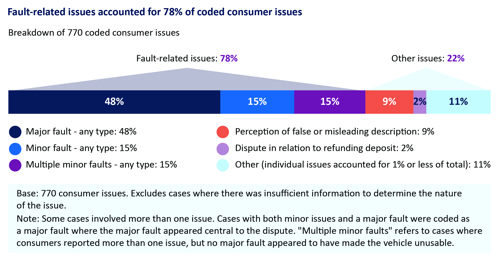
Just under half of sampled cases related to major faults that rendered the car unusable, while 30% involved less serious faults, including minor or multiple minor faults that did not prevent use. A further just under 10% concerned allegations that the vehicle had been falsely or misleadingly described at the point of sale.
Types of faults encountered
Over three quarters of sampled ADS cases involved alleged identifiable faults with the vehicle itself, with cases broadly categorised by severity and type. “Major faults” were those that rendered the vehicle unusable, often described as breakdowns or issues making the car unsafe to drive, while “minor faults” did not prevent continued use.
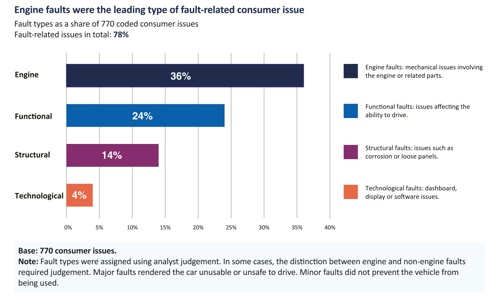
Engine faults were the most common issue in the cases, accounting for 36% of all cases. Most engine- fault cases were major, though the specific components involved varied widely. Other fault types included functional issues affecting drivability, such as gearbox, suspension or steering faults; structural defects, such as corrosion or bodywork issues; and technological faults, typically involving dashboards, infotainment systems or software updates.
Duration and timing of issues
Around 80% of sampled ADS cases arose within the first six months of purchase. This is a significant finding because this is the period in which Consumer Rights Act 2015 protections should be particularly important and, in many cases, more favourable to consumers in evidential terms. The fact that so many escalated cases arose during this period suggests that the existence of legal rights does not always translate into quick or effective redress in practice. Despite this, disputes still frequently emerged and escalated in practice. A smaller but notable number of cases involved prolonged disputes lasting several months or more, sometimes progressing to formal dispute resolution or court action.
Actions by consumers
Around a third of consumers contacted ADS without having taken prior action, seeking advice on their rights and available options. Where the desired outcome was recorded, many consumers had a clear remedy in mind - typically to reject the vehicle for a full refund or to have it repaired at no cost.
In financed purchases, some consumers appeared to direct rejection requests to the trader rather than the finance provider, indicating confusion about who was responsible for dealing with the complaint.
This suggests that some consumers are not only seeking a remedy, but also trying to understand the correct route to find it. In cases involving finance, warranty cover or multiple parties, consumers may face additional uncertainty about whether the trader, finance provider or warranty provider is responsible for resolving the problem.
The impact on consumers
Although most case notes did not explicitly record the impact on the consumer, it is likely that many of the cases involved some form of negative consequence. Impacts were only coded where the case notes strongly suggested that harm had occurred, for example where a consumer could not afford repairs, was left without access to a usable vehicle, or described stress, anxiety or wider disruption to daily life. As a result, the recorded impacts are likely to understate the full extent of consumer detriment across the cases reviewed.
Where impacts were recorded, the most common effect was financial. These included consumers facing unexpected repair costs, difficulty funding further inspections or repairs, or wider financial pressure after purchasing a vehicle that developed faults. Impacts on mental health were also evident, with some consumers reporting stress, anxiety or distress linked to the dispute. A smaller number of cases highlighted disruption to personal, family or working life, particularly where the loss of a vehicle affected caring responsibilities, travel to work or other essential journeys. Overall, the evidence suggests that vehicle faults and unresolved disputes can create harm that extends beyond the immediate cost of repair or refund.
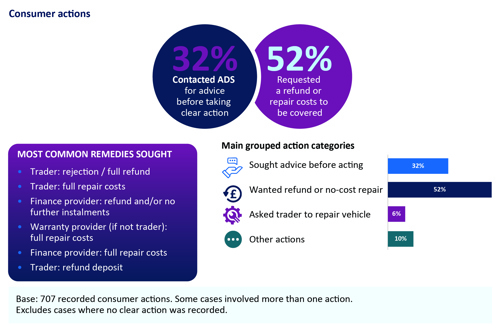
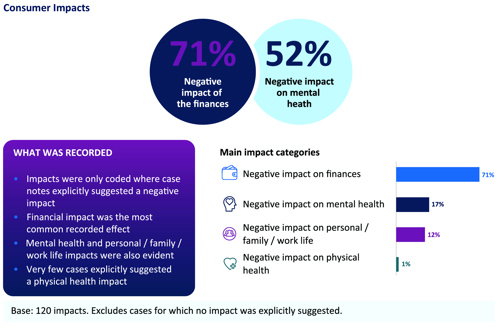
Actions by traders
Trader responses often mirrored the remedies consumers were seeking, but in many cases the recorded outcome was a refusal to provide a refund or repair, or a refusal to cover associated costs. A further group of cases involved unsuccessful repairs, where faults persisted or new issues emerged. While some traders attempted partial resolutions, such as further repairs or alternative offers, many disputes centred on disagreement over responsibility for faults. Consumers also frequently reported poor engagement, and some case notes suggested that traders did not always fully understand their obligations around refunds, repairs and rejection rights.
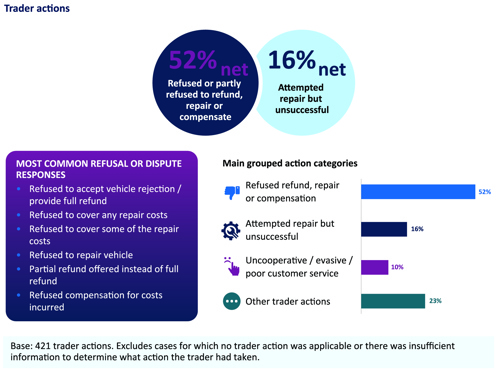
Motor finance adds layers of complexity
Motor finance was not the central subject of this investigation. The investigation focused on consumer experiences in the used-car market, including faults, trader conduct, remedies, complaint handling and routes to redress.
However, finance is relevant because many consumers use hire purchase, conditional sale or personal contract purchase agreements. Where problems arise, consumers may need to understand whether responsibility sits with the trader, finance provider or another party.
The wider motor finance commission issue has increased public and regulatory scrutiny of the sector. The FCA has introduced an industry-wide redress scheme for motor finance customers who were treated unfairly between 2007 and 2024.
This report does not examine historic commission arrangements or assess individual finance agreements. Its findings are limited to where motor finance affected consumers’ ability to understand responsibilities, pursue complaints or access redress.
In this investigation, around a third of sampled ADS cases involved some form of motor finance. However, finance providers accounted for a relatively small share of recorded counterparty actions, suggesting that some consumers may not have been clear about who to contact or who was responsible for resolving the issue. Where finance providers were involved, over half of recorded actions related to refusals to cancel agreements, provide refunds or cover repair costs.
ADS analysis indicates that, in around 18% of finance cases, consumers appear to have pursued the trader rather than the finance provider. This is significant because, where the vehicle is financed, contractual responsibility may sit with the finance provider. If this is not understood by the consumer and is not clearly explained at the point of sale, the complaint may begin down the wrong route.
This finding is consistent with the survey evidence discussed earlier, which showed that consumers who experienced problems contacted a range of organisations, including traders, warranty providers, finance providers, advice bodies and complaint processes. The ADS evidence shows why this matters in practice: where consumers pursue the wrong party, particularly in financed purchases, they may lose time before reaching the route most likely to resolve the complaint.
For consumers with serious faults, confusion over responsibility can be highly detrimental. They may remain without use of the vehicle while finance payments continue and may feel trapped between the dealer and lender. By the time they seek advice, they may already have spent weeks disputing the matter with the wrong party and may then face further delay while the correct complaints process begins.
CASE STUDY: Motor finance and confusion over who is responsible
A consumer acquired a used car through a hire purchase agreement from an independent trader. The consumer experienced a fault almost immediately, with the car getting stuck in gear shortly after they took possession of it.
The garage replaced the clutch and returned the vehicle to the consumer, but the same fault reappeared soon afterwards. The car was returned to the garage again. When the consumer raised the possibility of returning the vehicle and obtaining a refund, the trader reportedly became abusive.
The consumer had been dealing directly with the trader. ADS advised that, because the vehicle had been acquired through a hire purchase agreement, the consumer’s first point of contact should be the finance provider rather than the garage. ADS explained that the consumer’s contract was with the finance company and that the finance provider should deal with the complaint, including any potential short-term right to reject. The consumer was also advised that the finance company could take up to eight weeks to respond before the matter could be escalated to the Financial Ombudsman Service.
What this illustrates:
This case shows how finance arrangements can complicate redress. Where consumers and traders do not understand that responsibility may sit with the finance provider, the complaint can start down the wrong route. That can cause delay, frustration and further detriment, especially where the vehicle is unusable while the consumer remains liable under the finance agreement.
Location of traders subject to ADS cases
Trader location should be interpreted as a feature of sampled ADS cases, not as a measure of the wider distribution of used-car sales. The trader locations associated with cases were widely dispersed, spanning 102 different towns and cities in England, 72 in Scotland, 2 in Wales and 1 in Northern Ireland.
While approximately two thirds of cases involved traders based in Scotland, a particularly notable finding is that nearly a third (32%) related to purchases from traders in England, across a broad range of locations. Within Scotland, cases were most commonly linked to traders in the largest cities, with Glasgow accounting for the highest proportion (14%), reflecting both market concentration and sales volumes.
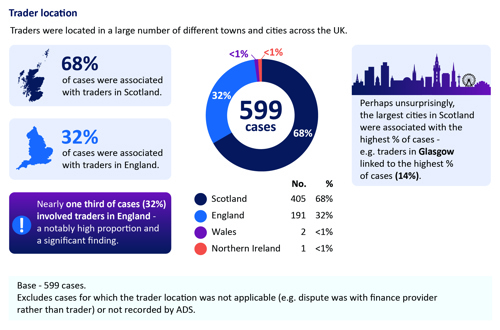
Trader types
Within the sampled ADS cases where trader type was recorded, most involved independent traders operating from a single location (57%). This does not show that independent traders account for most consumer detriment across the whole market, because ADS cases represent consumers who sought advice rather than all used-car purchases. However, it does indicate that independent traders featured prominently in escalated advice cases, including cases involving serious faults, remedy refusals, misleading descriptions and limited redress routes.
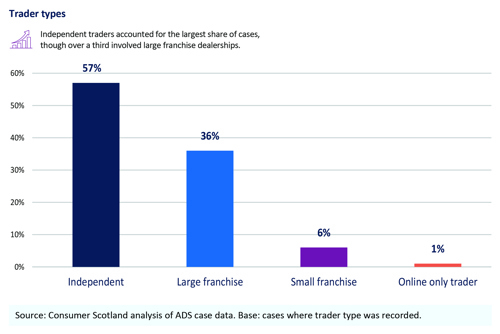
This finding is notable when compared with our survey of used car purchasers, discussed in Chapter 1, where 29% of respondents reported purchasing from an independent trader. The two figures are not directly comparable: the survey reflects purchasing behaviour across the wider market, while ADS data captures cases where consumers sought advice after experiencing a problem. However, the contrast between 29% of survey purchases and 57% of ADS cases where trader type was recorded suggests that independent traders may be over-represented in escalated advice cases. A potential explanation for this is that our survey also found that issues associated with purchases from independent traders had poorer resolution outcomes. When asked the extent to which an issue had been resolved, 54% of respondents who bought from an independent trader said it had been fully resolved, lower than the survey average of 64%. Conversely, 13% said the issue had not been resolved at all, higher than the survey average at 7%.
This should be treated as indicative rather than conclusive evidence, but it suggests that independent traders are an important focus when considering consumer detriment, complaint handling and access to redress.
A substantial proportion of sampled cases were also linked to large national or regional franchise groups, showing that serious disputes are not confined to smaller operators and can occur across the market. By contrast, relatively few sampled cases involved small franchise networks or online-only traders. This may reflect lower sales volumes, different consumer behaviour, different complaint routes, or other factors not captured in the ADS data.
General findings - What the ADS evidence analysis tells us
The survey shows the scale: ADS analysis shows escalation
The survey evidence showed that post-purchase issues are common among recent used-car buyers. The ADS case analysis provides a different, but complementary, view. It shows what can happen when those issues become serious, unresolved or contested, and when consumers reach the point of seeking external advice. In combination, the two sources suggest that vehicle faults after purchase are one of the central pathways through which consumer detriment arises in the used-car market.
Faults are the main pathway to harm
The ADS evidence indicates that many escalated disputes are not about minor dissatisfaction. They often involve vehicles becoming unusable, consumers facing unexpected repair costs, and disagreement about whether the trader, finance provider or warranty provider is responsible for putting things right. Over three quarters of sampled ADS cases involved an identifiable vehicle fault, and engine faults were the largest single category of complaint. Many of these cases involved major faults, indicating that consumers were often seeking advice after a breakdown or serious failure had affected their ability to use the vehicle.
Rights exist, but redress is contested
The timing of these cases is also significant. Around 80% of sampled ADS cases arose within the first six months of purchase. This is the period in which consumer protections under the Consumer Rights Act 2015 should be particularly important. However, the ADS evidence suggests that the existence of legal rights does not always translate into quick or effective redress. In practice, consumers may still face disputes about whether the fault was present at the point of sale, whether it reflects normal wear and tear, whether repair or rejection rights apply, and who is responsible for providing a remedy. Independent traders are prominent in escalated cases.
The comparison between survey and ADS evidence also suggests that independent traders are particularly prominent in escalated disputes. In the survey, 29% of respondents reported buying from an independent trader. By contrast, independent traders accounted for 57% of sampled ADS cases where trader type was recorded. These figures should not be treated as directly comparable, because the survey reflects purchasing behaviour across the wider market, while ADS data reflects consumers who experienced problems serious enough to seek advice. However, the scale of the difference suggests that independent traders may be disproportionately represented in cases involving consumer harm, contested liability and difficulties accessing redress.
This does not mean that detriment is confined to independent traders. A substantial proportion of sampled ADS cases involved large national or regional franchise groups, showing that serious disputes can occur across different parts of the market. The evidence therefore points to both a targeted issue - the prominence of independent traders in escalated cases - and a wider market issue around how faults, complaints and remedies are handled.
Distance can make redress harder
The survey suggests that buying entirely at a distance was a minority route among recent used-car purchasers. However, ADS case analysis found that nearly a third of sampled cases where trader location was recorded involved traders based in England. These figures measure different things and should not be treated as directly comparable and should not be seen as an issue for any one UK nation. Nonetheless, the contrast is important. It suggests that purchases at a distance may be disproportionately visible, potentially because distance makes it harder for consumers to return vehicles, obtain inspections, agree repairs, reject the vehicle or pursue redress. This is particularly relevant where the vehicle becomes unusable shortly after purchase, as consumers may face transport costs, recovery costs, continued finance payments and practical barriers to engaging with a trader located hundreds of miles away.
Finance and warranties add complexity
The ADS evidence also highlights how detriment can be worsened by complexity. Around a third of sampled ADS cases involved motor finance, and in some finance cases consumers appeared to pursue the trader rather than the finance provider. This reflects a wider theme from the survey evidence: when something goes wrong, consumers may contact traders, finance providers, warranty providers, advice bodies or complaints processes, but may not know which route is legally or practically responsible for resolving the issue. Where a vehicle is unusable, this confusion can prolong harm, particularly if finance payments continue while the consumer remains without access to a working car.
Escalation happens when responsibility is unclear
Overall, the ADS case analysis reinforces the central finding from the wider evidence base: consumer detriment in the used-car market is often driven by faults emerging after purchase, but it is intensified when responsibility is disputed, remedies are refused or delayed, and consumers are left navigating complex trader, finance and warranty arrangements. The evidence points to a need for clearer point-of-sale information, stronger complaint signposting, better understanding of Consumer Rights Act obligations, and more effective routes to redress when vehicles develop serious faults shortly after purchase.
Having considered what the ADS evidence tells us about how used-car problems escalate into disputes - the next section looks more closely at what is being contested in those disputes. It examines how consumer law applies to the issues raised in the case evidence, and the practical barriers consumers can face when trying to secure repair, rejection, refund or other redress.
Consumer expectations and complexity, risk and variability
Complex goods of uncertain history: why used car disputes become contested
A dominant theme from the evidence is that used cars are complex, variable products with uncertain histories. Trade stakeholders emphasised that modern vehicles contain highly integrated mechanical, electronic and software systems, meaning that not every fault can be identified or predicted at the point of sale. They also highlighted that used vehicles are affected by age, mileage, previous use, maintenance history and wear and tear, all of which can influence what it is reasonable to expect from a vehicle after purchase.
This creates an inherent tension. From a consumer perspective, a used car is often a major financial commitment and may be essential for active participation in work, family life and access to services. Consumers therefore expect a vehicle bought from a trader to be reliable, roadworthy, free from major faults and durable for a reasonable period. From a trader perspective, faults in older or higher-mileage vehicles may be viewed as an unavoidable feature of the used car market rather than evidence that the vehicle was not of satisfactory quality at the point of sale.
This is the conflict central to many disputes. Stakeholders, including trade representatives and ADR providers, pointed to a gap between consumer expectations and the realities of used vehicle sales. However, this should not be understood simply as consumers expecting too much or for used cars to be “as new”. The issue is more nuanced: consumers may accept that used cars carry some risk - but still expect significant faults shortly after purchase to be addressed by the trader. Disputes therefore arise when traders and consumers disagree about whether a fault reflects normal wear and tear, misuse, and a general conflict ensues as to whether the goods meet the legal standard of satisfactory quality.
The key concept of “satisfactory quality” is therefore important but difficult to apply in practice. The Consumer Rights Act 2015 requires an assessment of what a reasonable person would consider acceptable, taking account of factors such as price, age, mileage, description and other relevant circumstances. That flexibility is important, but it also creates room for disagreement. A consumer and trader may both consider their position reasonable, particularly where a fault emerges soon after purchase but the vehicle is older, higher mileage or lower value.
Satisfactory quality includes:
- Fitness for purpose: Safe, reliable everyday transport
- Freedom from minor defects: No unexpected faults beyond age and price
- Safety: Safe to drive
- Durability: Should last a reasonable time
- Appearance and finish: Condition should match what was represented
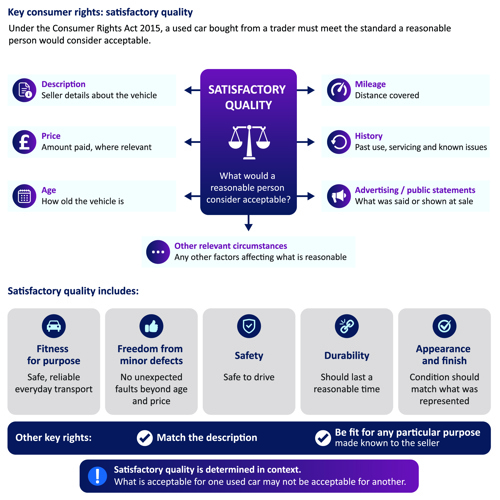
The same difficulty applies to the concept of ‘durability’ as an aspect of satisfactory quality. While consumers may reasonably expect that a vehicle should not suffer a major fault shortly after sale, traders may argue that some faults are consistent with age, mileage or normal degradation. In practice, assessing durability often requires judgement and, in some cases, technical evidence.
The post-sale six-month burden of proof resting on the trader is an important consumer protection because it recognises the imbalance of information and expertise between consumers and traders. However, the ADS evidence suggests that it does not always lead to quick or uncontested resolution. Traders can still argue that a fault was not present at sale, resulted from wear and tear, or was caused by the consumer’s use of the vehicle. Where responsibility is contested, consumers may still need strong independent reports or may have to escalate the case to ADR or court.
The practical problem is therefore that legal entitlement does not always translate into quick or effective redress. The law provides consumers with important protections, those protections depend on traders understanding and complying with them correctly, and on consumers being able to assert and evidence their rights in practice. This gap between rights in principle and resolution in practice is a key driver of used car disputes.
The requirement that used cars sold by traders must be of satisfactory quality is therefore central to consumer protection in this market. Where that standard is not met, consumers may be entitled to a range of remedies under the Consumer Rights Act 2015, including repair, replacement, price reduction or rejection of the vehicle.
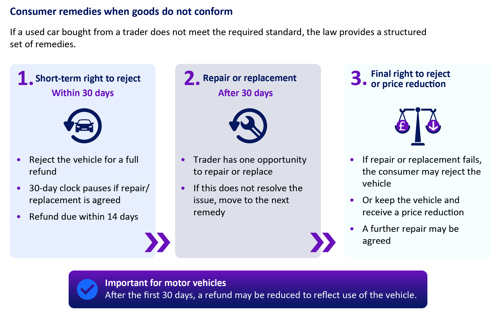
Securing a remedy can be difficult for consumers
The sampled ADS case analysis points to a consistent pattern of difficulty once consumers seek a remedy. Trader responses commonly involved refusing refunds, declining to cover repair costs, or carrying out repairs that did not resolve the issue. Even where traders did not refuse outright, cases often involved delay, partial offers or repeated repair attempts that prolonged the dispute.
This was particularly significant in relation to the short-term right to reject. The analysis found examples of traders, and sometimes finance providers, refusing rejection attempts made within 30 days. In some cases, consumers were told that the trader was ‘entitled’ to attempt a repair first; in others, the trader disputed whether the fault was serious enough to justify rejection. This points to recurring disagreement about how the right to reject applies in used car cases, particularly where “satisfactory quality” is contested. The harm for consumers is therefore not limited to the original fault. Difficulty securing a remedy can leave consumers with an unusable vehicle, ongoing costs and prolonged uncertainty. It may also place pressure on them to accept repairs or partial settlements rather than the remedy they believe they are entitled to.
CASE STUDY: Serious faults and disputed rejection rights
A consumer bought a used car from an independent trader in January 2024. Problems appeared almost immediately. On the journey home after collecting the vehicle, the car key fell apart, the consumer heard a whirring noise, and dashboard warnings appeared, including messages relating to engine servicing and tyre pressure. The consumer contacted the trader and sent photographs and video evidence of the issues. Within the 30-day period, the consumer attempted to reject the vehicle. The trader refused, saying the consumer would only be entitled to a refund if the car had a serious fault that was present at the time of sale.
The consumer then obtained an assessment from a third-party garage, which identified various major faults and described the vehicle as not fit for purpose. The trader did not wish to speak to the third-party garage and maintained that the consumer was not entitled to a refund unless a major fault had been present at the time of sale.
The dispute became highly stressful. The consumer said they were extremely anxious about losing the money paid for the car, could not afford to buy another vehicle, and needed their own transport for a new job due to start the following week. The outcome of the case was not recorded in the ADS data.
What this illustrates
This case shows how quickly a used-car fault can become a wider detriment issue. The dispute was not only about the mechanical condition of the vehicle, but about the consumer’s ability to exercise rejection rights, evidence the fault, engage with the trader and maintain access to essential transport.
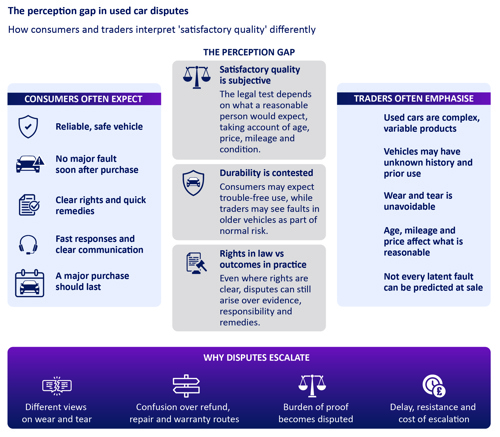
The recommendations in this report are intended to help narrow these perception gaps. Clearer consumer and trader guidance should help set more realistic expectations about satisfactory quality, durability, wear and tear, warranties and remedies. Stronger standards should support more consistent trader practice at the point of sale and when complaints arise. Clearer redress routes should make it easier for consumers and traders to understand how disputes can be resolved when agreement cannot be reached.
Summary findings
The evidence shows that used-car disputes most commonly arise after purchase, when faults - often serious - emerge and responsibility is contested. The survey evidence in Chapter 1 shows that post-purchase vehicle issues are common among recent used-car buyers, while the sampled ADS cases show how some of those issues escalate into disputes involving liability, remedies and redress. Many of these cases involved vehicles becoming unusable shortly after sale, creating immediate financial and practical pressure for consumers.
At the heart of many disputes is the difficulty of applying consumer rights to used vehicles in practice. Concepts such as “satisfactory quality”, durability, wear and tear, rejection rights and the burden of proof are clear in principle but highly contextual. Consumers and traders may therefore reach different views on whether a fault reflects normal deterioration or a failure to meet the required legal standard.
The evidence points to a need for stronger shared understanding across the sector. Clearer, practical guidance could help traders apply consumer rights more consistently, support consumers to understand what they can reasonably expect, and reduce the likelihood of disputes escalating unnecessarily. Improving dialogue between trade bodies, consumer advice services, advocacy organisations, Trading Standards and ADR providers will be important to building that shared understanding.
Recommendation: Strengthening practical guidance on used car rights and remedies
Lead: Scottish Motor Trade Association, working with Consumer Scotland, SCOTSS, Advice Direct Scotland, ADR bodies and other relevant partners.
The Scottish Motor Trade Association should lead a time-limited collaborative process to develop and promote clear, practical guidance on the application of consumer rights in the used-car sector. This should include:
- the application of “satisfactory quality” and durability to used vehicles
- the operation of the six-month burden of proof in practice;
- the correct use of remedies, including the short-term right to reject
- the interaction between statutory rights and warranties;
- examples of good practice in early complaint handling and resolution
- the information consumers should receive at or before the point of sale, including complaint routes, warranty limitations, ADR signposting and where responsibility sits when finance is used
The aim should be to reduce ambiguity, improve consistency across the sector, support responsible traders to comply with the law, and help consumers and traders resolve disputes earlier and more effectively. Appendix A summarises the main statutory framework underpinning these rights and obligations.
Independent traders featured prominently in ADS cases
The sampled ADS evidence suggests that independent traders featured prominently in more serious and escalated advice cases. This should not be read as showing that independent traders are associated with poorer outcomes across the whole used-car market, because ADS cases represent consumers who sought advice rather than all used-car purchases. However, within these cases, independent traders were associated with a higher proportion of major faults, remedy refusals, misleading description cases and escalation to court. Some sampled ADS cases involving independent traders also recorded financial strain, mental health impacts, poor communication, aggressive treatment or limited access to ADR or formal complaint routes. Several factors may help explain this pattern:
- Within the ADS sample and survey, independent traders were more commonly linked to lower- value vehicles and full upfront payments, both of which may increase consumer risk where faults arise. • Lower-value vehicles may be more prone to faults, while upfront payment can reduce consumer leverage and remove the involvement of a finance provider.
- Stakeholder and case evidence suggests that some independent traders may be less likely to participate in ADR schemes or codes of conduct, leaving consumers with fewer practical routes to redress.
Cross-border and distance-related purchases can create additional barriers
The evidence also points to cross-border and distance-related transactions as a source of complexity. Around one third of sampled ADS cases involved traders based in England, suggesting that consumer detriment is not confined to the Scottish market. Many consumers appear to be using online searches, travelling long distances, or engaging in partly remote transactions to access greater choice or lower prices. These “semi-distance” purchasing models can create uncertainty about rights, expectations and responsibilities. This aligns with the survey evidence in Chapter 1, which found that distance purchasing was a minority route overall but was more common among rural respondents and buyers from independent traders, and was associated with lower satisfaction.
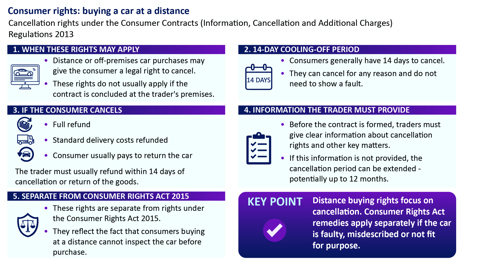
CASE STUDY: Buying at ‘a distance’ – cancellation rights and information
A consumer found a used car advertised online and viewed a video of the vehicle. This was the only form of pre-purchase inspection. The consumer then paid a deposit by bank transfer and the remaining balance when the vehicle was delivered to their home. The consumer did not have an opportunity to test drive or physically inspect the vehicle before payment was completed.
At delivery, the only person present was a delivery driver, who said they were contracted to deliver vehicles and was not employed by the trader. The consumer was not given a sales invoice, receipt or V5C registration document. The only documentation supplied was the new keeper slip and a stamped service book. The consumer later requested further documentation but reported that the trader did not respond.
On the first day of use, the consumer identified a fault when engaging second gear, with the vehicle producing a metal grinding noise. The consumer contacted the trader and requested a repair. The vehicle was collected and later returned, but the consumer reported that the fault remained and had worsened.
The circumstances raised questions about whether the contract was an off-premises sale, as the final payment was made when the vehicle was delivered to the consumer’s home. The consumer reported that they had not been given information about any cancellation rights or the paperwork required before the contract was concluded. Concerns were also raised about the trader’s identity and address, and the matter was reported to the police.
What this illustrates:
This case shows that risks that can arise where online and home-delivery sales do not provide consumers with clear pre-contract information, cancellation information, sales paperwork or reliable trader details. It also shows how disputes can become more difficult to resolve where consumers cannot inspect the vehicle before purchase and where the trader’s responsibilities, location or identity are unclear.
So it can be seen that distance and cross-border sales can also make redress harder in practice. Consumers may face difficulties returning vehicles, engaging with traders, arranging inspections, or enforcing remedies where the trader is geographically distant. Although distance-selling protections may apply in some cases, the ADS evidence does not definitively classify transactions in this way. This creates a further area of uncertainty, particularly where consumers are unclear about their cancellation rights or where sales are structured in ways that fall outside straightforward definitions of distance selling.
The ADS case analysis has provided important insight into more serious or escalated used-car disputes, including recurring issues around faults, complaint handling, trader location, distance-related purchases and routes to redress. While this evidence is not representative of all used-car purchases, it shows the value of consumer advice case information in identifying patterns of harm and areas where clearer guidance, better signposting or further compliance activity may be needed.
Recommendation: Strengthening consumer advice case intelligence on used-car complaints
Lead: Advice Direct Scotland and Consumer Scotland
Advice Direct Scotland and Consumer Scotland should work together to review how used-car advice case information can best support understanding of recurring consumer issues and routes to redress.
This should consider whether existing case information, or any future proportionate changes to recording practice, could help identify patterns relating to online and distance sales, cross-border purchases, trader location, complaint handling, ADR signposting and other factors relevant to consumer outcomes.
Consumer Scotland should also continue to work with Advice Direct Scotland and relevant partners to explore how aggregated or anonymised complaint intelligence can be shared, where appropriate, to support better understanding of recurring issues across the used-car sector and inform guidance, compliance activity and consumer protection work.
Any changes with resource implications should be subject to appropriate discussion of funding, feasibility and implementation. This should include consideration of the cumulative impact of any additional burdens on Advice Direct Scotland, including alongside ongoing or planned changes such as the review of advice and complaints codes.
Trader advice on consumer rights
The evidence from this investigation highlights the importance of responsible traders having access to clear, practical and sector-specific guidance on consumer rights. Many disputes in the used car sector appear to arise not only from alleged non- compliance, but from uncertainty, disagreement or inconsistent interpretation about how legal rights apply in real transactions.
This is particularly important in a market where vehicles are second-hand, technically complex and highly variable in age, mileage, price and condition. General statements of the law are unlikely to be sufficient on their own. This also responds to the survey finding that information provided before purchase was inconsistent, including low reported levels of information about complaints procedures, code membership and ADR.
Traders need guidance that explains how key consumer rights should be applied in realistic used car scenarios, including faults arising shortly after sale, the short-term right to reject, durability, the six-month burden of proof, repair and refund obligations, and the additional requirements that may apply to distance or off- premises sales. Business Companion, operated by the Chartered Trading Standards Institute, is a well-established and trusted source of practical consumer protection guidance. It has an important role to play alongside trade association advice, ADR schemes and local Trading Standards services in supporting traders to understand their obligations, resolve complaints earlier and prevent avoidable disputes.
Clearer guidance would also help improve consistency across the market and support consumer confidence, particularly where transactions involve online advertising, remote reservation, delivery, click-and-collect or cross-border sales.
Recommendation: CTSI to update Business Companion guidance on distance and cross-border used car sales
Lead: Chartered Trading Standards Institute
The Chartered Trading Standards Institute should, drawing on evidence from this investigation and the work of the Consumer Protection Partnership, review and update Business Companion guidance for the used-car sector.
The aim should be to ensure that guidance reflects the practical consumer protection issues arising from modern used-car purchasing, including point-of-sale information, online, distance, semi-distance and cross-border sales.
Updated guidance should provide clearer, sector-specific advice for traders on:
- when distance-selling cancellation rights apply, including transactions involving mixed or “semi-distance” elements;
- the information traders should provide before sale, including clear explanation of the nature of the transaction and the rights that apply;
- how traders should respond when faults arise shortly after sale, including the short- term right to reject, repair and refund requests, and the six-month burden of proof;
- expectations on traders to support practical access to remedies where the consumer lives some distance from the trader, including returns, repairs, refunds and timely communication; and
- how existing consumer rights apply to modern purchasing behaviours, including online advertising, remote reservation, delivery, click-and-collect and sales completed across local authority or national borders.
This would help responsible traders apply consumer law more consistently, reduce avoidable disputes and ensure consumers are not disadvantaged by the geographic or structural nature of the purchase.
The implications for consumers In vulnerable financial circumstances
Although the ADS data on vehicle value will not be wholly representative, the sampled cases suggest that lower-value purchases, particularly those under £10,000, feature prominently in advice cases. This matters because lower-cost vehicles may be purchased by consumers with less financial resilience, who may be least able to absorb repair costs, pay for an independent report, fund court action or replace the vehicle while a dispute is ongoing.
The case studies reinforce this point. A £3,500 -£5,000 car may be low value in market terms, but it can represent a household’s only affordable route into car ownership. It may also be the type of vehicle most likely to generate disputes about wear and tear, durability and reasonable expectations. This means detriment is not only about the number of complaints, but about where harm falls and who is least able to manage the consequences.
The impacts can be substantial. Case examples include consumers unable to afford another vehicle, travel to work, pay for evidence, or manage the stress and uncertainty of a prolonged dispute. Because cars are often essential for employment, childcare, caring responsibilities and access to services, a failed vehicle can quickly become more than a financial loss: it can disrupt daily life. These impacts may be harder to manage where consumers have fewer resources, lower confidence or less capacity to pursue a complaint. Cross-border or distance-based purchases can add further barriers, including the cost and difficulty of returning vehicles or maintaining effective communication with a distant trader. Complex finance arrangements and uneven access to ADR may also make it harder for consumers in vulnerable circumstances to secure redress.
Overall, the evidence points to the need for earlier, more accessible support so that consumers with limited financial resilience are not left to navigate complex disputes only after costs, delays and practical disruption have already escalated.
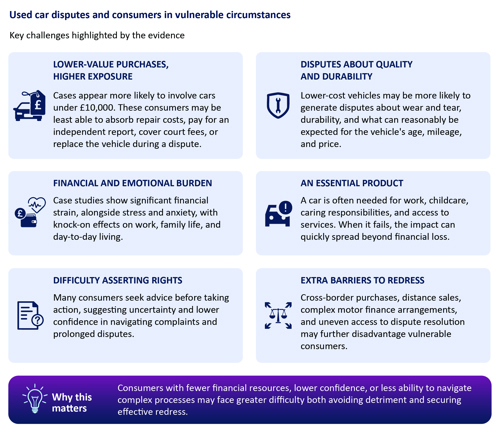
Recommendation: Strengthening support and protections for vulnerable consumers
Lead: UK Government / Department of Business and Trade (DBT), working with CPP partners, advice bodies and industry bodies.
The UK Government, through DBT and the Consumer Protection Partnership, should develop targeted measures to improve outcomes for consumers with lower financial resilience, particularly those purchasing lower- value vehicles or those less able to absorb the financial and practical consequences of a dispute.
This should include:
- clearer, accessible guidance tailored to lower-value purchases, setting out rights, risks and practical steps when problems arise
- improved signposting and early intervention through advice and support services
- measures to reduce the cost and complexity of pursuing remedies, including access to independent assessments and dispute resolution
- greater emphasis within industry standards and codes on the fair treatment of consumers in vulnerable circumstances
The aim should be to ensure that consumers most exposed to financial and practical harm are better supported to avoid detriment, understand their options and secure effective redress.
Resolving disputes: Complexity, fragmentation and delays
Resolving used car disputes: A fragmented redress landscape
Stakeholder evidence consistently describes the current dispute resolution landscape as complex, fragmented and difficult for consumers to navigate. Depending on the nature of the issue, consumers may need to engage with traders, finance providers, warranty providers, ADR bodies, advice organisations or regulators.
This creates uncertainty about who is responsible and where a complaint should be directed, particularly where finance or extended warranties are involved. Stakeholders reported that consumers may initially pursue complaints with the wrong party, leading to delay, duplication and frustration. This is consistent with the survey evidence in Chapter 1, which found that consumers who took action contacted a range of organisations, including traders, warranty providers, finance providers and advice bodies.
Practical pressures can also slow resolution. These include delays in obtaining repairs, shortages of technicians, rising ADR caseloads and increasing use of formal routes, including court action. ADR providers reported growing volumes of more complex cases, placing pressure on resolution times.
Overall, the collective evidence suggests that many disputes are not resolved efficiently at the earliest stage. Instead, unclear responsibilities, poor communication and delay can cause complaints to become more entrenched, costly and difficult to resolve.
Resolving used car disputes through the courts
For many consumers, court action is not a realistic or proportionate route to redress. In Scotland, Simple Procedure is limited to claims of £5,000, meaning that many used car disputes may fall outside this route. Higher-value cases require Ordinary Cause proceedings, which are more formal, usually more costly and may expose consumers to liability for the other party’s expenses if unsuccessful.
Even where Simple Procedure is available, consumers still face fees, evidential requirements, time commitments and uncertainty of outcome. Used car disputes are often technical and may depend on mechanical reports or expert evidence. This makes court action difficult for many consumers and underlines the importance of effective alternatives such as ADR.
Legal insight: recent case law in the used car sector
While individual cases turn on their specific facts, recent case law illustrates the practical challenges consumers may face when enforcing rights in used-car disputes. Cases can illustrate the gaps that can arise between strong consumer rights in principle and the practical difficulty of enforcing them. Claims may fail where consumers cannot provide clear evidence that a fault existed at the point of sale, as illustrated in David Adam v Moneybarn (2025). Courts also assess “satisfactory quality” in context, including age, mileage, price and condition, which can lead to outcomes that consumers may not expect.
At the same time, appellate authority has strengthened the consumer position. In Alan King v Black Horse (2024)41, the court confirmed that continued use of a vehicle does not necessarily defeat a previously exercised right to reject. However, cases such as Nash v Volkswagen Financial Services (2023) show that technical disputes can remain difficult and uncertain where expert evidence is contested.
Overall, the case law shows that the legal framework is robust, but litigation can be costly, evidentially demanding and unpredictable.
The emergence of claims management models and barriers to effective redress
The investigation also heard stakeholder evidence about the emergence of firms that pursue used-car complaints and court claims on behalf of consumers in return for a share of any settlement. Such models have developed in response to the difficulties consumers can face when enforcing their rights directly, particularly in higher-value or finance- related disputes.
Evidence from one such provider indicates that where disputes are prolonged by traders - through contested legal interpretations, repeated repair attempts, delayed responses, or lengthy complaint processes - these practices can undermine the practical value of time-bound consumer rights, including the short-term right to reject. The provider argued that they help to cut through these barriers by levelling the playing field in terms of bargaining power between the parties and by pursuing claims more robustly on behalf of consumers.
The emergence of these claims-management-style services is therefore notable. It indicates that some consumers are unable to secure effective redress without external intervention. While such services may assist individual claimants, their growth also points to wider weaknesses in the redress system: rights may be clear in law, but remain difficult to enforce in practice without considerable time, knowledge, or support.
ADR In the used car sector
Given the seriousness and complexity of used car complaints, more accessible, cheaper, and faster alternatives to court are essential. ADR should provide a quicker, less costly and more proportionate route to redress, particularly where disputes involve technical evidence, contested remedies or disagreement about the application of consumer rights. For many consumers, court action is unlikely to be practical because of cost, time, uncertainty and evidential demands. Key ADR and dispute-resolution routes relevant to the used-car sector are listed below.
ADR schemes in the used car sector
The Motor Ombudsman - is an independent, UK-wide ADR body that helps resolve disputes between consumers and automotive businesses, including those relating to vehicle sales, servicing and warranties, operating through CTSI-approved Codes of Practice.
AA Cars - operates an ADR and mediation service for disputes between consumers and its member dealers, supported by a CTSI-approved Code of Practice that sets standards for vehicle sales and complaint handling.
RAC Approved Garages - provides an alternative dispute resolution service for disputes between consumers and its member garages, operating under a CTSI-approved Code of Practice that sets standards for servicing, repairs and complaint handling.
The National Conciliation Service provides an ADR and conciliation service for disputes in the motor sector and is approved by the CTSI as an accredited ADR provider, although it does not operate a CTSI-approved Code of Practice.
The Financial Ombudsman Service - is an independent statutory body that resolves disputes between consumers and regulated financial businesses, including motor finance providers, making legally binding decisions based on what is fair and reasonable in the circumstances.
New ADR framework reinforces the importance of effective redress
Recent changes under the Digital Markets, Competition and Consumers Act 2024 strengthen the policy context for ADR. The Act replaces the previous 2015 framework and moves towards a more unified accreditation model for ADR providers. CTSI has an important role in this system, accrediting providers, monitoring standards and supporting greater consistency across the ADR landscape. Further detail on the ADR framework and related consumer protection legislation is provided at Appendix A.
Stakeholder evidence suggests that ADR can work well where it is embedded within Codes of Practice or membership-based schemes. In these contexts, there are clearer standards, defined escalation routes and stronger incentives for trader compliance. Early-stage mediation can also help resolve disputes before they reach formal adjudication.
However, the evidence also identifies important limitations. ADR is often reached only after disputes have become entrenched, but some cases may also escalate before there has been a meaningful opportunity for direct resolution. Access remains uneven, particularly where smaller or independent traders are not members of ADR schemes. Consumers may also face confusion where responsibility is split between traders, finance providers and warranty companies.
This aligns with the survey finding that relatively few respondents recalled being told before purchase whether the trader was part of an ombudsman or ADR scheme. Taken together with the ADS sampled evidence, it suggests that ADR may not be sufficiently visible to consumers at the point when it could help them understand their options.
ADR systems are also facing increasing pressure. Providers reported rising case volumes, more complex evidence and increasingly detailed submissions and expectations.
Access to ADR is not consistent across the used car market. Participation in ADR schemes is often voluntary, meaning some traders, particularly smaller or independent operators - may not be covered. Where ADR is unavailable, consumers may have limited options beyond court action. This creates uneven access to redress and widens the gap between consumer rights in theory and enforceability in practice.
Stakeholders identified emerging concerns about fairness and consistency in ADR outcomes. While this investigation did not identify clear evidence of systemic imbalance, these concerns reflect the pressure on ADR systems and the importance of transparent, consistent and trusted processes.
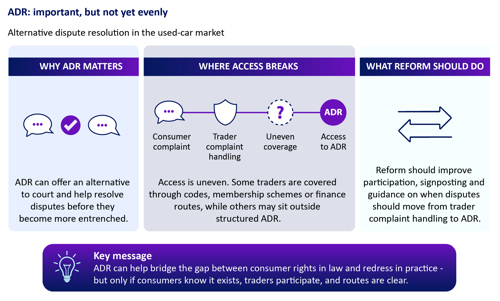
Overall assessment and direction of reform
Overall, the evidence suggests that ADR is a critical component of the consumer protection framework in the used car sector, providing an important alternative to court. However, its effectiveness is limited by inconsistent coverage, complexity in the wider system, and growing operational pressures.
There is a clear direction of travel emerging from the evidence: improving access to ADR, ensuring more consistent participation across the market, strengthening early-stage resolution, and providing clearer guidance to consumers on how and when to use ADR. Addressing these issues will be key to ensuring that consumer rights can be enforced in practice, without the need to rely on formal legal action.
Recommendation: Require better access to ADR in used-car disputes, with a particular focus on independent traders
Lead: CTSI, working with the Consumer Protection Partnership, ADR providers, industry bodies, consumer advice organisations and enforcement partners.
Consumer Scotland recommends that CTSI should use the opportunity created by the Digital Markets, Competition and Consumers Act 2024 to promote and strengthen access to ADR in the used-car sector.
This work should focus particularly on improving ADR coverage among independent used-car traders, where sampled ADS cases and stakeholder evidence indicate particular issues with serious faults, contested remedies, limited access to structured complaint processes and barriers to redress. While ADR is already embedded within parts of the market through Codes of Practice, membership schemes and finance-related routes, access and timescales remain inconsistent. This creates a gap between consumers’ statutory rights and their ability to enforce those rights in practice.
CTSI and partners should consider how the new ADR accreditation framework can support a more consistent and accessible redress landscape for used-car disputes. This should include exploring ways to increase trader participation in accredited ADR schemes, improve signposting to appropriate redress routes, and provide clearer guidance on when disputes should move from trader complaint handling to ADR. Particular attention should be given to avoiding unnecessary delay where time-bound rights, such as the short-term right to reject, may be affected.
The aim should be to make ADR a more practical, visible and trusted route to redress across the used-car market, including for consumers purchasing from smaller and independent traders. Improved ADR access would help reduce reliance on court action, support earlier resolution, improve consistency in outcomes and strengthen confidence in the sector.
A notable development is the increasing use of artificial intelligence (AI) tools by consumers to prepare complaints. While this can support access to information, stakeholders report that AI-generated submissions are sometimes overly confident in their legal merits, lack accurate interpretation of rights, and can obscure the core facts of the case. This can leave consumers with unrealistic expectations about likely outcomes, while also placing additional pressure on ADR processes by increasing the volume and complexity of case material that must be assessed.
5. Licensing, trading standards, and consumer codes
Key findings summary
- The regulatory framework is broad but fragmented: Licensing, Trading Standards, Police Scotland, Codes, ADR and assurance schemes all play a role, but the system remains fragmented.
- Second-hand dealer used car licensing is not fully aligned with the modern market: The CGSA framework is focused mainly on entry control, criminality and record-keeping, rather than modern consumer risks.
- The “fit and proper person” test provides only limited assurance: The test can exclude unsuitable traders, but does not consistently assess competence, complaint handling or future compliance.
- Licensing enforcement varies across Scotland: Enforcement benefits from partnership working, but limited resources and fragmented responsibilities affect consistency.
- The current system lacks graduated enforcement tools: There is a gap between informal engagement and serious sanctions, making persistent poor practice harder to address.
- Consumers may overestimate what a licence means: Consumers may assume licensing means stronger protection than it provides in practice.
- Trading Standards identifies recurring compliance gaps: The Scottish project found weaknesses in pricing, distance-selling information, cancellation rights, complaints and ADR signposting.
- Fair trading enforcement is resource constrained: Resource pressures limit proactive fair-trading surveillance and routine compliance checks.
- Consumer codes provide a valuable layer of protection: Codes can raise standards, improve complaint handling and provide clearer ADR routes.
- Such codes are valuable but uneven in coverage and visibility: Their impact depends on trader participation, consumer awareness, visibility and consistency between schemes.
Introduction: Examination and engagement
The preceding sections have set out the scale and importance of Scotland’s used car market, the experiences of consumers when problems arise, and the main drivers of disputes, including vehicle faults, contested remedies, unclear information and barriers to redress.
The survey evidence showed that consumers value signals of trader reliability, including code membership and the ability to check whether a trader holds a licence. It also showed that information about complaints procedures, code membership and ADR was not consistently provided before purchase.
Section 2 showed how some problems escalate into serious advice cases where faults, remedies, complaint handling and redress become contested. This chapter considers whether the regulatory and standards framework is sufficiently equipped to prevent those problems, support responsible traders and provide clearer routes for consumers when issues arise.
Effective regulation is essential in a market where purchases are high value - transactions are frequent, and sales increasingly take place online or across local authority and national boundaries. For consumers, the consequences of poor practice can be significant: financial pressures, loss of access to a vehicle, difficulty enforcing rights and prolonged stressful disputes over responsibility for faults or remedies.
This section examines the regulatory and standards framework that applies to second-hand vehicle dealers in Scotland. It considers how civic licensing, Trading Standards enforcement and voluntary Codes of Practice operate in practice, and whether they provide effective and consistent protection for consumers.
To inform this assessment, Consumer Scotland engaged with a wide range of stakeholders involved in the operation and oversight of the system, including local authority licensing services, local Trading Standards, Police Scotland, industry bodies, code operators and other regulatory partners. The evidence provides insight into the strengths and limitations of the current framework, and the opportunities to strengthen consumer protection in a modern, increasingly digital and geographically dispersed market.
The licensing of second-hand car dealers in Scotland
Unlike elsewhere in the UK, Scotland regulates second-hand vehicle dealers through a civic licensing regime under the Civic Government (Scotland) Act 1982 (CGSA).
The CGSA introduced a uniform code of law and procedure to regulate the issuing of licences by Scottish local authorities for a wide range of activities. In doing so, it replaced older, fragmented legal regimes, including the Burgh Police Acts, creating a more consistent and coherent system of civic licensing across Scotland. The overall founding principles of the CGSA was to:
- Maintain public order
- Ensure public safety
- Support crime prevention
The CGSA requires a person carrying on business as a second-hand dealer to hold a second-hand dealer’s licence, issued by the relevant local authority.
CGSA section 24 (1) …. a licence, to be known as a “second-hand dealer’s licence”, shall be required for carrying on business as a second-hand dealer. The framework applies to a range of second-hand goods activity, including the sale of used vehicles. In practice, this means that second-hand vehicle dealers in Scotland may be required to apply to their local authority, satisfy the relevant licensing criteria and comply with any conditions attached to their licence.
However, the CGSA is now more than 40 years old and was designed for a more local and analogue trading environment. Stakeholders consistently described the framework as outdated in language, process and application, with a stronger emphasis on criminal gatekeeping, local administration and record-keeping than on the consumer protection challenges that arise in a modern, digital and cross-border market.
Licensing under the CGSA therefore forms one part of a wider regulatory framework for the used car sector in Scotland. It operates alongside consumer protection legislation, Trading Standards enforcement, Police Scotland activity, industry odes of Practice, ADR arrangements and other forms of trader assurance.
The key issue for this investigation is whether the current licensing framework can support effective consumer protection in Scotland’s used car market.
Second-hand car licensing system framework: Fit for modern markets
Although the CGSA establishes a system for regulating second-hand vehicle dealers, the evidence suggests that it does not currently deliver its full potential as a consumer protection tool. The framework was developed in a period when the primary regulatory concern was the prevention of criminality within the trade which had become notorious for vehicle theft, car-clocking and the resale of stolen vehicles.
Those risks remain relevant, but the nature of consumer harm in the sector has changed. The evidence considered in this investigation suggests that consumer harm in the used-car sector today is often linked to vehicle quality (particularly faults), unclear or incomplete information, contested remedies, complaint handling, digital sales practices, finance, warranties and access to redress.
Stakeholders broadly agreed that the current framework is not well aligned with these modern risks. While licensing can provide a basic mechanism for controlling entry to the market and responding to serious misconduct, it does not consistently support ongoing compliance, trader competency, transparency for consumers or effective routes to redress.
This matters because consumers may reasonably expect that ‘a licensed dealer’ has met a meaningful standard of competence, accountability and consumer protection. This is particularly relevant given the survey finding that almost two thirds of respondents were aware of used-car licensing and a similar proportion said it would have been helpful to check whether a trader held a licence.
In practice, however, the current framework provides limited assurance about how a trader will behave once licensed, or whether they have the knowledge, systems and processes needed to broadly comply with consumer protection law.
This also raises an important question about whether second-hand vehicle dealer licensing should remain primarily a gatekeeping and record-keeping mechanism, or whether it can be strengthened to play a more active role in supporting fair trading, improving transparency and reducing consumer harm.
In summary – a key finding from this investigation was that the current second-hand vehicle dealer licensing framework is not well aligned with the modern used car market. It provides a mechanism for controlling entry to the market and responding to serious misconduct, but it does not consistently support transparency, competency, complaint handling or access to redress.
This is relevant considering the impacts of complaints in the used-car sector and ongoing efforts by public bodies across the UK to improve consumer outcomes, including the policy consideration of the UK Government for stronger dispute resolution mechanisms such as mandatory ADR. Against this backdrop, the following section examines how aspects of the second-hand vehicle dealer licensing system operate in practice - and considers the opportunities for it to be strengthened to improve outcomes for consumers.
Used cars and civic licensing: the "fit and proper person" test
Under the general provisions of the system a licensing committee may refuse an application or renewal if, in the Committee’s opinion: “the applicant or, where the applicant is not a natural person, any director of it or partner in it or any other person responsible for its management is not a fit and proper person to be the holder of the licence” The test is intended to provide a safeguard by allowing licensing authorities to prevent unsuitable persons from operating in the sector. However, stakeholder evidence suggests that, in practice, it operates as a relatively narrow and inconsistently applied threshold. Assessments tend to focus on criminal convictions or serious misconduct, with more limited consideration given to wider indicators of poor trading behaviour, such as repeated consumer complaints, complaint-handling failures, previous director conduct, or patterns of non- compliance with consumer protection law.
This limits the test’s value as a tool to effectively monitor ongoing standards. While it may help exclude the worst actors from the market, it does not provide a reliable assessment of whether a trader has the basic competence, systems or commitment needed to operate fairly and comply with consumer protection obligations. Its application also varies across licensing authorities, reflecting the absence of a clear statutory definition of “fit and proper person” within the CGSA.
As a result, the test functions more as a basic safeguard against criminality than as a meaningful assessment of likely trading standards. This creates a gap between the consumer expectation that a licensed dealer has met a recognised standard of accountability and the more limited assurance that the current licensing test may provide.
The evidence suggests that while the “fit and proper person” test provides an important basic safeguard, it is not sufficiently connected to the behaviours and systems most relevant to consumer protection in the used-car sector. Its current application does not consistently assess basic trader competence, complaint-handling arrangements or the likelihood of future good practice.
Compliance arrangements: Enforcement and compliance in practice
The enforcement of second-hand vehicle dealer licensing operates within a multi-agency framework, with responsibilities shared across Police Scotland and Scotland’s 32 local authorities. In practice, the day-to-day monitoring of compliance with licence conditions is by local authority officers, including Licensing Standards Officers (LSOs), Licensing Enforcement Officers (LEOs) or Civic Government Licensing Officers (CGLOs). In some areas, Trading Standards Officers (TSOs) also play a regulatory role, particularly where licensing issues intersect with wider consumer protection concerns.
Police Scotland’s role is more focused and distinct, with responsibility for addressing unlicensed trading and exercising inspection powers to prevent and detect criminal activity, including the handling of stolen vehicles and ensuring vehicle traceability. At a national level, coordination between Police Scotland and local licensing authorities is supported through the Violence Prevention and Licensing Co-ordination Unit (VPLCU), alongside established forums for collaboration and information exchange, including engagement through the Society of Local Authority Lawyers & Administrators in Scotland (SOLAR).
Stakeholder evidence suggests that, in principle, this system of shared responsibility is supported by strong working relationships and established mechanisms for cooperation at both local and national levels.
In practice, enforcement activity is often engagement-led, with a focus on securing compliance rather than pursuing formal sanctions. This can be proportionate and effective where businesses are willing to improve. However, stakeholders identified continuing difficulties in tackling persistent non-compliance and unlicensed trading, particularly where resources are limited or where conduct does not clearly meet the threshold for formal action.
The evidence therefore points to a system with strong foundations for partnership working, but uneven practical capacity. Limited resources, fragmented responsibilities and inconsistent intelligence-sharing can make it difficult to identify and address persistent poor practice, particularly where issues sit between licensing, trading standards and police enforcement.
Limitations in enforcement tools and licence conditions
While the licensing framework provides a mechanism for oversight, the tools available to enforce compliance are relatively limited. In practice, enforcement action often depends on breaches of licence conditions being escalated to licensing committee hearings, where a licence may be suspended or revoked. Referrals may also arise where a trader has been convicted of a relevant offence.
These routes are important, but they sit at the more serious end of the enforcement spectrum. They are not always well suited to addressing repeated lower-level poor practice, weak complaint handling, misleading information, or patterns of non- compliance that may cause consumer harm but fall short of the threshold for revocation.
Stakeholder evidence suggests that this creates a gap between informal engagement and formal sanctions. Regulators may be able to advise, warn or encourage compliance, but have fewer graduated tools to address persistent poor practice before it escalates into more serious harm.
Criminal enforcement is also constrained in practice. Prosecutions relating to unlicensed trading or consumer protection offences may be deprioritised within the wider criminal justice system, reflecting resource pressures and competing public interest priorities. This can reduce the deterrent effect of enforcement and contribute to a perception that serious cases do not always progress.
Overall, the current system lacks a modern, flexible set of enforcement tools that would allow regulators to respond proportionately to different types and levels of non-compliance. This limits the ability of the licensing regime to drive consistent standards, address repeated poor practice and respond to emerging risks in the sector.
Why licensing should matter for consumers
Consumers often assume that a licensed dealer meets meaningful standards of competence, accountability and consumer protection standards. Survey findings show that 64% were aware of licensing requirements and 63% said it would be helpful to check whether a business holds a licence. However, in practice, the framework offers limited assurance about how a trader will behave once licenced.
For example, there is no consistent mechanism for ongoing monitoring, no common baseline for consumer protection standards, and limited public transparency about what a licence means. It is not always easy for consumers to check whether a trader is licensed, understand what standards a licence requires, or know how to report concerns about licensed or unlicensed traders.
This gap is particularly important because the evidence considered in earlier chapters suggests that sampled ADS cases featured independent traders prominently, particularly in cases involving faults, disputed remedies, poor complaint handling and difficulty securing redress. While many independent dealers operate responsibly, this pattern points to the need for clearer and more consistent baseline standards across this part of the market.
Licensing should be one of the mechanisms for supporting those standards. At present, it can help exclude the most serious actors, but it does less to promote good practice, prevent harm or support consistent standards across the market. Strengthening minimum expectations around consumer law awareness, complaint handling, redress signposting and recognised good practice would help licensing operate as a more proactive consumer protection tool.
Can and should licensing deliver better consumer protections?
The position of consumer protection under second hand licensing was complicated by the House of Lords decision in Stewart (AP) (Respondent) v. Perth and Kinross Council (Appellants) (Scotland) [2004] UKHL 16. Although the case clarified the limits of local authority powers under CGSA, in doing so, it introduced uncertainty about the scope of licensing as a potential tool to protect consumers.
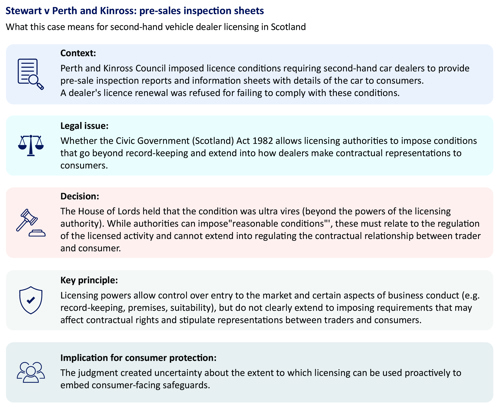
While the court confirmed that licensing authorities can impose conditions to regulate aspects of a dealer’s business, it drew a boundary where such conditions begin to interfere directly with contractual relationships and representations between traders and consumers. In practice, this created uncertainty about how far authorities can currently go in designing conditions intended to raise standards and support consumer protection in the sector.
The result was a less confident and variable enforcement approach across local authorities, with some reluctant to risk going beyond the limits of their powers under consumer protection. This lack of clarity, combined with constrained enforcement capacity, has had a limiting effect on the use of the licensing scheme to deliver fair trading in the sector. It further weakens the consistency and effectiveness of the regime as a means of delivering robust consumer protection outcomes.
Although the Perth case limited the conditions in terms of prescriptive contractual information, it did not close the door on consumer protection conditions for CGSA used car dealers. Licensing is recognised as a mechanism for safeguarding the public from dishonest or unscrupulous trading, and authorities do retain discretion to frame licence conditions that promote consumer protection outcomes. While this power cannot be used to interfere in the substantive terms of trade between businesses and consumers, it nonetheless allows for a wide range of measures aimed at shaping trader conduct and supporting consumer confidence.
“My object in expressing the views which I have set out in this judgment, however, is to make it clear that they can exercise those powers for the purposes of consumer protection, so long as they do not interfere with the terms of trade between dealers and customers. I think that that still leaves them with a good deal of scope to fulfil the objects of the legislation by suitably framed conditions”. Lord Carswell - Stewart (AP)(Respondent) v. Perth and Kinross Council (Appellants)(Scotland)
Other areas of civic licensing enforce basic competency and standards
The limitations in second-hand vehicle dealer licensing should be seen alongside how other activities are regulated under the wider CGSA framework. In several areas, civic licensing goes beyond basic entry checks and record-keeping. It is used to set expectations around competency, conduct, safety, transparency and public protection.
For example, taxi and private hire licensing can include local knowledge tests, medical standards, disability awareness training, visible identification, fare transparency and conduct requirements. Skin piercing and tattooing licences can include hygiene, sterilisation and premises standards. Public entertainment licensing can include fire safety, crowd management, emergency procedures and nuisance controls.
These examples are not direct comparators to second-hand vehicle dealing, but they illustrate that civic licensing can, where powers and conditions are clear, support minimum standards, preventative regulation and public confidence.
Minimum standards within selected CGSA-licensed activities
| Licensed activity | Examples of minimum standards/licence conditions |
|---|---|
| Taxi & Private Hire Drivers (Schedule 1 – Civic licensing of drivers, vehicles and operators) | • Competency & fitness: local knowledge tests, Group 2 medical standard, disability training • Conduct: civil behaviour, no unreasonable refusals, passenger assistance • Consumer protection: transparent fares, reasonable routes, lost property handling • Accountability/Transparency: visible ID badge |
| Taxi/Private Hire Booking Offices (Schedule 1 – Civic Licensing of vehicles, drivers and operators) | • Operational controls: mandatory record keeping of bookings, drivers and vehicles. • Consumer protection: traceability of journeys to support complaints and enforcement |
| Skin Piercing / Tattooing (Schedule 1 – Skin piercing and tattooing) | • Public health protections: hygiene, sterilisation, infection control procedures • Premises standards: inspection requirements and safe equipment use |
| Public Entertainment (Schedule 1 – Public entertainment licensing) | • Safety & risk management: fire safety compliance, crowd capacity limits, emergency procedures • Public protection: noise control, nuisance mitigation, stewarding requirements |
| Window Cleaners (Schedule 1 – Window cleaner licensing) | • Basic safeguards: public liability insurance, individual licensing of operatives • Public protection: identifiable, licensed individuals carrying out work |
| Late Hours Catering (Schedule 1 – Late hours catering licensing) | • Public safety: hygiene, waste management, and operating standards (often aligned with environmental health). • Public nuisance controls: hours, noise, and anti-social behaviour mitigation |
| Second-hand Vehicle Dealers (Schedule 1 – Second-hand dealers) |
• Limited baseline requirements: primarily subject to the “fit and proper person” test and basic record keeping • Absence of defined competency standards: no requirement for training, qualifications, or knowledge of consumer law • Limited consumer protection conditions: no ADR participation, Code of Practice, or transparency requirements • Inconsistent local conditions: additional requirements are variable not systematically linked to consumer outcomes |
The Task Force On Civic Licensing Reform
There is a growing recognition across the licensing system that the CGSA may be outdated in terms of process and language and no longer fully supports the way many licensed activities, businesses and markets now operate. The CGSA is more than four decades old and its licensing provisions cover a wide range of activities and businesses, including taxis and private hire cars, public entertainment, boat hire, short-term lets, late-hours catering premises, street traders and second-hand dealers.
These wider concerns about the CGSA led to the establishment of the Scottish Government’s Task Force on Civic Licensing Reform, which has been asked to review the licensing provisions of the CGSA and make recommendations on possible reform. The Task Force brings together practitioners from across the licensing system, including local authorities, Police Scotland, Trading Standards, licensing standards officers and other relevant interests. Its work is considering whether the current legislative framework remains capable of supporting effective civic licensing in a modern context, including in relation to consistency, proportionality, enforcement, public protection, administrative effectiveness and the impact of technological and market change.
Consumer Scotland has closely engaged with the Task Force during this investigation, including discussions about how the issues identified in second-hand vehicle dealer licensing sit within the wider reform of civic licensing. That engagement has helped inform Consumer Scotland’s assessment of whether the current framework can support effective, consistent and modern licensing outcomes for consumers.
The limitations identified in this chapter - including outdated terminology, inconsistent local application, limited public transparency, variable conditions and an uncertain link to consumer protection outcomes - reflect wider questions about whether the CGSA remains fit for purpose. Reforming the civic licensing framework in Scotland therefore provides an important opportunity to clarify the purpose of licensing; to modernise its operation and strengthen its ability to prevent harm, support compliance and improve outcomes for consumers and citizens in a user-centred system, aligned with the public service reform agenda and better suited to digital, distance, and cross-border markets, particularly where consumer protection risks arise.
The findings of this investigation point to two distinct but complementary routes for improvement.
- The first requires legislative reform of the civic licensing framework to modernise its purpose and operation.
- The second identifies practical measures that can be taken within the current framework to improve consistency and strengthen consumer protection outcomes in the interim.
Recommendation: (Requires Legislative Reform) Modernise Scotland’s civic licensing framework
Lead: Scottish Government.
This recommendation is contingent on wider legislative reform of the CGSA and reflects the need for structural change to the licensing framework.
The Scottish Government should as a priority implement the findings of its Task Force on Civic Licensing Reform and use its recommendations to bring forward a modernised framework for local civic licensing in Scotland that delivers a clearer, more consistent and be user-centred system aligned with the public services reform agenda. In doing so the recommendation does not replace the principals of the CGSA to uphold public order, public safety and crime prevention but updates and extends them for a modern context.
Reform should also create a framework better suited to digital and cross-boundary markets, including sectors where traders operate online, across local authority boundaries or under multiple licensing jurisdictions. This should include a clearer overarching statutory purpose for civic licensing, stronger national guidance, greater consistency in local authority practice, improved support for enforcement. It should also enhance public transparency addressing current challenges where it is not always easy for consumers to check if a trader is licensed, understand what standards a licence requires, or know how to report concerns about licensed or unlicensed traders so that consumers understand what licensing is intended to provide and how to raise concerns.
While legislative change may be required to deliver framework modernisation - improvements can be made while that is pending. In any case the Scottish Government should also seek to address concerns by urgently supporting the ‘best practice’ approach explored below.
Summary of second-hand car dealers’ licensing
Overall, the evidence assessment of the CGSA suggests that the current licensing framework for second hand cars is not well aligned with the realities of a modern, complex and increasingly digital market. Its design was for an analogue administrative model, and in practice it can operate as a narrow criminal gatekeeping system – missing the potential for better standards of trading and better consumer outcomes. This is reinforced by variation in how licensing is applied across local authorities, resulting in uneven standards and reduced confidence for both consumers and traders.
The operation of key elements within the framework further limits its effectiveness. The “fit and proper person” test - while intended as a safeguard - is not defined in statute and is applied inconsistently, with limited connection to the factors most closely associated with consumer harm or future compliance.
A best practice model for second-hand vehicle dealer licensing would provide a practical way to strengthen the current system without removing local authority discretion. Such a model could help licensing authorities consider how licence conditions, guidance and public information might better reflect the realities of the modern used car market. It could also support more consistent expectations for traders, clearer information for consumers and a more level playing field for responsible businesses.
A model approach could cover areas such as consumer law awareness, transparent pricing, complaint handling, ADR signposting, online sales, warranties, finance-related information, record- keeping, and membership of recognised codes or equivalent assurance schemes where appropriate. The aim would not be to regulate individual contractual disputes through licensing, but to use licensing more effectively to support fair trading, prevent harm and improve consumer confidence.
Recommendation: (Deliverable under current framework): Best practice conditions for second- hand vehicle dealer licensing in Scotland
Lead: local authority licensing leaders, working with SCOTSS, The Scottish Motor Trade Association and Consumer Scotland.
This recommendation could be implemented within the existing powers of the CGSA, without requiring legislative reform.
In the absence of full legislative reform of the CGSA and its framework, local authority Licensing leaders, Trading Standards leaders (SCOTSS), the SMTA and Consumer Scotland should work together to develop best practice conditions for second-hand vehicle dealer licensing in Scotland. Whilst respecting local democratic accountability and the autonomy of individual licensing authorities, it is important to protect consumers under the current licensing framework in the used car market, as well as provide greater consistency in how licences are used to raise standards within this sector.
The work should examine how licence terms and conditions can be updated to better reflect the modern used car sector - including online sales, cross-border trading, vehicle finance, warranties, complaint handling and routes to redress. It should also consider how licensing can provide clearer consumer protection outcomes, including greater transparency about what a licence does and does not mean, how consumers can check whether a trader is licensed, and how concerns about licensed or unlicensed traders can be reported.
As part of this work, partners should consider whether a core set of standard or model conditions could be developed for second- hand vehicle dealer licences to illustrate best practice. These could examine the potential inclusion of issues such as minimum competency expectations, compliance with consumer protection law, transparent complaint-handling processes, signposting to ADR, and membership of an approved Code of Practice or equivalent standards scheme where appropriate.
Any model conditions should be developed with careful regard to the limits of licensing powers, including the need to avoid regulating individual contractual terms, while still supporting lawful and proportionate consumer protection outcomes. It is important to identify what can be improved to strengthen consumer protection under the current licensing framework, while longer- term legislative reform is considered.
The outcome should be a practical best practice model for second-hand vehicle dealer licensing that licensing authorities can adopt or adapt locally. This should help modernise the use of licensing in the sector, support responsible traders, improve consistency across Scotland, raise standards and strengthen consumer protection in the used car market.
Taken together, these recommendations combine longer-term structural reform with shorter-term, deliverable improvements, allowing progress to be made both within the existing system and through future legislative change.
| Recommendations for licensing | Type | Delivery |
|---|---|---|
| Modernise civic licensing framework | Structural reform | Requires legislation |
| Best practice licence conditions | Operational improvement | Within current powers |
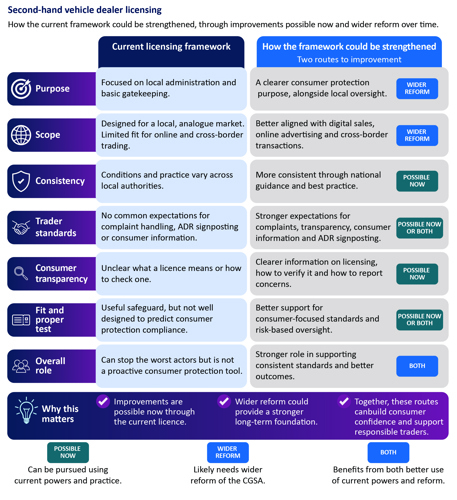
Consumer protection
Scottish Trading Standards: Compliance and enforcement
Licensing is only one part of the regulatory framework for the used car sector. Trading Standards services play a central role in addressing unfair trading practices, misleading information, pricing issues, complaint handling failures and wider breaches of consumer protection law.
SCOTSS highlighted that the used car sector remains a significant and persistent source of consumer harm in Scotland. Disputes often involve high-value purchases, complex evidence and consumers who rely on their vehicle for work, family life and essential travel. This is particularly crucial in rural areas of the country where provision of public transport services is sparse and sometimes non-existent. From a Trading Standards perspective, problems can arise across the full consumer journey, including advertising, vehicle descriptions, pre-sale checks, warranties, complaint handling and access to redress.
Formal enforcement action is not always taken in every situation, but only where it is warranted and where resources allow, through constructive engagement with businesses to ensure future compliance. This reflects the reality of constrained resources within local authority Trading Standards services (LATS), where activity must be prioritised based on risk, scale of harm, and the likelihood of effective intervention. Current pressures - particularly the need to respond to tobacco and vape-related enforcement - further limit capacity. As a result, individual disputes are unlikely to be investigated or pursued through formal enforcement, especially where issues are more appropriately addressed through private redress and there is no evidence of wider or repeated non-compliance.
The evidence nevertheless highlights the important role of Trading Standards in identifying patterns of harm, supporting compliance, and taking action where poor practice is systemic or repeated. Its effectiveness, however, depends on available resources, strong intelligence-sharing, and the ability to target activity at areas of greatest consumer detriment.
One part of the wider compliance landscape is Primary Authority, which can support more consistent regulatory advice for some businesses operating across multiple areas. Where Primary Authority works well for larger franchised dealerships it is limited when addressing enforcement across independent dealerships where trader resources may be restricted.
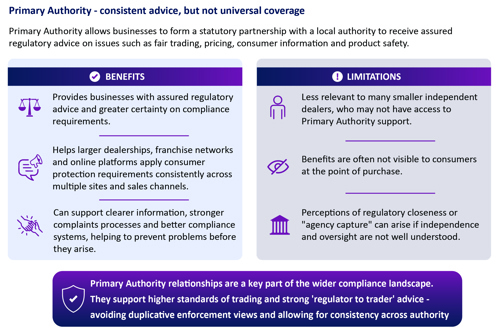
SCOTSS – Used car dealer project 2025/2026
In response to high levels of complaints and a lack of recent coordinated activity in the sector, SCOTSS conducted its Car Dealer Project 2025-2026 to assess how consumer protection requirements are presented and applied across used car sales, both online and at dealership premises.
The project focused on whether dealers provide clear pre-purchase information, comply with distance-selling requirements, present prices transparently, and signpost post-sale rights and redress routes.
The project was carried out in two parts. Part A reviewed dealership websites, including trader identity, contact details, pricing information, regulatory or scheme membership claims, and online sales features such as purchase, reservation or click-and-collect. Part B involved onsite inspections, covering vehicle documentation, pre-sale checks, pricing practices, complaints procedures, ADR signposting, second-hand dealer licensing, finance-related registration and electric vehicle information.
The project suggests that many dealers are meeting basic expectations around trader identity, vehicle documentation, pre-sale checks, licensing and finance-related registration. However, it also identified recurring weaknesses that may limit consumers’ ability to make informed decisions, compare offers, understand their rights, and access redress when problems arise.
These findings also align with the survey evidence in Chapter 1, which found that information about complaints procedures, code membership and ADR was not consistently provided before purchase. The SCOTSS project provides regulatory evidence of similar weaknesses in trader information, complaint handling and redress signposting. The main findings are set out below.
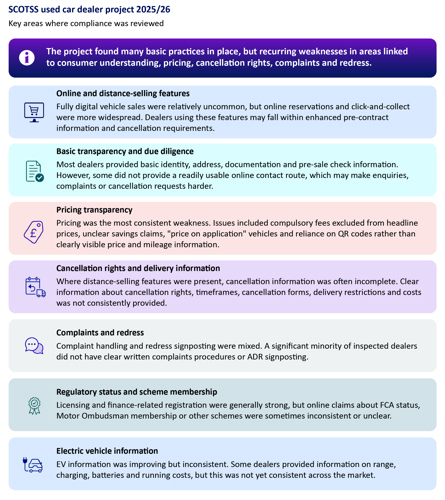
Overall, the SCOTSS project highlights a sector where many basic compliance practices are in place, but important gaps remain in areas closely linked to consumer harm. Key risks include weak signposting of complaints and redress routes, inconsistent presentation of regulatory status, and uneven EV information. The pricing weaknesses identified by the SCOTSS project are particularly significant because they concern basic fair-trading requirements. Issues such as unclear headline prices, compulsory fees being added separately, or reliance on QR codes rather than clearly displaying price information, can make it harder for consumers to compare offers and understand the total price payable. These discrepancies also point to the practical limits of Scotland’s fair-trading enforcement. In a resource- constrained environment, Trading Standards services have limited capacity for proactive market surveillance, routine compliance checks and follow- up action. As a result, basic regulatory requirements may be applied unevenly, and standards slip - weakening consumer confidence and creating an unfair advantage for traders who do not invest in compliant practices.
These findings support a targeted, risk-based approach by Trading Standards, combining advice and guidance with proportionate enforcement where businesses fail to comply.
Recommendation: Dissemination of the SCOTSS Car Dealer Project 2025–2026 to used car dealers and relevant trade bodies
Lead: SCOTSS, working with Consumer Scotland and the Scottish Motor Trade Association.
SCOTSS should work with Consumer Scotland and the Scottish Motor Trade Association to disseminate the findings of the SCOTSS Car Dealer Project 2025–26 to used car dealers and relevant trade bodies. This engagement should focus on the areas where the project identified the greatest risk of consumer detriment, particularly pricing transparency and the provision of key pre-contract information.
The work should support traders to understand and meet their obligations, including ensuring that headline prices include unavoidable charges, pricing claims are accurate and not misleading, consumers are given clear information about cancellation rights and delivery costs, and complaints and redress routes are clearly signposted. This would provide a practical route for improving compliance across the sector, while supporting fair competition and reducing avoidable harm for consumers.
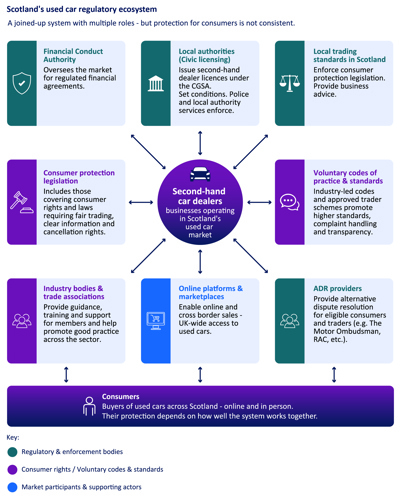
Consumer protection: Voluntary and approved codes of practice
Self-Regulation: Codes of practice in the used car sector
Voluntary Codes of Practice play an important role in supporting higher standards in the used car sector. While they do not replace statutory protections, licensing or Trading Standards enforcement, they are a vital system that raises standards of trading and translates legal obligations into practical expectations for traders. This is particularly important considering the constrained resource environment within which public enforcement now operates. Well-designed codes can strengthen compliance by setting clear standards on advertising, pricing, vehicle descriptions, complaints handling, redress and customer service.
This is also relevant to the survey evidence in Chapter 1, which found that only a minority of respondents recalled being told whether the trader was a member of a Code of Practice or trusted trader scheme, despite many consumers valuing signals of trader reliability.
Codes approved under the Chartered Trading Standards Institute’s Approved Code Scheme are particularly important because they are subject to independent oversight and meet defined core criteria. These include requirements around governance, consumer information, complaints handling, access to ADR, monitoring, reporting and sanctions. In a market where consumers may face complex disputes and significant financial losses, approved codes provide an additional layer of assurance and a clearer route to redress.
The CTSI Approved Code Scheme (formerly known as the Consumer Codes Approval Scheme - CCAS) fosters trust and high customer service standards by approving business codes of practice. It helps consumers avoid rogue traders and ensures businesses offer high standards of protection, including robust ADR processes.
However, the protection offered by codes depends on their coverage, visibility and compliance mechanisms. Participation is voluntary, and consumers may not always know whether a dealer is covered by a code, what protections apply, or how to escalate a complaint. Codes also vary in how clearly they set out complaint handling expectations, ADR routes, reporting information and sanctions.
Overview of key motor trade codes
Note: figures reflect information available as of 15 January 2026, based on the evidence provided.
| Aspect | AA Cars Dealer Promise Code CTSI approved | The Motor Ombudsman Vehicle Sales Code CTSI Approved | RAC Used Vehicle Code CTSI Approved | SCOTTS Approved Trader Scheme |
|---|---|---|---|---|
| Coverage/scale | Around 1,865 dealer members. Significant ADR use through its approved provider | Largest scheme considered. TMO has over 8,500 members across its major codes and a high volume of ADR cases | Smaller scheme with around 205 dealer members | Scotland-wide scheme for traders without access to a Trusted local Trader scheme |
| Core model | Online marketplace with a dealer promise attached to participating dealers. ADR provided through the National Conciliation Service | Structured motor code framework with mediation, adjudication and published complaint routes | More selective scheme using a conciliation-first approach with escalation to third party ADR | Trading Standards-backed assurance scheme. members are vetted and sign up to a Code of Practice |
| Consumer accessibility | Recognisable consumer brand but the code itself appears relatively concise and more focused on dealer commitments | Strong. Consumer rights, protections and escalation routes are clearly explained | Strong. Consumer protections, complaint handling and ADR routes are clearly presented | Potentially strong where promoted locally, but impact depends on visibility and consumer awareness |
| Complaint handling | Clearest response timeframe: dealers must respond to complaints within 14 days | Strong ADR journey, but the code itself does not appear to prescribe a mandatory initial response period | Requires named responsibility for complaint handling and escalation, but no specific response timeframe | Requires prompt complaint handling though detailed process may depend on scheme materials |
| Reporting transparency | Publishes annual reporting, but with limited detail on code specific performance and consumer outcomes | Strongest reporting transparency, with detailed annual reports and ACS aligned information |
Publishes annual reporting that appears to meet core ACS expectations, but with less detail than TMO | Not directly comparable with CTSI-approved motor codes, but may support local accountability and intelligence-sharing |
| Main consumer value | Recognisable brand and access to dispute resolution | Most developed consumer journey and ADR infrastructure | Trusted brand and selective membership model | Scotland-focused, Trading Standards-backed assurance route, useful where local schemes are limited |
| Main limitation | Consumer protections and complaint routes appear less detailed within the Code itself | Strong ADR model, but initial complaint timescales could be clearer | Smaller scale limits wider market influence | Voluntary uptake and local visibility may limit impact |
Comparative analysis of codes
The three CTSI-approved motor industry codes considered in this analysis all seek to improve standards and provide routes to redress, but they differ significantly in scale, design and consumer visibility. The Motor Ombudsman has the broadest reach and the most developed ADR infrastructure, with more than 8,500 members across its motor codes and over 73,000 disputes handled between 2023 and 2025. Its Vehicle Sales Code appears to provide the clearest consumer journey, including defined routes through mediation and adjudication. This gives consumers a more visible and structured route for escalating unresolved disputes.
AA Cars operates on a different model and is primarily an online marketplace with a dealer promise attached to participating traders. Its dealer membership is significant, at around 1,865 dealers, and its ADR service handled 2,729 disputes in 2023–24. However, the Code appears less detailed in explaining the consumer journey within the Code document itself. While ADR is available, key information is more reliant on website materials, which may make the protections less immediately clear to consumers.
The RAC Used Vehicle Code operates at a smaller scale, with around 205 dealer members. Its more selective model may provide a stronger sense of assurance for consumers dealing with participating traders, but its limited coverage means it has less capacity to influence standards across the wider market. The RAC model also uses conciliation before potential escalation to third-party ADR, but the precise nature of this is not clearly defined, which may raise questions about transparency and consumer protection.
There is variation across the schemes in complaint handling, transparency and consumer visibility. This matters because delay is a common feature of detriment in the used car sector, and clear response times help consumers understand what to expect while encouraging timely engagement by traders. Differences in reporting also make it harder to compare scheme performance or assess how effectively codes reduce consumer harm. Similarly, where consumer protections and complaint routes are not clearly explained, consumers may struggle to understand their rights, raise concerns or navigate redress when problems arise.
Across all schemes, the evidence points to similar sources of consumer harm. These include post-purchase faults, disputes about vehicle condition, poor complaint handling, repair costs, refund disputes, repeated faults, delays, loss of access to a vehicle and associated stress or financial pressure.
The consistency of these issues across different codes and ADR providers suggests that the main problems are not isolated to individual schemes. Rather, they reflect wider structural issues in the used car market, including inconsistent pre-sale information, variable complaint handling, differing interpretations of wear and tear, and consumer uncertainty about statutory rights.
Voluntary codes make a very important contribution but with limitations. Membership is not universal, consumers may not always know whether a trader is covered, and removal from a scheme does not prevent a business from continuing to trade. Codes also vary in how clearly, they set out ADR timescales, reporting information and sanctions. This creates uneven protection across the market and may contribute to consumer confusion.
Trusted trader schemes, including SCOTSS Approved Trader, provide a complementary form of assurance. Their value lies in linking trader vetting and standards more directly to Trading Standards expertise and consumer advice pathways. This is particularly important in Scotland, where local coverage may vary and rural or island consumers may have fewer accessible routes to trusted traders. However, like approved codes, trusted trader schemes are voluntary and cannot substitute for effective statutory enforcement.
Overall, approved codes, ADR services and trusted trader schemes provide a hugely important layer of self-regulation in the used car sector. They can support better compliance, encourage fairer complaint handling, and provide consumers with routes to redress that may be quicker and less formal than court action.
However, their effectiveness depends on clearer consumer-facing information, stronger consistency between schemes, more transparent reporting, and better integration with Trading Standards, licensing and wider regulatory intelligence. In a high-value market with persistent complaint levels, voluntary schemes should be seen as a useful part of the consumer protection framework, but not as a complete replacement for statutory oversight.
Recommendation: Promote wider uptake and visibility of recognised motor industry codes
Lead: trading standards and trade bodies, working with code operators, regulatory partners and industry bodies.
Industry stakeholders, including Trading Standards, trade bodies, code operators and regulatory partners, should support wider awareness, uptake and visibility of recognised motor industry Codes of Practice across the used-car sector.
This should include targeted promotion of CTSI-approved codes and related assurance schemes to independent traders and new second-hand dealer licence holders in Scotland. The aim should be to raise awareness of good practice standards, improve compliance with consumer protection requirements, strengthen complaint handling and ADR signposting, and support more consistent consumer outcomes across the market.
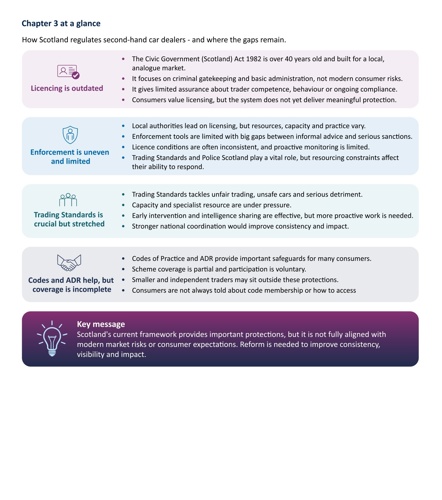
6. Appendix A
Fair Trading Law and The Used Car Trade
The Alternative Dispute Resolution for Consumer Disputes (Competent Authorities and Information) Regulations 2015
The Alternative Dispute Resolution for Consumer Disputes (Competent Authorities and Information) Regulations 2015 largely established a framework for resolving consumer disputes without going to court. However, most of their provisions have now been replaced and consolidated under the Digital Markets, Competition and Consumers Act 2024. Despite this, the requirement for traders to signpost consumers to an approved ADR provider remains in place. Traders must still inform consumers of a relevant ADR body when a complaint cannot be resolved and indicate whether they will engage with the process.
Civic Government (Scotland) Act 1982 The Civic Government (Scotland) Act 1982 is a wide-ranging law regulating many aspects of civic life in Scotland. It provides a framework for the licensing and control of activities such as taxis, private hire vehicles, street trading, public entertainment, and certain businesses—including used car dealers— ensuring they operate safely and responsibly. The Act also gives local authorities powers to maintain public order, address antisocial behaviour, and protect public spaces, supported by clear administrative and enforcement procedures. Overall, it aims to streamline regulation, promote public safety, and uphold civic standards, supporting effective local governance in Scotland.
Consumer Rights Act 2015 – goods, quality and remedies
The Consumer Rights Act 2015 (CRA 2015) consolidates UK consumer law, protecting buyers of goods, services, and digital content, and provides clear remedies for faulty or misdescribed products.
Under CRA 2015, Goods must be of:
- Satisfactory Quality which includes: fitness for all the purposes for which goods of that kind are usually supplied, appearance and finish, freedom from minor defects, safety and durability
- As Described
- Fit for particular purpose. This applies to a contract to supply goods if before the contract is made the consumer makes known to the trader (expressly or by implication) any particular purpose for which the consumer is contracting for the goods.
Consumer Rights Act 2015 – goods, quality and remedies (continued)
The trader must also have right to sell the vehicle. (e.g. not subject to any finance agreement).
Where a vehicle bought from a trader does not meet these standards the CRA 2015 provides a structured set of remedies for the consumers as follows:
- Short term right to reject and request a refund (within 30 days from day consumer receives vehicle)
- Repair or replacement after short term right to reject period – After the initial 30-day short-term right to reject period, the consumer will usually be entitled to require the trader to repair or replace the vehicle where it does not meet the standards required by the CRA 2015. If the fault becomes apparent within the first six months, it is generally presumed to have been present at the time of delivery unless the trader can show otherwise.
- Final right to reject or price reduction – The trader usually has one opportunity to repair or replace the vehicle. If repair or replacement is unsuccessful, impossible, disproportionate or not provided within a reasonable time and without significant inconvenience to the consumer, the consumer may then be entitled to a price reduction or to exercise the final right to reject. The consumer may reject the vehicle or keep the vehicle and receive a price reduction, which may be up to the full price paid.
Where the consumer exercises the final right to reject, the trader may be able to make a deduction from the refund to reflect the consumer’s use of the vehicle. A deduction for use should not be applied where the consumer exercises the short-term right to reject within the first 30 days.
Unfair Contract Terms
The CRA 2015 covers also contracts for the sale of goods, supply of services, and digital content. Part 2 of the Act clarifies and consolidates existing consumer legislation on unfair terms and both contractual and non- contractual consumer notices. A consumer notice includes an announcement or other communication which it is reasonable to assume is intended to be read by a consumer. Non-contractual consumer notices (e.g. a sign in a car park) do not include an exchange of something in return for something else of value (known as “consideration”) as a contract does.
Consumer Contracts (Information, Cancellation and Additional Charges) Regulations 2013 (CCRs)
The CCRs Regulation protects consumers by requiring traders to provide clear information, granting cancellation rights, and regulating additional charges for distance and off premises contracts.
The CCRs Regulation protects consumers by requiring traders to provide clear information, granting cancellation rights, and regulating additional charges for distance and off-premises contracts.
Part 1 General provides important definitions relating to ‘consumer’ and ‘trader’ as well as ‘distance sales’ and ‘off-premises’ and ‘on-premises’ rights which are linked to Part 2 Information requirements and Part 3 Right to Cancel.
Where a consumer cancels a qualifying distance or off-premises contract, the trader must generally refund the consumer without undue delay.
Where the consumer is responsible for returning the vehicle, the trader may usually wait until the vehicle has been returned, or until the consumer provides evidence that it has been sent back.
Where the trader has agreed to collect the vehicle, the refund should generally be made within 14 days of cancellation.
The trader must also provide the consumer with a cancellation notice in order to exercise this right in a durable format. The consumer must also have received pre-contract information as prescribed under Schedule 1. No reason is required to be given for cancellation and there is no requirement for there to be anything wrong with the car. The trader must reimburse the consumer within 14 days of cancellation or delivery of the vehicle.
Under Regulation 35 (5) the consumer may bear the costs of returning the vehicle unless the trader has agreed to do so or the trader has failed to provide the consumer with the information about the consumer bearing those costs, required by paragraph (m) of Schedule 2, in accordance with Part 2. If the trader does not state, that, following cancellation, the consumer is responsible for returning the vehicle to them at their own cost, then the consumer may have a claim against the trader for any reasonable costs incurred in doing this.
Failure to provide the consumer with the information on the right to cancel required by paragraph (l) of Schedule 2, in accordance with Part 2 can result in cancellation period being extended up to the end of 12 months after the day on which it would have ended under regulation 30.
It is an offence under regulation 19 if a trader enters into an off-premises contract to which regulation 10 applies but fails to give the consumer the information listed in paragraph (l), (m) or (n) of Schedule 2 in accordance with that regulation. And a further potential offence under Digital Markets, Competition and Consumers Act 2024, 227 Misleading omissions.
Digital Markets, Competition and Consumers Act 2024 (DMCCA 2024)
Part 4, Chapter 1 of the DMCCA 2024 prohibits traders, including second-hand car dealers, from engaging in unfair commercial practices in connection with the promotion, sale and supply of vehicles or other services to consumers.
The DMCCA 2024 sets out broad rules outlining when business practices are unfair.
These fall into six main categories.
1. Misleading actions. Giving false information to, or deceiving, consumers - for example, through false or deceptive advertisements or statements.
2. Misleading omissions. Giving insufficient information to consumers - for example, leaving out or hiding important information.
3. Aggressive practices. Acting aggressively - for example, through sales techniques that use harassment, coercion or undue influence.
4. Contraventions of the requirements of professional diligence (in other words, acting in a way that falls below the level of care and skill that may be expected, taking account of honest market practice and general principles of good faith). This is intended to act as safety net protection for all consumers.
5. Omitting material information from invitations to purchase. The DMCCA 2024 requires certain specified information to be included whenever there is an invitation to purchase, unless that information is already apparent (such as the address of the business, when standing in a car dealership).
6. In addition, the DMCCA 2024 bans 32 specific practices outright.
Chapter 4 of Part 4 replaces the Alternative Dispute Resolution for Consumer Disputes (Competent Authorities and Information) Regulations 2015 (SI 2015/542) (“the Regulations”).
The Regulations provide for the approval by competent authorities against the criteria in Schedule 3 of persons or bodies who seek to become entities accredited to provide ADR in disputes concerning consumer contracts, and ongoing reporting and monitoring of the ADR entities against the criteria. However, a key aspect of the Regulations is that they establish a largely voluntary system. An ADR provider does not have to be approved under the Regulations to offer ADR. The key change brought about by Chapter 4 of Part 4 is (subject to exceptions) to make accreditation compulsory.
The availability of ADR in individual used-car disputes will depend on factors including the trader’s membership of a relevant scheme, the nature of the dispute and the scope of the ADR provider. This distinction is important because signposting to ADR and participation in ADR are not always the same thing.
Price Marking Order 2004
The Price Marking Order 2004 implements the European Directive 98/6/ EC on consumer protection regarding the indication of prices for products offered to consumers. It came into force on 22 July 2004 and requires that prices for goods must be clearly indicated and inclusive of VAT, applying specifically to sales between traders and consumers. The order aims to enhance transparency in pricing and protect consumers from misleading price indications.
Consumer Rights (Payment Surcharges) Regulations 2012
These Regulations prohibit traders from charging consumers fees for using certain payment methods beyond the actual cost incurred, ensuring transparency and fairness in payment transactions.
The General Product Safety Regulations 2005
These Regulations ensure that all consumer products placed on the UK market are safe and impose obligations on producers and distributors to maintain product safety.
7. Appendix B
Consumer Scotland gathered evidence from a range of trade, regulatory and consumer stakeholders. This included bilateral meetings, a stakeholder roundtable event, and the views of several individual consumers. This engagement helped Consumer Scotland consider a broad range of perspectives and experiences from across the used-car sector.
Evidence was gathered from various stakeholders.
List of stakeholders:
- AA Cars
- Advice Direct Scotland
- Autotrader
- Arnold Clark
- Bridgend Motor Group
- Chartered Trading Standards Institute
- Citizens Advice
- Consumer Protection Partnership
- Civic Government (Scotland) Act 1982 Taskforce
- Courmacs Legal Ltd
- Financial Conduct Authority
- Finance and Leasing Association
- Financial Ombudsman Service
- LM Motor Company
- Local authority Trading Standards (multiple)
- National Franchised Dealers Association
- Police Scotland
- Reject My Car
- Senior individual employed in financial services
- Society of Chief Trading Standards Officers in Scotland
- The Motor Ombudsman
- The Society of Motor Manufactures and Traders
- Scottish Motor Trade Association
- Scott Dixon (The Complaints Resolver)