Dear [redacted information]
REQUEST UNDER THE FREEDOM OF INFORMATION (SCOTLAND) ACT 2002 (FOISA)
Thank you for your request dated 21/04/2026 under the Freedom of Information (Scotland) Act 2002 (FOISA).
Your request
Your request asked for a copy of the bid submitted by Smarts and award notification in relation to the reference number MAY449713.
Our response
I have attached both the bid (Annex A) and the award notification (Annex B) as separate documents for your reference.
Please note that there are some redactions within the documents. These exemptions come under sections 38(1)(b) - third party personal data; 33(1)(b) applies to certain information within your request. Section 38(1)(b) is an absolute exemption and is not subject to a public interest test.
Your right to request a review
If you are unhappy with this response to your FOI request, you may ask us to carry out an internal review of the response, by writing to;
Sam Ghibaldan,
Chief Executive
Consumer Scotland
Thistle House,
91 Haymarket Terrace
Edinburgh,
EH12 5HD
Or by email to: corporateservices@consumer.scot
Your review request should explain why you are dissatisfied with this response, and should be made within 40 working days from the date when you received this letter. We will complete the review in accordance with FOISA as soon as possible, and not later than 20 working days from the day following the date we receive your review request.
If you are not satisfied with the result of the review, you then have the right to appeal to the Scottish Information Commissioner. More detailed information on your appeal rights is available on the Commissioner’s website at:
https://www.itspublicknowledge.info/YourRights/Unhappywiththeresponse/AppealingtoCommissioner.aspx .
Yours sincerely
[redacted information]
Data Protection Officer
Consumer Scotland
Annex A
Contract For the Provision of
Comms Support – Consumer Scotland
Technical Response Template
Instructions
Bidders Guidance
Tenderers should complete the questions within this Technical Response Template in the spaces provided below each question. These will expand to accommodate your full response. However, Tenderers should aim to keep their answers as concise as possible. Tenderers are instructed to provide an answer for each question failure to do so may lead to the bid being deemed non- compliant.
Once complete Tenderers are requested to upload this document to Public Contracts Scotland.
Please ensure you have answered all of the questions in the document before uploading your response. Please note that there is a 30 MB file limit on attachment questions within PCS.
The Information and Instruction to Tenderers document provides further information about the scoring and weighting of each section and the questions contained within.
Responses should provide a complete answer to each question without cross- referencing to other areas in the response template.
Only the information provided in the tender submission will be evaluated.
Tenderers must also provide details of any services which will be carried out by Sub-Contractors or Consortia members in delivering the core requirements and clearly articulate how this will be delivered in practice.
Tenderers should be aware that information provided in response to the questions contained within this document will be classified as Service Provider Sensitive Information and will only be used by the evaluation panel to score the response.
The information will be treated as confidential, and all evaluators will be required to complete and sign a confidentially/non-disclosure and conflict of interest declaration prior to being given access to the tenderers responses.
Technical Response Summary (70%)
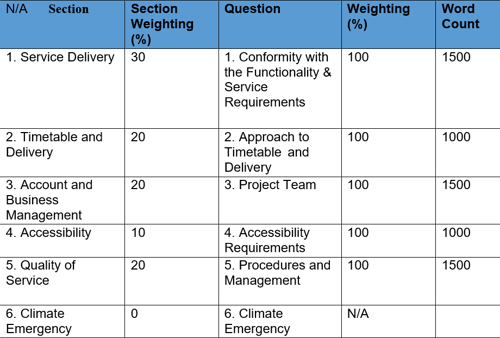
Section 1 - Service Delivery (30%)
Question 1 - Conformity with the Functionality & Service Requirements (100%)
The tenderer must confirm that their proposed service meets the deliverables, functionality and service requirements described in the specification – and must specifically reference any difficulties or obstacles, or areas where some development or co-operation may be required.
As part of their response, the tenderer should place particular emphasis on quality and performance measurements, and customer satisfaction to meet the ordered service.
Tenderers should note that any words exceeding the 1500 limit will not be considered for evaluation purposes
Understanding of the requirement
The consumer landscape in Scotland is complex, with a range of organisations handling policy, regulation, enforcement, advocacy and advice.
The creation of Consumer Scotland (CS) and its associated remit, has been heralded as delivering a positive change to the Scottish consumer landscape post COVID-19, reducing harm to consumers and in turn, increasing confidence at a time we seek economic recovery and growth post pandemic.
Although the Bill has been passed following consultation, information on how the body will operate, its powers and specifically the difference it will make to the consumers in Scotland, has yet to be communicated.
This brief provides an exciting opportunity to launch CS, establish its remit, and profile those involved in delivering this important and timely advocacy and advice service for Scotland.
Service Requirement
You require an agency to help launch and establish profile for CS, with outputs across a one-year period including:
- a CS communications strategy, incorporating plans for launch and ongoing PR post-vesting
- press office support for CS across its pre and post vesting period, including an approach to deliver proactive and reactive communications across print and broadcast and online media, and developing content for both social and web
Proposed service to meet those requirements
Getting the communications strategy right at the outset will put CS onto a firm footing. The service requirements need a strategic, tactical and collaborative
agency approach – one that we have demonstrable experience of delivering. This is backed by our sound understanding of the purpose and workings of public sector organisations and non-department public bodies, borne out of having worked on the Framework for the past 11 years delivering against multiple briefs that require a blend of strategy development, creative tactical delivery and a multi-channel approach to ensure effective targeting of defined audiences.
Agency team members also have direct experience of delivering communications strategies and plans for a range of public bodies, including Scottish Enterprise, Children’s Hearings Scotland, Historical Environment Scotland, Quality Meat Scotland and Social Work Inspection Agency.
Our public sector work has been recognised through being awarded 21 Gold or Silver PR awards in the past five years alone.
Developing a robust CS communications strategy will require a solid understanding of the contextual landscape so that the strategy is informed and ‘lands’ as intended. Stakeholder insights and engagement, media audits and social media ‘listening’ will be crucial in encouraging ongoing advocacy and to minimise detractors. We know from experience that understanding the attitudes of diverse audiences and hearing the voices of their, often heavily invested stakeholders, is key to effective delivery of communications.
Bringing stakeholders on the journey will be important and who needs to know what and when will be an important part of the comms strategy.
Our work on sensitive subjects such as organ donation law change, the COVID- 19 vaccine and TV Licensing has required this inquisitive and robust approach to communications strategy development. The strategy may need to adapt and change in line with an ever-changing environmental landscape, our work on COVID-19 compliance campaigns being a case in point.
Insights that inform the strategy development and the tactical execution of comms needs to be inclusive. Across numerous briefs – COVID-19 campaigns, Hate Crime and the likes, we have a wealth of experience in targeting ‘seldom heard’ audiences (including young people, ME community and C2DEs) harnessing organisations and community voices.
Developing launch plans. We are adept at working with multiple agencies to ensure integrated, effective and cohesive responses and seamless tactical activation. In developing launch plans, again, this will need to be cognisant of the media backdrop, whether there will be Ministerial involvement and handling in conjunction with the Scottish Government news team. Planning launches, that meet the needs of media, the personalities and stakeholders involved is our bread and butter.
We are skilled in amplifying launch comms through stakeholders and creating content for use on social.
Press office support. We have considerable understanding of Scotland’s media landscape, editorial style of media outlets and journalists and understand the political and policy context. We have built a diverse range of media contacts across broadcast print and online that we would harness proactively in engaging and delivering media outputs.
In proactively managing potential reactive media relations, through our strategy development we would create a robust database of media responses to likely questions that can be tailored and honed towards enquiries.
We manage social channels for a range of clients (The Scottish Government, Scottish Veterans Commissioner), handling all aspects of planning and community management. We successfully apply a blend of creativity, audience insight and strategic messaging to deliver social content with stand out, from infographics, to animations and films.
Areas for consideration and co-operation
When getting under the skin of any brief, we welcome working closely with clients from the outset to understand context and establish milestones.
For example, having reviewed the written submissions following consultation on the Consumer Scotland bill, we noted some broad themes, such as:
- Clarity on the role of Consumer Scotland
- How Consumer Scotland work with existing consumer bodies to ensure co- ordination and limit duplication of effort
- Robustness of funding to fulfil the objectives set out in the Bill
- Broadening the scope and providing a more up to date definition of ‘vulnerable’ groups in Scotland
- Powers to compel organisations to supply data, and impact of GDPR
Overall, the key challenges will be communicating the need for CS and managing the expectations of what it will deliver, against stakeholder and public perceptions of what these might be. Your ears and insight, together with ours, will be crucial to understand the conversations that have already been had, the information gleaned and the nuances of existing relationships. Message crafting and consistent delivery of these messages through a range of channels will be important against this backdrop.
To do this, we would welcome workshopping with key Board members to address sensitivities, political or otherwise, that could potentially have a negative impact on the launch of CS, such as Scottish Government funding of existing advocacy and advice services, alongside the positive narrative and key advocates we can call on for support.
Quality and Performance Measurements
Our approach to quality and performance involves:
Putting the right team with the right mix of skills in place at the outset both senior counsel and tactical implementation to make best use of time and budget resources. We have daily team meetings to identify workloads, priorities and any sticky points that need addressed.
Ensuring accuracy is built in at the outset through our robust planning process to ensure every brief is understood following rigorous research and scrutiny and that both the client and agency are aligned on the objectives, the work that is required and the responsibilities of who is delivering what and when.
As part of our strategic planning process, we ensure every project includes SMART objectives to ensure activity is both measurable and effective. These are communicated and agreed before the implementation phase.
We adhere to the Chartered Institute of Public Relations policies and standards, and continually seek appropriate metrics to evidence the added value of PR spend, particularly important given scrutiny on the public purse.
A robust monitoring and evaluation process is put in place to monitor each project stage to ensure delivery is on plan both in its content and its timeframe, adapting our approach if necessary.
KPIs are tracked throughout the project with review dates in place, so delivery against objectives can be monitored regularly, and our approach can be tailored or adapted if required.
Regular status update calls and meetings (weekly if time sensitive), backed up with a google doc so there is real-time visibility on progress against the agreed plan to assist with internal reporting and account management. This is particularly important when dealing with sensitive issues.
Real-time information on content generation and delivery against objectives.
It is highly unlikely issues would arise but we have a clear approach and timetable for problem resolution and addressing non-adherence/failure to deliver service, as follows:
- Problem reported to account lead, solution presented and timescales agreed
- If not deemed acceptable problem escalated to contract lead
- Contract lead confirms investigation into cause with actions documented and circulated to client and agency team
- Cause identified with solution agreed and applied which becomes a regular agenda item and monitored until the client agrees the issue has been fully resolved.
Customer Satisfaction
We encourage regular dialogue and open and honest feedback between clients and our colleagues. Customer satisfaction approaches are client tailored, typically recommending quarterly reviews and campaign wash-ups which provides useful learnings to take into future work, alongside regular client ‘check-ins’ as work progresses. This will be particularly important between phase 1 and 2.
The Referral Rating Company carries out six-monthly independent client assessment ‘emotional checks’ for us which benchmarks:
- agency scores overall
- by client
- by industry norm
While we consistently score above the UK PR industry recommendation-norm of 8.87/10, most recently scoring 9.15 there is always scope for improvement which we action within the client team.
Section 2 - Timetable and Delivery (20%)
Question 2 - Approach to Timetable and Delivery (100%)
The tenderer must confirm their ability to implement and deploy the service within the expected timescales, highlighting any pre-requisites, risks or dependencies. As part of their response, tenderers may wish to provide a timetable or project plan highlighting key tasks and milestones.
Tenderers should include a narrative explaining how they will ensure that the Scottish Government is kept up to date with progress though out the duration of the Contract.
Tenderers should note that any words exceeding the 1000 limit will not be considered for evaluation purposes.
We can implement and deploy our resources to deliver the requirements of this brief within expected timescales.
By adopting our rigorous planning process outlined below, we will ensure the requirements are fully understood, the strategy set is right, the audience insights and channel selection are robust to meet agreed KPIs, the implementation is planned but flexible for the opportunities that are identified and that the learnings are taken forward into part 2.
Pre-requisites, risks and dependencies
There are a number of pre-requisites, risks and dependencies in delivering this project:
Adhering to timetables – both the agency and the client – as dates have yet to be set for launch we will need a fluid but realistic plan with timeframes built in for discussion and approvals.
Access to the relevant expertise - within CS and stakeholders to inform the strategy and agree tactical plans.
Resources – agency and the client – we will ensure we have the right mix of skills and capacity to deliver the project and have access to over 100+ PR practitioners so can quickly scale-up to meet both strategic and tactical needs.
Project reputation risks – we outline how we would audit risk and our strategies for both mitigation and reporting / evaluation below that would be built into our comms strategy.
Key tasks
Part 1: Communications Strategy & Recommendations
1. Insight gathering
Fully understanding how CS will operate, to be clear on its strategic importance in a policy context, and to explore attitudes held by the public, and by key partners and stakeholders (ie. Citizens Advice Scotland, Competition and Markets Authority, Trading Standards Scotland) will be our starting point.
Key areas where we would look for clarity include:
• How will it improve support for consumers?
• Will it cause consumer confusion on where to turn for advice / will they be able to go direct?
• Does it have specific enforcement powers?
• How will it interact with the Scottish Government?
• How will success be measured?
Insight gathering typically involves accessing information across a variety of platforms which may include:
• Auditing submissions in response to the Bill
• Face-to-face meetings with key Board members to understand what has been progressed since appointment
• Connecting with related stakeholder networks to use as a sounding board for ideas, hot topics and source of factual advice.
2. Audience and stakeholder identification
We would work with you to identify key audiences, ranking them, if appropriate, in terms of their importance, to ensure plans are aligned and effective delivery and measurement.
We then develop a channel matrix based on our audiences’ media consumption and social media profiling, to develop materials that will inform and resonate, whether public, partner or stakeholder.
3. Objectives / measurement
We would set SMART objectives and develop our strategic and tactical approach for launch.
Example KPIs would include metrics around increased awareness, key message penetration, increased digital engagement, frequency of stakeholder communication and press office outputs.
4. Messaging and positioning
Using insight gleaned, we would develop a core script, detailing key messages and proof points. This would be used to brief key personnel, arranging media training if required for identified spokespersons, and shared with the Scottish Government to ensure they have sight, with associated feedback incorporated.
Strategy for launch would also be agreed at this stage, with approach (i.e. trails, broadcast access, launch event) and timing agreed, again in consultation with SG.
5. Implementation
A timetabled implementation plan for launch, dovetailing a solid proactive press office function and social media strategy would be put in place. This would include a launch release, full Q&A, stakeholder briefings, social media content / planners (including associated infographics and films).
Timetable
An indicative timeline for how long each piece of work will take is below but this can be expedited once firm timeframes are known.
Part 2: Press Office Support
We would take stock following launch, adapting materials and approach as required.
From launch, we would seek to maintain profile, with a robust press office function harnessing and converting opportunities, which would involve:
• identifying milestones, announcements and hitchhiking opportunities
• drafting proactive news releases, quotes, and lines to take for reactive enquiries
• placing op-eds
• delivering timely social media and web content
• securing and brief third parties to support media relations
Scottish Government liaison
When setting out mechanisms for reporting, we would contact the appropriate SG contact to outline timescales and approach, agree roles and responsibilities, and methods and frequency of reporting to ensure key personnel have the information required. We work regularly and collaboratively with Scottish Government policy, marketing and news.
Section 3 – Account and Business Management (20%) Question 3 – Proposed Project Team (100%)
The tenderer must provide details of all roles and responsibilities proposed for the delivery of the project and provide named individuals against these roles where relevant. This should include details of the experience, qualifications, competency and specialist skills these individuals possess to carry out the specified role.
Tenderers should note that any words exceeding the 1500 limit will not be considered for evaluation purposes.
Section 4 –Accessibility (10%)
Question 4– Accessibility Requirements (100%)
The tender must provide details on how they ensure that communications are accessible to everyone, including people with disabilities, making sure it can be used by as many people as possible.
The tender must tell us about any standards that communications have been designed to meet e.g. WCAG 2.1 AA, BS8878, EN 301 549, PDF/UA providing evidence to support?
Tenderers should note that any words exceeding the 1000 limit will not be considered for evaluation purposes.
Accessibility
With one in five of the population having some form of disability, ensuring web and social content is accessible isn’t an option, it must be a priority.
As such, accessibility will be embedded into every part of our design and build process. But accessibility extends beyond the needs of those with difficulties or impairments, we also consider accessibility across devices and platforms as well as digital competence and confidence.
We work extensively with clients to ensure we meet their existing accessibility guidelines for content creation across campaigns such as Parent Club, Organ Donation, Clear Your Head, Autism and Road Safety, and work closely with suppliers to ensure briefs build in accessibility requirements at every stage of development.
Accessible design and content
Accessibility starts with good design fundamentals. Our aim will be to achieve “AA” of WCAG 2.1 guidance.To achieve “AA” compliance, we will apply the following principles to the development of online materials across the following:
• Design and layout
• Structure and navigation
• Assistive technologies
• Content formats
Design and layout
• Use a logical, consistent and familiar layout with guidance from Government Design Standards and Digital Scotland Design System
• Use bold, simple colours with good contrast in line with the brand palette
• Use good contrasts and readable font size
• Ensure text flows and is visible when text is magnified to 200%
• Let users change the contrast between background and text
Page structure and navigation
• Make large clickable actions
• Make buttons descriptive – e.g. attach files
• Ensure descriptive links and headings – e.g. Contact us
• Ensure buttons and notifications are in context
• Build simple and consistent layouts
• Allow and build for keyboard navigation only
• All non-textual content on a page should have an alt tag – this is so screen readers can describe the image/item
Assistive technology and accessible formats
• Ensure use of assisted technologies such as screen readers
• Use subtitles or provide transcripts for video
• Describe images using alt tags
• Provide options for alternative formats (audio, video) and languages
• Support multiple contact options
Developing to W3C standards
The Front End development team has the job of creating HTML, CSS and JavaScript to AA compliance of W3C and WCAG as well as our own standards. This gives us a consistent and common base on all our projects that follow industry best practices and standards as set by the W3C and WCAG.
Our HTML is developed primarily using HTML5 elements adding AI-ARIA attributes to our HTML where appropriate to ensure accessible to all. When naming things (class names) in our HTML to use as hooks for our CSS we use the BEM (Block, Element, Modifier) naming convention to ensure clean modular reusable code and a consistent naming strategy across our various projects.
Testing for accessibility
We test our design and our code for accessibility with various tools and using various assisted technologies so any issues can be identified and fixed.
Some of the tools we use for accessibility testing are noted below, however, we can arrange real-world testing with key disability user groups if required.
• Wave Evaluation toolbar
• Quick JavaScript Switcher
• Colour Contrast Checker
• W3C Markup Validation Service
Section 5 – Quality of Service (20%)
Question 5 – Procedures and Management (100%)
The tenderer must describe their approach to ensuring a high quality of service, including acceptance procedures, incident management and customer relationship management. The tenderer must describe their approach to managing risks to the continuity and reliability of the service (including availability of key staff).
Tenderers should note that any words exceeding the 1500 limit will not be considered for evaluation purposes.
Procedures and Management
We are experts in executing communications and campaigns that add value. Our approach to delivering a high quality of service incorporates:
• our highly skilled and experienced team
o has 11 years’ Framework experience (average staff tenure of nine years)
o understands Scotland’s political, social and economic backdrop (and is fully informed of the corporate affairs context) against which activity will be delivered
• appropriate processes
access to high quality industry tools.
daily team calls to share and resolve problems.
We operate a quality system that is an integral part of normal business activity. We aim at all times to deliver on brief, on time and on budget, whilst aiming to add value throughout the process. The quality system that supports this is in line best practice procedures defined industry bodies including CIPR and PRCA.
Overall responsibility for ensuring quality of service and delivery will rest with Lesley Alexander, the contract lead.
Service Level Agreement
At the outset of each contract or project, individual service level agreements (SLA) and KPIs are agreed. By setting clear, agreed guidelines and KPIs for client service, this ensures we have in place a measurable framework for service level delivery and a clear understanding of the client’s expectations.
Our standard Service Level Agreement cover the following areas and apply across all the marketing service areas we would be providing:
• Scope of work
• Team and resources
• Access & response times
• Contact & reporting
• KPI’s
• Risk management
• Administration and invoicing
• Performance measurement
• Problem management
• Disaster recovery
Measuring, monitoring and improving
Although our SLA defines the standard we should meet, we have a number of processes for measuring monitoring and improving service levels. These include:
Formal agency appraisal
Our group has a formal evaluation process that incorporates feedback across a number of key service measures and KPIs.
The frequency of appraisal is agreed upfront with individual clients. We recommend reviews bi-annually or midway through and on completion of a major
project. The process involves completion (by both senior client and day to day client contact) of a pro-forma feedback questionnaire, followed up by a face to face meeting between the senior client and The Gate’s Managing Director.
This process monitors broader performance and service levels whilst also allowing us to track performance of individual account managers.
Project review and informal feedback
In addition to the formal process outlined, there are a number of processes that support more informal or ad-hoc client feedback.
All client activity is subject to regular, structured meetings and reviews. These provide an additional vehicle for service level and performance feedback, which is documented within contact reports. In addition, our culture of building strong, open relationships with our clients. Frequent informal contact, along with structured meetings, provide further opportunity for regular ongoing feedback.
Service improvement
Both formal and informal feedback is discussed initially amongst the senior agency management and then with the specific account teams and individuals. Any corrective actions, service initiative ideas or specific training needs are identified.
Recommendations are presented in writing by the contract lead to the client for agreement, before being incorporated into our working practices, procedures, KPIs or individual training plans.
Ongoing monitoring
Using the processes outlined, monitoring of service levels and service level improvements are continuous. We aim to ensure improvements to service delivery have effectively been delivered and can be measured over time.
Managing risks
Mechanism for approval of change
Our team’s average length of service is over nine years and we pride ourselves on recruiting wisely, investing in our staff and being inclusive, supportive and ambitious.
Nevertheless, changes do happen from time to time in our account team. And so, to ensure this does not disrupt client service we:
• ensure all staff members are on contracts with a notice period. Typically, this is one month for account executives and managers and three months for senior account managers and above
• seek permanent solutions, from within the company, or through recruitment, before the staff change happens and build in a period of ‘shadowing’ for new recruits.
• if a permanent solution is not feasible in the timeframe we will upweight the time spent by the exiting employee’s next most senior colleague, or introduce a more senior person to the team in the interim at the lower team member’s hourly rate
• allow the client to vet the proposed new team member’s CV, or meet them if requested, before appointment
• put the new team member an established, and fast track, induction process on Framework strategies (at Smarts’ expense)
• share insights and activities on our daily Zoom calls, at our monthly team meetings and away days. Consequently, there is a high level of awareness of current activities and strategies amongst the entire agency staff.
Resourcing procedures and contingencies
We ensure that no client account or campaign is overly reliant on one person as we work in teams of no less than three.
No two members of the same client team are allowed to be on holiday at the same time. Workloads, project milestones and holidays are input into our project management tool, Synergist, and hours and tasks that had been allocated to the ‘missing’ team member are reallocated to other team members so that there is visibility of workload across all clients.
We manage our human resource so that there is scope for the team to work outside normal working hours: a condition of contract. This has been particularly important during the pandemic, to adapt to expedited campaign delivery and greater working day flexibility. For instance, matching our ‘owls’ with ‘larks’ to cover early morning and evening requirements that work for our clients and fit with our team’s lifestyles.
We operate a rota system to track emerging issues and manage social media through an ‘always on’ capability so that the burden is equally and fairly spread.
Clearly sickness and emergency situations cannot be predicted, so having visibility across all client workloads enables us to quickly identify capacities within the team and develop a solution to cover any gaps, ensuring client work is delivered on time.
In an emergency situation, the experience of senior staff is necessary, so our CEO and Associate Directors deputise for each other, on other client business and management responsibilities, while one or the other of them addresses the emergency. During the pandemic and the quick turnaround required, particularly on ‘Healthier’, this flexibility across client work has been key to manage our resources effectively.
Our ‘mechanism for approval of change’ (above) would be applied should a senior team member leave the company.
Complaints procedure and escalation process
All client contacts are given details of Smarts’ five stage complaints procedure before work gets underway. We have a clear process for problem resolution and addressing non-adherence/failure to deliver service within prescribed timescales:
1. Problem reported and documented
Any problems or complaints are highlighted during the internal weekly review of targets attended by all agency team members. A solution is agreed and presented to client.
2. Immediate solution sought or problem escalated
The client’s team leader will notify the client of the issue the day the problem is identified and reassure them that a solution is being worked on. If this is not deemed acceptable the problem is escalated to director level.
3. Director contacts client and confirms actions and next steps
A time-plan is agreed with the client to investigate the cause of the shortfall. The actions are documented and circulated among the client and agency team.
4. Investigate problem and identify cause
The Director instigates a review that is reported back to the client and a satisfactory solution is agreed and then applied.
5. Monitoring
The solution becomes a team meeting agenda item and monitored at weekly team meetings until the client agrees the issue has been fully resolved.
In addition, at the commencement of contract all clients are issued with:
• contact details and processes for issuing a complaint with the team
• agreed metrics and minimum service standards of project delivery reporting and how this will be quantified
• timescales for when and how a response to a complaint will be dealt with including provision to ensure that there is interim cover for on-going work while complaint is being investigated
• detailed action plan, to be overseen by independent member of staff, to change working practises as required while delivering on campaign need
• clear triggers to escalate complaints outside of the account management team to senior management
Section 6 – Climate Emergency (0%)
Question 6 – Organisations Approach to the Climate Emergency
The Scottish Ministers are committed to a fairer and more sustainable Scotland to support citizens now and in future generations. Responsible businesses around the world are considering their own sustainable credentials and how they can counter the climate emergency. Scottish Ministers want to do business with responsible suppliers and actively encourage all bidders, suppliers and partners in the supply chain to the Scottish public sector to collaborate in tackling these global issues together. Scottish Ministers welcome creative thinking and commitment in how to build and shape sustainable solutions and supply chains for Scotland, ensuring that a key consideration in how our supply chains are shaped includes minimising emissions, underpinning a circular economy and supporting our Carbon Management Plan.
Please provide details of how the contract will be delivered in a way that ensures that it supports the Scottish Minister’s sustainability objectives outlined above. This should include details of how the tenderer will work with the Purchaser to meet external and internal targets for reducing energy consumption, and ways in which they will reduce their carbon footprint in the delivery of this contract.
Responses should also address the approach taken to ensure efficiency of logistics operations, the management of waste and energy efficiency in delivering the service.
Please note your response to this question is restricted to a maximum word limit of 500 words. Tenderers should note that any words exceeding the 500 limit will not be considered for evaluation purposes.
Smarts confirms that it supports Scottish Ministers’ policies on Sustainability and Corporate Social Responsibility.
We are committed to, and passionate about, reducing our impact on the environment and being a good corporate citizen, and working with clients who share our ethos.
Environmental Sustainability
Smarts is committed to reducing its environmental impact by:
• Reducing – e.g. the use of energy, water, paper, printing and car travel. Promoting cycling to work with office bike racks and showers, public transport and an Electric Vehicle Scheme.
• Reusing – materials wherever possible e.g. glass milk bottle deliveries, re- purposing props, sending obsolete technology to the Edinburgh Remakery for repurposing.
• Recycling – e.g. with a commitment to send nothing to landfill we have no office bins beyond recycling ones.
In doing so, we adopt the following practices:
• Team: encourage and educate our team on best environmental practice.
• Suppliers: use contractors and suppliers whose environmental policies reflect our own.
• Purchasing: where practicable, investigate environmentally acceptable alternatives and purchase products and services that have a minimal impact on the environment.
Carbon Emissions
Smarts (and our sister agencies) has been Carbon Negative since 2020. We offset more carbon than we generate.
We've pledged to reduce our overall carbon emissions per employee by a further 50% by 2024 and have approved Science-Based Targets in place for 2030, from 2019 base year:
• Reduce absolute scopes 1 and 2 greenhouse gas (GHG) emissions by 100% by 2026
• Reduce scope 3 GHG emissions by 70% per full-time employee by 2030
• Commit that 50% of our suppliers, by spend, covering purchased goods and services, will have science-based targets by 2026.
Recognising the changing nature of the pandemic on our footprint, we accurately measure our carbon emissions across four areas:
• Commuting emissions
• In-work (business travel) emissions
• Working from home emissions
• Office consumption
We also run a staff contribution scheme so that our teams can also offset their personal emissions.
For FPBs we can estimate the total carbon emissions generated from each project and agree a strategy detailing how we’ll offset them.
As part of our carbon reduction commitment, we have moved to a 100% renewable energy-fuelled multi-occupier building in Glasgow with reduced energy demand measures built into the recent refurbishment.
Annex B
Annex B – Smarts – Award Letter - Redacted
E: [redacted information]
Smarts Communicate
Studio 6.02
Onyx
215 Bothwell Street
GLASGOW
G2 7EZ
By Email: [redacted information]
Phone: 0141 222 2040
Our ref: CASE/587275
03/05/2022
CONTRACT AWARD LETTER – Consumer Scotland:Comms Support
Dear [redacted information]
I refer to your tender submission dated 20th April 2022 in respect of the above Invitation to Tender. We have now completed our evaluation of all tenders received in
accordance with the previously published evaluation criteria, and I am pleased to
inform you that your tender has been found to offer the best price quality ratio.
Table 1 below shows the individual scores given against the published evaluation criteria in respect of your submission:
|
PUBLISHED EVALUATION CRITERIA
|
WEIGHTING
|
YOUR SCORE |
|
Price |
70% |
62.13% |
|
Quality |
30% |
29.38% |
|
OVERALL SCORE |
100% |
91.50% |
Specific feedback from the Evaluation Panel can be found at Annex A below.
This letter is an acceptance of your tender.
The documents listed below shall be deemed to form part of the contract:
• This Contract Award Letter;
• The Scottish Ministers Specification of Requirements Schedule 5.1 of the Terms and Conditions; attached Annex B
• Smarts Communicate tender response dated 11th March 2022; attached Annex C
• The Public Relations Framework Agreement: attached Annex D
The contract shall commence on 9th May 2022 and shall expire on 8th May 2023 or on conclusion of the services, whichever is earlier, unless the contract is terminated in accordance with the Terms and Conditions. The Contract has a maximum extension period of 8th November 2023. The prices within the Pricing Schedule 5.2 shall apply. The maximum contract value is £28,592.00 exclusive of VAT. Invoices shall be submitted monthly in arrears and payment shall be made within 30 days of a valid invoice being received.
Please confirm your acceptance of this contract offer by signing and returning a copy of this contract letter.
Please review and return a completed copy of Schedule 5 Terms and Conditions.
Please note that the Contract Manager for this contract is [redacted information] who can be contacted on [redacted information] or by email at [redacted information].
Yours Sincerely
[redacted information]
Procurement Modern Apprentice
Consumer Scotland : Comms Support
I/We acknowledge receipt of this contract award letter for the above-mentioned contract on behalf of Smarts Communicate and agree to provide the services in accordance with all of the provisions therein.
Name: [redacted information]
Signature: [redacted information]
Designation: CEO: SCOTLAND
Date: 05/05/2022
Question Specific Feedback
SECTION 1 – Service Delivery (Section Weighting – 30%)
Question 1 – Conformity with the Functionality & Service Requirements
(weighting: 100%)
The tenderer must confirm that their proposed service meets the deliverables, functionality and service requirements described in the specification – and must specifically reference any difficulties or obstacles, or areas where some development or co-operation may be required.
As part of their response, the tenderer should place particular emphasis on quality and performance measurements, and customer satisfaction to meet the ordered service.
Tenderers should note that any words exceeding the 1500 limit will not be considered for evaluation purposes
Question 1 (Score Awarded 0 to 4): 4
Justification
Strengths (or positive evidence)
Excellent grasp of the brief with an opening statement which includes accurate analysis
of the nature of the organisation, the context in which it will be operating and the communications challenges that will face Consumer Scotland and how to address them.
Identification of the importance of other stakeholders, media contacts in broadcast/print and online.
Management of social media channels.
Key understanding of management of expectations of what Consumer Scotland will deliver against public perceptions and awareness of sensitivities with existing advocacy services.
The approach to assessing quality and performance is thorough.
Weaknesses (or lack of evidence)
Lack of specifics on plans for launch.
Comments / Clarifications required
SECTION 2 – Timetable and Delivery (Section Weighting – 20%)
Question 2 - Approach to Timetable and Delivery (weighting: 100%)
The tenderer must confirm their ability to implement and deploy the service within the expected timescales, highlighting any pre-requisites, risks or dependencies. As part of their response, tenderers may wish to provide a timetable or project plan highlighting key tasks and milestones.
Tenderers should include a narrative explaining how they will ensure that the Scottish Government is kept up to date with progress though out the duration of the Contract.
Tenderers should note that any words exceeding the 1000 limit will not be considered for evaluation purposes.
Question 2 (Score Awarded 0 to 4) 3.5
Justification
Strengths (or positive evidence)
Awareness of risks and actions to counter potential reputational damage
Understanding of key questions such as how it will improve support for consumers, enforcement powers, relationship with Scottish Government
Importance of stakeholders
Good understanding of key aspects of press office support including the importance of announcements
Gives confidence in the competence of the tenderer.
Weaknesses (or lack of evidence)
While the tender gives confidence that timescales will be met it does not set out, for
example, an easily understandable timetable to prepare for a public launch.
Comments / Clarifications required
SECTION 3 – ACCOUNT AND BUSINESS MANAGEMENT (Section Weighting – 20%)
Question 3 – Proposed Project Team (Sub-weighting: 100%)
The tenderer must provide details of all roles and responsibilities proposed for the delivery of the project and provide named individuals against these roles where relevant. This should include details of the experience, qualifications, competency and specialist skills these individuals possess to carry out the specified role.
Tenderers should note that any words exceeding the 1500 limit will not be considered for evaluation purposes.
Question 3 (Score Awarded 0 to 4) 3
Justification
Strengths (or positive evidence)
High profile former clients/accounts
Range of experienced staff with appropriate qualifications
Weekly updates to ensure appropriate activity
Weaknesses (or lack of evidence)
Quite heavy jargon/delivery wheel
Comments / Clarifications required
SECTION 4 –ACCESSIBILITY (Section Weighting – 10%)
Question 4– Accessibility Requirements (Section weighting 100%)
The tender must provide details on how they ensure that communications are accessible to everyone, including people with disabilities, making sure it can be used by as many people as possible.
The tender must tell us about any standards that communications have been designed to meet e.g. WCAG 2.1 AA, BS8878, EN 301 549, PDF/UA providing evidence to support?
Tenderers should note that any words exceeding the 1000 limit will not be
considered for evaluation purposes.
Question 4 (Score Awarded 0 to 4) 3
Justification
Strengths (or positive evidence)
Nice approach to the values of accessibility and its importance
Building in accessibility requirements at every stage of development
Mentions WCAG standards and what goals are and how they work towards W3C standards which is where WCAG is from
Very good breakdown on the areas that are important for accessibility – design, layout, page structure and navigation
Awareness of alternative formats to aid user needs and assistive technology
List of tools they use to test for accessibility
Weaknesses (or lack of evidence)
Listed names of campaigns but no examples or images of where accessibility was integrated into the process of creating them
Comments / Clarifications required
SECTION 5 – Quality of Service (Section Weighting – 20%)
Question 5 – Procedures and Management (Sub-weighting: 100%)
The tenderer must describe their approach to ensuring a high quality of service, including acceptance procedures, incident management and customer relationship management.
The tenderer must describe their approach to managing risks to the continuity and reliability of the service (including availability of key staff).
Tenderers should note that any words exceeding the 1500 limit will not be considered for evaluation purposes.
Question 5 (Score Awarded 0 to 4) 3.5
Justification
Strengths (or positive evidence)
Clear statement of intent on brief, time and budget and clear lines of accountability with contract lead
Robust procedures including service level agreement with measurable framework of delivery, client feedback.
Importance of informal relationships as part of this process.
Clear complaints procedure
The tenderer gives confidence with their approach to ensuring a high quality of service, including incident management and customer relationship management.
Weaknesses (or lack of evidence)
Comments / Clarifications required
SECTION 6 – Climate Emergency (Section Weighting – N/A)
Question 6 – Organisations Approach to the Climate Emergency
The Scottish Ministers are committed to a fairer and more sustainable Scotland to support citizens now and in future generations. Responsible businesses around the world are considering their own sustainable credentials and how they can counter the climate emergency.
Scottish Ministers want to do business with responsible suppliers and actively encourage all bidders, suppliers and partners in the supply chain to the Scottish public sector to collaborate in tackling these global issues together.
Scottish Ministers welcome creative thinking and commitment in how to build and shape sustainable solutions and supply chains for Scotland, ensuring that a key consideration in how our supply chains are shaped includes minimising emissions, underpinning a circular economy and supporting our Carbon Management Plan.
Please provide details of how the contract will be delivered in a way that ensures that it supports the Scottish Minister’s sustainability objectives outlined above.
This should include details of how the tenderer will work with the Purchaser to meet external and internal targets for reducing energy consumption, and ways in which they will reduce their carbon footprint in the delivery of this contract.
Responses should also address the approach taken to ensure efficiency of logistics operations, the management of waste and energy efficiency in delivering the service.
Tenderers should note that any words exceeding the 500 limit will not be considered for evaluation purposes.
Question 6 (Score Awarded 0 to 4) 4
Justification
Strengths (or positive evidence)
Gives in depth answer on how they are reducing, reusing and recycling. Also highlights how they aim to reduce their carbon emissions by 50% and how they give back to the planet if they are using high carbon emissions for specific contracts
Weaknesses (or lack of evidence)
Comments / Clarifications required